
Pulp Fiction, 1913 · page 24 of 36
Cheer Boys Cheer: The Boys' Journal, No. 62 — page 24: what you’re looking at
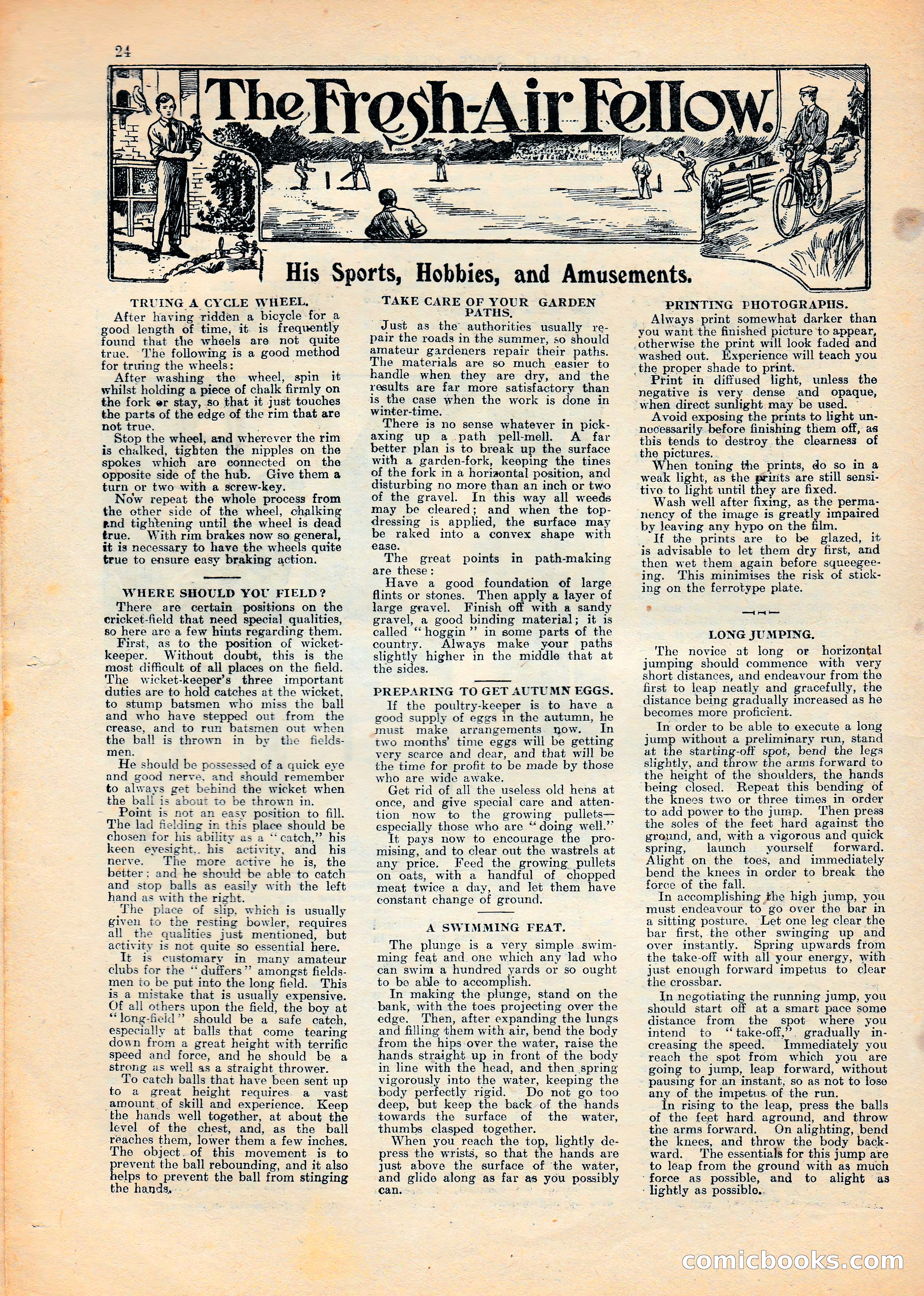
A restored page from Pulp Fiction, 1913. Page through the whole issue in the reader above.
📄 Transcribed text from this page (OCR, searchable)
Machine-transcribed from the original scan — historical spelling and the odd misread are preserved.
nO Ste TRUING A CYCLE WHEEL, After haying ridden a bicycle for a good length of time, it is frequently found that the wheels are not quite true. The following is a good method for truing the wheels: : : After washing the wheel, spin it whilst holding a piece of chalk firmly on the fork er stay, so that it just touches the parts of the edge of the rim that are not true. ‘ Stop the wheel, and wherever the rim is chalked, tighten the nipples on the spokes which are connected on the opposite side of the hub. Give them a turn or two with a screw-key. Now repeat the whole process from the cther side of the wheel, chalking end tightening until the wheel is dead frue. With rim brakes now so general, it is necessary to have the wheels quite true to ensure easy braking action. WHERE SHOULD YOU FIELD? There are certain positions on the ericket-field that need special qualities, so here aro a few hints regarding them. First, as to the position of wicket- keeper. Without doubt, this is the most difficult of all places on the field. The wicket-keeper’s three important duties are to hold catches at the wicket, to stump batsmen who miss the ball and who have stepped out from the crease, and to run batsmen out when the bal! is thrown in by the fields- men. He should be possessed of a quick eye and good nerve, and should remember to always get behind the wicket when the ball is about to be thrown in. Point is not an easy position to fill. The lad fielding in this place should be chosen for his ability as a ‘‘ catch,” his keen eyesight.. his activity, and his nerve. The more active he is, the better: and he should be able to catch and stop balls as easily with the left hand as with the right. “The place of slip, which is usually given to the resting bowler, requires all the qualities just mentioned, but activity 1s not quite so essential here. It is customary in many amateur clubs for the ‘‘ duffers” amongst fields- men io be put into the long field. This is a mistake that is usually expensive. Of all others upon the field, the boy at “lJong-field’”? should be a safe catch, especially at balls that come tearing down from a great height with terrific speed and force, and he should be a strong as well as a straight thrower. To catch balls that have been sent up to a great height requires a vast amount of skill and experience. Keep the hands well together, at about the level of the chest, and, as the ball reaches them, lower them a few inches. Tho object. of this movement is to prevent the ball rebounding, and it also helps to prevent the ball from stinging the hands... His Sports, Hobbies, and Amusements. TAKE CARE OF YOUR GARDEN PATHS, Just as the authorities usually re- pair the roads in the summer, so should amateur gardeners repair their paths. The materials are so much easier to handle when they are dry, and the results are far more satisfactory than is the case when the work is done in winter-time. There is no sense whatever in pick- axing up a path pell-mell. A far better plan is to break up the surface with a garden-fork, keeping the tines of the fork in a horizontal position, and disturbing no more than an inch or two of the gravel. In this way all weeds may be cleared; and when the top- dressing is applied, the surface may be raked into a convex shape with ease. The great points in path-making are these: Have a good foundation of large flints or stones. Then apply a layer of large gravel. Finish off with a sandy gravel, a good binding material; it is called “‘hoggin’’ in some parts of the country. Always make your paths slightly higher in the middle that at the sides. PREPARING TO GET AUTUMN EGGS. If the poultry-keeper is to have a good supply of eggs in the autumn, he must make arrangements yow. In two months’ time eggs will be getting very scarce and dear, and that will be the time for profit to be made by those who are wide awake. Get rid of all the useless old hens at once, and give special care and atten- tion now to the growing pullets— especially those who are “doing well.” It pays now to encourage the pro- mising, and to clear out the wastrels at any price. Feed the growing pullets on oats, with a handful of chopped meat twice a day, and let them have constant change of ground. A SWIMMING FEAT. The plunge is a very simple swim- ming feat and one which any lad who can swim a hundred yards or so ought to be able to accomplish. In making the plunge, stand on the bank, with the toes projecting over the edge. Then, after expanding the lungs and filling them with air, bend the body from the hips over the water, raise the hands straight up in front of the body in line with the head, and then spring vigorously into the water, keeping the body perfectly rigid. Do not go too deep, but keep the back of the hands towards the surface of the water, thumbs clasped together. When you reach the top, lightly de- press the wrists, so that the hands are just above the surface of the water, and glide along as far as you possibly can. - ee Se ‘to add power to the jump. PRINTING PHOTOGRAPHS. Always print somewhat darker than you want the finished picture to appear, otherwise the print will look faded and washed out. Experience will teach you _the proper shade to print. Print in diffused light, unless the negative is very dense and opaque, when direct sunlight may be used. © Avoid exposing the prints to light un- necessarily. before finishing them off, as this tends to destroy the clearness of the pictures. When toning the prints, do so in a weak light, as the prints are still sensi- tivo to light until they are fixed. Wash well after fixing, as the perma- nency of the image is grontly impaired by leaving any hypo on the film. If the prints are to be glazed, it is advisable to let them dry first, and then wet them again before squeegee- ing. This minimises the risk of stick- ing on the ferrotype plate. oH LONG JUMPING. The novice at long or horizontal jumping should commence with very short distances, and endeavour from the first to leap neatly and gracefully, the distance being gradually increased as he becomes more proficient. In order to be able to execute a long jump without a preliminary run, stand at the starting-off spot, bend the legs slightly, and throw the arms forward to the height of the shoulders, the hands being closed. Repeat this bending of the knees two or three times in order Then press the soles of the feet hard against the ground, and, with a vigorous and quick spring, launch yourself forward. Alight on the toes, and immediately bend the knees in order to break the force of the fall. ; In accomplishing the high jump, you must endeavour to go over the bar in a sitting posture. Let one leg clear the bar first, the other swinging up and over instantly. Spring upwards from the take-off with all your energy, with just enough forward impetus to clear the crossbar. In negotiating the running jump, you should start off at a smart pace some distance from the spot where you intend to ‘‘take-off,”. gradually in- creasing the speed. Immediately you reach the spot from which you are going to jump, leap forward, without pausing for an instant, so as not to lose any of the impetus. of the run. In rising to the leap, press the balls of the feet hard aground, and throw the arms forward. . On alighting, bend the knees, and throw the body back- ward. The essentials for this jump are to leap from the ground with as much ‘force as possible, and to alight -as - lightly as possible.. : Arana le ~ Ks Araya) CONMIC MOO KSaCcOrnn)