
Pulp Fiction, 1920 · page 77 of 132
The Black Mask — page 77: what you’re looking at
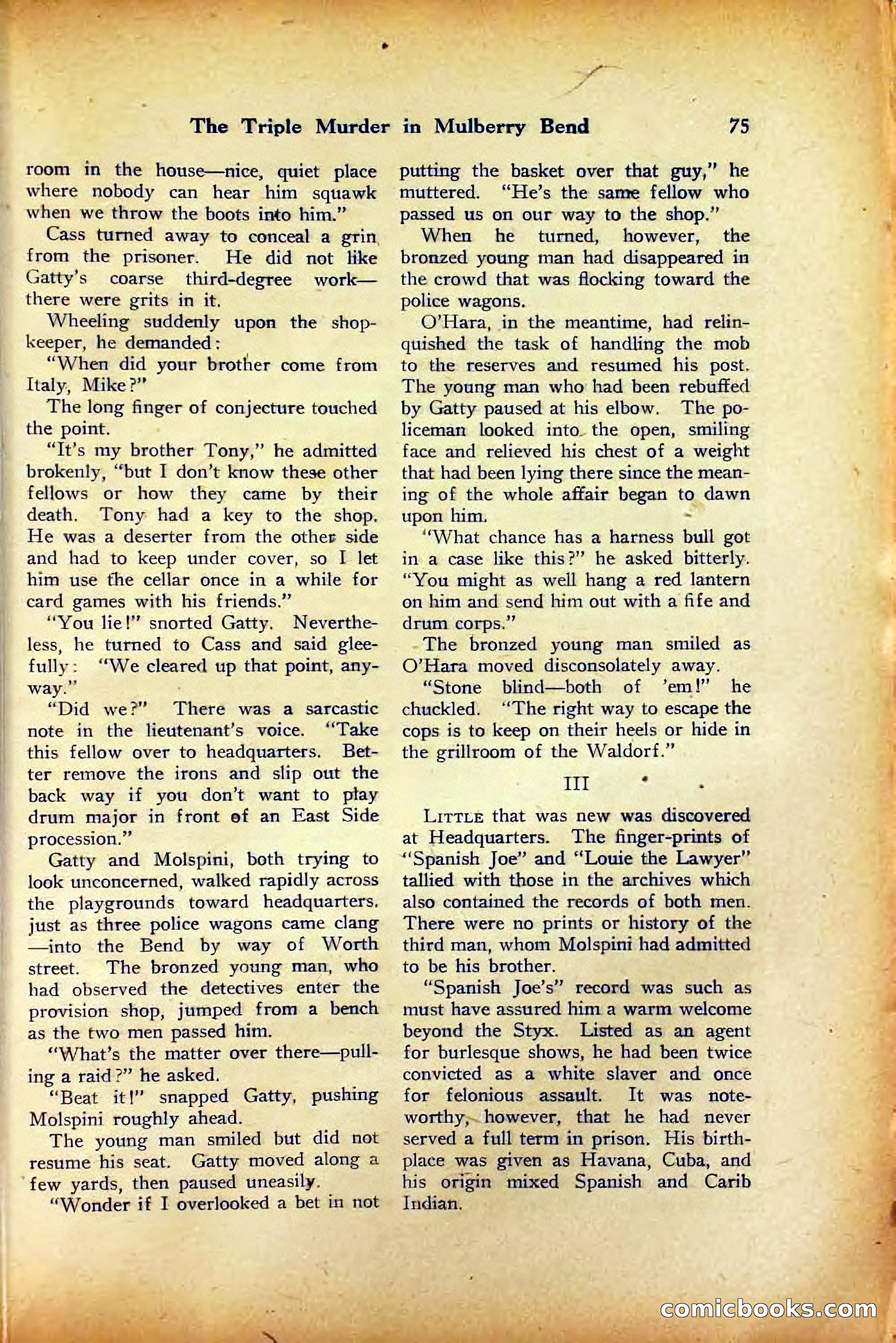
A restored page from Pulp Fiction, 1920. Page through the whole issue in the reader above.
📄 Transcribed text from this page (OCR, searchable)
Machine-transcribed from the original scan — historical spelling and the odd misread are preserved.
The Triple Murder in Mulberry Bend 75 room in the house—nice, quiet place where nobody can hear him squawk when we throw the boots into him.” Cass turned away to conceal a grin, from the prisoner. He did not like Gatty’s coarse third-degree work— there were grits in it. ; Wheeling suddenly upon the shop- keeper, he demanded: “When did your brother come from Italy, Mike?” The long finger of conjecture touched the point. “It’s my brother Tony,” he admitted brokenly, “but I don’t know these other fellows or how they came by their death. Tony had a key to the shop. He was a deserter from the other side and had to keep under cover, so I let him use fhe cellar once in a while for card games with his friends.” “You lie!’ snorted Gatty. Neverthe- less, he turned to Cass and said glee- fully: “We cleared up that point, any- way.” “Did we?” There was a sarcastic note in the lieutenant’s voice. ‘Take this fellow over to headquarters. Bet- ter remove the irons and slip out the back way if you don’t want to play drum major in front ef an East Side procession.” Gatty and Molspini, both trying to look unconcerned, walked rapidly across the playgrounds toward headquarters. just as three police wagons came clang —into the Bend by way of Worth street. The bronzed young man, who had observed the detectives enter the provision shop, jumped from a bench as the two men passed him. “What’s the matter over there—pull- ing a raid?” he asked. “Beat it!” snapped Gatty, pushing Molspini roughly ahead. The young man smiled but did not resume his seat. Gatty moved along a ‘few yards, then paused uneasily. “Wonder if I overlooked a bet in not putting the basket over that guy,” he muttered. “He’s the same fellow who passed us on our way to the shop.” When he turned, however, the bronzed young man had disappeared in the crowd that was flocking toward the police wagons. O’Hara, in the meantime, had relin- quished the task of handling the mob to the reserves and resumed his post. The young man who had been rebuffed by Gatty paused at his elbow. The po- liceman looked into. the open, smiling face and relieved his chest of a weight that had been lying there since the mean- ing of the whole affair began to dawn upon him, “‘What chance has a harness bull got in a case like this?” he asked bitterly. “You might as well hang a red lantern on him and send him out with a fife and drum corps.” -The bronzed young man smiled as O’Hara moved disconsolately away. “Stone blind—both of ’em!” he chuckled. ‘‘The right way to escape the cops is to keep on their heels or hide in the grillroom of the Waldorf.” III : . Litre that was new was discovered at Headquarters. The finger-prints of “Spanish Joe” and “Louie the Lawyer” tallied with those in the archives which also contained the records of both men. There were no prints or history of the third man, whom Molspini had admitted to be his brother. “Spanish Joe’s” record was such as must have assured him a warm welcome beyond the Styx. Listed as an agent for burlesque shows, he had been twice convicted as a white slaver and once for felonious assault. It was note- worthy, however, that he had never served a full term in prison. His birth- place was given as Havana, Cuba, and his origin mixed Spanish and Carib Indian.