
Pulp Fiction, 1920 · page 78 of 132
The Black Mask — page 78: what you’re looking at
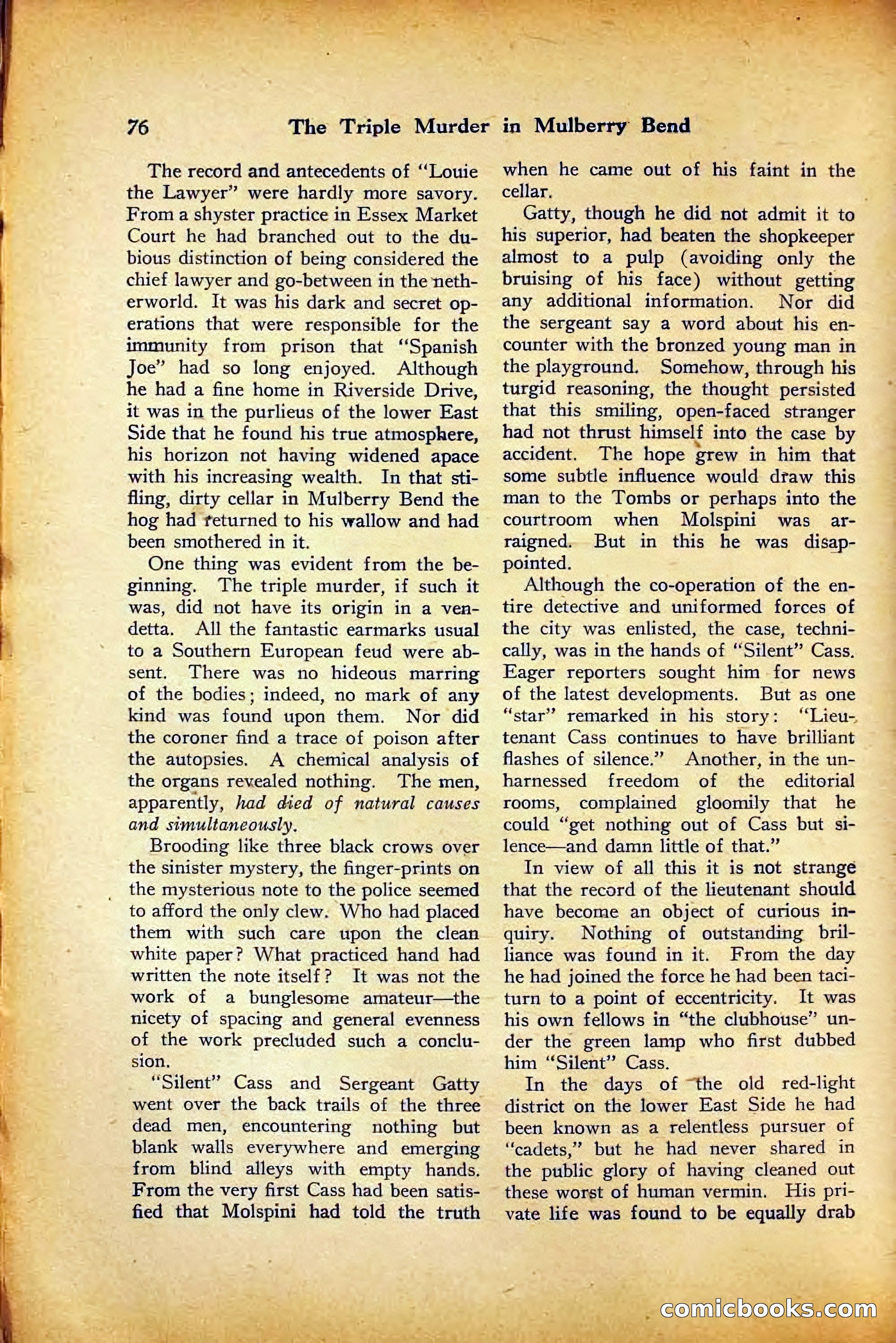
A restored page from Pulp Fiction, 1920. Page through the whole issue in the reader above.
📄 Transcribed text from this page (OCR, searchable)
Machine-transcribed from the original scan — historical spelling and the odd misread are preserved.
76 The Triple Murder in Mulberry Bend © The record and antecedents of ‘Louie the Lawyer” were hardly more savory. From a shyster practice in Essex Market Court he had branched out to the du- bious distinction of being considered the chief lawyer and go-between in the neth- erworld. It was his dark and secret op- erations that were responsible for the immunity from prison that “Spanish Joe” had so long enjoyed. Although he had a fine home in Riverside Drive, it was in the purlieus of the lower East Side that he found his true atmosphere, his horizon not haying widened apace with his increasing wealth. In that sti- fling, dirty cellar in Mulberry Bend the hog had teturned to his wallow and had been smothered in it. One thing was evident from the be- ginning, The triple murder, if such it was, did not have its origin in a ven- detta. All the fantastic earmarks usual to a Southern European feud were ab- sent. There was no hideous marring of the bodies; indeed, no mark of any kind was found upon them. Nor did the coroner find a trace of poison after the autopsies. A chemical analysis of the organs revealed nothing. The men, apparently, had died of natural causes and simultaneously. Brooding like three black crows over the sinister mystery, the finger-prints on the mysterious note to the police seemed to afford the only clew. Who had placed them with such care upon the clean white paper? What practiced hand had written the note itself? It was not the work of a bunglesome amateur—the nicety of spacing and general evenness of the work precluded such a conclu- sion. “Silent” Cass and Sergeant Gatty went over the back trails of the three dead men, encountering nothing but blank walls everywhere and emerging from blind alleys with empty hands. From the very first Cass had been satis- fied that Molspini had told the truth when he came out of his faint in the cellar. Gatty, though he did not admit it to his superior, had beaten the shopkeeper almost to a pulp (avoiding only the bruising of his face) without getting any additional information. Nor did the sergeant say a word about his en- counter with the bronzed young man in the playground. Somehow, through his turgid reasoning, the thought persisted that this smiling, open-faced stranger had not thrust himself into the case by accident. The hope grew in him that some subtle influence would draw this man to the Tombs or perhaps into the courtroom when Molspini was ar- raigned. But in this he was disap- pointed. Although the co-operation of the en- tire detective and uniformed forces of the city was enlisted, the case, techni- cally, was in the hands of “Silent” Cass. Eager reporters sought him for news of the latest developments. But as one “star”? remarked in his story: ‘Lieu- tenant Cass continues to have brilliant flashes of silence.” Another, in the un- harnessed freedom of the editorial rooms, complained gloomily that he could “get nothing out of Cass but si- lence—and damn little of that.” In view of all this it is not strange that the record of the lieutenant should have become an object of curious in- quiry. Nothing of outstanding bril- liance was found in it. From the day he had joined the force he had been taci- turn to a point of eccentricity. It was his own fellows in “the clubhouse” un- der the green lamp who first dubbed him “Silent” Cass. In the days of “the old red-light district on the lower East Side he had been known as a relentless pursuer of “cadets,” but he had never shared in the public glory of having cleaned out these worst of human vermin. His pri- vate life was found to be equally drab Le eee ee ee LS ee ee he