
Pulp Fiction, 1920 · page 76 of 132
The Black Mask — page 76: what you’re looking at
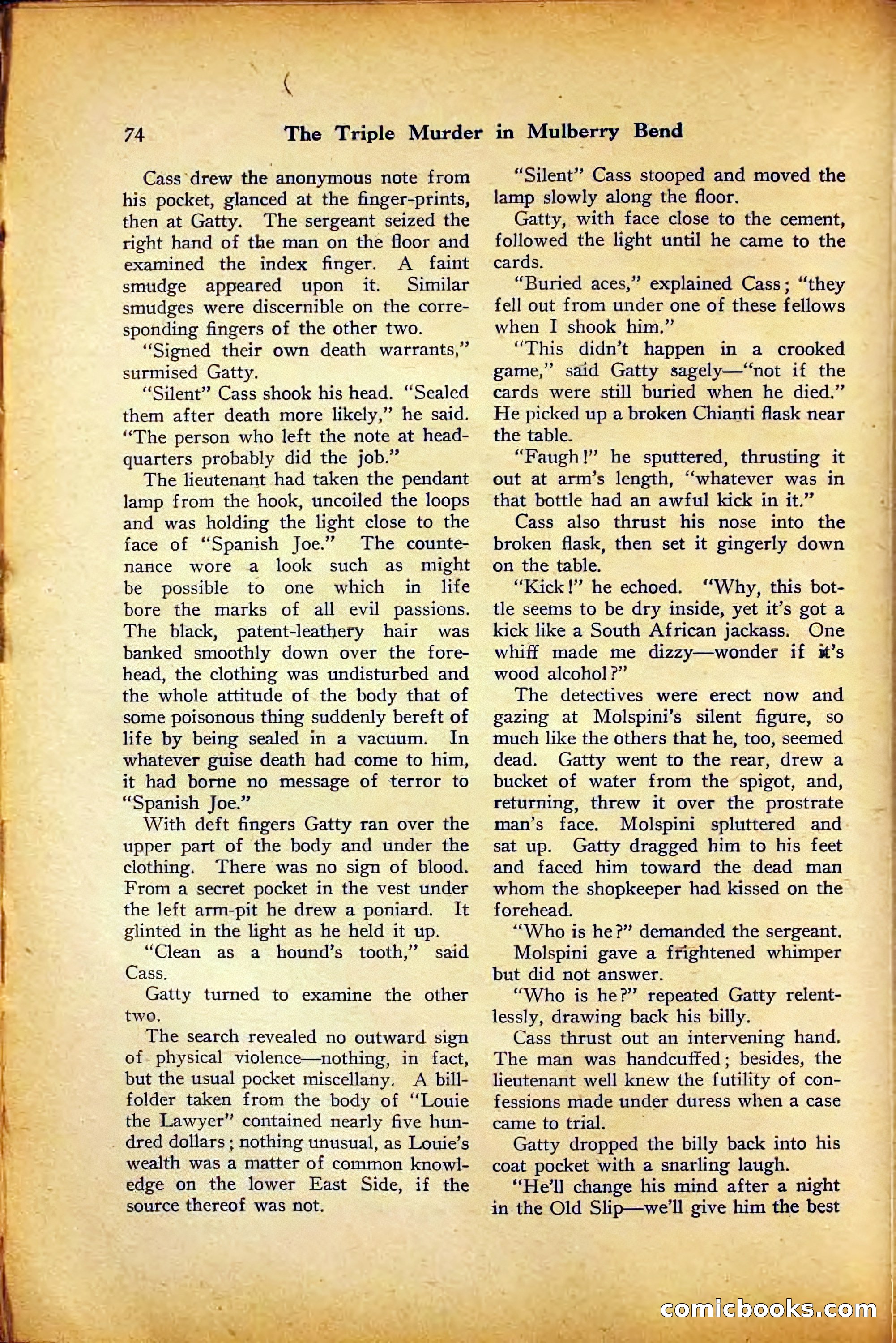
A restored page from Pulp Fiction, 1920. Page through the whole issue in the reader above.
📄 Transcribed text from this page (OCR, searchable)
Machine-transcribed from the original scan — historical spelling and the odd misread are preserved.
74 The Triple Murder in Mulberry Bend Cass drew the anonymous note from his pocket, glanced at the finger-prints, then at Gatty. The sergeant seized the right hand of the man on the floor and examined the index finger. A faint smudge appeared upon it. Similar smudges were discernible on the corre- sponding fingers of the other two. “Signed their own death warrants,” surmised Gatty. “Silent” Cass shook his head. “Sealed them after death more likely,” he said. “The person who left the note at head- quarters probably did the job.” The lieutenant had taken the pendant lamp from the hook, uncoiled the loops and was holding the light close to the face of “Spanish Joe.” The counte- nance wore a look such as might be possible to one which in life bore the marks of all evil passions. The black, patent-leathery hair was banked smoothly down over the fore- head, the clothing was undisturbed and the whole attitude of the body that of some poisonous thing suddenly bereft of life by being sealed in a vacuum. In whatever guise death had come to him, it had borne no message of terror to “Spanish Joe.” With deft fingers Gatty ran over the upper part of the body and under the clothing. There was no sign of blood. From a secret pocket in the vest under the left arm-pit he drew a poniard. It glinted in the light as he held it up. “Clean as a hound’s tooth,’ said Cass. Gatty turned to examine the other two. The search revealed no outward sign of. physical violence—nothing, in fact, but the usual pocket miscellany. A bill- folder taken from the body of ‘Louie the Lawyer” contained nearly five hun- . dred dollars ; nothing unusual, as Louie’s wealth was a matter of common knowl- edge on the lower East Side, if the source thereof was not. “Silent”? Cass stooped and moved the lamp slowly along the floor. Gatty, with face close to the cement, followed the light until he came to the cards. ; “Buried aces,” explained Cass; “they fell out from under one of these fellows when I shook him.” “This didn’t happen in a crooked game,” said Gatty sagely—“not if the cards were still buried when he died.” He picked up a broken Chianti flask near the table. “Faugh!”’ he sputtered, thrusting it out at arm’s length, “whatever was in that bottle had an awful kick in it.” Cass also thrust his nose into the broken flask, then set it gingerly down on the table. “Kick!” he echoed. ‘Why, this bot- tle seems to be dry inside, yet it’s got a kick like a South African jackass. One whiff made me dizzy—wonder if it’s wood alcohol ?” The detectives were erect now and gazing at Molspini’s silent figure, so much like the others that he, too, seemed dead. Gatty went to the rear, drew a bucket of water from the spigot, and, returning, threw it over the prostrate man’s face. Molspini spluttered and. sat up. Gatty dragged him to his feet and faced him toward the dead man whom the shopkeeper had kissed on the forehead. “Who is he?” demanded the sergeant. Molspini gave a frightened whimper but did not answer. “Who is he?” repeated Gatty relent- lessly, drawing back his billy. Cass thrust out an intervening hand. The man was handcuffed; besides, the lieutenant well knew the futility of con- fessions made under duress when a case came to trial. Gatty dropped the billy back into his coat pocket with a snarling laugh. “He'll change his mind after a night in the Old Slip—we’ll give him the best