
Pulp Fiction, 1920 · page 40 of 132
The Black Mask — page 40: what you’re looking at
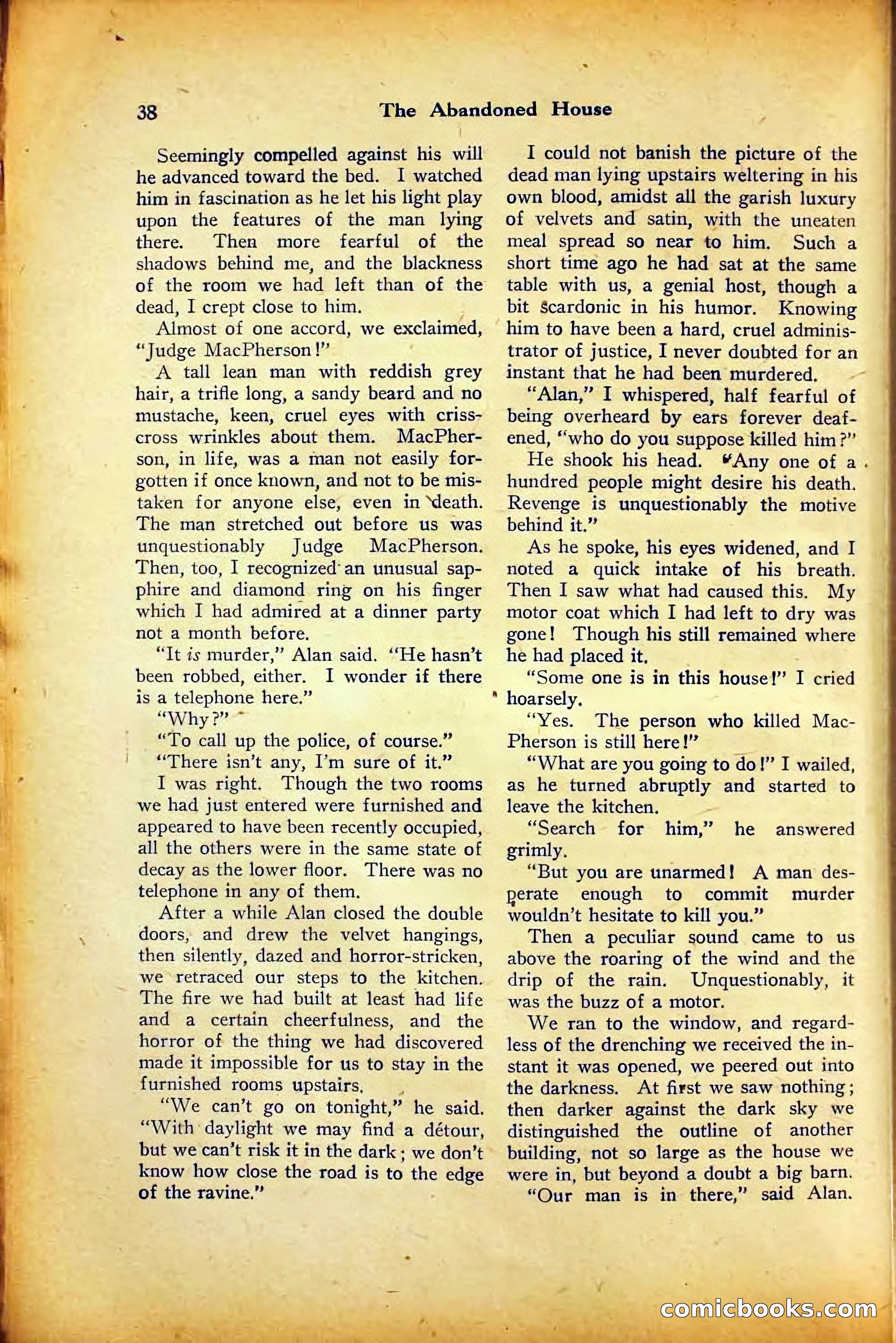
A restored page from Pulp Fiction, 1920. Page through the whole issue in the reader above.
📄 Transcribed text from this page (OCR, searchable)
Machine-transcribed from the original scan — historical spelling and the odd misread are preserved.
= 38 | Seemingly compelled against his will he advanced toward the bed. I watched him in fascination as he let his light play upon the features of the man lying there. Then more fearful of the shadows behind me, and the blackness of the room we had left than of the dead, I crept close to him. Almost of one accord, we exclaimed, “Judge MacPherson!” A tall lean man with reddish grey hair, a trifle long, a sandy beard and no mustache, keen, cruel eyes with criss- cross wrinkles about them. MacPher- son, in life, was a man not easily for- gotten if once known, and not to be mis- taken for anyone else, even in death. The man stretched out before us was unquestionably Judge MacPherson. Then, too, I recognized’an unusual sap- phire and diamond ring on his finger which I had admired at a dinner party not a month before. “It is murder,” Alan said. ‘He hasn’t been robbed, either. I wonder if there is a telephone here.” “Why ?” es “To call up the police, of course.” “There isn’t any, I’m sure of it.” I was right. Though the two rooms we had just entered were furnished and appeared to have been recently occupied, all the others were in the same state of decay as the lower floor. There was no telephone in any of them. After a while Alan closed the double doors, and drew the velvet hangings, then silently, dazed and horror-stricken, we retraced our steps to the kitchen. The fire we had built at least had life and a certain cheerfulness, and the horror of the thing we had discovered made it impossible for us to stay in the furnished rooms upstairs, “We can’t go on tonight,” he said. “With daylight we may find a détour, The Abandoned House but we can’t risk it in the dark ; we don’t - know how close the road is to the See of the ravine.” 4 I could not banish the picture of the dead man lying upstairs weltering in his own blood, amidst all the garish luxury of velvets and satin, with the uneaten meal spread so near to him. Such a short time ago he had sat at the same table with us, a genial host, though a bit Scardonic in his humor. Knowing him to have been a hard, cruel adminis- trator of justice, I never doubted for an instant that he had been murdered. “Alan,” I whispered, half fearful of being overheard by ears forever deaf- ened, “who do you suppose killed him ?” He shook his head. “Any one of a hundred people might desire his death. Revenge is unquestionably the motive behind it.” As he spoke, his eyes widened, and I noted a quick intake of his breath. Then I saw what had caused this. My motor coat which I had left to dry was gone! Though his still remained where he had placed it, “Some one is in this house!’ I cried hoarsely, “Yes. The person who killed Mac- Pherson is still here!” “What are you going to do!” I wailed, as he turned abruptly and started to leave the kitchen. - “Search for him,” he answered grimly. : “But you are unarmed! A man des- perate enough to commit murder wouldn’t hesitate to kill you.” Then a peculiar sound came to us above the roaring of the wind and the drip of the rain. Unquestionably, it was the buzz of a motor. We ran to the window, and regard- less of the drenching we received the in- stant it was opened, we peered out into the darkness. At first we saw nothing ; then darker against the dark sky we distinguished the outline of another building, not so large as the house we were in, but beyond a doubt a big barn. “Our man is in there,” said Alan. «