
Pulp Fiction, 1920 · page 39 of 132
The Black Mask — page 39: what you’re looking at
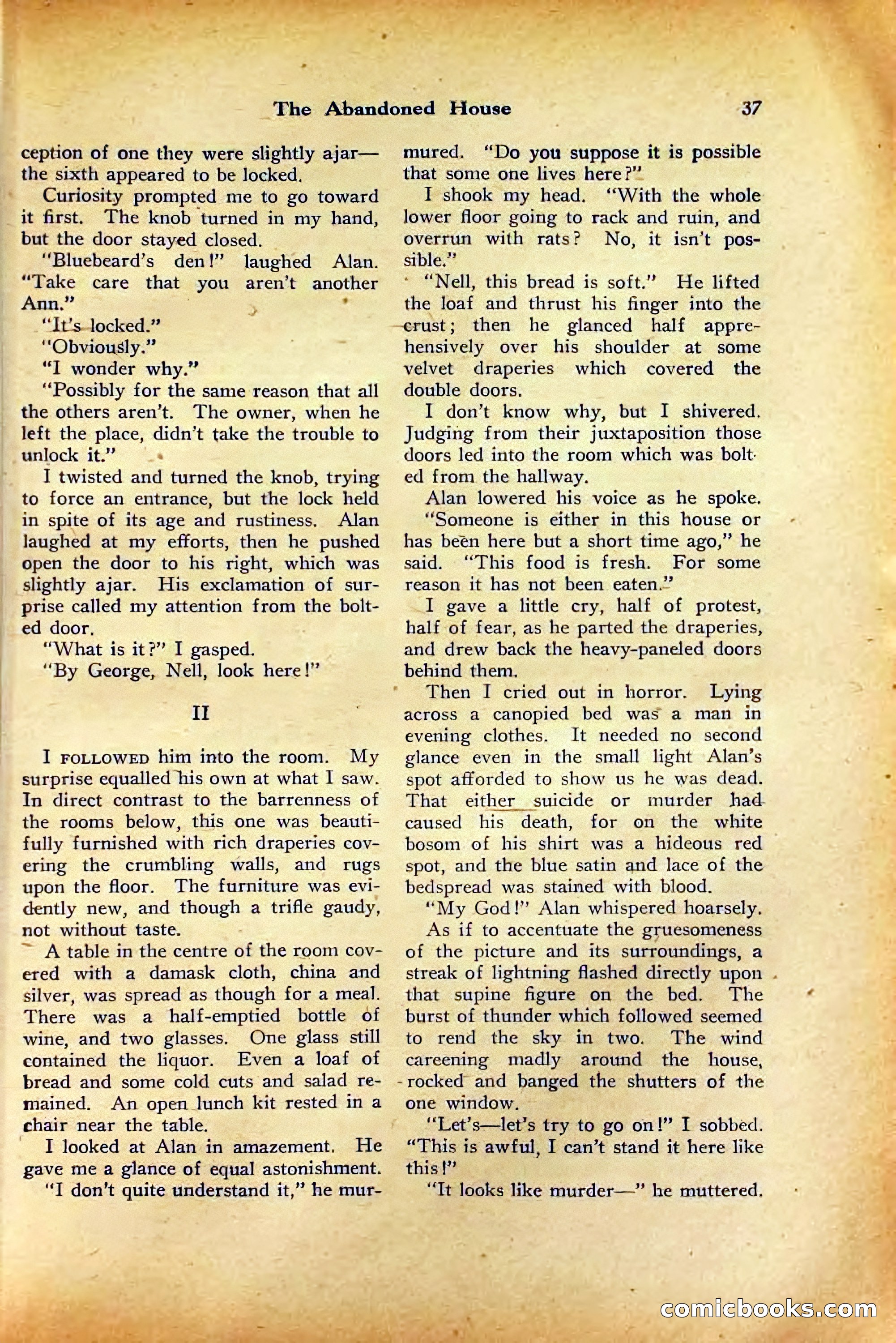
A restored page from Pulp Fiction, 1920. Page through the whole issue in the reader above.
📄 Transcribed text from this page (OCR, searchable)
Machine-transcribed from the original scan — historical spelling and the odd misread are preserved.
& it first. <= _The Abandoned House ae ception of one they were slightly ajar— the sixth appeared to be locked. Curiosity prompted me to go toward The knob turned in my hand, but the door stayed closed. “Bluebeard’s den!” laughed Alan. “Take care that you aren *t another Ann.” > “ “It’s locked.” “Obviously.” ; 5 “IT wonder why.” “Possibly for the same reason that all the others aren’t. The owner, when he left the place, didn’t take the trouble to punlock it.” “us I twisted and turned the knob, trying to force an entrance, but the lock held in spite of its age and rustiness, Alan laughed at my efforts, then he pushed open the door to his right, which was slightly ajar. His exclamation of sur- prise called my attention from the bolt- ed door. “What is it?” I gasped. “By George, Nell, look here!” II I FOLLOWED him into the room. My surprise equalled his own at what I saw. In direct contrast to the barrenness of the rooms below, this one was beauti- fully furnished with rich draperies cov- ering the crumbling walls, and rugs upon the floor. The furniture was evi- dently new, and though a trifle gaudy, not without taste. ~ A table in the centre of the room cov- ered with a damask cloth, china and silver, was spread as though for a meal. There was 2 half- emptied bottle of wine, and two glasses. One glass still contained the liquor. Even a loaf of bread and some cold cuts and salad re- mained. An open lunch kit rested in a chair near the table. I looked at Alan in amazement, He gave me a glance of equal astonishment. “T don’t quite understand it,” he mur- mured. “Do you suppose it is possible that some one lives here?” I shook my head. ‘‘With the whole lower floor going to rack and ruin, and overrun with rats? No, it isn’t pos- sible.” * “Nell, this bread is soft.” He lifted the loaf and thrust his finger into the —erust; then he glanced half appre- hensively over his shoulder at some velvet draperies which covered the double doors. I don’t know why, but I shivered. Judging from their juxtaposition those doors led into the room which was bolt: ed from the hallway. Alan lowered his voice as he spoke. “Someone is either in this house or has been here but a short time ago,” he said. ‘This food is fresh. For some reason it has not been eaten.” _I gave a little cry, half of protest, half of fear, as he parted the draperies, and drew back the heavy-paneled doors behind them. Then I cried out in horror. Lying across a canopied bed was a man in evening clothes. It needed no second glance even in the small light Alan’s spot afforded to show us he was dead. That either suicide or murder had caused his death, for on the white bosom of his shirt was a hideous red spot, and the blue satin and lace of the bedspread was stained with blood. “My God!’ Alan whispered hoarsely. As if to accentuate the gruesomeness of the picture and its surroundings, a streak of lightning flashed directly upon . that supine figure on the bed. The burst of thunder which followed seemed to rend the sky in two. The wind careening madly around the house, -rocked and banged the shutters of the one window. — ‘“Let’s—let’s try to go on!” I sobbed. “This is awful, I can’t stand it here like this!” “Tt looks like murder—” he muttered. o> © ae a ee