
Pulp Fiction, 1920 · page 41 of 132
The Black Mask — page 41: what you’re looking at
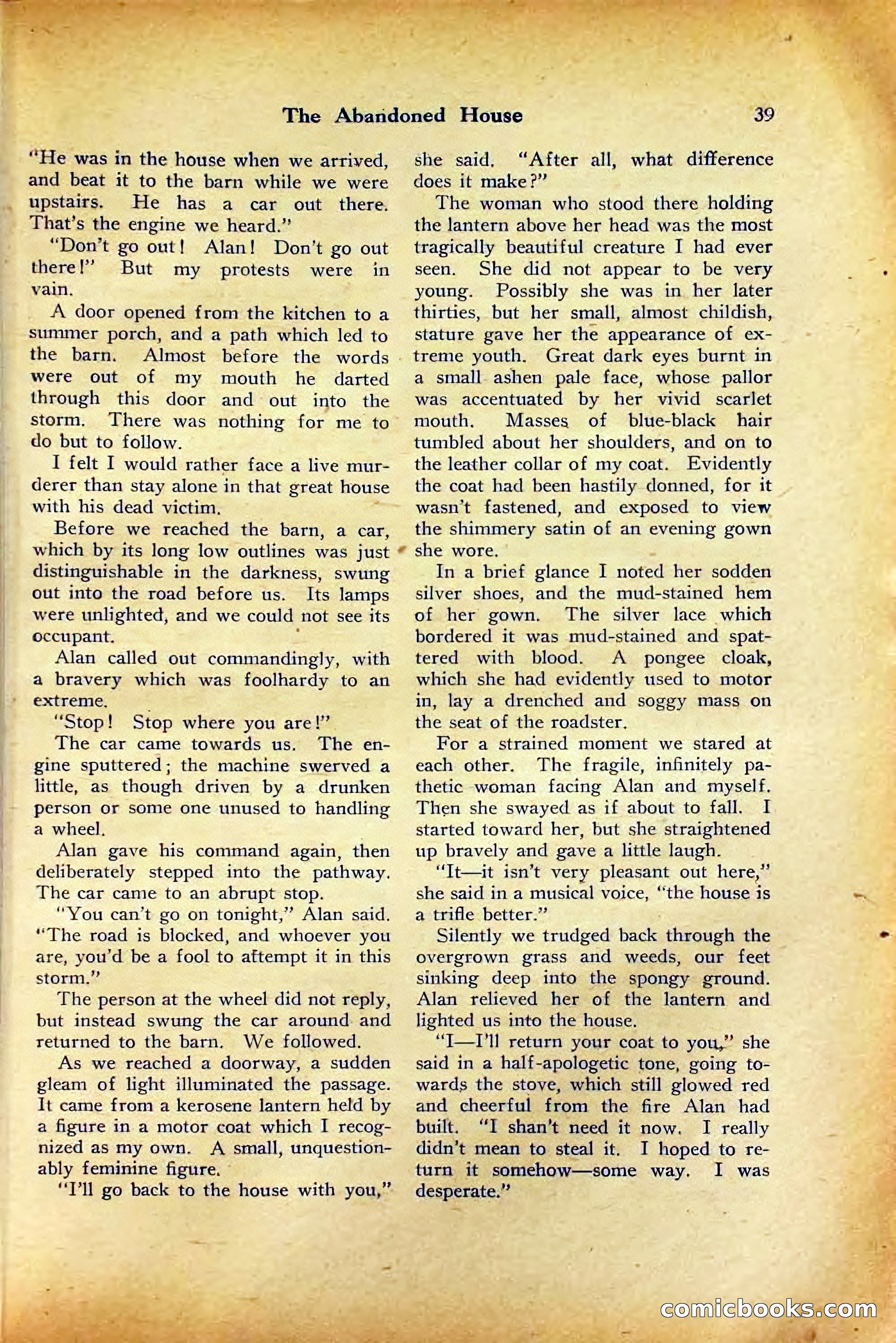
A restored page from Pulp Fiction, 1920. Page through the whole issue in the reader above.
📄 Transcribed text from this page (OCR, searchable)
Machine-transcribed from the original scan — historical spelling and the odd misread are preserved.
The Abandoned House 39 “He was in the house when we arrived, and beat it to the barn while we were upstairs. He has a car out there. That's the engine we heard.” “Don’t go out! Alan! Don’t go out there!’ But my protests were in vain. A door opened from the kitchen to a summer porch, and a path which led to the barn. Almost were out of my mouth he darted through this door and out into the storm. There was nothing for me to do but to follow. I felt I would rather face a live mur- derer than stay alone in that great house with his dead victim. Before we reached the barn, a car, which by its long low outlines was just distinguishable in the darkness, swung out into the road before us. Its lamps were unlighted, and we could not see its occupant. Alan called out commandingly, with a bravery which was foolhardy to an extreme, ; “Stop! Stop where you are!’ The car came towards us. The en- gine sputtered; the machine swerved a little, as though driven by a drunken person or some one unused to handling a wheel. Alan gave his command again, then deliberately stepped into the pathway. The car came to an abrupt stop. “You can’t go on tonight,” Alan said. “The road is blocked, and whoever you are, you'd be a fool to attempt it in this storm.” The person at the wheel did not reply, but instead swung the car around and returned to the barn. We followed. As we reached a doorway, a sudden gleam of light illuminated the passage. It came from a kerosene lantern held by a figure in a motor coat which I recog- nized as my own. A small, unquestion- ably feminine figure, ~ “Tl go back to the house with you,” before the words - * she said, “After all, what difference does it make?” The woman who stood there holding the lantern above her head was the most tragically beautiful creature I had ever seen. She did not appear to be very young. Possibly she was in her later thirties, but her small, almost childish, stature gave her the appearance of ex- treme youth. Great dark eyes burnt in a small ashen pale face, whose pallor was accentuated by her vivid scarlet mouth. Masses of blue-black hair tumbled about her shoulders, and on to the leather collar of my coat. Evidently the coat had been hastily donned, for it wasn't fastened, and exposed to view the shimmery satin of an evening gown she wore. In a brief glance I noted her sodden silver shoes, and the mud-stained hem of her gown. The silver lace which bordered it was mud-stained and spat- tered with blood. A _ pongee cloak, which she had evidently used to motor in, lay a drenched and soggy mass on the seat of the roadster. For a strained moment we stared at each other. The fragile, infinitely pa- thetic woman facing Alan and myself. Then she swayed as if about to fall. I started toward her, but she straightened up bravely and gave a little laugh. “TIt—it isn’t very pleasant out here,” she said in a musical voice, “the house is a trifle better.” Silently we trudged Hick through the overgrown grass aud weeds, our feet sinking deep into the spongy ground. Alan relieved her of the lantern and lighted us into the house. “Jl’ll return your coat to you,” she said in a half-apologetic tone, going to- wards the stove, which still glowed red and cheerful from the fire Alan had built. “I shan’t need it now. I really didn’t mean to steal it. I hoped to re- turn it. somehow—some way. I was desperate.’ » Seas, 6 Be