
Pulp Fiction, 1920 · page 38 of 132
The Black Mask — page 38: what you’re looking at
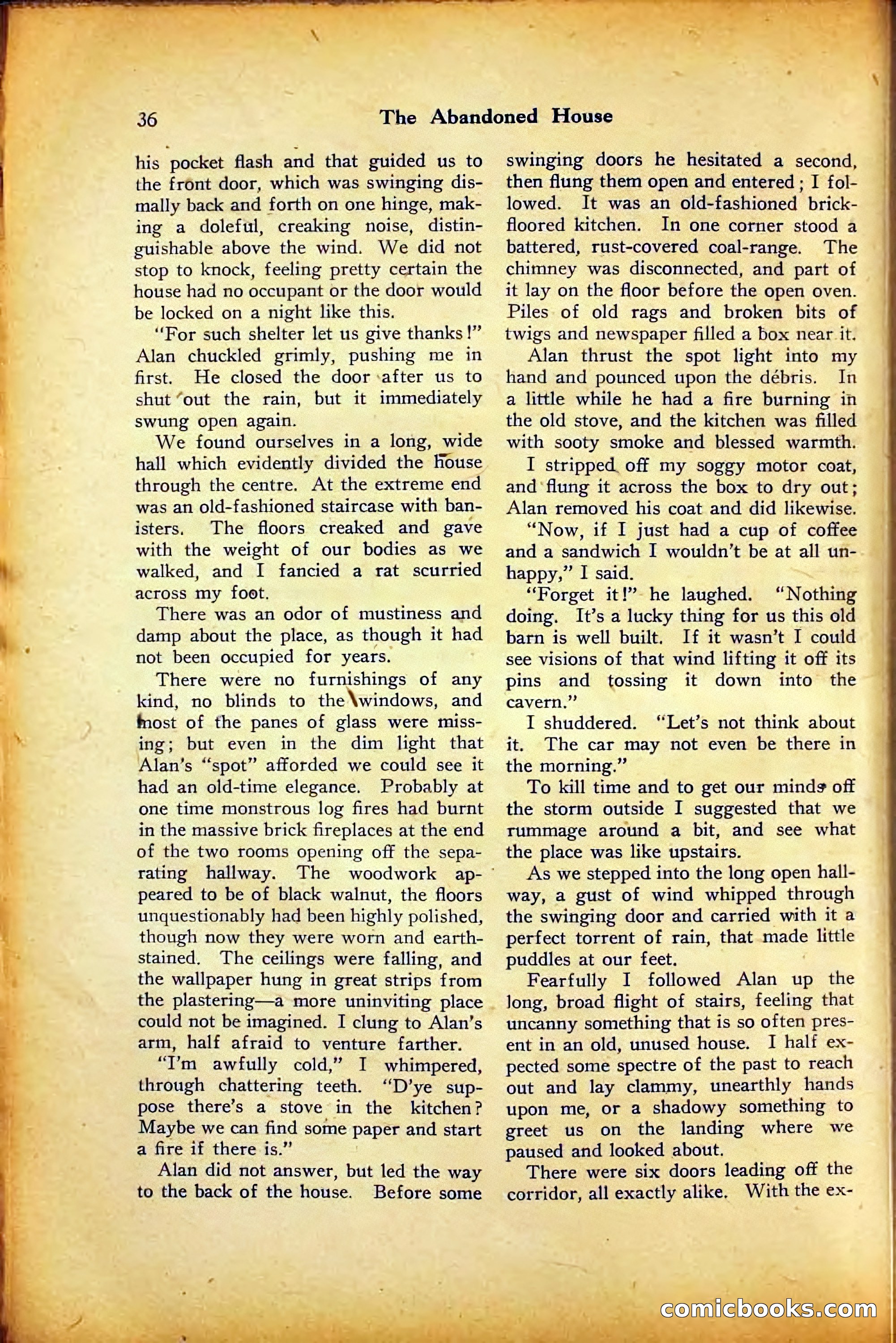
A restored page from Pulp Fiction, 1920. Page through the whole issue in the reader above.
📄 Transcribed text from this page (OCR, searchable)
Machine-transcribed from the original scan — historical spelling and the odd misread are preserved.
36 The Abandoned House his pocket flash and that guided us to the front door, which was swinging dis- mally back and forth on one hinge, mak- ing a doleful, creaking noise, distin- guishable above the wind. We did not stop to knock, feeling pretty certain the house had no occupant or the door would be locked on a night like this. “For such shelter let us give thanks!” Alan chuckled grimly, pushing me in first. He closed the door after us to shut “out the rain, but it immediately swung open again. We found ourselves in a long, wide hall which evidently divided the House through the centre. At the extreme end was an old-fashioned staircase with ban- isters. The floors creaked and gave with the weight of our bodies as we walked, and I fancied a rat scurried across my foot. There was an odor of mustiness and damp about the place, as though it had not been occupied for years. There were no furnishings of any kind, no blinds to the \windows, and fost of the panes of glass were miss- ing; but even in the dim light that Alan’s “spot” afforded we could see it had an old-time elegance. Probably at one time monstrous log fires had burnt in the massive brick fireplaces at the end of the two rooms opening off the sepa- rating hallway. The woodwork ap- ~ peared to be of black walnut, the floors unquestionably had been highly polished, though now they were worn and earth- stained. The ceilings were falling, and the wallpaper hung in great strips from the plastering—a more uninviting place _ could not be imagined. I clung to Alan’s arm, half afraid to venture farther. “Tm awfully cold,” I whimpered, through chattering teeth. ‘“D’ye sup- pose there’s a stove in the kitchen? Maybe we can find some paper and start a fire if there is.’ Alan did not answer, but led the way to the back of the house. Before some swinging doors he hesitated a second, then flung them open and entered ; I fol- lowed. It was an old-fashioned brick- floored kitchen. In one corner stood a battered, rust-covered coal-range. chimney was disconnected, and part of it lay on the floor before the open oven. Piles of old rags and broken bits of twigs and newspaper filled a box near it. Alan thrust the spot light into my hand and pounced upon the débris. In a little while he had a fire burning in _ the old stove, and the kitchen was filled © with sooty smoke and blessed warmth. I stripped. off my soggy motor coat, and ‘flung it across the box to dry out; Alan removed his coat and did likewise. “Now, if I just had a cup of coffee and a sandwich I wouldn’t be at all un- happy,” I said. “Forget it!” he laughed. “Nothing doing. It’s a lucky thing for us this old barn is well built. If it wasn’t I could see visions of that wind lifting it off its pins and tossing it down into the © cavern,” I shuddered. “Let’s not think about it. The car may not even be there in the morning.” To kill time and to get our minds off the storm outside I suggested that we rummage around a bit, and see what the place was like upstairs. As we stepped into the long open hall- way, a gust of wind whipped through the swinging door and carried with it a perfect torrent of rain, that made little puddles at our feet. Fearfully I followed Alan up the long, broad flight of stairs, feeling that uncanny something that is so often pres- ent in an old, unused house. I half ex- pected some spectre of the past to reach out and lay clammy, unearthly hands upon me, or a shadowy something to greet us on the landing where we paused and looked about. There were six doors leading off the corridor, all exactly alike, With the ex- The .