
Pulp Fiction, 1920 · page 26 of 132
The Black Mask — page 26: what you’re looking at
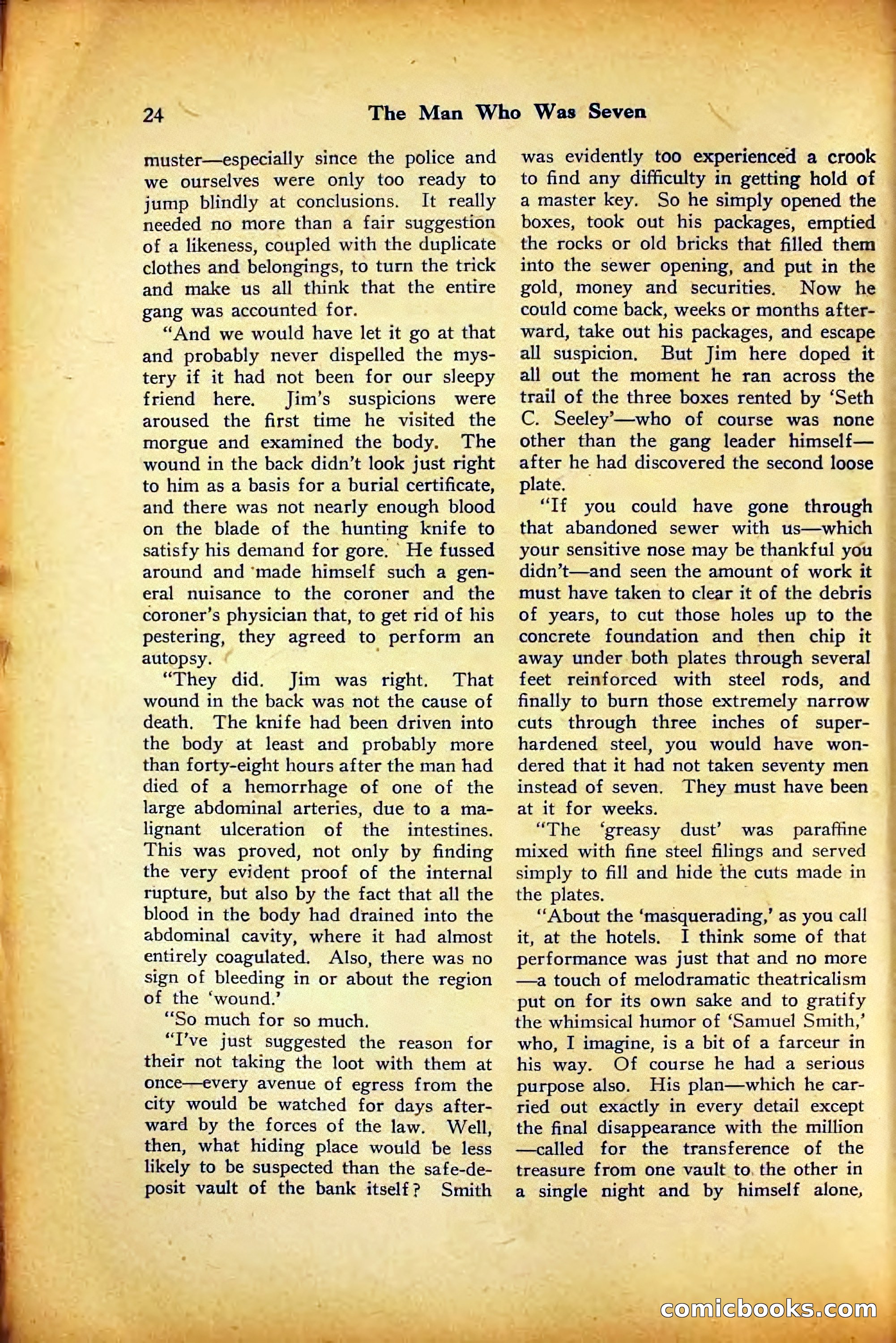
A restored page from Pulp Fiction, 1920. Page through the whole issue in the reader above.
📄 Transcribed text from this page (OCR, searchable)
Machine-transcribed from the original scan — historical spelling and the odd misread are preserved.
244 ™~ muster—especially since the police and we ourselves were only too ready to jump blindly at conclusions. It really needed no more than a fair suggestion of a likeness, coupled with the duplicate clothes and belongings, to turn the trick and make us all think that the entire gang was accounted for. “And we would have let it go at that and probably never dispelled the mys- tery if it had not been for our sleepy friend here. Jim’s suspicions were aroused the first time he visited the morgue and examined the body. The wound in the back didn’t look just right to him as a basis for a burial certificate, and there was not nearly enough blood on the blade of the hunting knife to satisfy his demand for gore. ‘ He fussed around and ‘made himself such a gen- eral nuisance to the coroner and the coroner’s physician that, to get rid of his pestering, they agreed to perform an autopsy. © : “They did. Jim was right. That wound in the back was not the cause of death. The knife had been driven into the body at least and probably more than forty-eight hours after the man had died of a hemorrhage of one of the large abdominal arteries, due to a ma- lignant ulceration of the intestines. This was proved, not only by finding the very evident proof of the internal rupture, but also by the fact that all the blood in the body had drained into the abdominal cavity, where it had almost entirely coagulated. Also, there was no sign of bleeding in or about the region of the ‘wound.’ “So much for so much. “T’ve just suggested the reason for their not taking the loot with them at once—every avenue of egress from the city would be watched for days after- ward by the forces of the law. Well, then, what hiding place would be less likely to be suspected than the safe-de- posit vault of the bank itself? Smith The Man Who Was Seven at was evidently too experienced a crook to find any difficulty in getting hold of a master key. So he simply opened the boxes, took out his packages, emptied the rocks or old bricks that filled them | into the sewer opening, and put in the gold, money and securities. Now he could come back, weeks or months after- — ward, take out his packages, and escape — But Jim here doped it | all out the moment he ran across the © trail of the three boxes rented by ‘Seth — C. Seeley-—who of course was none all suspicion, other than the gang leader himself— after he had discovered the second loose plate. that abandoned sewer with us—which your sensitive nose may be thankful you didn’t—and seen the amount of work it must have taken to clear it of the debris of years, to cut those holes up to the concrete foundation and then chip it away under both plates through several feet reinforced with steel rods, and finally to burn those extremely narrow cuts through three inches of super- hardened steel, you would have won- dered that it had not taken seventy men instead of seven. They must have been at it for weeks. “The ‘greasy dust’ was paraftine mixed with fine steel filings and served simply to fill and hide the cuts made in the plates. ae “About the ‘masquerading,’ as you call it, at the hotels. I think some of that performance was just that and no more —a touch of melodramatic theatricalism put on for its own sake and to gratify the whimsical humor of ‘Samuel Smith,’ who, I imagine, is a bit of a farceur in his way. Of course he had a serious purpose also. His plan—which he car- ried out exactly in every detail except the final disappearance with the million —called for the transference of the treasure from one vault to, the other in a single night and by himself alone, “If you could have gone through |