
Pulp Fiction, 1920 · page 25 of 132
The Black Mask — page 25: what you’re looking at
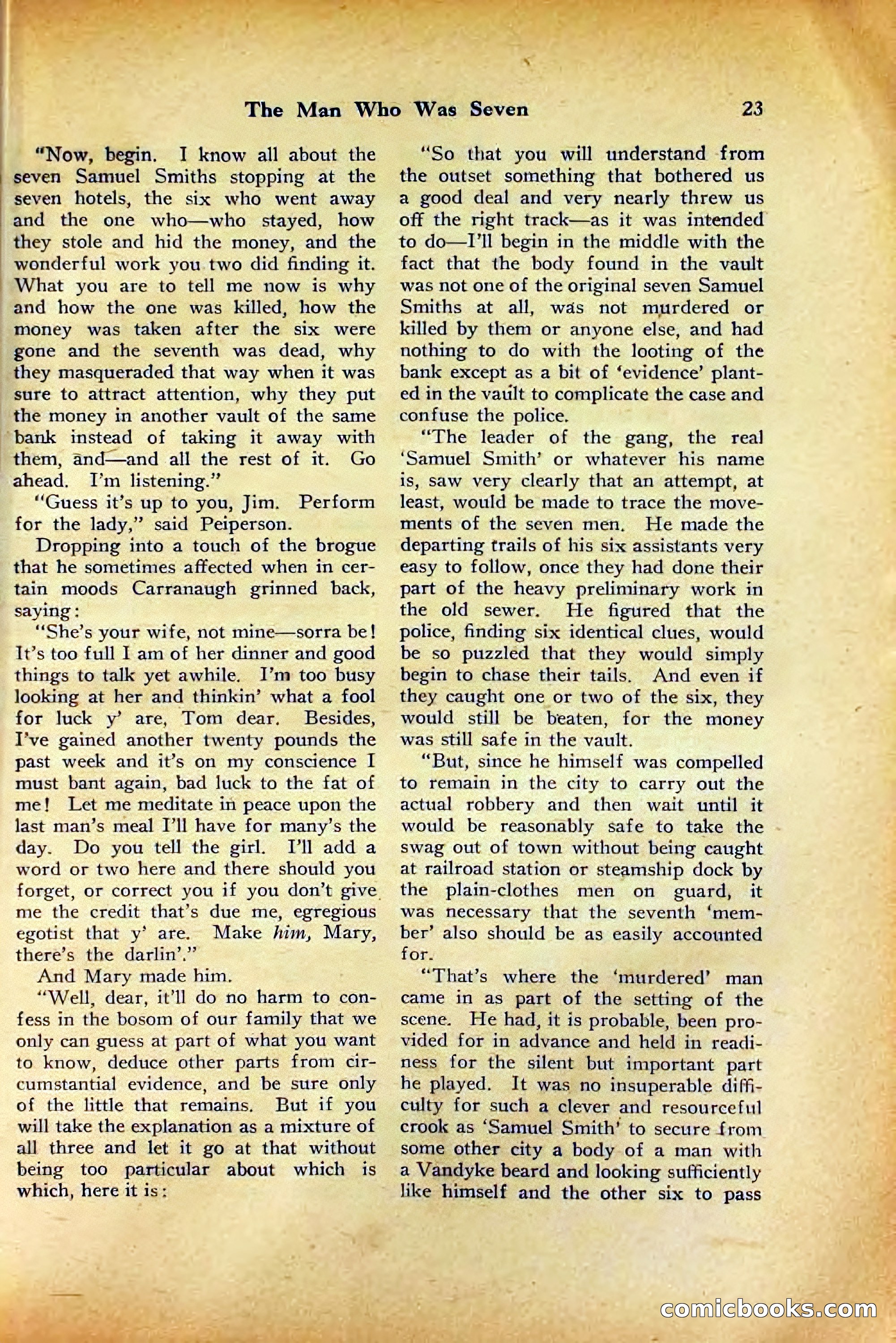
A restored page from Pulp Fiction, 1920. Page through the whole issue in the reader above.
📄 Transcribed text from this page (OCR, searchable)
Machine-transcribed from the original scan — historical spelling and the odd misread are preserved.
The Man Who Was Seven =23 _ “Now, begin. I know all about the seven Samuel Smiths stopping at the seven hotels, the six who went away and the one who—who stayed, how they stole and hid the money, and the wonderful work you. two did finding it. What you are to tell me now is why and how the one was killed, how the money was taken after the six were gone and the seventh was dead, why _ they masqueraded that way when it was sure to attract attention, why they put _the money in another vault of the same bank instead of taking it away with them, and—and all the rest of it. Go ahead. I’m listening.” “Guess it’s up to you, Jim. Perform for the lady,” said Peiperson. Dropping into a touch of the brogue that he sometimes affected when in cer- tain moods Carranaugh grinned back, saying : “She’s your wife, not mine—sorra be! It’s too full I am of her dinner and good things to talk yet awhile. I’m too busy looking at her and thinkin’ what a fool for luck y’ are, Tom dear. Besides, I’ve gained another twenty pounds the past week and it’s on my conscience I must bant again, bad luck to the fat of me! Let me meditate in peace upon the last man’s meal I’ll have for many’s the day. Do you tell the girl. Ill add a word or two here and there should you forget, or correct you if you don’t give. me the credit that’s due me, egregious egotist that y’ are. Make fim, Mary, there’s the darlin’.” And Mary made him. “Well, dear, it’ll do no harm to con- fess in the bosom of our family that we only can guess at part of what you want to know, deduce other parts from cir- cumstantial evidence, and be sure only of the little that remains. But if you will take the explanation as a mixture of all three and let it go at that without being too particular about which is which, here it is: “So that you will understand from the outset something that bothered us a good deal and very nearly threw us off the right track—as it was intended to do—lI’ll begin in the middle with the fact that the body found in the vault was not one of the original seven Samuel Smiths at all, wads not murdered or killed by them or anyone else, and had nothing to do with the looting of the bank except as a bit of ‘evidence’ plant- ed in the vault to complicate the case and confuse the police. “The leader of the gang, the real ‘Samuel Smith’ or whatever his name is, saw very clearly that an attempt, at least, would be made to trace the move- ments of the seven men. He made the departing trails of his six assistants very easy to follow, once they had done their part of the heavy preliminary work in the old sewer. He figured that the police, finding six identical clues, would be so puzzled that they would simply begin to chase their tails. And even if they caught one or two of the six, they would still be beaten, for the money was still safe in the vault. “But, since he himself was compelled to remain in the city to carry out the actual robbery and then wait until it would be reasonably safe to take the swag out of town without being caught at railroad station or steamship dock by the plain-clothes men on guard, it was necessary that the seventh ‘mem- ber’ also should be as easily accounted for. “That’s where the ‘murdered’ man came in as part of the setting of the scene. He had, it is probable, been pro- vided for in advance and held in readi- ness for the silent but important part he played. It was no insuperable diffi- culty for such a clever and resourceful crook as ‘Samuel Smith’ to secure from some other city a body of a man with a Vandyke beard and looking sufficiently like himself and the other six to pass ay comicbooksxcoin) ot lees” J we G2. 1 Oh: F ; ’ a > 5 eae 2 ‘ -