
Pulp Fiction, 1920 · page 27 of 132
The Black Mask — page 27: what you’re looking at
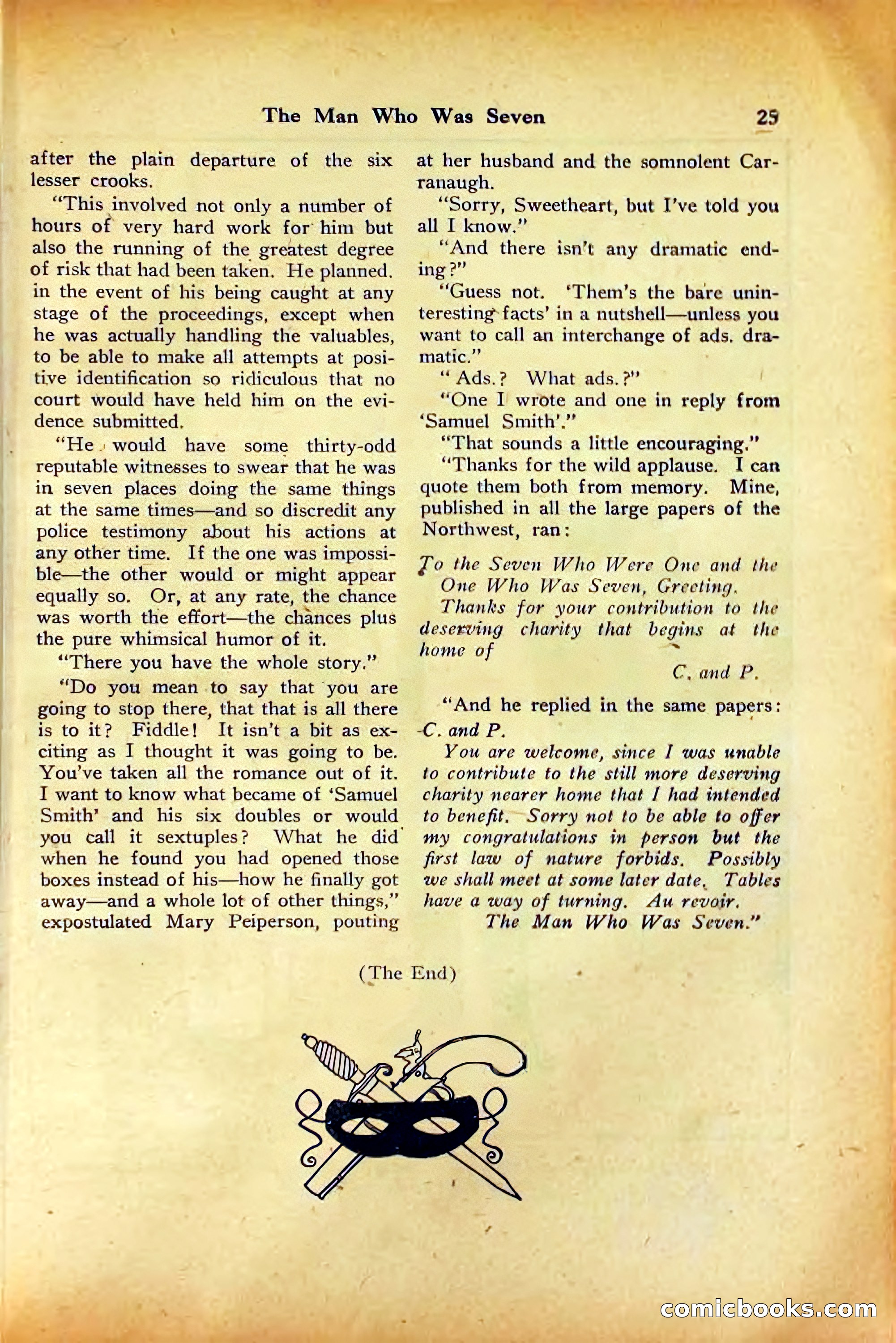
A restored page from Pulp Fiction, 1920. Page through the whole issue in the reader above.
📄 Transcribed text from this page (OCR, searchable)
Machine-transcribed from the original scan — historical spelling and the odd misread are preserved.
The Man Who Was Seven 25 after the plain departure of the six lesser crooks. “This involved not only a number of hours of very hard work for him but also the running of the greatest degree of risk that had been taken. He planned. in the event of his being caught at any stage of the proceedings, except when he was actually handling the valuables, to be able to make all attempts at posi- tive identification so ridiculous that no court would have held him on the evi- dence submitted. “He. would have some thirty-odd reputable witnesses to swear that he was in seven places doing the same things at the same titnes—and so discredit any police testimony about his actions at any other time. If the one was impossi- ble—the other would or might appear equally so. Or, at any rate, the chance was worth the effort—the chances plus the pure whimsical humor of it. “There you have the whole story.” “Do you mean to say that you are going to stop there, that that is all there is to it? Fiddle! It isn’t a bit as ex- citing as I thought it was going to be. You’ve taken all the romance out of it. I want to know what became of ‘Samuel Smith’ and his six doubles or would you call it sextuples? What he did’ when he found you had opened those boxes instead of his—how he finally got away—and a whole lot of other things,” expostulated Mary Peiperson, pouting at her husband and the somnolent Car- Tanaugh. “Sorry, Sweetheart, but I’ve told you all I know.” “And there isn’t any dramatic end- ing ?” “Guess not. ‘Them’s the bare unin- teresting facts’ in a nutshell—unless you want to call an interchange of ads, dra- matic.” ; “Ads.? What ads. ?” “One I wrote and one in reply from ‘Samuel Smith’.” “That sounds a little encouraging.” “Thanks for the wild applause. I can quote them both from memory. Mine, published in all the large papers of the Northwest, ran: go the Seven Who Were One and the One Who Was Seven, Greeting, Thanks for your contribution to the deserving charity that begins at the home of es C, and P. “And he replied in the same papers: -C. and P. You are welcome, since I was unable to contribute to the still more deserving charity nearer home that I had intended to benefit. Sorry not to be able to offer my congratulations in person but the first law of nature forbids. Possibly we shall meet at some later date, Tables have a way of turning. Au revoir, The Man Who Was Seven.” (The End) : See A Conmiclaoolk :