
Pulp Fiction, 1920 · page 24 of 132
The Black Mask — page 24: what you’re looking at
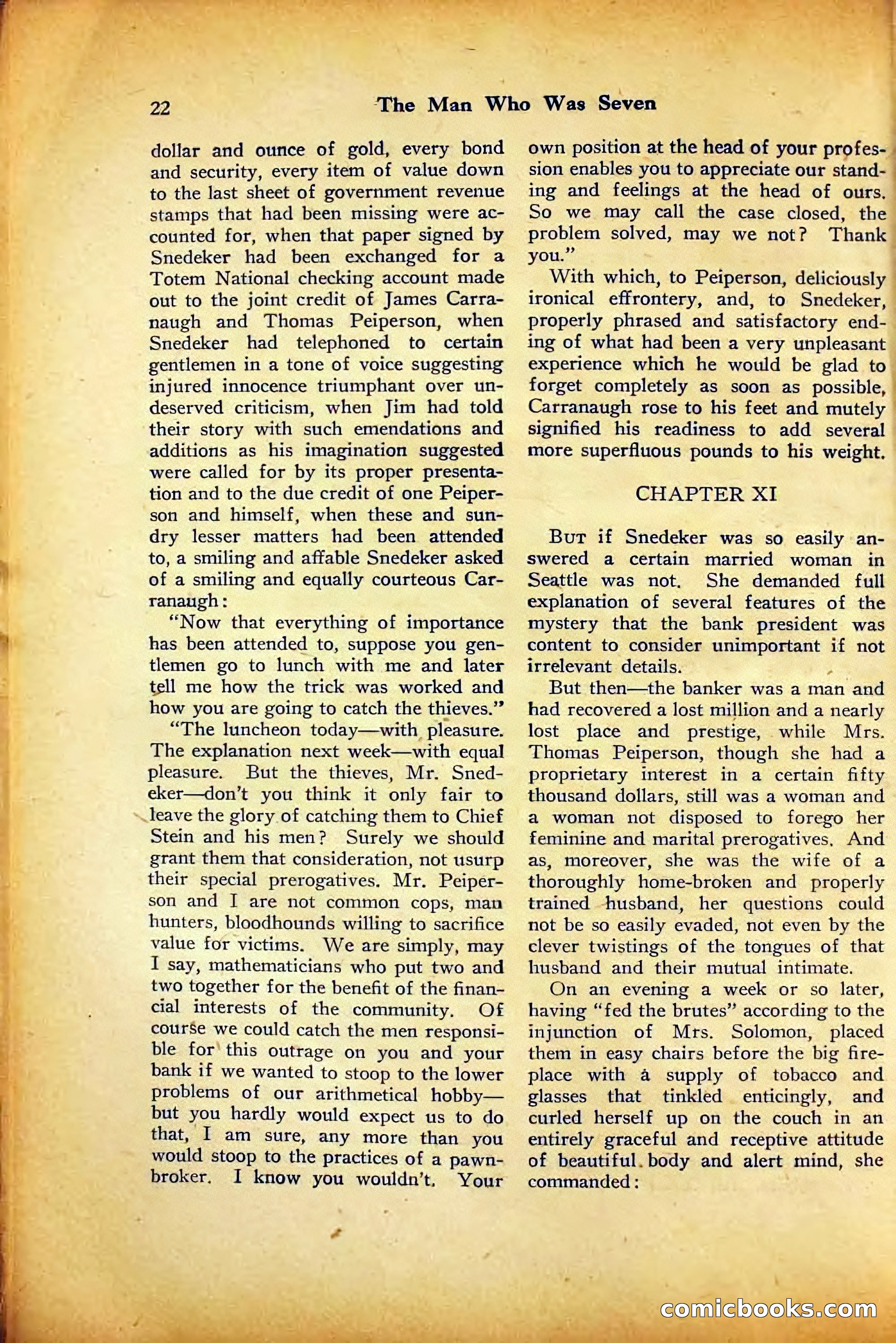
A restored page from Pulp Fiction, 1920. Page through the whole issue in the reader above.
📄 Transcribed text from this page (OCR, searchable)
Machine-transcribed from the original scan — historical spelling and the odd misread are preserved.
dollar and ounce of gold, every bond and security, every item of value down to the last sheet of government revenue stamps that had been missing were ac- counted for, when that paper signed by Snedeker had been exchanged for a Totem National checking account made out to the joint credit of James Carra- naugh and Thomas Peiperson, when Snedeker had telephoned to certain gentlemen in a tone of voice suggesting injured innocence triumphant over un- deserved criticism, when Jim had told their story with such emendations and additions as his imagination suggested were called for by its proper presenta- tion and to the due credit of one Peiper- son and himself, when these and sun- dry lesser matters had been attended to, a smiling and affable Snedeker asked of a smiling and equally courteous Car- Tanaugh: “Now that everything of importance has been attended to, suppose you gen- tlemen go to lunch with me and later tell me how the trick was worked and how you are going to catch the thieves.” “The luncheon today—with pleasure. The explanation next week—with equal pleasure. But the thieves, Mr. Sned- eker—don’t you think it only fair to leave the glory of catching them to Chief Stein and his men? Surely we should grant them that consideration, not usurp their special prerogatives. Mr. Peiper- son and I are not common cops, man hunters, bloodhounds willing to sacrifice value for victims. We are simply, may I say, mathematicians who put two and two together for the benefit of the finan- cial interests of the community. Of course we could catch the men responsi- ble for’ this outrage on you and your bank if we wanted to stoop to the lower problems of our arithmetical hobby— but you hardly would expect us to do that, I am sure, any more than you would stoop to the practices of a pawn- broker. I know you wouldn’t. Your 22 ‘The Man Who Was Seven own position at the head of your profes- sion enables you to appreciate our stand- ing and feelings at the head of ours, So we may call the case closed, the problem solved, may we not? Thank you.” With which, to Peiperson, deliciously ironical effrontery, and, to Snedeker, properly phrased and satisfactory end- ing of what had been a very unpleasant experience which he would be glad to forget completely as soon as possible, Carranaugh rose to his feet and mutely signified his readiness to add several more superfluous pounds to his weight. CHAPTER XI Bur if Snedeker was so easily an- swered a certain married woman in Seattle was not. She demanded full explanation of several features of the mystery that the bank president was content to consider unimportant if not irrelevant details. : But then—the banker was a man and had recovered a lost million and a nearly lost place and prestige, while Mrs. Thomas Peiperson, though she had a proprietary interest in a certain fifty thousand dollars, still was a woman and a woman not disposed to forego her feminine and marital prerogatives, And as, moreover, she was the wife of a thoroughly home-broken and properly trained -husband, her questions could not be so easily evaded, not even by the clever twistings of the tongues of that husband and their mutual intimate. On an evening a week or so later, having “fed the brutes” according to the injunction of Mrs. Solomon, placed them in easy chairs before the big fire- place with a supply of tobacco and glasses that tinkled enticingly, and curled herself up on the couch in an entirely graceful and receptive attitude of beautiful. body and alert mind, she commanded : ; 1