
Pulp Fiction, 1879 · page 9 of 40
Beadle's New York Dime Library, No. 66 — page 9: what you’re looking at
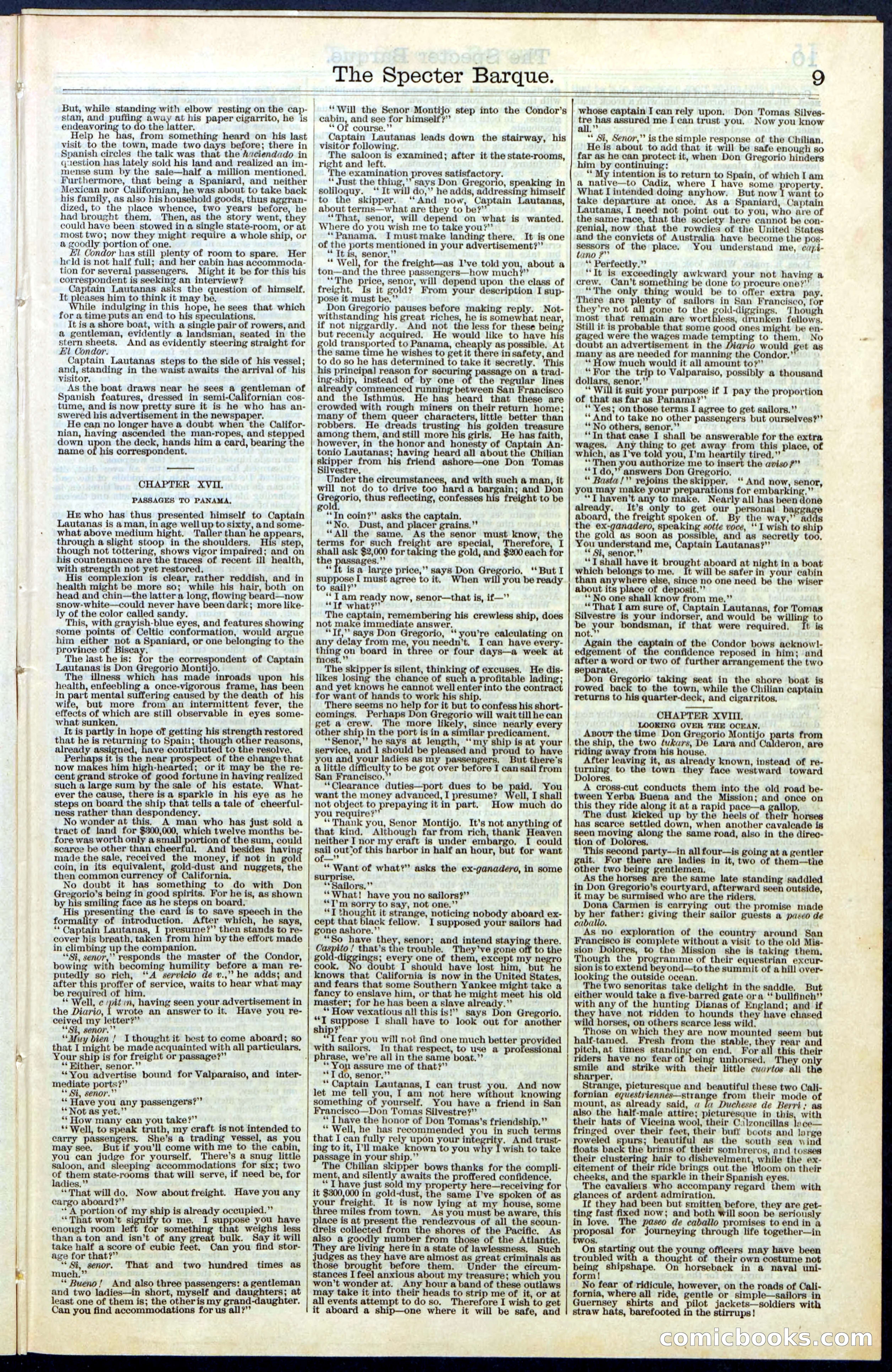
A restored page from Pulp Fiction, 1879. Page through the whole issue in the reader above.
📄 Transcribed text from this page (OCR, searchable)
Machine-transcribed from the original scan — historical spelling and the odd misread are preserved.
4 a —— But, while standing with elbow resting on the cap- | stan, and puffing away at his paper cigarrito, he is endeavoring to do the latter. Help he has, from something heard on his last visit to the town, made two days before; there in Spanish circles the talk was that the haciendado in question has lately sold his land and realized an im- mense sum by the sale—half a million mentioned. Furthermore, that being a Spaniard, and neither Mexican nor Californian, he was about to take back his family, as also his household goods, thus aggran- dized, to the place whence, two years before, he had brought domi. Then, as the story went, they could have been stowed in a single state-room, or at most two; now they might require a whole ship, or a goodly portion of one. El Condor has still plenty of room to spare. Her held is not half full; and her cabin has accommoda- tion for several passengers. Might it be for this his correspondent is seeking an interview? Captain Lautanas asks the question of himself. It pleases him to think it may be. While indulging in this hope, he sees that which for a time puts an end to his speculations. It is a shore boat, with a single pair of rowers, and a gentleman, evidently a landsman, seated in the stern sheets, And as evidently steering straight for dl Condor. Captain Lautanas steps to the side of his vessel; and, standing in the waist awaits the arrival of his visitor. As the boat draws near he sees a gentleman of Spanish features, dressed in semi-Californian cos- tume, and is now pretty sure it is he who has an- swered his advertisement in the newspaper. He can no longer have a doubt when the Califor- nian, having ascended the man-ropes, and stepped down upon the deck, hands him a card, bearing the name of h his correspondent. ; CHAPTER XVII. PASSAGES TO PANAMA, Hr who has thus presented himself to Captain Lautanas is aman, in age well up to sixty, and some- what above medium hight. Taller than he appears, through a slight stoop in the shoulders. step, though not tottering, shows vigor impaired; and on his countenance are the traces of recent ill health, with strength not yet restored. His complexion is clear, rather reddish, and in health make ht be more so; while his hair, both on head and chin—the latter a long, flowing beard—now snow-white—could never have ndark; more like- ly of the color called sandy. This, with grayish-blue eyes, and features showing some points of Celtic conformation, would argue him either not a Spaniard, or one belonging to the province of Biseay. The last he is: for the co ndent of Captain Lautanas is Don Gregorio Montijo, The illness which has made inroads upon his health, enfeebling a once-vigorous frame, has been in part mental suffering caused by the death of his wife, but more from an intermittent fever, the effects of which are still observable in eyes some- what sunken. It is partly in hope of getting his strength restored that he is returning to Spain; though other reasons, already assigned, have contributed to the resolve. Perhaps it is the near pros of the ch that now makes him h-hearted; orit may be the re- cent grand stroke of fortune in having realized such a large sum by the sale of his estate. What- ever the cause, there is a sparkle in his eye as he steps on board the ship that tells a tale of cheerful- ness rather than despondency. No wonder at this. A man who has just sold a tract of land for $300,000, which twelve months be- fore was worth only a smail portion of the sum, could scarce be other than cheerful. And besides havin made the sale, received the money, if not in gol coin, in its equivalent, ety and nuggets, the then common currency of California, No doubt it has something to do with Don Gregorio’s being in good spirits. For he is, as shown by his smiling face as hes = on board, His presenting the card is to save speech in the formality of introduction, After which, he says, ‘* Captain Lautanas, I presume?’’ then stands to re- cover his breath, taken — him by the effort made in climbing up the companion. “Si, senor,” responds the master of the Condor, bowing with becoming humilit before a man re- putedly so rich, ‘A servicio de v.,"’ he adds; and after this proffer of service, waits to hear what may be required of him. ** Well, ¢ pitin, having seen your.advertisement in the Diario, | wrote an answer to it. Have you re- ceived my letter?” ** Si, senor.” “Muy bien! I thought it best to come aboard; so that I might be made acquainted with all particulars, rae is for freight or passage?” ther, senor.” “You advertise bound for Valparaiso, and inter- mediate ports?” ** Si, senor.” ” ““ Have you any passengers? r ao as yet.” owt ** How many can you ef ** Well, to speak entths my craft is not intended to carry passengers. She’s a trading vessel, as you may see. Butif a come with meé to the cabin, you can judge for yourself. There’s a snug little saloon, and sleeping accommodations for six; two - them state-rooms that will serve, if need be, for “That will do, Now about freight. Have you any cargo aboard?” 7 “A portion of my ship is already occupied. “That won't si to me. I npc you have enough room left for something that weighs less than aton and isn’t of any great bulk. Say it will take half a score of cubic feet. Can you find stor- age for that?” “Si, senor. That and two hundred times as much.” ‘** Bueno! And also three passengers: a gentleman and two ladies—in short, syeslt and daughters; at least one of them is; the otheris my grand-daughter. Can you find accommodations for us all?”’ _ The Specter Barque. ** Will the Senor Montijo step into the Condor's cabin, and see for himself?’ ‘**Of course.” Captain Lautanas leads down the stairway, his | visitor following. The saloon is examined; after it the state-rooms, right and left. The examination proves satisfactory. Just the thing,’’ says Don Gregorio, speaking in soliloquy. ‘* It wil) do,” he adds, addressing himself to the skipper. ‘“‘And now, Captain Lautanas, _ about terms—what are they to be?” “That, senor, will depend on what is wanted. Where do you wish me to take you?” ‘**Panama. I must make landing there. It is one of the ports mentioned in your advertisement?” “ Tt is, senor,” “Well, for the freight—as I’ve told you, about a ton—and the three passengers—how much?” price, senor, will depend upon the class of freight. Is it gold? From your description I sup- pose it must be,”’ Don Gregorio pauses before making reply. Not- withstanding his great riches, he is somewhat near, if not niggardly. And not the less for these being but recenuly acquired. He would like to have his old transported to Panama, cheaply as possible, At the same time he wishes to getit there in safety, and to do so he has determined to take it secretly. This his principa] reason for peo eee | passage on a trad- ing-ship, instead of by one of the regular lines already commenced running between San Francisco and the Isthmus. He has heard that these are crowded with rough miners on their return home; many of them queer characters, little better than robbers. He dreads trusting his golden treasure among them, and still more his girls. He has faith, however, in the honor and honesty of Captain An- tonio Lautanas; having heard all about the Chilian skipper from his friend ashore—one Don Tomas Silvestre, Under the circumstances, and with such a man, it will not do to drive too hard a bargain; and Don rity aia thus reflecting, confesses his freight to be go ‘**In coin?” asks the captain. “No. Dust, and placer grains.” “All the same, As the senor must know, the terms for such freight are special, Therefore, I shall ask $2,000 for taking the gold, and $200 each for the reo “It isa large price,” says Don Gregorio, “But I rong tap I must agree to it, When you be ready + ded ‘*Tam ready now, senor—that is, if—"’ “Tf what?’ The captain, remembering his crewless ship, does not make immediate answer, “Tf,’’ says Don Gregorio, “ you’re calculating on any delay from me, you needn’t. I can have every- thing on board in three or four days—a week at most.’ The skipper is silent, thinking of excuses. He dis- likes losing the chance of such a profitable lading; and yet knows he cannot well enter into the contract for want of hands to work his ship. There seems no help for it but to confess his short- comings. Perhaps Don Gregorio will wait till he can get a crew. The more likely, since nearly every other ship in the port is in a similar predicament, “Senor,” he says at length, ay ship is at your service, and 1 should be pleased and proud to have you and your ladies as my passengers. But there's a little d fficulty to be got over before I can gail from San Francisco.”’ “Clearance duties—port dues to be paid. You want the money advanced, I presume? Well, I shall not object to prepaying itin part. How much do you require?’ ‘Thank you, Senor Montijo. It’s not anything of that kind. Although far from rich, thank Heaven neither I nor my craft is under embargo. I could s outiof this harbor in half an hour, but for want rs) ee 8 Red of what?”’ asks the ex-ganadero, in some se. ** Sailors,” ‘*What! have you no sailors?” “I’m sorry to say, not one,”’ “I thought it strange, noticing nobody aboard ex- cept that black fellow. I supposed your sailors had gone ashore.”’ “So have they, senor; and intend staying there. C / that’s the trouble. They've gone to the gol 8; every one of them, except my n cook. No doubt I’ should have lost him, but he knows that California is now in the United States, and fears that some Southern Yankee might take a fancy to enslave him, or that he might meet his old m r; for he has been a slave already.” ** How vexatious all this is!’ says Don Gregorio. an ee I shall have to look out for another oF fear you will not find one much better pore with sailors. In that respect, to use a professional || phrase, we're all in the same boat.” * Yon assure me of that?” **T do, senor.” “Captain Lautanas, I can trust you. And now let me tell you, I am not here without knowing something of yourself. You have a friend in San Francisco—Don Tomas Silvestre?” ‘ T have the honor of Don Tomas’s friendship.” * Well, he has recommended you in such terms that I can fully rely upon your ee . And trust- ing to it, '1] make known to you why I wish to take passage in your ship.” The Chilian skipper bows thanks for the compli- ment, and silently awaits the proffered confidence. “T have a sold my peopesty here—receiving for it $300,000 in gold-dust, the same I’ve ken of as our freight. It is now lying at my house, some e miles from town. As you must be aware, this eer is at present the rendezvous of all the scoun- Is collected from the shores of the Pacific. As also a goodly number from those of the Atlantic. They are living herein a state of lawlessness. Such udges as they have are almost as great criminals as hose brought ore them. Under the circum- stances I feel ous about my treasure; which you won't wonder at. Any hour a d of these outlaws may take it into their heads to sain me of it, or at all events attempt to do so. Therefore I wish to get it aboard a ship—one where it will be safe, and _the ship, the two (vkars, De Lara and 9 Send a apo a ge whose captain I can rely upon. Don Tomas Silves- coer assured me I can trust you. Now you know ** Si, Senor,” is the simple response of the Chilian. He is about to add that it will be safe enough so far as he can protect it, when Don Gregorio hinders him_ by continuing: ‘“* My intention is to return to Spain, of which I am a native—to Cadiz, where I have some property. What I intended doing anyhow. But nowt want take departure at once. As a Spaniard, Captain Lautanas, I need not point out to you, who are of the same race, that the society here cannot be con- genial, now that the rowdies of the United States and the convicts of Australia have become the pos- aon of the place. You understand me, capé- ano ?"° * Perfectly.” “It is exceedingly awkward “te not having a crew. Can't something be done to procure one?"' “The only thing would be to offer extra pay. There are plenty of sailors in San Francisco, {or they're not all gone to the Seek ps Though most that remain are worthless, drunken fellows. Still it is probable that some good ones might be en- gaged were the wages made aye ed to them. No oubt an advertisement in the Diario would get as per as are needed for manning the Condor.’ “How much would it all amount toy” “For the trip to Valparaiso, possibly a thousand dollars, senor.’ “Will it suit your purpose if I pay the proportion of that as far as Panama’”’ ‘Yes; on those terms I agree to get sailors." ‘** And to take no other passengers but ourselves?” “No others, senor.” **In that case I shall be answerable for the extra w Any thing to get away from this place, of which, as I've told you, I'm heartily tired.” ‘Then you authorize me to insert the aviso ?” ‘**T do,”’ answers Don Gregorio. “ Basta!” rejoins the noon “And now, senor, you may make your preparations for embarking,” “T haven't any to make. Nearly all has been done already. It’s only to get our personal bepgage ahoard, the freight spoken of. By the way,’ ad the 5 grr speaking sotte voce, ‘I wish to ship the gold as soon as possible, and as secretly too. You understand me, Captain Lautanas?” ** Si, senor.”’ “IT shall have it brought aboard at night in a boat which belongs to me, It will be saferin your cabin than anywhere else, since no one need be the wiser about its place of deposit.” ** No one shall know from me.” “That I am sure of, Captain Lautanas, for Tomas Silvestre is your indorser, and would be willing to be your bondsman, if that were required. It is not.” the ca of the Condor bows acknow]- edgement of the confidence reposed in him; and after a word or two of further arrangement the two separate. on Gregorio taking seat in the shore boat is rowed back to the town, while the Chilian captain returns to his quarter-deck, and cigarritos, CHAPTER XVIII, LOOKING OVER THE OCEAN. Axsout the time Don Gregorio Montijo parts from deron, are away from his house. After leaving it, as already known, instead of re- sata to the town they face westward toward olores. A cross-cut conducts them into the old road be- tween Yerba Buena and the Mission; and once on this they ride along it at a rapid pace—a gallop, The dust kicked up by the heels of their horses scarce settled down, when another cavalcade is seen mo along the same road, also in the direc- This cing ath in allf is going at tl secon y--in our—is going at a gentler gait. For there are ladies in it, two of them—the other two being gentlemen, As the horses are the same late standing saddled in Don Gregorio’s courtyard, afterward seen outside, it may be surmised who are the riders, Dona Carmen is carrying out the promise made phos: 7 father: giving their sailor guests a paseo de Cando, As no exploration of the country around San Francisco is complete without a visit to the old Mis- sion Dolores, to the Mission she is taking them, Though the programme of their equestrian excur- sion is to extend beyond—to the summit of a hill over- looking the outside ocean. The two senoritas take delight in the saddle. But either would take a five-barred gate ora “ bullfinch” with any of the vem | Dianas of England; and if they have not ridden to hounds they have chased wild horses, on others scarce less wild, Those on which they are now mounted seem but half-tamed. Fresh from the stable, they rear and pitch, at times a 1g er end. For all this their riders have no fear of being unhorsed. They only aie and strike with their little cucrtos all the arper. Strange, picturesque and beautiful these two Cali- fornian equestiiennés—strange from their mode of mount, as already said, a la Duchesse de Berri; as also the half-male attire; picturesque in this, with their hats of Viceina wool, their Calzoncillas loce— fringed over their feet, their buff boots and large roweled spurs; beautiful as the south sea wind floats back the brims of their sombreros, and tosses their clustering hair to dishevelment, while the ex- citement of their ride brings out the ‘gloom on their cheeks, and the sparkle in their Spanish of fa The cavaliers who accompany regard them with glances of ardent admiration. If they had been but rye we 4 ara they are get- fast fixed now; and both Will soon be seriously in love. The paseo de caballo promises to end in a pronoen! for journeying through life together—in Os. On spe gen out the young officers may have been troubled with a thought of their own costume not Leia shipshape. On horseback in a naval uni- orm No fear of ridicule, however, on the roads of Cali- fornia, where all ride, gentle or simple—sailors in Guernsey shirts and pilot jackets—soldiers with straw hats, barefooted in the stirrups! aaa er SSS SSS SSS Ss: (E(©) Eomicbooks