
Pulp Fiction, 1879 · page 8 of 40
Beadle's New York Dime Library, No. 66 — page 8: what you’re looking at
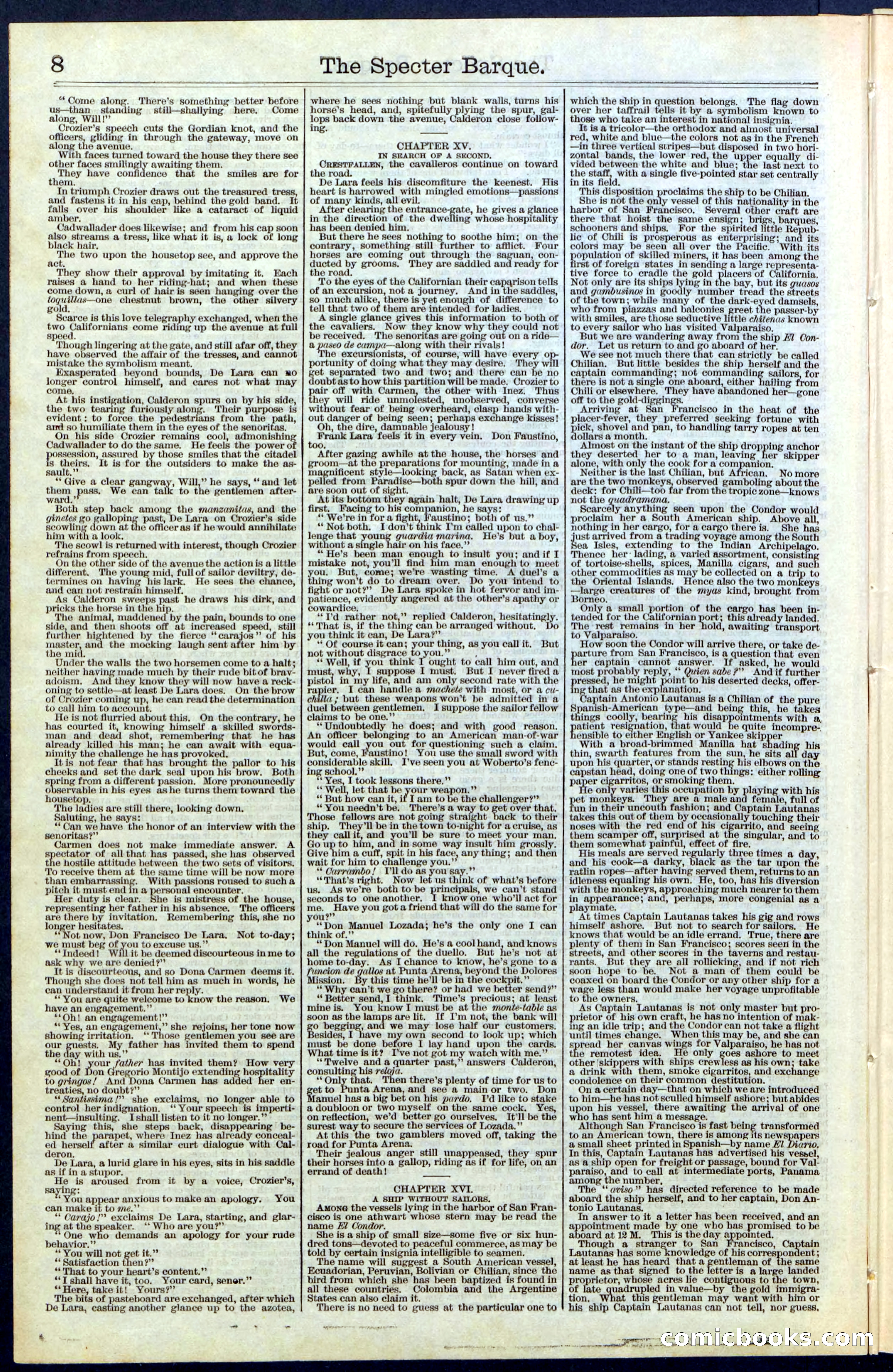
A restored page from Pulp Fiction, 1879. Page through the whole issue in the reader above.
📄 Transcribed text from this page (OCR, searchable)
Machine-transcribed from the original scan — historical spelling and the odd misread are preserved.
8 —, “Come along. There’s something better before us—than standing still—shallying here. Come along, Will!” Crozier’s speech cuts the Gordian knot, and the Officers, gliding in through the gateway, move on along the avenue. With faces turned toward the house they there see other faces gerne 9 awaiting them. Wi oo have confidence that the smiles are for em. In triumph Crozier draws out the treasured tress, and fastens it in his eap, behind the gold band. It falls over his shoulder like a cataract of liquid amber. Cadwallader does likewise; and from his cap soon also streams a tress, like what it is, a lock of long black hair, The two upon the housetop see, and approve the act. They show their approval by imitating it. Each raises a hand to her riding-hat; and when these come down, a curl of hair is seen hanging over the Hn, ee ae chestnut brown, the other silvery gold, Scarce is this love telegraphy exchanged, when the two Californians come riding up the avenue at full speed. ui 4 lingering at the gate, and still afar off, they have observed the affair of the tresses, and cannot mistake the symbolism meant. Exasperated beyond bounds, De Lara can _%o longer control himself, and cares not what may come, At his instigation, Calderon spurs on by his side, the two tearing furiously sic Their purpose is evident : to force the pedestrians from the pe ard so humiliate them in the eyes of the senoritas. On his side Crozier remains cool, admonishin Cadwallader to do the same. He feels the power o ssession, assured by those smiles that the citadel is theirs. It is for the outsiders to make the as- Aa Gis ] Will,” I “and let ‘Give a clear gangway, Wi 16 says, “and le _— pass. We can talk to the gentlemen after- Ww Both step back among the manzanitas, and the ginetes go ipalloping past, De Lara on Crozier’s side scowling down at the officer as if he would annihilate him with a look. The scow! is returned with interest, though Crozier refrains from speech. On the other side of the avenue the action is a little different, The young mid, full of sailor deviltry, de- termines on having his lark. He sees the chance, and can not restrain himself, As Calderon sweeps past he draws his dirk, and pricks the horse in the hip. The animal, maddened by the pain, bounds to one side, and then shoots off at increased speed, still further hightened by the fierce “carajos”’ of his ae and the mocking laugh sent after him by the mid, Under the walls the two horsemen come to a halt; neither having made much by their rude bit of brav- adoism. And they know they will now have a reck- oning to settle—at least De Lara does. On the brow of Crozier coming up, he can read the determination to call him to account. He is not flurried about this. On the contrary, he has courted it, knowing himself a skilled swords- man and dead shot, remembering that he has already killed his man; he can await with equa- nimity the challenge he has provoked. It is not fear that has brought the pallor to his cheeks and set the dark seal upon his brow. Both apeang from a different passion. More pronouncedly observable in his eyes ashe turns them toward the housetop. The ladies are still there, looking down, Saluting, he says: “Can we have the honor of an interview with the senoritas?”’ Carmen does not make immediate answer. A spectator of all that has , She has observed the hostile attitude between the two sets of visitors. To receive them at the same time will be now more than embarrassing. With passions roused to such a pitch it must end in a were et encounter. Her duty is clear. She is mistress of the house, representing her father in his absence. The officers are there by invitation. Remembering this, she no longer hesitates. **Not now, Don Francisco De Lara. Not to-day; we must beg of you to excuse us.”’ “Indeed! Will it be deemed discourteous in me to ask why we are denied?” It is discourteous, and so Dona Carmen deems it. Though she does not tell him as much in words, he can understand it from her ee “You are quite welcome to know the reason. We have an engagement.” **Oh! an engagement!” ** Yes, an engagement,” she rejoins, her tone now showing irritation. ‘“*Those gentlemen you see are our guests. My father has invited them to spend the day with us.” * Oh! Pg ather has invited them? How very good of Don orio Montijo ee hospitality to gringos/ And Dona Carmen has added her en- treaties, no doubt?” ** Santissima |”? she exclaims, no longer able to control her indignation. ‘‘ Your speech is imperti- nent—insulting. Ishall listen to it no longer.” Saying this, she steps back, disap g be- hind the apet, where Inez has already conceal- herself after a similar curt dialogue with Cal- eron, De Lara, a lurid glare in his eyes, sits in his saddle as if in a stupor. He is aroused from it by a voice, Crozier’s, saying: ‘You appear anxious to make an apology. You can make it to me.”’ “ Oarajo!” exclaims De Lara, starting, and glar- ing at the s er. “* Who are you?” One who demands an apology for your rude behavior.” “You will not get it.’ ** Satisfaction then?” “That to your heart’s content.” “T shall have it, too. Your card, sener.” ** Here, take it! Yours?’’ The bits of pasteboard are exchanged, after which De Lara, casting another glance up to the azotea, _ > ad where he sees nothing but blank walls, turns his horse’s head, and, spitefully plying the spur, gal- lops back down the avenue, Calderon close follow- ing. CHAPTER XV. IN SEARCH OF A SECOND. CRESTFALLEN, the cavalleros continue on toward the road. De Lara feels his discomfiture the keenest. His heart is harrowed with mingled emotions—passions of many kinds, all evil. After clearing the entrance-gate, he gives a glance in the direction of the dwelling whose hospitality has been denied him. But there he sees nothing to soothe him; on the contrary, something still further to afflict. Four horses are coming out through the saguan, con- ducted by grooms, They are saddled and ready for the road. To the eyes of the Californian their caparison tells of an excursion, not a journey. And in the saddles, s0 much alike, there is yet enough of difference to tell that two of them are intended for ladies. A single glance gives this information to both of the cavaliers. Now they know why they could not be received. The senoritas are going out on a ride— a paseo de campa—along with their rivals! he excursionists, of course, will have every o portunity of doing what they may desire. They will et separated two and two; and there can be no oubt as to how this partition will be made. Crozier to pair off with Carmen, the other with Inez. Thus they will ride unmolested unobserved, converse without fear of being overheard, —— hands with- out danger of being seen; perhaps exchange kisses! Oh, the dire, damnable jealousy ! Frank Lara feels it in every vein. Don Faustino, too, After gazing awhile at the house, the horses and groom—at the preparations for mounting, made in a magnificent style—looking back, as Satan when ex- pelled from Paradise—both spur down the hill, and are soon out of sight. At its bottom they again halt, De Lara drawing up first. Facing to his reir he says: * We're in for a fight, Faustino; both of us.” “Not both. I don’t think I'm called upon to chal- lenge that young quardia marina, He's but a boy, without a single hair on his face,” “ He’s been man enough to insult you; and if I mistake not, you'll find him man enough to meet — But, come; we're wasting time. A duel’s a hing won't do to dream over. Do you intend to fight or not?” De Lara spoke in hot fervor and im- patience, evidently angered at the other’s apathy or cowardice, ‘““T'd rather not,” replied Calderon, hesitatingly. **That is, if the thing can be arranged without, Do you think it can, De Lara?” “ Of course it can; he thing, as you callit. But not without disgrace tc 2 eel P ** Well, if you think I ought to call him out, and mrs why, [ suppose I must. But I never fired a pistol in my life, and am only second rate with the rapier. I can handle a machele with most, or a cu- chilla ; but these weapons won't be admitted in a duel between gentlemen, I suppose the sailor fellow claims to be one.” ““Undoubtedly he does; and with good reason. An officer belonging to an American man-of-war would call you out for questioning such a claim. But, come, Faustino! You use the small sword with considerable skill. I’ve seen you at Woberto’s fenc- ing school,” ** Yes, I took lessons there.”’ ‘** Well, let that be your weapon.” ** But how can it, if IT am to be the challenger?” “You needn’t be. There’s a way to get over that. Those fellows are not going straight to their ship. They'll be in the town to-night for a cruise, as they call it, and you'll be sure to meet your man. Go rym him, and in some way insult him grossly. Give him a cuff, spit in his face, any thing; and then wait for him to challenge you.’ * Carrambo! Tl do as you say.”’ “That's right. Now let us think of what’s before us. As we’re both to be principals, we can’t stand seconds to one another. know one who'll act for me. Have you got a friend that will do the same for ou?’ me Don Manuel Lozada; he’s the only one I can think of." “Don Manuel will do. He’s a cool hand, and knows all the regulations of the duello. But he’s not at home to-day. As I chance to know, he’s gone toa Suncion de fare at Punta Arena, beyond the Dolores Mission. By this time he'll be in the cockpit,” M i Me we go there? or had we better send?” “Better send, I think. Time’s precious; at least mine is. You know I must be at the monte-table as soon as the lamps are lit, If I’m not, the bank will go begging, and we may lose half our customers. esides, I have my own second to look up; which must be done before I lay hand upon the cards. What time is it? I’ve not got my watch with me.” “Twelve and a quarter past,” answers Calderon, consulting his a. **Only that. en there's plenty of time for us to get to ta Arena, and see a main or two. Don anuel has a big bet on his pardo. I'd like to stake a doubloon or two myself on the same cock. Yes, on reflection, we’d better go ourselves, It'll be the surest way to secure the services of Lozada.” At this the two gamblers moved off, taking the road for Punta Arena. Their jealous anger still unappeased, they spur their horses into a gallop, riding as if for life, on an errand of death! CHAPTER XVI. A SHIP WITHOUT SAILORS, Awone the vessels lying in the harbor of San Fran- cisco is one athwart whose stern may be read the name Hl Condor. She is a ship of small size—some five or six hun- dred tons—devoted to peaceful commerce, as may be told by certain insignia intelligible to seamen. The name will suggest a South American vessel, Ecuadorian, Peruvian, Bolivian or Chilian, since the bird from which she has been baptized is found in all these countries. Colombia and the Argentine States can also claim it. There is no need to guess at the particular one to YY adele 9D BIT OST Ge EH twee ve Specter Barque. — - ee ee — which the ship in question belongs. The flag down over her taffrai] tells it by a symbolism known to those who take an interest in national insignia. It is a tricolor—the orthodox and almost universal red, white and blue—the colors not as in the French —in three vertical stripes—but disposed in two hori- zontal bands, the lower red, the upper equally di- vided between the white and blue; the last next to the staff, with a single five-pointed star set centrally in its field. This disposition 1 eee the ship to be Chilian. She is not the only vessel of this nationality in the harbor of San Francisco. Several other craft are there that hoist the same ensign; brigs, barques, schooners and ships. For the spirited little Repub- lic of Chili is prosperous as enterprising; and its colors may be seen all over the Pacific. With its st A 9 of skilled miners, it has been among the rst of foreign states in sending a large representa- tive force to cradle the gold placers of California, Not only are its ships lying in the bay, but its guasos and gambusinos in goodly number tread the streets of the town; while many of the dark-eyed damsels, who from piazzas and balconies greet the passer-by with smiles, are those seductive little chitenus known to every sailor who has visited Valparaiso. But _we are wandering away from the ship Zl Con- dor. Let us return to and go aboard of her. We see not much there that can strictly be called Chilian. But little besides the ship herself and the captain commanding; not ee ean sailors, for there is not a single one aboard, either hailing from Chili or elsewhere. They have abandoned her—gone off to the gold-diggings. Arriving at San Francisco in the heat of the placer-fever, they preferred seeking fortune with pick, shovel and pan, to handling tarry ropes at ten dollars a month. Almost on the instant of the ship dropping anchor they deserted her to a man, leaving her skipper alone, with only the cook for a companion. Neither is the last Chilian, but African. No more are the two monkeys, observed gamboling about the deck: for Chili—too far from the tropic zone—knows not the quadramana. Scarcely anything seen upon the Condor would proclaim her a South American ship. Above all, nothing in her cargo, for a cargo there is. She has oo arrived from a trading voyage among the South sea Isles, extending to the Indian Archipelago. Thence her: lading, a varied assortment, consisting of tortoise-shells, spices, Manilla cigars, and pe other commodities as may be collected on a trip to the Oriental Islands. Hence also the two monkeys —large creatures of the myas kind, brought from Pony ll portion of the cargo has b nly a sma on of the as been in- tended for the Californian cua this already landed. The rest remains in her hold, awaiting transport to Valparaiso. How soon the Condor will arrive there, or take de- rture from San Francisco, is a question that even 1er captain cannot answer. If asked, he would most probably reply, “* sabe?” Andif further ressed, he might ya to his deserted decks, offer- ng that as the explanation. Captain Antonio Lautanas is a Chilian of the pure S sh-American type—and being this, he takes things coolly, bearing his disappointments with a, atient resignation, that would be quite incompre- ensible to either English or Yankee skipper With a broad-brimmed Manilla hat shading his thin, swarth features from the sun, he sits all da upon his quarter, or stands a his elbows on the capstan head, doing one of two things: either rolling paper ci tos, or smoking them. e only varies this occupation by Mar he with his t monkeys. They are a male and female, full of fm in their uncouth fashion; and Captain Lautanas takes this out of them by occasionally touching their noses with the red end of his cigarrito, and seeing them scamper off, surprised at the singular, and to them somewhat painful, effect of fire. His meals are served regularly three times a day, and his cook—a darky, black as the tar upon the ratlin ropes—after having served them, returns to an idleness equaling his own. He, too, has his diversion with the monkeys, approaching much nearer to them at te agra and, perhaps, more congenial as a aymate. ; At times Captain Lautanas takes his gig and rows himself ashore. But not to search for sailors. He knows that would be an idle errand. True, there are plenty of them in San Francisco; scores seen in the streets, and other scores in the taverns and restau- rants. But they are all rollicking, and if not rich soon hope to be. Not a man of them could be coaxed on board the Condor or any other ship for a yee less than would make her voyage unprofitable to the owners. As Captain Lautanas is not only master but pro- rietor of his own craft, he has no intention of mak- ing an idle trip; and the Condor can not take a flight until times change. When this may be, and she can spread her canvas wings for Valparaiso, he has not e remotest idea. He only goes ashore to meet other ‘skippers with ships crewless as his own; take a drink with them, smoke cigarritos, and exchange condolence on their common destitution. On a day—that on which we are introduced to him—he has not sculled himself ashore; but abides ing his vessel, there awaiting the arrival of one who has sent him a message. Although San Francisco is fast being transformed to an American town, there is among its newspapers a small sheet printed in —by name Zl . In this, Captain Lautanas has advertised his vessel, as a ship open for freight or passage, bound for Val- paraiso, and to call at intermediate ports, Panama among the number, The “aviso” has directed reference to be made aboard the ship herself, and to her captain, Don An- tonio Lautanas. In answer to it a letter has been received, and an appointment made by one who has promised to be aboard at 12M. This is the day ie nted, Though a een a San ancisco, Captain ow Lautanas has some edge of his co ondent ; at least he has heard that a poatleman of the same name as that signed to the letteris a landed proprietor, whose acres lie contiguous to the town, of late aed in value—by the gold immigra- tion, at this gentleman may want with him or his ship Captain Lautanas can not tell, nor guess, S —5> = sl eee ————— = me Si a > (E(O)