
Pulp Fiction, 1879 · page 10 of 40
Beadle's New York Dime Library, No. 66 — page 10: what you’re looking at
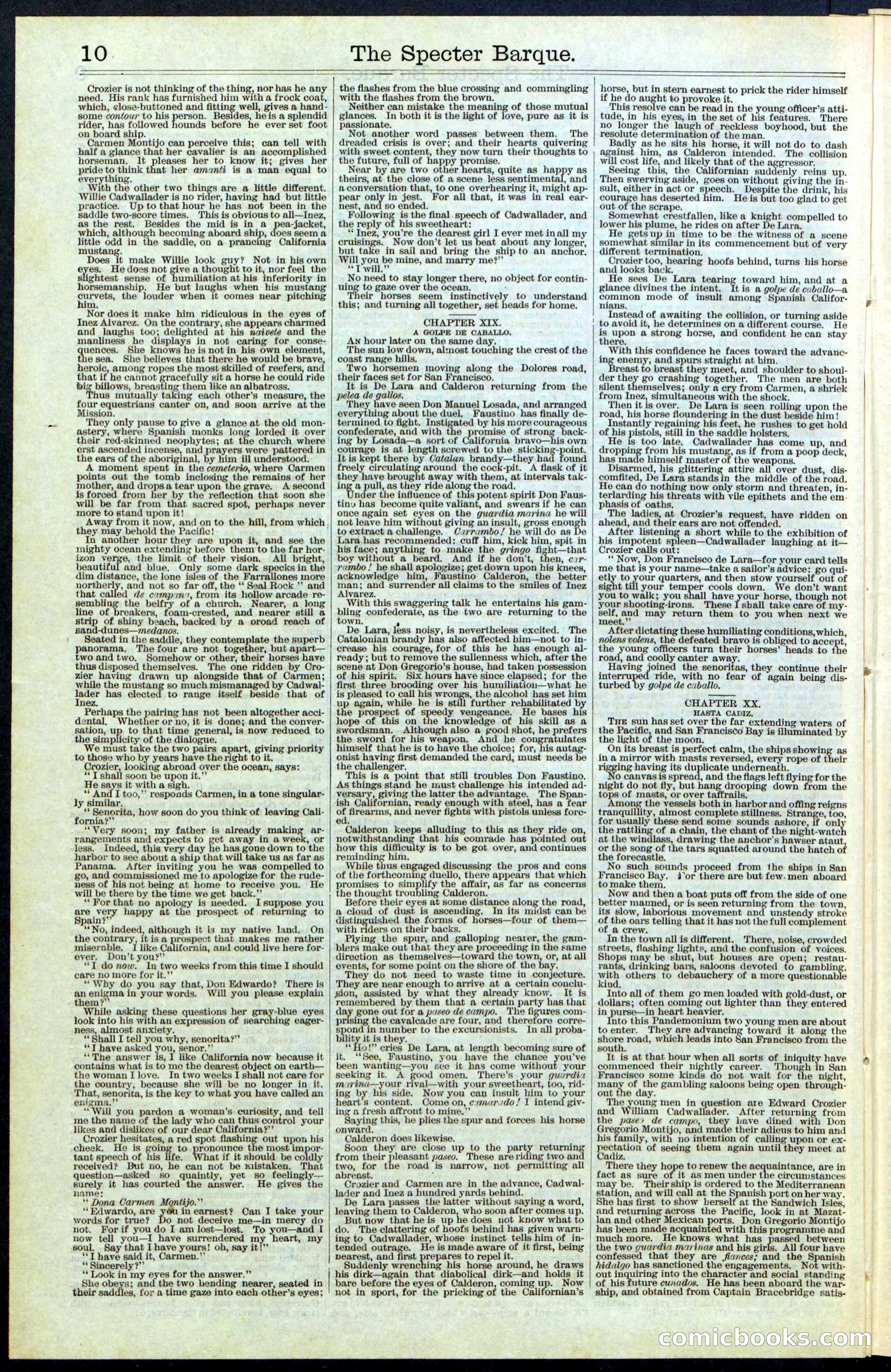
A restored page from Pulp Fiction, 1879. Page through the whole issue in the reader above.
📄 Transcribed text from this page (OCR, searchable)
Machine-transcribed from the original scan — historical spelling and the odd misread are preserved.
10. oe a Crozier is not thinking of the thing, nor has he an need. His rank has furnished him with a frock coat, which, elose-buttoned and fitting well, gives a hand- some contour to his person. Besides, heis a splendid rider, has followed hounds before he ever set foot on board ship. Carmen Montijo can perceive this; can tell with half a glance that her cavalier is an accomplished horseman. It pleases her to know it; gives her pride to think that her amanti is a man equal to everything. With the other two things are a little different. Willie Cadwallader is no rider, having had but little practice. Upto that hour he has not been in the saddle two-score times. This is obvious to all—Inez, as the rest. Besides the mid is in a -jacket, which, although becoming aboard ship, does seem a little Pn in the saddle, on a prancing California mus 4 Does it make Willie look guy? Not in his own pa He does not give a thought to it, nor feel the slightest sense of humiliation at his inferiority in horsemanship. He but laughs when his mustang curvets, the louder when it comes near pitching m. Nor does it make him ridiculous in the eyes of Inez Alvarez. On the contrary, she appears charmed and laughs too; delighted at his naivele and the manliness he displays in not caring for conse- uences. She knows he is notin his own element, the sea. She believes that there he would be brave, heroic, among ropes the most skilled of reefers, and that if he cannot gracefully sit a horse he could ride big billows, breasting them like an albatross. Thus mutually taking each other’s measure, the four equestrians canter on, and soon arrive at the Mission. They only pause to give a glance at the old mon- astery, where Spanish monks long lorded it over their red-skinned neophytes; at the church where erst ascended incense, and prayers were pattered in the ears of the aboriginal, by him ill understood. A moment spent in the cemeterio, where Carmen points out the tomb inclosing the remains of her mother, and dropsa tear upon the grave, A second is forced from her by the reflection that soon she will be far from that sacred spot, perhaps never more to stand upon it! Away from it now, and on to the hill, from which. they may behold the Pacific! In another hour they are upon it, and see the mighty ocean extending before them to the far hor- izon verge, the limit of their vision, All bright, beautiful and blue. Only some dark specks in the dim distance, the lone isles of the Farrallones more northerly, and not so far off, the *‘ Seal Rock *’ and that called de campin’, from its hollow arcade re- sembli the belfry of a church. Nearer, a long line of breakers, foam-crested, and nearer still a strip of shiny beach, backed by a oroad of sand-dunes—medanos. Seated in the saddle, they Comenaniate the superb orama., The four are not together, but apart— wo and two. Somehow or other, their horses have thus disposed themselves. The one ridden by Cro- zier having drawn up alongside that of Carmen; while the ypirere, so much mismanaged by Cadwal- lader has elected to range itself beside that of ez. Perhaps the pairing has not been altogether acci- dental, Whether or no, it is done; and the conver- sation, UP to that time general, is now reduced to Wen te eoiheino sete rt, giving priorit e must take the two a , giving priority to those who by years have the ight to it. Crozier, looking abroad over the ocean, says: **T shall soon be upon it.”’ He says it with a sigh. - I too,”’ responds Carmen, in a tone singular- y similar. A sf : Cae how soon do you think of leaving Cali- orn ” ‘Very soon; my father is already making ar- rangements and expects to get away in a week, or less. Indeed, this very day he has gone down to the harbor to see about a ship that will take us as far as Panama. After inviting you he was compelled to go, and commissioned me to apologize for the rude- ness of his not b at home to receive you. He will be there by the time we get back.” ‘For that no apology is needed. I suppose you are Pa happy at the prospect of returning to pa b “No, indeed, although it is my native land, On the contrary, it is a prospect that makes me rather miserable, ‘I like C ornia, and could live here for- ever, Don’t you?” I do now. In two weeks from this time I should care no more for it.” “Why do you say that, Don Edwardo? There is an enigma in your words. Will you please explain them?” While asking these questions her gray-blue eyes look into his with an expression of searching eager- ness, almost anxiety. “Shall I tell you why, senorita?” “T have asked you, senor.”’ “The answer 1s, I like California now because it contains what is to me the dearest object on earth— the woman I love. In two weeks I shall not care for the country, because she will be no longer in it. That, senorita, is the key to what you have called an enigma,”’ “Will you pardon a woman's curiosity, and tell me the name of the lady who can thus control your likes and dislikes of our dear California?"’ Crozier hesitates, a red spot eset, out upon his cheek. He is Sa a one the most impor- tant speech of e. What if it should be coldly received? But no, he can not be mistaken. That question—asked so quaintly, yet so qn TA surely it has courted the answer. He gives the name: ** Dona Carmen Montijo.” *Edwardo, are M in earnest? Can I take your words for true? Do not deceive me—in mercy do not. Forif you do I am lost—lost. To you—and I now tell you—I have surrendered ws heart, my soul. Say that I have yours! ob, say it!” **T have said it, Carmen.”’ “* Sincerely ?”’ ‘* Look in my eyes for the answer.” She obersi and the two bending nearer, seated in eir saddles, for a time gaze into each other’s eyes; | | ee LE ae j NS the flashes from the blue crossing and commingling | with the flashes from the brown, Neither can mistake the meaning of those mutual glances. In both it is the light of love, pure as it is passionate. Not another word passes between them. The dreaded crisis is over; and their hearts quivering with sweet content, they now tarn their thoughts to the future, full of happy promise. Near by are two other hearts, quite as happy as theirs, at the close of a scene less sentimental, and a conversation that, to one overhearing it, might ap- pear only in jest. For all that, it was in real ear- nest, and so ended. Following is the final. speech of Cadwallader, and the reply of his sweetheart: “Inez, you're the dearest girl I ever met in all my cruisings. Now don’t let us beat about any longer, but take in sail and bring the shipto an anchor Will you be mine, and marry me?”’ *T will.” No need to stay longer there, no object for contin- uing to gaze over the ocean. Their horses seem instinctively to understand this; and turning all together, set heads for home. CHAPTER XIX. A GOLPE DE CABALLO. An hour later on the same day. The sun low down, almost touching the crest of the coast range hills. Two horsemen moving along the Dolores road, their faces set for San Francisco. It is De Lara and Calderon returning from the pelea de gallos, They have seen Don Manuel Losada, and arranged everything about the duel, Faustino has finally de- termined to fight. Instigated by his more courageous confederate, and with the promise of strong back- ing by Losada—a sort of California bravo—his own courage is at length screwed to the picing pole. It is kept there by Catalan brandy—they h ound freely circulating around the cock-pit. A flask of it they have brought away with them, at intervals tak- ing @ pul as they ride along the road. nder the influence of this potent spirit Don Faus- tinv has become quite valiant, and swears if he can once again set eyes on the guardia marina he will not leave him without giving an insult, gross enough to extract a challenge. Currumbo/ he will do as De Lara has recommended: cuff him, kick him, spit in his face; anything to make the gringo fight—that boy without a beard. And if he don’t, then, cv7r- rambo ! he shall apologize; get down upon his knees, acknowledge him, Faustino Calderon, the better a and surrender all claims to the smiles of Inez varez. With this swaggering talk he entertains his gam- ping confederate, as the two are returning to the wn. i De Lara, less noisy, is nevertheless excited. The Catalonian brandy has also affected him—not to in- crease his courage, for of this he has enough al- ready ; but to remove the sullenness which, after the scene at Don Gregorio’s house, had taken possession of his spirit. Six hours have since elapsed; for the first three brooding over his humiliatiou—what he is pleased to call his wrongs, the alcohol has set him up again, while he is 1 further rehabilitated by the prospect of s y vengeance. He bases his hope of this on the knowledge of his skill as a swordsman. Although also a good shot, he prefers the sword for his weapon. And he congratulates himself that he is to have the choice; for, antag- onist having first demanded the card, must needs be the challenger. This is a point that still troubles Don Faustino. As things stand he must challenge his intended ad- versary, giving the latter the advantage. The Span- ish Californian, ready enough with steel, has a fear be firearms, and never fights with pistols unless fore- Calderon keeps alluding to this as they ride on notwithstanding that his comrade has pointed ou how this difficulty is to be got over, and continues reminding him. While thus engaged discussing the pros and cons of the forthcoming duello, there appears that which promises to vee rs the affair, as far as concerns the thought troubling Calderon. Before their eyes at some distance along the road, a cloud of dust is ascending. In its midst can be distinguished the forms of horses—four of them— ee I noe on their veateell af ing the spur, an oping nearer, the gam- biere sale out that they are proceeding in the same direction as themselves—toward the town, or, at all events, for some point on the shore of the ba They do not need to waste time in conjecture. They are near enough to arrive at a certain conclu- sion, assisted by what they already know. remembered by them that a certain party has that day gone out for a paseo de campo. The fi Ss com- tm the cavalcade are four, and therefore corre- In all proba- spond in number to the excursionists. bility it is they. Hot” eries De Lara, at length becoming sure of it. ‘*See, Faustino, you have the chance you've been wanting—you sce it has come without your seeking it. A good omen, There’s your quurdia mirina—your rival—with your sweetheart, too, rid- ing by his side. Now you can insult him to your heart's content. Come on, evmarsdo/ I intend giv- ing a fresh affront to mine.” aying this, he plies the spur and forces his horse onward. Calderon does likewise. y Soon they are close up to the gad returnin from their poneen paseo. These areriding two an two, for t abreast. Crozier and Carmen are in the advance, Cadwal- lader and Inez a hundred yards behind. De Lara passes the latter without saying a word, leaving them to Calderon, who soon after comes up. But now that he is up he does not know what to do. The clattering of hoofs behind has given warn- ing to Cadwallader, whose instinct tells him of in- tended outrage. He is made aware of it first, being nearest, and first prepare to repel it. Suddenly wrenching his horse around, he draws his dirk—again that diabolical dirk—and holds it bare before the eyes of Calderon, coming Pra Now not in sport, for the pricking of the Californian’s It is | \ j | | e road is narrow, not permitting all | There they hepe to renew : fact as sure of it as men | | horse, but in stern earnest to prick the rider himself if he do aught to provoke it. This resolve can be read in the young officer's atti- tude, in his eyes,in the set of his features. There no longer the laugh of reckless boyhood, but the resolute determination of the man. Badly as he sits his horse, it will not do to dash against him, as Calderon intended. The collision will cost life, and likely that of the aggressor. Seeing this, the Californian suddenly reins up. Then swerving aside, goes on without giving the in- sult, either in act or speech. Despite the drink, his courage has deserted him. He is but too glad to get out of the scrape. . Somewhat crestfallen, like a knight compelled to lower his plume, he rides on after De Lara. He getsup in time to be the witness of a scene somewhat similar in its commencement but of very different termination. Crozier too, hearing hoofs behind, turns his horse and looks back. He sees De Lara tearing toward him, and at a glance divines the intent, Tt is a golpe de caballo—a nici mode of insult among Spanish Califor- nians. Instead of awaiting the collision, or turning aside to avoid it, he determines on a different course. He 7 upon a strong horse, and confident he can stay ere, With this confidence he faces toward the advanc- ing enemy, and spurs straight at him. reast to breast they meet, and shoulder to shoul- der Sed go crashing together. The men are both silent t emselves; only a ery from Carmen, a shriek rom Inez, simultaneous with the shock. Then it is over. De Lara is seen rolling upon the road, his horse floundering in the dust beside him! Instantly regaining his feet, he rushes to get hold of his pimols, still in the saddle holsters. He is too late. Cadwallader has come up, and dropping from his mustang, as if from a poop deck, has made himself master of the weapons. Disarmed, his glittering attire all over dust, dis- comfited, De Lara standsin the middle of the road. He can do nothing now only storm and threaten, in- terlarding his threats with vile epithets and the em phasis of oaths, The ladies, at Crozier’s request, have ridden on ahead, and their ears are not offended. After listening a short while to the exhibition of his impotent spleen—Cadwallader laughing at it— Crozier calls out: ** Now, Don Francisco de Lara—for your card tells me that is your name—take a sailor's advice: go qui- etly to your quarters, and then stow yourself out of sight till your temper cools down. We don’t want you to walk; you shall have your horse, though not your shooting-irons. These I shall take care of my- self, sae may return them to you when next we mee After dictating these humiliating conditions, which, nolens volens, the defeated bravo is obliged to accept, the young officers turn their horses’ heads to the road, and coolly canter away. Having joined the senoritas, they continue their interru ride, with no fear of again being dis- turbed by golpe de caballo. CHAPTER XX. HASTA CADIZ. Tue sun has set over the far extending waters of the Pacific, and San Francisco Bay is illuminated by the light of the moon. On its breast is perfect calm, the ships showing as in a mirror with masts reversed, every rope of their rigging having its duplicate underneath. 0 canvas is spread, and the flags left flying for the night do not fly, but hang drooping down from the tops of masts, or over taffrails. Among the vessels both in harbor and offing reigns tranquillity, almost complete stillness. Strange, too, for usually these send some sounds ashore, if only the Sane of a chain, the chant of the night-wate at the windlass, drawing the anchor's hawser ataut or the song of the tars squatted around the hatch of the forecastle. No such sounds proceed from the ships in San Francisco Bay. Jor there are but few.men aboard to make them. Now and then a boat puts off from the side of one better manned, or is seen returning from the town, its slow, laborious movement and unsteady stroke of the oars telling that it has not the full complement of a crew. In the town all is different. There, noise, crowded streets, flashing lights, and the confusion of voices. Shops may be shut, but houses are open; restau- rants, drinking bars, saloons devoted to gambling, with others to debauchery of a more questionable od, Into all of them go men loaded with gold-dust, or dollars; often coming out lighter than they entered in purse—in heart heavier, nto this Pandemonium two young men are about toenter. They are advancing toward it along the meet road, which leads into San Francisco from the south. It is at that hour when all sorts of iniquity have commenced their nightly career. Though in San Francisco some kinds do not wait for the night, many of the gambling saloons being open through- out the day. The young men in question are Edward Crozier and William Cadwallader. After returning from the pase» de campo, they have dined with Don tg Cie Montijo, and made their adieus to him and his family, with no intention of calling upon or ex- een of seeing them again until they meet at a 9 the a pyrene. are in under the circumstances may be. Theirship is ordered to the Mediterranean | | confessed that they are jfiances; and the § station, and will call at the Spanish port on her way. She has first to show herself at the Sandwich Isles, and returning across the Pacific, look in at Mazat- lan and other Mexican ports. Don Gregorio Montijo has been made acquainted with this programme and much more. He knows what has passed between the two guardia marinas and his girls. All four have ish hidalgo has sanctioned the engagements. Not with- out inquiring into the character and social standing of his future cunados. He has been aboard the war- ship, and obtained from Captain Bracebridge satis- --— NIGDOOKS.GO (e(e) (€