
Pulp Fiction, 1879 · page 7 of 40
Beadle's New York Dime Library, No. 66 — page 7: what you’re looking at
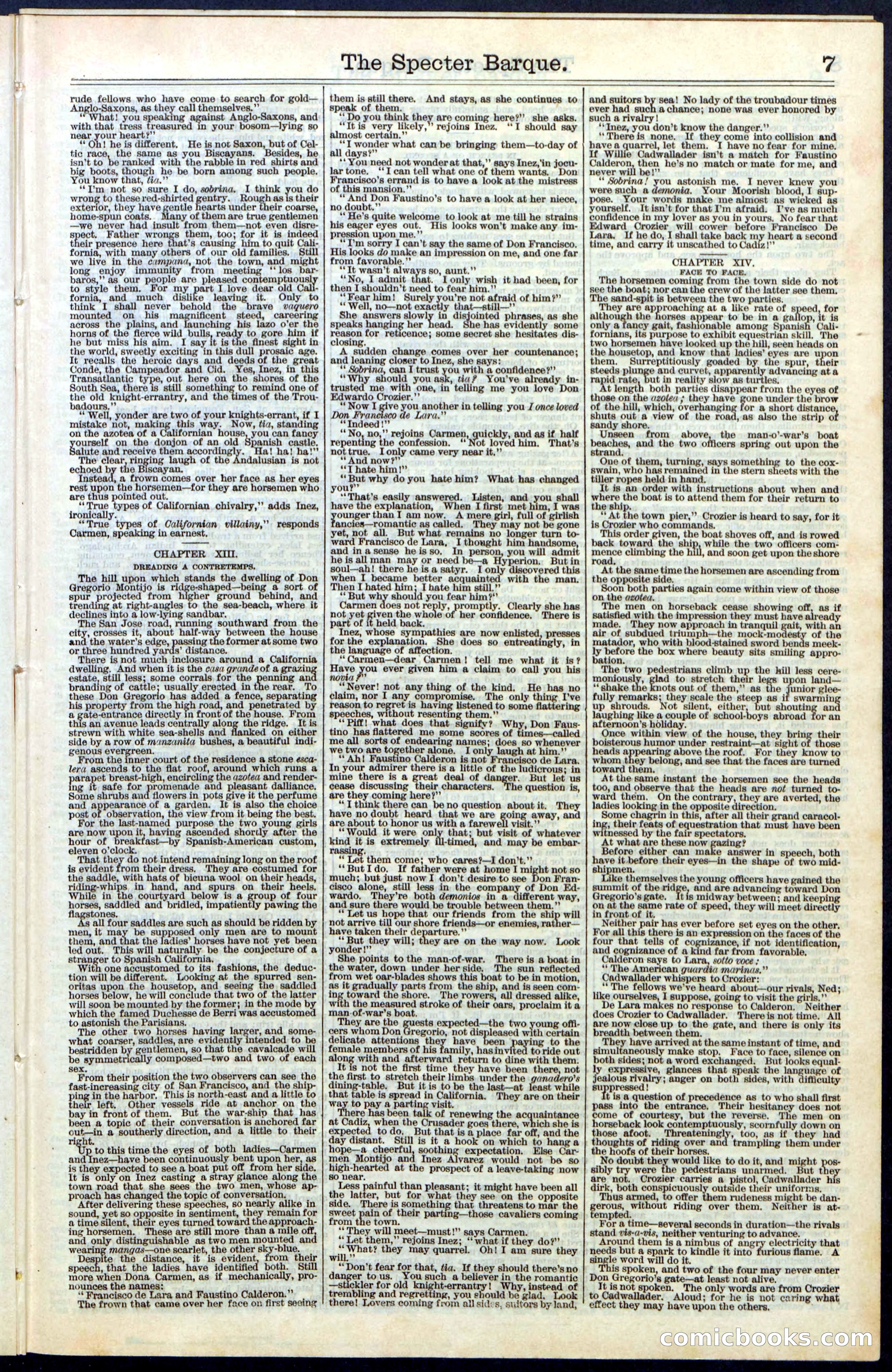
A restored page from Pulp Fiction, 1879. Page through the whole issue in the reader above.
📄 Transcribed text from this page (OCR, searchable)
Machine-transcribed from the original scan — historical spelling and the odd misread are preserved.
SS a SSS SPS SSS SS SSS SS ss sss seer iF —_ rude fellows who have come to search for gold— Anglo-Saxons, as they call themselves.”’ What! you epee inst Anglo-Saxons, and with that tress treasured in your bosom—lying so near your heart?”’ “Oh! he is different, He is not Saxon, but of Cel- tic race, the same as you Biscayans. Besides, he isn't to ranked with the rabble in red shirts and big boots, though he be born among such people. You know that, tia.” : ‘I’m not so sure I do, sobrina, I think you do wrong to these red-shirted gentry. Rough as is their exterior, they have gentle hearts under their coarse, home-spun coats. ny of them are true gentlemen —we never had insult from them—not even disre- spect. Father ping a them, too; for it is indeed their presence here t’s causing him to quit Cali- fornia, with many others of our old families. Still we live in the campanda, not the town, and might long enjoy immunity from meeting ‘los bar- baros,’’ as our people are pleased contemptuou to style them. For my part I love dear old Cali- fornia, and much dislike leaving it. Only to think I shall never behold the brave vaquero mounted on his magnificent steed, careering across the plains, and launching his lazo o'er the horns of the flerce wild bulls ready. to gore him if he but miss his aim. I say It is the finest sight in the world, sweetly exciting in this dull prosaic age. It recalls the heroic days and deeds of the great Conde, the Campeador and Cid. Yes, Inez, in this Transatlantic ty Des out here on the shores of the South Sea, there is still something to remind one of the old knight-errantry, and the es of the Trou- badours,”’ “Well, yonder are two of your knights-errant, if I mistake not, rryg, this way. Now, tia, standing on the azotea of a Californian house, you can fancy ourself on the donjon of an old Spanish castle. Salute and receive them accordingly. a! ha! ha!” The clear, ringing laugh of the Andalusian is not echoed by the Biscayan. Tnetead. a frown comes over her face as her eyes rest upon the horsemen—for they are horsemen who are thus pointed out. met types of Californian chivalry,’ adds Inez, cally. “True types of Californian villainy,” responds Carmen, speaking in earnest, CHAPTER XIIl. DREADING A CONTRETEMPS, The hill upon which stands the dwelling of Don Gregorio Montijo is ridge-shaped—being a sort of spur projected from higher ground behind, and trending at right-angles to the sea-beach, where it declines into a low-lying sandbar. The San Jose road, running southward from the city, crosses it, about half-way between the house and the water's edge, ng former at some two or three hundred yards’ distance. There is not much inclosure around a California dwelling. And when it is the casa grande of a grazi estate, still less; some corrals for the penning an branding of cattle; usually erected in the rear. To these Don Gregorio has added a fence, separa his property from the high road, and penetrated by a gate-entrance directly in front of the house. From this an avenue leads centrally along the ridge. It is strewn with white sea-shells and flanked on either side by a row of manzanita bushes, a beautiful indi- enous evergreen. 3 From the inner court of the residence a stone esca- lera ascends to the flat roof, around which runs a arapet breast-high, encircling the azofea and render- ng it safe for promenade and pleasant dalliance. Some shrubs and flowers in pots give it the perfume and appearance of a garden. It is also the choice post oF observation, the view from it being the best. For the last-named purpose the two young girls are now upon it, having ascended shortly after the hour of reakfast—by Spanish-American custom, eleven o'clock. That they do not intend remaining long on the roof is evident from their dress. They are costumed for the saddle, with hats of bicuna wool on their heads, a lie a in hand, and spurs on their heels, While in the courtyard below is a group of four Pap saddled and bridled, impatiently pawing the tones. a four more eee fe should be ziaden by men, it ma, su only men are moun them, and that the ladies’ horses have not yet been led out. pn will aise. be the conjecture of a stranger panish California. With one accustomed to its fashions, the deduc- tion will be different. Looking at the spurred sen- oritas upon the housetop, and seeing the. saddled horses below, he will conclude that two of the latter will soon be mounted by the former; in the mode by which the famed Duchesse de Berri was accustomed to astonish the Parisians. The other two horses having larger, and some- what coarser, saddles, are evidently intended to be bestridden by gentlemen, so that the cavalcade will be symmetrically composed—two and two of each ar their position the two observers can see the rom their tiadsimamengion | city of San Francisco, and the shi in the harbor, This is north-east and a little Eat left. Other vessels ride at anchor on the bay in front of them. But the war-ship that has been a topic of their conversation is anchored far out—in a southerly direction, and a little to their ht. to this time the eyes of both ladies—Carmen and Inez—have been continuously bent upon her, as is they expected to see a boat put off from her side, It is only on Inez casting a stray glance along the town road that she sees the two men, whose ap- proach has changed the topic of conversation, After delivering these speeches, so nearly alike in sound, yet so opposite in sentiment, ey remain for a time silent, their eyes turned toward the approach- ing horsemen. These are still more than a mile off and 0 ble as two men mounted an wearing mangas—one scarlet, the other sky-blue. D ite the distance, it is evident m their speech, that the ladies have identified both. Still more sey Dona Carmen, as if mechani » pro- nounces the names: ‘Francisco de Lara and Faustino Calderon.” The frown that came over her face on first secing The Specter Barque. them is still there. And stays, as she continues to speak of them. ‘**Do you think they are coming here?’’ she asks. “Itis very likely,” rejoins Inez. “I should say almost certain.” “I wonder what can be bringing them—to-day of all days?” ** You need not wonder at that,’ says Inez,'in jocu- lartone. ‘‘I can tell what one of them wants. Don Francisco's errand is to have a look at the mistress of this mansion.”’ ** And Don Faustino’s to have a look at her niece, no doubt.”’ ‘* He’s quite welcome to look at me till he strains his eager eyes out. His looks won't make any im- ression upon me.”’ “I’m sorry I can’t say the same of Don Francisco. His looks do make an impression on me, and one far from favorable.” ‘**Tt wasn’t always so, aunt." “No, I admit that. Lonly wish it had been, for then I shouldn’t need to fear him.” “Fear him! Surely you’re not afraid of him?” ** Well, no—not exactly that—still—”’ She answers slowly in disjointed phrases, as she speaks Panne her head. She has evidently some Arete for reticence; some secret she hesitates dis- closing. A sudden change comes over her countenance; and leaning closer to Inez, she says: ** Sobrina, can I trust you with a confidence?” “Why should you , a? You've already in- trusted me with one, in telling me you love Don he Late soa ther in telling you J once loved “Now ve you another in you J once love Don ‘eee de Lara.” “Indeed !”’ “No, no,” rejoins Carmen, quickly, and as if half repenting the confession. “Not loved him. That’s nottrue. LIonly came very near it,” **And now?” “c I him ”» oe why do you hate him? What has changed you ” ‘That's easily answered. Listen, and you shall have the explanation, When I first met him, I was “gg than I am now. A mere girl, full of girlish ancies—romantic as called. They may not be gone yet, not all. But what remains no longer turn to- ward Francisco de Lara, I thought him handsome and in asense heisso, In person, you will admit he is allman may or need be—a Hyperion, But in soul—ah! there he is a satyr. I only discovered this when I became better acquain with the man. Then I hated him; I hate him still.” “But why should you fear him?" Carmen does not end ae: Clearly she has not yet given the whole of her confidence. There is par of pele pesca tte 3 nez, whose sym es are now enlisted, presses for the explanation. She does so entreatingly, in the language of affection. “Carmen—dear Carmen! tell me what it is? Have P ever given him a claim to call you his “Never! not any thing of the kind. He has no claim, nor I any compromise. The only I've renee ro Negra as having listened to some fla speeches, out resenting them." ‘* Pifft! what does that signifv? Why, Don Faus- tino has flattered me some scores of Tesenséalied me all sorts of endearing names; does so whenever we two are tone er alone. I only laugh at him.” “Ah! Fa o » Calderon is not Francisco de Lara. In your admirer there is a little of the ludicrous; in mine there is a — deal of r. But let us cease discussing their characters. e question is, are they coming here?”’ ““I think there can_ be no question about it. They have no doubt heard that we are going away, and are about to honor us with a farew t.”* *“Would it were only that; but visit of whatever kind it is extremely ill-timed, and may be embar- ** Let them come; who cares?—I don’t.” ‘*ButIdo. If father were at home I — not so much; but just now I don’t desire to see Don Fran- cisco alone, still less in the rte ype. 2 Don Ed- wardo. They’re both demonios in a erent way, and sure there would be trouble between them.” ** Let us hope that our friends from the ship will not arrive till our shore friends—or enemies, rather— have taken their de ure.”’ Be pod they will; they are on the way now. Look yonder!” She points to the man-of-war. There is a boat in the water, down under her side, The sun reflected from wet oar-blades shows this boat to be in motion, as it gradually parts from the ship, and is seen com- ing toward the shore. The rowers, all dressed alike, the measured stroke of their oars, proclaim it a mane rel © boat. * bed. ti ”% ey are the guests expected—the two yo offi- cers whom Don Gregorio, not displeased withiceraain delicate attentions they have n to the female members of his family, hasin to ride out oong wae and afterward return to dine with them. It is not the first time they have been there, not the first to stretch their limbs under the ganadero’s gang cables But it is to be the last—at least while that table is spread in California. They are on their vere pay a only yee ere has been of renewing the uaintance at Cadiz, when the Crusader goes there, which she is expected todo, But that is a place far off, and the day distant. Still is it a hook on which to hang a hope—a cheerful, soothing expectation. Else Car- men Montijo and Inez varez would not be so high-hearted at the prospect of a leave-taking now so near. Less painful than pleasant; it might have been all the latter, but for what they see on the opposite side. There is something that threatens to mar the sweet of their g—those cavaliers coming from the town. ‘* They will meet—must!" says Carmen ‘Let them,”’ rejoins Inez; “ what if they do?” “What? they may quarrel. Oh! I am sure they “Don’t fear for that, tia. If they should there’s no Ganges tous. Yousuch a believer in the romantic —stickler for old re renay | Why, instead of trembling and regretting, you should be glad. Look there! Lovers coming from all sides, suitors by Jand, @ and suitors ms sea! No lady of the troubadour times ever had such achance; none was ever honored by such a rivalry! ** Inez, you don’t know the danger.” “There is none. If they come into collision and have a quarrel, let them. I have no fear for mine. If Willie Cadwallader isn’t a match for Faustino Calderon, then he’s no match or mate for me, and never will be!” ‘“ Sobrina! you astonish me. I never knew you were such a demonia. Your Moorish blood, I sup- pose. Your words make me almost as wicked as yourself. Itisn’t for that I’m afraid. I’ve as much confidence in my lover as you in yours, No fear that Edward Orozier will cower before Francisco De Lara, If he do, I shall take back my heart a second time, and carry it unscathed to Cadiz!" CHAPTER XIV. FACE TO FACE. The horsemen coming from the town side do not see the boat; nor can the crew of the latter see them, The sand-spit is between the two parties. They are approaching at a like rate of speed, for although the horses erates to be in a gallo , it is only a fancy gait, fashionable among Spanish Cali- fornians, its purpose to exhibit equestrian skill. The two horsemen have looked up the hill, seen heads on the housetop, and know that ladies’ eyes are go them. Surreptitiously goaded by the spur, their steeds plu and curvet, apparently advancing ata rapid rate, but in reality slow as turtles. t length both parties disappear from the eyes of those on the azolea ; they have gone under the brow of the hill, which, overhangin shuts out a view of the , 48 also the strip o sandy shore. Unseen from above, the man-o’-war’s boat peaches and the two officers spring out upon the stran One of them, turning, says something to the cox- swain, who has remained in the stern sheets with the tiller ropes held in hand, It is an order with instructions about when and where the boat is to attend them for their return to the ey *‘ At the town pier,’’ Crozier is heard to say, for it is Crozier who commands. This order given, the boat shoves off, and is rowed back toward the ship, while the two officers com- — climbing the , and soon get upon the shore or a short distance At the same time the horsemen are ascending from the opposite side. Soon both parties again come within view of those on the aeotea. The men on horseback cease showing off, as if satisfied with the impression they must have already made, They now approach in tranquil gait, with an air of subdued triumph—the mock-modesty of the matador, who with blood-stained sword bends meek- pe a the box where beauty sits smiling appro- on, The two pedestrians climb up the hill less cere- moniously, giad to stretch the one upon land— “shake the knots out of them,’’ as the Junior glee- fully remarks; they scale the sop as if swarmin up shrouds. Not silent, either, but shou an laughing like a couple of school-boys abroad for an afternoon's holiday. Once within view of the house, they b their boisterous humor under restraint—at sight of those heads pe mare above the roof. For they know to whom they belong, and see that the faces are turned toward them, At the same instant the horsemen see the heads too, and observe that the heads are not turned to- ward them. On the contrary, they are averted, the ladies looking in the opposite direction. Some c in this, after all their grand caracol- ing; thelr feats of equestration that must have been essed by the fair spectators, At what are these now ng? Before either can m answer in speech, both pare it before their eyes—in the shape of two mid- men, Like themselves the young officers have gained the summit of the mtge and are advancing toward Don Gregorio's gate. It is midway between; and keeping at the same rate of speed, they will meet directly on in front of it, Neither has ever before set eyes on the other, For all there is an expression on the faces of the four that tells of co ce, if not identification, and cognizance of a kind far from favorable, Calderon says to solto voce ; “The American guardia marinas.” Cadwallader whispers to Crozier: ‘The fellows we've heard about—our rivals, Ned; like ourselves, I suppose, going to visit the girls,” De Lara makes no response to Calderon, Neither does Crozier to Cadwallader. Thereis not time. All are now close up to the gate, and there is only its breadth between them. They have arrived at the same instant of time, and simultaneously make stop. Face to face, silence on both sides; not a word exchanged. But looks equal- ly expressive, glances that speak the janguage of castoue sty Aany ; anger on both sides, with difficulty supp tt is a question of precedence as to who shall first pass into the entrance, Their hesitancy does not come of , but the reverse. The men on horseback look contemptuously, scornfully down on op Paice a Threateningly, too, as cy = _— ain over and trampling them under the hoofs of their horses. No doubt peg eet like to do it, and might sibly try were the pedestrians unarmed. jigs 9 are not. Crozier carries a pistol, Cadwallader dirk, both conspicuously outside their uniforms. Thus armed, to offer them rudeness might be dan- Sear oA without riding over them. Neither is at- mp For a time—several seconds in duration—the rivals stand vis-a-vis, neither venturing to advance. Around them is a nimbus of re th ae? that needs but a spark to kindle it into ous flame. A le word will do it. spoken, and two of the four may never enter Don Gregorio’s gate—at least not alive. It is not spoken. The only words are from Crozier to Cadwallader. Aloud; for he is not caring what effect they may have upon the others, EGomicboo <S (Efe)