
Pulp Fiction, 1879 · page 6 of 40
Beadle's New York Dime Library, No. 66 — page 6: what you’re looking at
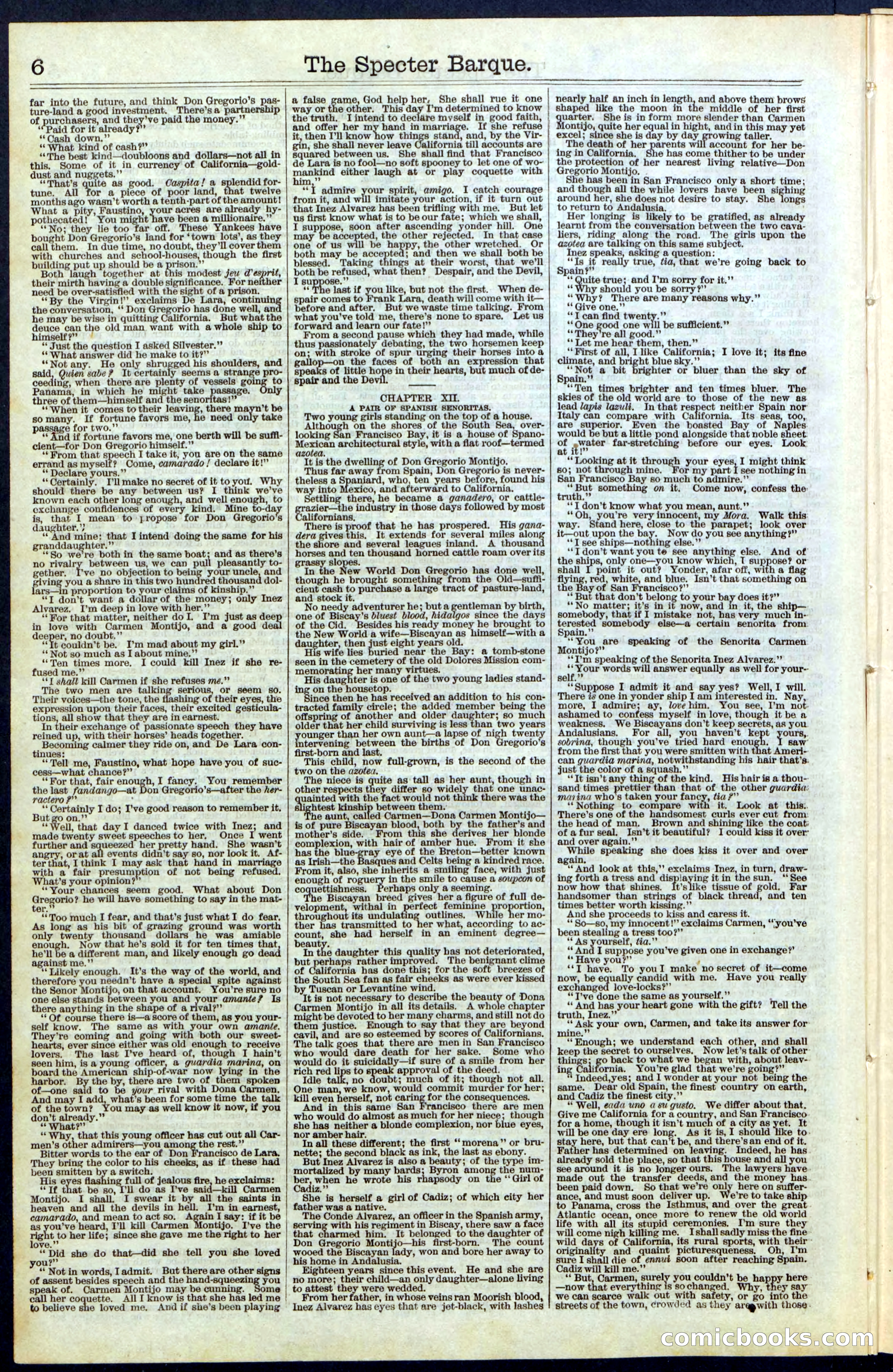
A restored page from Pulp Fiction, 1879. Page through the whole issue in the reader above.
📄 Transcribed text from this page (OCR, searchable)
Machine-transcribed from the original scan — historical spelling and the odd misread are preserved.
he Be 6 far into the future, and think Don Gregorio’s pas- ture-land a good investment. There’sa partn of purchasers, and they’ve paid the money.” ‘Paid for it already?” ‘*Cash down,”’ ‘““What kind of cash?” “The best kind—doubloons and dollars—not all in this. Some of it in currency of California—gold- dust and nuggets.”’ “That’s quite as good. Casptta! a splendid for- tune. All for a piece of poor land, that twelve months ago wasn’t worth a tenth-part of the amount! What a pity, Faustino, he 2 acres are already hy- pothecated! You might have been a millionaire.” ‘‘No; they lie too far off. These Yankees have bought Don Gregorio’s land for ‘town lots’, as they callthem. In due time, no doubt, they'll cover them with churches and school-houses, though the first building put up should be a prison.”’ Both laugh together at this modest jeu @’ t, their mirth having a double significance. For neither need be over-satisfied with the sight of a prison. ‘*By the Virgin!” exclaims De Lara, contin the conversation, ‘* Don Gregorio has done well, an he may be wise in quitting California. But what the deuce can the old man want with a whole ship to Pp * Just the question I asked Silvester.” ‘* What answer did he make to it?” ‘Not any. He only shrugged his shoulders, and said, Quien sabe? It certainly seems a str pro- ceeding, when there are plenty of vessels go to Panama, in which he might take A eens pe nly three of them—himself and the senoritas!” ‘‘When it comes to their leaving, there mayn’t be somany. If fortune favors me, he need only take passage for two.” ‘* And if fortune favors me, one berth will be suffi- cient—for Don Gregorio himself.” ‘*Wrom that speech I take it, you are on the same errand as myself? Come, camarado / declare it!” ** Declare yours.” ‘Certainly. I’llmake no secret of it toyou. Why should there be any between us? I think we’ve known each other long enough, and well ee to exchange confidences of every kind. Mine day is, — I mean to jropose for Don Gregorio’s aughter.’? ‘And mine: that I intend doing the same for his granddaughter.” ‘*So we're both in the same boat; and as there’s no rivalry between us, we can pull pleasantly to- gether. I’ve no objection to being your uncle, and ving you a share in this two hundred thousand dol- rs—in proportion to your claims of kinship.” “T don’t want a dollar of the money; only Inez Alvarez. I’m deep in love with her.” ‘‘For that matter, neither dol. I’m just as dee in love with Carmen Montijo, and a good d deeper, no doubt,”’ “Tt couldn’t be. I’m mad about my girl.” ‘* Not so much as I about mine.” “Ten times more. I could kill Inez if she re- fused me. ‘*T shall kill Carmen if she refuses me.” The two men are talking serious, or seem so. Their voices—the tone, the ng of their eyes, the expression upon their faces, their excited gesticula- tions, all show that they are in earnest. In their exchange of passionate s h they have reined up, with their horses’ heads together. Pc | wrod calmer they ride on, and De Lara con- ues: “Tell me, Faustino, what hope have you of suc- cess—what chance?” “For that, fair ae I fancy. You remember pie eal fandango—at on Gregorio’s—after the her- ractero , B ame are I do; I’ve good reason to remember it, u on.”’ “Well, that day I danced twice with Inez; and made twenty sweet speeches to her, Once I went further and of gperen her pretty hand. She wasn’t angry, or at all events didn’t say so, nor look it. Af- ter that, I think I may ask that hand in marriag th a fair presumption of not being refused. t’s your opinion?” “Your chances seem good. What about Don abe sacs he will have something to say in the mat- r. ‘“‘Too much I fear, and that’s just what I do fear. As long as his bit of grazing ground was worth only twenty thousand dollars he was amiable enough, Now that he’s sold it for ten times that ya Jo a different man, and likely enough go dead aga me.’ ‘Likely enough. It’s the way of the world, and therefore you needn't have a special spite against the Senor Montijo, on that account. You're sure no one else stands between you and ae amante? Is there eny thing in the shape of a rival?”’ ‘*Of course there is—a score of them, as you your- self know. The same as with your own amanie. They’re coming and going with both our sweet- hearts, ever since either was old enough to receive lovers. The last I’ve heard of, though I hain’t seen him, is a young officer, a guardia marina, on board the American ship-of-war now lying in the harbor. By the by, there are two of them spoken of—one said to be your rival with Dona Carmen, And may I add, what's been for some time the talk of the town? You may as well know it now, if you don't es ** What?’ “Why, that this young officer has cut out all Car- men’s other admirers—you among the rest.” Bitter words to the ear of Don cisco de Lara. They bring the color to his cheeks, as if these had been smitten by a switch. His e da oatcto full of jealous fire, he exclaims: “rm t be so, [ll do as I've said—kill Carmen Montijo. I shall, I swear it by all the saints in beaven and all the devils in h I'm in earnest, camarado, and mean to act so. A I say: if it be ah rg i heard, I'll kill Carmen Montijo. I've the rig t to her life; since she gave me the right to her ove - bid she do that—did she tell you she loved ou?” sc: Not in words, Iadmit. But there are other signs of assent besides speech and the hand-sq you speak of. Carmen Montijo may be cunning. me call her coquette. All I know is that she has led me - to believe she loved me. And if she’s been playing God help her, She shall rue it one a false game way or the other. This day I’m determined to know the truth. I intend to declare myself in good faith, | and offer her my hand in yrs If she refuse it, then I'l) know how things stand, and, by the Vir- gin, she shall never leave California till accounts are squared between us. She shall find that Francisco de Lara is no fool—no soft spooney to let one of wo- mankind either laugh at or play coquette with him “T admire from it, and w that Inez Alvarez has been triflin us first know what is to be our fate; which we shall, I obey trp goon after ascending yonder hill. One may pe ae the other rejected. In that case one of us will be happy, the other wretched. Or both may be aeignt ree ; and then we shall both be vene spirit, amigo. I catch courage 1 imitate your action, if it turn out with me. But let blessed. Taking things at their worst, that we'll Ma ie be refused, what then? Despair, and the Devil, su e.”” ‘* The last if you like, but not the first. When de- spair comes to nk Lara, death will come with it— before and after. But we waste time talking. From what you've told me, there’s none tospare, Let us forward and learn our fate!” From a second pause which they had made, while thus passionately debating, the two horsemen keep on; with stroke of spur urging their horses into a gallo n the faces of both an expression that Speaks of little hope in their hearts, but much of de- spair and the De p aL CHAPTER XII. A PAIR OF SPANISH SENORITAS. Two young girls standing on the top of a house. meee on the shores of the South Sea, over- looking San Francisco Bay, it is a house of Spano- ated architectural style, with a flat roof—termed azoted. It is the dwelling of Don Gregorio Montijo. Thus far away from Spain, Don Gregorio is never- theless a Spaniard, who, ten years before, found his way into Mexico, and afterward to California. ttling there, he became a ganadero, or cattle- azier—the industry in those days followed by most alifornians, There is proof that he has prospered. His gana- dera gives this. It extends for several miles eid | the shore and several leagues inland. A thousan horses and ten thousand horned cattle roam over its gr: slopes. ithe New World Don Gregorio has done well, though he brought something from the Old—suffi- ei cash = purchase a large tract of pasture-land, an ‘ No needy adventurer he; but a gentleman by birth, one of Biscay’s dluest blood, hidalgos since the days of the Cid. Besides his ready money he brought to the New World a wife—Biscayan as himself—with a daughter, then just eight years old. wife lies buried near the Bay: a tomb-stone seen in the cemetery of the old Dolores Mission com- memorating her many virtues. His daughter is one of the two young ladies stand- ing on the housetop. ince then he has received an addition to his con- tracted family circle; the added member being the offsp of another and older daughter; so much older that her child surviving is less than two years ounger than her own aunt—a lapse of nigh twenty tervening between the births of Don Gregorio's first-born and last. This child, now full-grown, is the second of the two on the azolea, The niece is —— as tall as her aunt, though in other respects they differ so widely that one unac- uainted with the fact would not there was the slightest kinship between them. e aun ed Carmen—Dona Carmen Montijo— is of pure yan blood, both by the father’s and mother’s side. From this she derives her blonde From it she Sey gc with hair of amber hue. has the blue-gray eye of the Breton—better known as Irish—the ues and Celts being a kindred race. From it, also, she inherits a smiling face, with just enough of ey in the smile to cause a soupcon of coquettishness. Perhaps only a seeming. e Biscayan breed gives her a figure of full de- cninine velopment, withal in perfect fe ae pega throughout its undula eo outlines. While her mo- ther transmitted to her what, according to ac- cous she had herself in an eminent degree— auty. In the daughter this quality has not deteriorated, but perhaps rather improved. The benignant clime of ornia has done this; for the soft breezes of the South Sea fan as fair cheeks as were ever kissed by Tuscan or Levantine wind. It is not necessary to describe the beauty of Dona Carmen Montijo in all its details. A whole chapter might be devoted to her many charms, and still not do them justice. Enough to say that they are beyond cavil, and are so esteemed by scores of Californians. The talk goes that there are men in San Francisco Who would dare death for her sake. Some who would do it suicidatly—if sure of a smile from her rich red lips to & approval of the deed. pe no doubt; much of it; though not all. ne we know, would commit murder for her; kill even herself, not ort for the consequences. And in this same San cisco there are men who would do almost as much for her niece; though she has neither a blonde complexion, nor blue eyes, nor amber hair. In all these different; the first ‘‘morena”’ or bru- nette; the second black as ink, the last as ebony. But Inez Alvarez is also a beauty; of the type im- mortalized by many bards; Byron among the num- ai when he wrote his rhapsody on the ‘ Girl of She is herself a girl of Cadiz; of which city her father was a native. The Conde Alvarez, an officer in the army, meter Beer his regiment in Biscay, there saw a face that charmed him. It belonged to the daughter of Don Gregorio Montijo—his born. The count wooed the Biscayan , won and bore her away to his home in Andalusia. Eighteen years since this event. He and she are no more; their child—an only daughter—alone living to attest they were wedded. From her father, in whose veins ran Moorish blood, Inez Alvarez has eyes that are jet-black, with lashes nearly half an inch in length, and above them brows shaped like the moon in the middle of her first uarter. She is in form more slender than Carmen ontijo, quite her equal in hight, and in this may yet excel; since she is day by day growing taller. The death of her parents will account for her be- ing in California. e has come thither to be under the protection of her nearest living relative—Don Gregorio Montijo. She has been in San Francisco only a short time; and though all the while lovers have been sighing around her, she does not desire to stay. She Sones to return to Andalusia. ; Her ae gh is likely to be gratified, as already learnt from the conversation between the two cava- liers, riding along the road. The girls upon the azotea are talking on this same subject. Inez speaks, asking a question: a nee really true, tia, that we’re going back to pain e Ee true; and I’m sorry for it.” ‘Why should you be sorry?”’ “Why? There are many reasons why.” ** Give one.” ““T can find twenty.” **One good one will be sufficient.” “They're all good.” “Ph mel tll Tike ‘Calif wai T ‘First of all, ce ornia; ove it; its fine climate, and bright blue sky.”’ e ei a bit brighter or bluer than the sky of pain, “Ten times brighter and ten times bluer. The skies of the old world are to those of the new as lead lapis lazuli. In that respect neither Spain nor Italy can compare with California. Its seas, too, are superior. Even the boasted Bay of Naples. would be but a little pond alongside that noble sheet: “ Pg far-stretching before our eyes. Look at i “Looking at it through your eyes, I might think 60; not through mine. For my part i see nothing in San Francisco Bay so much to admire.” mh 4 something on it. Come now, confess the ‘*T don’t know what you mean, aunt.” “Oh, you're very innocent, my Mora. Walk this: way. Stand here, close to the parapet; look over it—out upon the — Now do you see anything?” ‘*T see ships—nothing else.” ‘*T don’t want you te see anything else. And of the ships, only one—you know which, T suppose? or shall I point it out? Yonder, afar off, with a flag fiying, red, white, and blue. Isn't that something on the y of San Francisco?”’ ‘**But that don’t pens to your bay does it?” **No matter; it’s in it now, and in it, the ship— somebody, that if I mistake not, has very much in- terested somebody else—a certain senorita from. Spain.” “You are speaking of the Senorita Carmen Montijo?” **I’m speaking of the Senorita Inez Alvarez.” ee words will answer equally as well for your- self.’ eee I admit it and say yes? Well, I will. There is one in yonder ship I am interested in. Nay, more, I admire; ay, lovehim. You see, I’m not. ashamed to confess myself in love, though it be a weakness. We Biscayans don't keep secrets, as you Andalusians. For all, you haven’t kept yours, sobrina, though pain tried hard enough. saw from the first that you were smitten with that Ameri- can guardia marina, notwithstanding his hair that’s. just the color of a squash.”’ “Tt isn’t any thing of the kind. His hair is a thou- sand times prettier than that of the other guardia: marina who's taken your fancy, tia ?” ‘*Nothing to compare with it. Look at this:. There’s one of the handsomest curls ever cut from: the head of man. Brown and shining like the coat: of a fur seal. Isn't it beautiful? I could kiss it over and over again.” While speaking she does kiss it over and over again, “And look at this,’’ exclaims Inez, in turn, draw- ing forth a tress and displaying itin the sun. “See now how that shines. It’slike tissue of gold. Far handsomer than strings of black thread, and ten times better worth kissing.’’ And she proceeds to kiss and caress it. “*So—so, my innocent!’ exclaims Carmen, ““you've been stealing a tress too?” “As ma tia.” “*“AndI co es you've given one in exchange?’ ** Have you?” ; ‘*T have. To youl make no secret of it—come now, be 7 candid with me. Have you really exchanged love-locks?”’ “‘T’ve done the same as yourself.”’ ‘And has your heart gone with the gift? Tell the truth, Inez.” ay Ask your own, Carmen, and take its answer for ne.” ‘‘Wnough; we understand each other, and shall keep the secret to ourselves, Now let's talk of other apa go back to what we began with, about leav- ing ornia. You're glad that we're going?” Indeed,yes; and I wonder at your not being the same. Dear old Spain, the finest country on earth, and Cadiz the finest city.’ “ Well, eada uno asuqgusto, We differ about that. Give me California for a poaeey: and San Francisco for a home, though it isn’t much of a city as a It will be one day ere long. As it is, I should like to. stay here, but that can’t be, and there’s an end of it. Father has determined on leaving. he has sold the place, so that this house and all you see around it is no Jonger ours. The lawyers have. made out the transfer deeds, and the money has. been paid down. So that we're gs here on suffer- ance, and must soon deliver up. We're to take ship to Panama, cross the Isthmus, and over the great. Atlantic ocean, once more to renew the old world life with all its stupid ceremonies. I’m sure they will come nigh killing me. Ishallsadly miss the fine wild days of California, its rural sports, with their’ originality and quaint picturesqueness. Oh, I’m sure I shall die of ennui soon after reaching Spain. Seton nats sured uldn’t be happy b armen, surely you co ere —now that everything 13 soc d. Why, ey say we can scarce walk out with ety, or go into the streets of the town, crowded as they arepwith those - \ A aA\iCe| eoxe) (€ Ss (E(0) seat (E(@) co) bi ‘ -