
Pulp Fiction, 1879 · page 3 of 40
Beadle's New York Dime Library, No. 66 — page 3: what you’re looking at
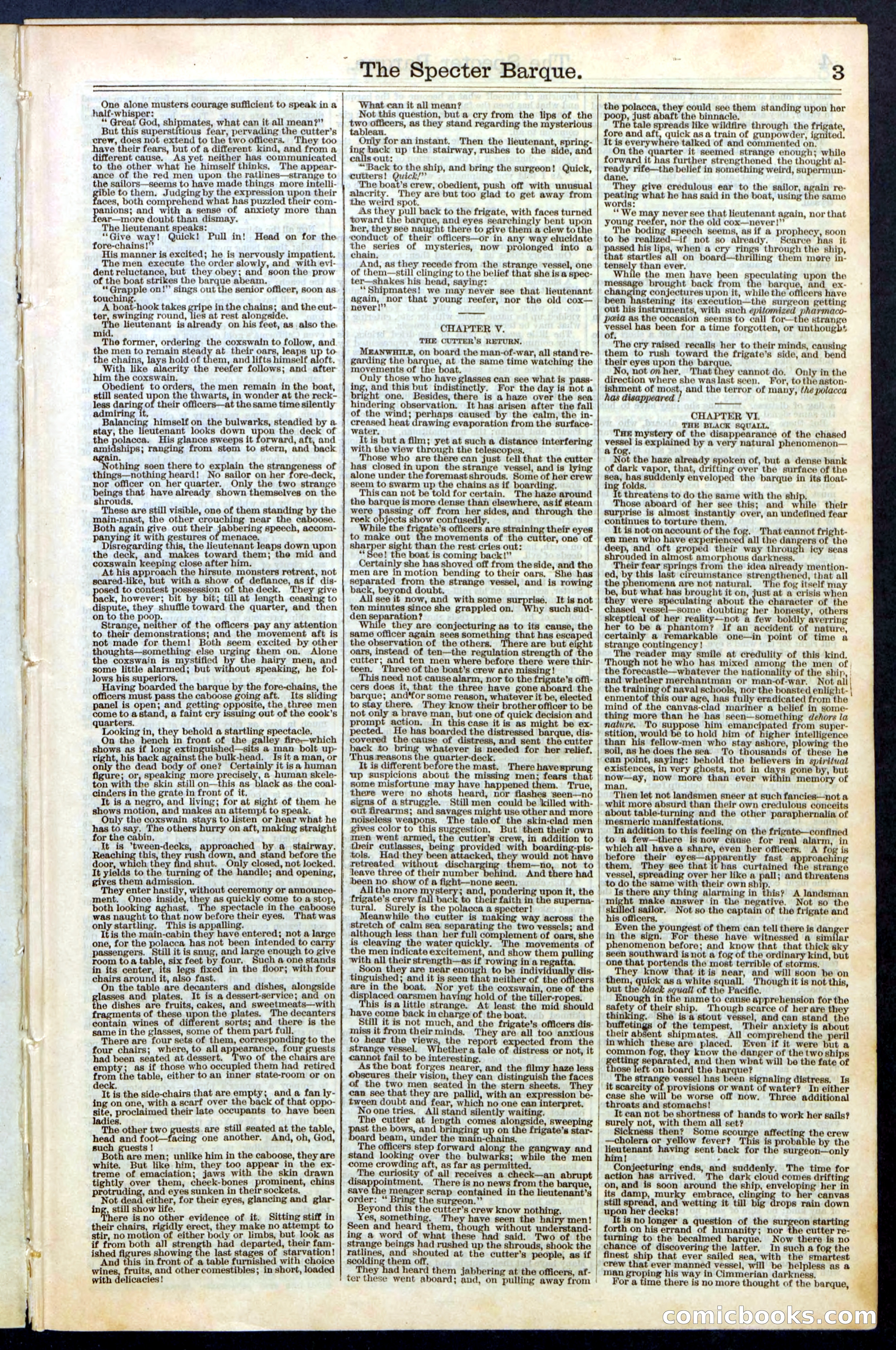
A restored page from Pulp Fiction, 1879. Page through the whole issue in the reader above.
📄 Transcribed text from this page (OCR, searchable)
Machine-transcribed from the original scan — historical spelling and the odd misread are preserved.
— ee e? — al -_——-— ee One alone musters courage sufficient to speak in a half-whisper: “* Great God, shipmates, what can it all mean?” But this superstitious fear, pervading the cutter’s crew, does not extend to the two officers. They too have their fears, but of a different kind, and from a different cause. As yet neither has communicated to the other what he himself thinks, The appear- ance of the red men upon the ratlines—strange to the sailors—seems to have made things more intelli- ble to them. Judging by the expression upon their aces, both com rehend what has puzzled their com- nions; and with a sense of anxiety more than fear—more doubt than dismay. The lieutenant speaks: “Give way! Quick! Pull in! fore-chains!” : His manner is excited; he is nervously impatient. The men execute the order vgs and with evi- dent reluctance, but they obey; and soon the prow of the boat strikes the barque abeam. “Grapple on!” sings out the senior officer, soon as touching. A boat-hook takes gripe inthe chains; and the cut- ter, swinging round, lies at rest alongside. e lieutenant is already on his feet, as also the. mid. The former, ordering the coxswain to follow, and the men to remain steady at their oars, leaps up to the chains, lays hold of them, and lifts himself aloft. With like alacrity the reefer follows; and after him the coxswain. Obedient to orders, the men remain in the boat, still seated upon the thwarts, in wonder at the reck- less ceringo their officers—at the same time silently t, admiring Balanc himself on the bulwarks, steadied by a stay, the lieutenant looks down upon the deck of the polacca. His glance sweeps it forward, aft, and amidships; ranging from stem to stern, and back ain. othing seen there to explain the strangeness of things—no g heard! No sailor on her fore-deck, nor officer on her quarter. Only the two ew beings that have already shown themselves on the shrouds. These are still visible, one of them standing by the main-mast, the other crouching near the caboose. Both again give out their pavbering speech, accom- panying it with seeare of menace. Disregarding t. the lieutenant leaps down upon the deck, an es toward them; the mid and coxswain keeping close after him. At his approach the hirsute monsters retreat, not sceared-like, but with a show of defiance, asif dis- sed to contest possession of the deck. They give bank, however; bit by bit; tillat length ena to dispute, they shuffle toward the quarter, and then on to the poop. Strange, neither of the officers pay any attention to their demonstrations; and the movement aft is not made for them! Both seem excited by other thoughts—something else urging them on. Alone the coxswain is se by the hairy men, and some little orl ; but without speaking, he fol- lows his superiors. Having toamied the barque by the fore-chains, the officers must the caboose going aft. Its sliding panel is open; and getting opposite, the three men come to a stand, a faint cry issuing out of the cook's quarters. : Looking in, they behold a startling spectacle, On the bench in front of the galley fire—which shows as if long extinguished—sits a man bolt up- right, his back against the bulk-head, Is it a man, or only the dead body of one? Certainly it isa human figure; or, speaking more precisely, 2 human skele- ton with the skin still on—this as black as the coal- cinders in the grate in front of it. It is a negro, and living; for at sight of them he shows motion, and makes an attempt to speak. Only the coxswain stays to listen or hear what he has to say. The others hurry on aft, making straight for the cabin. Head on for the It is ‘tween-dec approached by a stairway. Reac this, the wg and stand before the door, which the dshut. Only closed, not locked. It yields to the turning of the handle; and opening, gives them admission. They enter hastily, without ceremony or announce- ment. Once inside, be. as quickly come to a stop, both looking aghast e spectacle in the caboose was naught to cay ited emp Ne their eyes. That was only startling. appalling. Te is the main-cabin they have entered; not a large one, for the polacca has not been intended to ¢ passengers. Still it is snug, and large enough to give room toa table, six feet by four. Such a one stands in its center, its legs fixed in the floor; with four chairs around it, also fast. On the table are decanters and dishes, alongside lasses and plates. It is a dessert-service; and on the dishes are fruits, cakes, and sweetmeats—with Seements of these hr em the plates. The decanters contain wines of erent sorts; and there is the same in the glasses, some of them part full. There are four sets of them, corresponding to the four chairs; where, to all appearance, four guests had been seated at dessert. Two of the chairs are empty; as if those who occupied them had retired from the table, either to an inner state-room or on deck i hairs that are empty; anda fan ly- oe be ith PM scarf over the back of that oppo- site, proclaimed their late occupants to have been ladi es. The other two guests are still seated at the table, head and foot—tecing one another. And, oh, God, such guests ! Both are men; unlike him in the caboose, they are white. But like him, they too appear in the ex- treme of emaciation; jaws with the skin drawn tightly over them, cheek-bones promingst, chins protru , and eyes sunken in their sockets. Not d ae ig "1 for their eyes, glancing and glar- ing, still show life. There is no other evidence of it. Sitting stiff in their chairs, rigidly erect, they make no attempt to stir, no motion of either body or limbs, but look as if from both all strength had departed, their fam- ished res showing the last stages of starvation! And this in front of a table furnished with choice wines, fruits, and other comestibles; in short, loaded with delicacies! ig - The Specter Barque. What can it all mean? : Not this question, but a cry from the lips of the two officers, as they stand regarding the mysterious tableau. Only for an instant. Then the lieutenant, spring- ing back up the stairway, rushes to the side, and calls out: “'Back to the ship, and bring the surgeon! Quick, cutters! Quick/” ‘The boat’s crew, obedient, push off with unusual alacrity. They are but too glad to get away from the weird spot. As they pull back to the frigate, with faces turned toward the barque, and eyes searchingly bent upon her, they see naught there to give them a clew to the conduct of their officers—or in any way elucidate the series of mysteries, now prolonged into a chain, And, as they recede from the strange vessel, one of them—still clinging to the belief that she is a spec- ter—shakes his head, saying: “Shipmates! we may never see that lieutenant oa moan that young reefer, nor the old cox— never CHAPTER V. THE CUTTER'S RETURN. MEANWHILE, on board the man-of-war, all stand re- garding the barque, at the same time watching the movements of the boat. Only those who have ene can see what is pass- ing, and this but indistinctly. For the day is not a bright one. Besides, there is a haze over the sea hindering observation. It has arisen after the fall of the wind; } sc caused by the calm, the in- creased heat drawing evaporation from the surface- water. It is but a film; yet at such a distance interfering with the view through the telescopes. Those who are there can just tell that the cutter has closed in upon the strange vessel, and is lying alone under the foremast shrouds. Some of her crew seem to swarm up the chains as if boarding. This can not be told for certain. The haze around the barque is more dense than elsewhere, asif steam were passing off from her sides, and through the reek objects show confusedly. While the yee officers are straining their eyes to make out the movements of the cutter, one of sharper sight than the rest cries out: ** See! the boat is coming back!” Certainly she has shoved off from the side, and the men are in motion bending to their oars. She has separated from the strange vessel, and is rowing back, beyond doubt. All see it now, and with some rise. It is not ten minutes since she grappled on. y such sud- den separation? While they are conjecturing as to its cause, the same officer again sees somet that has eye tt the observation of the others. ere are but e ght oars, instead of ten—the regulation strength of the cutter; and ten men where before there were thir- teen. Three of the boat’s crew are missing! This need not cause alarm, nor to the f te’s offi- cers does it, that the three have gone ard the barque; and*for some reason, whatever it be, elected to stay there. They know their brother officer to be not only a brave man, but one of quick decision and pram action. In this case it is as might be ex- pecte He has boarded the distressed barque, dis- covered the cause of distress, and sent the cutter back to bring whatever is needed for her relief, Thus reasons the quarter-deck. It is different before the mast. There havesprun up suspicions about the missing men; fears that some misfortune may have happened them. True, there were no shots heard, nor flashes seen—no signs of astruggle. Still men could be killed with- out firearms; and savages might use other and more noiseless weapons. The taleof the skin-clad men gives color to this suggestion. But then their own men went armed, the cutter’s crew, in addition to their cutlasses, being provided with boarding-pis- tols. Had they been attacked, they would not have retreated without an them—no, not to leave three of their number nd. And there had been no show of a fight—none seen. All the more mystery; and, pondering upon it, the frigate’s crew fall back to their faith in the superna- tural. Surely is the polacca a specter! Meanwhile the cutter is making way across the stretch of calm sea separating the two vessels; and although less than her full eanprothent of oars, she is cleaving the water quickly. The movements of the men indicate excitement, and show them ulling with all their strength—as if rowing in a re fea. Soon they are near enough to be individually dis- tinguished; and it is seen that neither of the officers are in the boat. Nor yet the coxswain, one of the displaced oarsmen having hold of the tiller-ropes. is isa little strange. At least the mid should have come back in ch of the boat. Still it is not much, and the frigate’s officers dis- miss it from theirminds. They are all too anxious to hear the views, the report ted from the strange vessel. ether a tale of dintress or not, it cannot fail to be interesting. As the boat forges nearer, and the filmy haze less o their vision, they can distinguish the faces of the two men seated in the stern sheets. They can see that they are pallid, with an expression be- tween doubt and fear, which no one can interpret. No one tries. I stand silently vee oe, ne at pngen con om e, oh pe eé bows, and bringing up on the frigate’s star- Peat beam, under the Spadiechuning: The officers step forward along the pangway and stand looking over the bulwarks; while the men come crowding aft, as far as permitted. The curiosity of all receives a check—an abrupt cesppolasnenh. There is no news from the barque, Save the meager scrap contained in the lieutenant’s order: “ Bring the surgeon.” Beyond this the cutter’s crew know nothing. Yes, something. They have seen the hairy men! Seen and heard them, though without understand- ing a word of what these said. Two of the strange beings had rushed up the shrouds, shook the ratlines, and shouted at the cutter’s people, as if scolding them off, They had heard them jabbering at the officers, af- | ter these went aboard; and, on pulling away from | lee — i a —— eee | surel 3 the polacca, they could see them standing upon her a just abaft the binnacle. 6 tale spreads like wildfire through the frigate, fore and aft, quick asa train of gunpowder, ignited. It is everywhere talked of and commented on. On the quarter it seemed strange enough; while forward it has further strengthened the thought al- ready rife—the belief in something weird, supermun- ne, They give credulous ear to the sailor, again re- we what he has said in the boat, using the same words: ‘* We may never see that lieutenant again, nor that young reefer, nor the old cox—never!"’ The boding speech seems, as if a prophecy, soon to be realized—if not so already. Scarce has it passed his lips, when a cry rings through the ship, that startles all on board—thrilling them mere in- tensely than ever. While the men have been speculating upon the m e brought back from the barque, and ex- changing conjectures upon it, while the officers have been hastening its execution—the surgeon getting out his instruments, with such epitomized pharmaco- paia as the occasion seems to call for—the strange vessel has been for a time forgotten, or unthougb+ of. The cry raised recalls her to their minds, causing them to rush toward the frigate’s side, and ben their eyes upon the barque, No, not onher, Thatthey cannot do. Only in the direction where she was last seen. For, tothe aston- ishment of most, and the terror of many, thé polacca has disappeared | CHAPTER VI. THE BLACK SQUALL. Tak mystery of the disappearance of the chased a is explained by a very natural phenomenon— a fog. Not the haze already spoken of, but a dense bank of dark vapor, that, drifting over the surface of the oy suddenly enveloped the barque in its float- ng folds. Te threatens to do the same with the see Those aboard of her see this; and while their surprise is almost instantly over, an undefined fear continues to torture them, It is not on account of the fog. That cannot fright- en men who have experienced all the dangers of the deep, and oft groped their way through icy seas shrouded in almost amorphous darkness. Their fear springs from the idea already mention- ed, by this last circumstance strengthened, that all the phenomena are not natural. 16 fog itself may be, but what has brought it on, just at a crisis when they were > Rater, about the character of the chased vessel—some doubting her honesty, others skeptical of her reality—not a few boldly averring her to be a phantom? If an accident of nature, certainly a remarkable one—in point of time a strange contingency! The reader may smile at credulity of this kind. Though not he who has mixed among the men of the forecastle—whatever the nationality of the ship, and whether merchantman or man-of-war. Not all the training of naval schools, nor the boasted enlight- | enmentof this our age, has fully eradicated from the mind of the canvas-clad mariner a belief in some- thing more than he has seen—something dehors la nature. To suppose him emancipated from super- stition, would to hold him of higher intelligence than his fellow-men who stay ashore, plowing the soil, as he does the sea. To thousands of these he can point, saying: behold the believers in spiritual existences, in very ghosts, not in days gone by, but now—ay, now more than ever within memory of man. Then let not landsmen sneer at such fancies—not a whit more absurd than their own credulous conceits about table-turning and the other paraphernalia of mesmeric manif: tions. In addition to this feeling on the frigate—confined to a few—there is now cause for real alarm, in which all have a share, even her officers. A fog is before their eyes—apparently fast approaching them. They see that it has curtained the strange vessel, spreading over her like a cons and threatens to do the same with their own sh Pp. Is there any thing alarming in this? A landsman might make answer in the negative. Not so the skilled sailor, Not so the captain of the frigate and his officers. Even the youngest of them can tell there is danger in the sign. For these have witnessed a similar phenomenon before; and know that that thick sky seen southward is not a fog of the ordinary kind, but one that portends the most terrible of storms. They know that itis near, and will soon be on them, quick as a white squall. Though it is not this, but the dlack squall of the Pacific. Enough in the name to cause apprehension for the safety of their ship. Though scarce of her are they thinking. She is a stout vessel, and can stand the buffetings of the tempest, Their anxiety is about their absent shipmates. All comprehend the inwhich these are placed. Even if it were but a common fog, they know the danger of the two ships etting separated, and then what will be the fate of ose left on board the barque? The — vessel has been signaling distress. Is it scarcity of provisions or want of water? In either case she will be worse off now. Three additional throats and stomachs! It can not be shortness of hands to work her sails? not, with them all set? Sic then? Some scourge affecting the crew —cholera or yellow fever? This is probable by the lieutenant having sent back for the surgeon—only ! . Conjecturing ends, and suddenly. The time for action has arrived. The dark cloud comes drifting on, and is soon around the ship, enveloping her in its damp, murky embrace, a tie to her canvas still “inp and wetting it till ops rain down = er decks! tis no longer a question of the stig Nr starting forth on his errand of humanity; nor the cutter re- turning to the becalmed barque. Now there is no chance of discovering the latter. In such a fog the finest ship that ever sailed sea, with the smartest crew that ever manned vessel, will be helpless as a man Py his way in Cimmerian darkness. For a time there is no more thought of the barque, S) Gomilecbooks- co