
Pulp Fiction, 1879 · page 2 of 40
Beadle's New York Dime Library, No. 66 — page 2: what you’re looking at
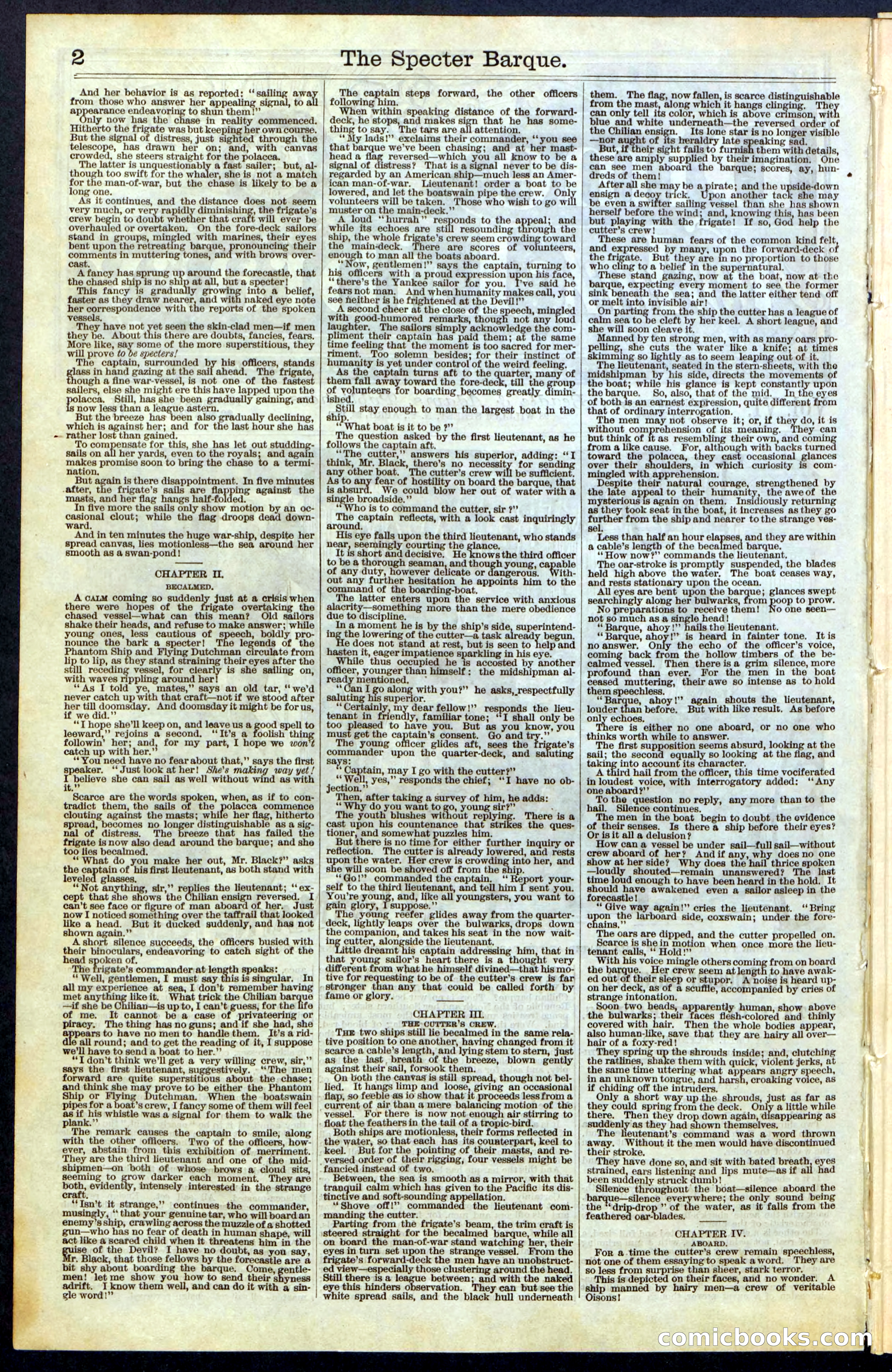
A restored page from Pulp Fiction, 1879. Page through the whole issue in the reader above.
📄 Transcribed text from this page (OCR, searchable)
Machine-transcribed from the original scan — historical spelling and the odd misread are preserved.
The Specter Barque. And her behavior is as reported: “sailing awa from those who answer her appealing signal, to a Sg rye endeavoring to shun them!” nly now has the c in reality commenced. Hitherto the frigate was but keeping her own course, But the signal of distress, just sighted through the telescope, has drawn her on; and, with canvas crowded, she steers straight for the The latter is unquestionably a fast sailer; but, al- though too swift for the whaler, she is not a match for the man-of-war, but the chase is likely to be a long one. As it continues, and the distance does not seem very much, or very rapidly diminishing, the frigate’s crew begin to doubt whether that craft will ever be overhauled or overtaken. On the fore-deck sailors stand in groups, mingled with marines, their eyes bent upon the retreating barque, Bai cm. their comments in muttering tones, and with brows over- cast. A fancy has sprung up around the forecastle, that the chased ship is no ship at all, but a specter! This fancy is gradually growing into a belief, faster as they draw nearer, and with naked eye note her | mle neat with the reports of the spoken vessels, They have not yet seen the skin-clad men—if men they be. About this there are doubts, fancies, fears. More like, say some of the more superstitious, they will prove @o be specters! The captain, surrounded by his officers, stands lass in hand gazing at the sail ahead. The frigate ough a fine war-vessel, is not one of the fastest sailers, else she might ere this have lapped upon the lacca, Still, has she been gradually gaining, and now less than a league astern. But the breeze has been also gradually declining, which is against her; and for the last hour she has rather lost than gained. To compensate for this, she has let out sdding: sails on all her yards, even to the royals; and again wee promise soon to bring the chase to a termi- nation. But oe is there disappointment. In five minutes after, the frigate’s sails are mer ing against the masts, and her flag hangs half-folded. In five more the sails only show motion by an oc- cnt clout; while the flag droops dead down- ward, And in ten minutes the huge war-ship, despite her spread canvas, lies motionless—the sea around her smooth as & swan-pond! CHAPTER I, BECALMED. A CALM coming so suddenly just at a crisis when there were hopes of the frigate overtaking the chased vessel—what can this mean? Old sailors shake their heads, and refuse to make answer; while young ones, less cautious of s h, boldly pro- nounce the bark a specter! 6 legends of the Phantom Ship and Dutchman circulate from lip to lip, as they stand straining their eyes after the still receding vessel, for clearly is she sailing on, with waves rippling around her “As I told ye, mates,” says an old tar, “ we'd never catch up with that craft—notif we stood after her till doomsday. And doomsday it might be for us, if we did.” “‘T hope she'll keep on, and leave us a good spell to leeward,’’ rejoins a second, ‘It’s a foolish thing followin’ her; and, for my part, I hope we won’t catch up with her.’ ‘*You need have no fear about that,’ says the first ker. ‘‘ Just look at her! She's making way yet! ‘ believe she can sail as well without wind as with Scarce are the words spoken, when, as if to con- tradict them, the sails of the polacca commence clouting against the masts; while her flag, hitherto spread, becomes no longer distinguishable as a sig- of distress. The breeze that has failed the frigate is now also dead around the barque; and she too lies becalmed. “What do you make her out, Mr. Black?” asks the om ee of his first lieutenant, as both stand with leveled glasses. “*Not anything, sir,’’ replies the lieutenant; ‘ ex- cept that she shows the lian ensign reversed. I can't see face or figure of man aboard of her. Just now I noticed something over the taffrail that looked like a head. But it ducked suddenly, and has not shown again.” A short silence succeeds, the officers busied with their binoculars, endeavoring to catch sight of the head spoken of. The frigate’s commander at may sm speaks: “Well, gentlemen, I must say is singular. In all my experience at sea, I don’t remember having | met anyt likeit. What trick the Chilian barque ~—if she be Chilian—is up to, I can’t guess, for the life of me. It cannot be a case of privateering or . The thing has no guns; and if she had, she a rs to have no men to handle them. It’s a rid- @ all round; and to get the reading of it, I suppose we'll have to send a boat to her.” “IT don’t think we'll get a very willing crew, sir,”’ says the first lieutenant, suggestively. ‘The men | | forward are quite superstitious about the chase; | and think she may prove to be either the Phantom Ship or i or utchman. When the boatswain pipes for a boat’s crew, I fancy some of them will feel a stat whistle was a signal for them to walk the Pp n Ty The remark causes the captain to smile, along with the other officers. Two of the officers, how- ever, abstain from this exhibition of merriment. They are the third lieutenant and one of the mid- shipmen—on both of whose brows a cloud sits, seeming to both, eviden ‘Isn't it strange,” continues. the commander, musingly, “that your genuine tar, who will board an enemy’s ship, crawling across the muzzle of a shotted gun—who has no fear of death in human shape, will act like a scared child when it threatens him in the Gite of the Devil? I have no doubt, as you say, . Black, that those fellows by the forecastle are a bit shy about boarding the barque. Come, gentle- men! let me show you how to send their shyness adrift. I know them well, and can do it with a sin- gle word!” aed darker each moment. They are - tly, intensely interested in the strange | —- following When within speaking distance of the forward- deck, he stops, and makes sign that he has some- thing to say. The tars are all attention. ** My lads!’ exclaims their commander, *‘you see that barque we've been chasing; and at her mast- head a Pe Beto me you all know to be a signal of ress? That is a signal never to be dis- regarded by an American ship—much less an Amer- ican man-of-war. Lieutenant! order a boat to be lowered, and let the boatswain pipe the crew. or volunteers will be taken. Those who wish to go w muster on the main-deck.”’ A loud “hurrah” responds to the appeal; and while its echoes are still resounding through the ship, the whole frigate’s crew seem crowding toward the main-deck. ere are scores of volunteers, enough to man all the boats aboard. ‘Now, gentlemen!” says the captain, turning to his officers with a proud expression upon his face, ‘‘there’s the Yankee sailor for you. I’ve said he fearsnot man. And when humanity makes call, you see heither is he frightened at the Devil!” A second cheer at the close of the speech, mingled with good-humored remarks, though not any loud laughter. The sailors simply acknowledge the com- pliment their captain has paid them; at the same time feeling that the moment is too sacred for mer- riment, Too solemn besides; for their instinct of humanity is yet under control of the weird feeling, As the captain turns aft to the quarter, many of them fall away toward the fore-deck, till the up oe LS aoa. for boarding becomes greatly dimin- shed. ee stay enough to man the largest boat in the = p. ** What boat is it to be ?” The question asked by the first lieutenant, as he follows the captain aft. ‘The cutter,’ answers his superior, adding: “I think, Mr. Black, there’s no necessity for sending any other boat. The cutter’s crew be sufficient, As er fear of hostility on board the barque, that isa . We could blow her out of water with a single broadside." : o is to command the cutter, sir ?”’ rai bee reflects, with a look cast inquiringly around, His eye falls upon the third lieutenant, who stands near, seemingly courting the eter. It is short and decisive. He knows the third officer to be a thorough seaman, and ye om young, capable of any duty, however delicate or angerous. ith- out any further hesitation he appoints him to the command of the boarding-boat, The latter enters upon the service with anxious alacrity—something more than the mere obedience due to discipline. In a moment he is by the ship’s side, superintend- ing the lowering of the cutter—a task already ’ e does not stand at rest, but is seen to help and hasten it, eager impatience sparkling in his eye. While thus occupied he accosted by another officer, younger than himself: the midshipman al- read SE anaes rey eS b : **Can I go alon th you?” he asks, respectfull saluting his superibr. . ae : Certainly, my dear fellow!” responds the lieu- tenant in friendly, familiar tone; “I shall only be too ear to have you. But as you know, you must get the captain’s consent. Go and try.” The young officer glides aft, sees the ate’s commander upon the quarter-deck, and saluting says: : eee may I go with the cutter?” j “ane , yes,” responds the chief; “I have no ob- ection.’ Then, after taking a survey of him, he adds: ‘* Why do you want to RO, young sir?” . The youth blushes without rep There is a cast upon his countenance that st tioner, and somewhat puzzles him. But there is no time for either further inquiry or reflection. The cutter is already lowered, and rests upon the water. Her crew is crow into her, and she will soon be shoved off from the ship. ‘*Go!”” commanded the captain. ‘ Report your- self to the third lieutenant, and tell him I sent you. You're young, and, like all youngsters, you want to gain glory, I suppose.” The young reefer glides away from the quarter- deck, lightly leaps over the bulwarks, drops down the companion, and takes his seat in the now wait- ing cutter, et the lieutenant. ttle dreamt his captain addressing him, that in that young sailor’s heart there is a thought very different from what he himself divined—that his mo- tive for requesting to be of the cutter’s crew is far stronger n any that could be called forth by fame or glory. es the ques- CHAPTER II. THE CUTTER'S CREW. THE two ships still lie becalmed in the same rela- tive position to one another, having changed from it scarce a cable’s length, and lying stem to stern, just as the last. breath of the breeze, blown gently against their sail, forsook them. On both the canvas is still spread, though not bel- lied. It hangs limp and loose, giving an occasional flap, so feeble as io show that it proceeds less from a current of air than a mere balancing motion of the vessel. For there is now not enough air stirring to float the feathers in the tail of a tropic-bird. Both ships are motionless, their forms reflected in the water, so that each has its counterpart, keel to keel. But for the pointing of their masts, and re- versed order of their rigging, four vessels might be ‘fancied instead of two. Between, the sea is smooth as a mirror, with that tranguil calm which has given to the Pacific its dis- tinctive and soft-sounding appellation. “Shove off!’ command the lieutenant com- manding the cutter. Parting from the frigate’s beam, the trim craft is steered straight for the becalmed barque, while all on board the man-of-war stand watching her, their eyes in turn set upon the strange vessel. From the frigate’s forward-deck the men have an unobstruct- ed view—especially those clustering around the head. Still there is a | e between; and with the naked eye this hinders observation. They can but see the white spread sails, and the black hull underneath The ie emer steps forward, the other officers m. them. The flag, now fallen, is scarce distinguishable from the mast, along which it hangs clin ae can only tell its color, which is above crimson with blue and white underneath—the reversed order of the Chilian a Its lone star is no longer visible —nor t of its heraldry pate eee king sad. But, if their sight fails to fu them with details, these are amply supplied by their imagination. One can see men aboard the barque; scores, ay, hun- dreds of them! After all she may be a pirate; and the upside-down ensign chpe Lae pon another tack she may be even a swifter sailing vessel than she has shown herself before the wind; and, knowing this, has been but playing with the frigate! If so, God help the cutter’s crew! These are human fears of the common kind felt and expressed by many, upon the forward-deck of the frigate. But they are in no proportion to those who cling to a belief in the supernatural. These stand gazing, now at the boat, now at the barque, Seen every moment to see the former sink beneath the sea; and the latter either tend off or melt into invisible air! On parting from the ship the cutter has a league of calm sea to be cleft rh her keel. A short league, and she will soon cleave it. Manned by ten strong men, with as many oars pro- pelling, she cuts the water like a knife; at times skimming 80 lightly as to seem leaping out of it. The lieutenant, seated in the stern-sheets, with the midshipman by his side, directs the movements of the boat; while his glance is kept constantly upon the barque. So, also, that of the mid. In the eyes of both is an earnést expression, quite different from that of ordinary interrogation. The men may not observe it; or, if they do, it is without COM ETONSDEOR of its meaning. ey can but think of it as resembling their own, and comin from a like cause. For, although with backs turn toward the polacca, they cast occasional glances over their shoulders, in which curiosity is com- mingled with apprehension. Despite their natural courage, strengthened by the late dass to their ot age! the aweof the mysterious is again on them. In diously returning as they took seat in the boat, it increases as they go further from the ship and nearer tothe strange ves- sel, Less than half an hour elapses, and they are within a cable’s length of the beca ed barque. ‘How now?”’ commands the lieutenant, The oar-stroke is promptly suspended, the blades held high above the water. The boat ceases way, and rests stationary upon the ocean. All ee are bent upon the barque; glances swept searchingly along her bulwarks, from poop to prow. No preparations to receive them! No one seen— not sO much as a le head! ““Barque, ahoy!”’ hails the lieutenant. ** Barque, ahoy!"’ is heard in fainter tone. It is no answer. Only the echo of the officer’s voice, coming back from the hollow timbers of the be- calmed vessel. Then thereisa grim silence, more profound than ever. For the men in the boat ceased muttering, their awe so intense as to hold them speechless. ; % ue, ahoy!” again shouts the lieutenant, louder than before, But with like result. As before only echoes. ere is either no one aboard, or no one who thinks worth while to answer. The first rie yeep seems absurd, looking at the sail; the second equally so looking at the flag, and taking into account its character. A third hail from the officer, this time vociferated in loudest voice, with interrogatory added: ‘Any one aboard ?’’ To the question no reply, any more than to the hail. Silence continues. The men in the boat begin to doubt the evidence of their senses. Is there a ship before their eyes? Or is it all a delusion? How can a vessel be under sail—full sail—without crew aboard of her? Andif any, why does no one show at her side? Why does the hail thrice spoken —loudly shouted—remain unanswered? The last time loud enough to have been heard in the hold. It should have awakened even a sailor asleep in the forecastle |! “ Give way again!” cries the lieutenant. “ Bring u - the larboard side, coxswain; under the fore- chains, The oars are dipped, and the cutter propelled on. Scarce is shein motion when once more the lieu- tenant calls, ‘* Hold!” With his voice mingle others coming from on board the barque. Her crew seem at length to have awak- ed out of their sleep or stupor, A noise is heard up- on her deck, as of a scuffle, accompanied by cries of strange intonation, Soon two heads, apparently human, show above the bulwarks; their faces flesh-colored and thinly covered with hair. Then the whole bodies appear, also human-like, save that they are hairy all over— hair of a foxy-red! They spring the shrouds inside; and, clutching the ratlines, shake them with quick, violent jerks, at the same time uttering what appears angry speech, in an unknown tongue, and harsh, croaking voice, as if chiding off the intruders. Only a short way up the shrouds, just as far as they could spring from the deck. Only a little while there. Then they drop down again, heap vearink as suddenly as they had shown themselves, The leutenant’s command was a word thrown away. Without it the men would have discontinued their stroke. They have done so, and sit with bated breath, eyes strained, ears listening and lips mute—as if all had been suddenly struck dumb! Silence throughout the boat—silence aboard the e—silence everywhere; the only sound being the “‘drip-drop ” of the water, as it falls from the feathe oar-blades. CHAPTER IV. ABOARD. For a.time the cutter’s crew remain speechless, not one of them essaying to speak aword. They are so less from surprise than sheer, stark terror. This is depicted on their faces, and no wonder. A ship manned by hairy men—a crew of veritable Oisons! —— — lt Eomicbooks (E(0)