
Pulp Fiction, 1879 · page 4 of 40
Beadle's New York Dime Library, No. 66 — page 4: what you’re looking at
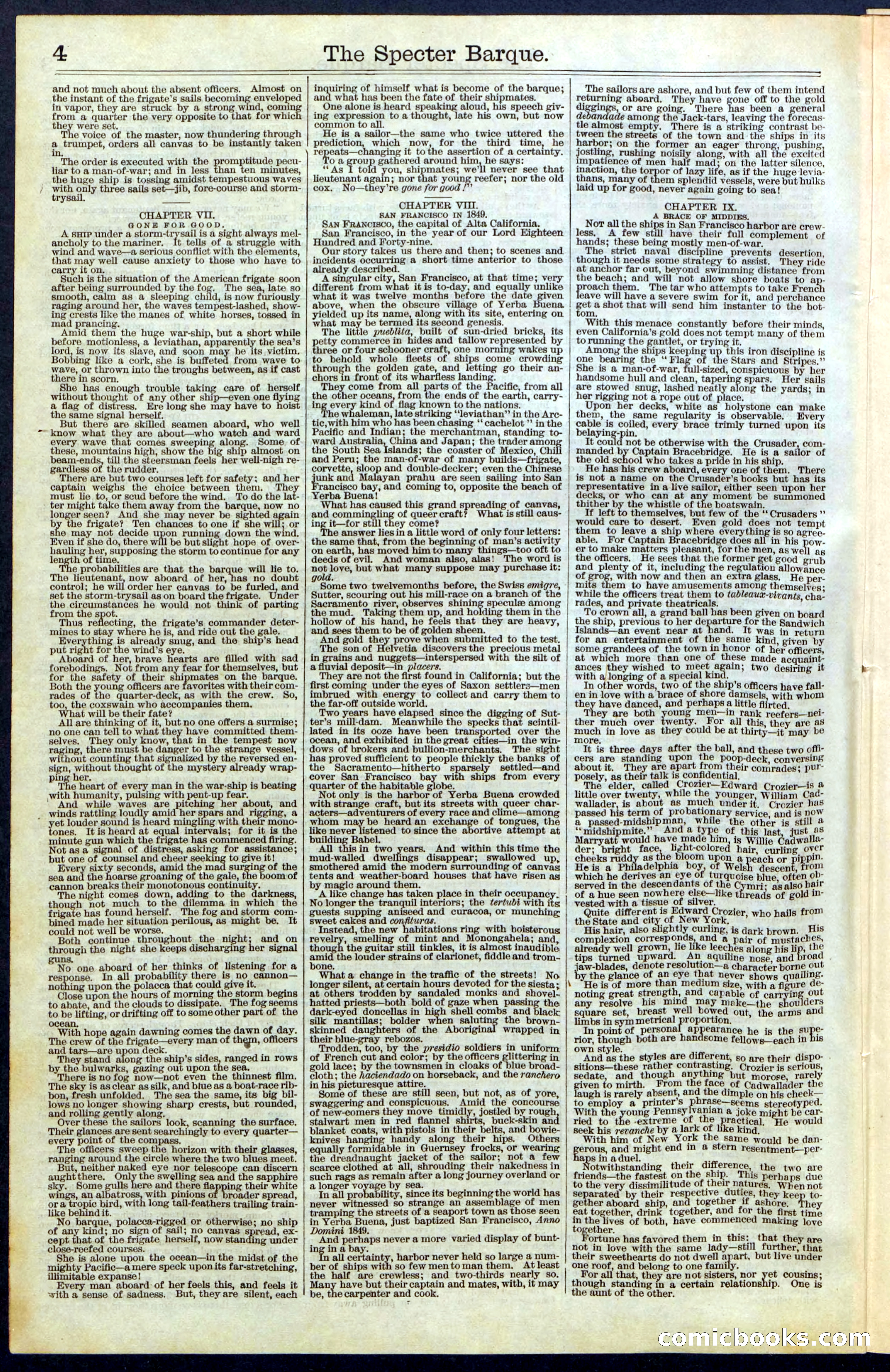
A restored page from Pulp Fiction, 1879. Page through the whole issue in the reader above.
📄 Transcribed text from this page (OCR, searchable)
Machine-transcribed from the original scan — historical spelling and the odd misread are preserved.
“~ know what the A i —_ ee and not much about the absent officers. Almost on the instant of the frigate’s sails becoming enveloped in vapor, they are struck by a strong wind, ve from a quarter the very opposite to that for whi they were set. ; The voice of the master, now thundering through .: trumpet, orders all canvas to be instantly taken The order is executed with the promptitude pecu- liar to a man-of-war; and in less than ten minutes, the huge ship is tossing amidst tempestuous waves / with only three sails set—jib, fore-course and storm- trysail. CHAPTER VI. GONE FOR GOOD, A sip under a storm-trysail is a sight always mel- ancholy to the mariner. It tells of a struggle with wind and wave—a serious conflict with the elements, that may well cause anxiety to those who have to carry it on. Such is the situation of the American frigate soon after being surrounded by the fog. The sea, late so smooth, calm as a sleeping child, is now furiously raging around her, the waves tempest-lashed, show- ing crests like the manes of white horses, tossed in mad prancing. Amid them the huge war-ship, but a short while before motionless, a leviathan, apparently the sea’s lord, is now its slave, and soon may be its victim. Bobbing like a cork, she is buffe from wave to wave, or thrown into the troughs between, as if cast there in scorn. She has enough trouble taking care of herself without thought of any other ship—even one flying a flag of distress. Ere long she may have to hoist the same signal herself. But there are skilled seamen aboard, who well are about—who watch and ward every wave that comes sweeping along. Some of these, mountains high, show the big ship almost on beam-ends, till the steersman feels her well-nigh re- gardless of the rudder. There are but two courses left for safety: and her captain weighs the choice between them, ahey must lie to, or scud before the wind. To do the lat- ter might take them away from the barque, now no longer seen? And she may never be sighted again by he frigate? Ten chances to one if she ; or she may not decide upon running down the wind. Even if she do, there will be but slight hope of over- hauling her, supposing the storm to continue for any length of time. e probabilities are that the barque will lie to. The lieutenant, now aboard of her, has no doubt control; he will order her canvas to be furled, and set the storm-trysail as on board the frigate. Under the circumstances he would not think of parting from the appr. Thus reflecting, the frigate’s commander deter- mines to stay where he is, and ride out the gale. wr irae is already snug, and the ship’s head put right for the wind’s eye. Aboard of her, brave hearts are filled with sad forebodings. Not from any fear for themselves, but for the safety of their s jaar on the barque. Both the young officers are favorites with their com- rades of the quarter-deck, as with the crew. So, too, the coxswain who accompanies them, What will be their fate? All are thinking of it, but no one offers a surmise; no one can tell to what they have committed them- selves. They only know, that in the tempest now raging, there must be danger to the strange vessel, without counting that signalized by the reversed en- sign, without thought of the mystery already wrap- her. . The heart of every man in the war-ship is beating with humanity, pulsing with pent-up fear, And while waves are pitching her about, and _ winds rattling loudly amid her spars and rigging, a t louder sound is heard ling with their mono- e tones. It is heard at equal in als; for it is the minute gun which the frigate has commenced Not asa signal of distress, as for assistance; but one of counsel and cheer see to give it! : Every sixty seconds, amid the ey of the sea and the hoarse groaning of the gale, Len e mof y. cannon breaks their monotonous contin The night comes down, adding to the darkness, though not much to the dilemma in which the frigate has found herself. The fog and storm com- bined made her situation perilous, as might be, It could not well be worse. Both continue throughout the ht; and on through the night she keeps ng her No one oe of ei one of aged kok a response. robability there is no cannon— nothing upon the a olaces that could give it. Close upon the hours of mo the storm begins to abate, and the clouds to dissipate. The fog seems to be lifting, or drifting off to some other part of the ocean, With hope again dawning comes the dawn of day. The crew of the frigate—every man of thgm, officers and tars—are upon deck. i Shes eens pane the ship’s sid ; ranged in rows e bulwarks, gazing out upon the sea. "There is no fog ow aot even the thinnest film. The sky is as clear as silk, and blue as a boat-race rib- bon, fresh unfolded. The sea the same, its big bil- lows no longer showing sharp crests, but rounded, and rolling gently along. Over these the sailors look, scanning the surface. Their glances are sent searchingly to every quarter— every point of the compass, The officers sweep the horizon with their glasses, ranging around the circle where the two blues meet. But, neither naked eye nor telesco m pe can ate there. Only the swelling sea and the sapphire Some guile ere and there hop ing their white wings, an albatross, with pinions of broader spread, ora tro ic bird, with long tail-feathers trailing train- e ; No barque, polacca-rigged or otherwise; no shi of an kind: no sign of sail; no canvas , ad, me cept that of the frigate herself, now stan under close-reefed courses. She is alone upon the ocean—in the midst of the mighty Pacific—a mere speck upon its far-stretching, illimitable expanse! Every man aboard of her feels this, and feels it with a sense of sadness. But, they are silent, each The Specter Barque. me ge oy of himself what is become of the barque; and what has been the fate of their shipmates. One alone is heard speaking aloud, his speech giv- ing expression to a thought, late his own, but now common to all. He is a sailor—the same who twice uttered the prediction, which now, for the third time, he Bey. pe garner it tothe assertion of a certainty. oa grou gathered around him, he says: “As I told you, shipmates; we'll never see that lieutenant again; nor that young reefer; nor the old cox. No—they’re gone for good !”’ CHAPTER VII. SAN FRANCISCO IN 1849. San FRANcrsco, the capital of Alta California. San Francisco, in the year of our Lord Eighteen Hundred and Forty-nine. Our story takes us there and then; to scenes and. incidents occurring a short time anterior to those already described. ; A singular city, San Francisco, at that time; very different from what it is to-day, and equally unlike what it was twelve months before the date given above, when the obscure village of Yerba Buena yielded up its name, along with its site, entering on what may be termed its second genesis. The little puedlita, built of sun-dried heey its petty commerce in hides and tallow represented by three or four schooner craft, one morning wakes up to behold whole fleets of ships come crowding siti be the golden gate, and letting go their an- chors in front of its wharfless landing. They come from all parts of the Pacific, from all the other oceans, from the ends of the earth, carry- ing every kind of flag known to the nations. e whaleman, late striking “leviathan” in the Arc- tic,with him who has been chasing ‘‘ cachelot ”’ in the Pacific and Indian; the merchantman, standing to- ward Australia, China and Japan; the trader amo the South Sea Islands; the coaster of Mexico, Chi and Peru; the man-of-war of many builds—frigate, corvette, sloop and double-decker; even the Chinese unk and yan prahu are seen sailing into San ancisco bay, and coming to, opposite the beach of Yerba Buena! What has caused this grand spreading of canvas, and Spar pea of queer craft? What is still caus- ing it—for still they come? é answer lies in a little word of only four letters: the same that, from the beginning of man’s activity on earth, has moved him to many things—too oft to deeds of evil. And woman also, alas! The word is not love, but what many suppose may purchase it: old. 3 Some two twelvemonths before, the Swiss emigre, Sutter, scouring out his mill-race on a branch of the Sacramento river, observes shining specule among the mud. Taking them up, and holding them in the hollow of his hand, he feels that they are heavy, and sees them to be of golden sheen. And gold ey prove when submitted to the test. The son of Helvetia discovers the precious metal in and nuggets—interspersed with the silt of a fluvial deposit—in placers. They are not the first found in California; but the first coming under the eyes of Saxon settlers—men imbrued with energy to collect and carry them to the far-off outside world. Two years have elapsed since the digging of Sut- ter’s mill-dam. Meanwhile the specks that scintil- lated in its ooze have been transported over the ocean, and exhibited in the great cities—in the win- dows of brokers and bullion-merchants. The sight has proved sufficient to people thickly the banks of the Sacramento—hitherto of ed settled—and cover San Francisco bay with ships from every quarter of the habitable globe. Not only is the harbor of Yerba Buena crowded with strange craft, but its streets with queer char- acters—adventurers of every race and clime—among whom ws aro heard an ex e of tongues, the like never weet to since the abortive attempt at buil Babel. All in two Se ag And within this time the mud-walled dwellings disappear; swallowed up, smothered amid the modern surrounding of canvas tents and weather-board houses that have risen ag by magic around them. A like change has taken place in their occupancy. No longer the tranquil interiors; the ¢tertudi with it guests supping aiiosed and curacoa, or munching: sweet cakes and uras. Instead, the new habitations ring with boisterous en! smelling of mint and Monongahela; and, tho the guitar still tinkles, it is almost inaudible a id the louder strains of clarionet, fiddle and trom- ne. What a change in the traffic of the streets! No longer silent, at certain hours devoted for the siesta; at others trodden by sandaled monks and shovel- hatted priests—both bold of gaze when p the dark-eyed doncellas in h shell combs and black silk mantillas; bolder when salu the brown- skinned daughters of the Abori wrapped in their blue-gray rebozos. Trodden, too, by the presidio soldiers in uniform of French cut and color; by the officers oe in gold lace; by the townsmen in cloaks of blue broad- cloth; the haciendado on horseback, and the ranchero in his picturesque attire. Some of these are still seen, but not, as of yore, swaggering and conspicuous. Amid the concourse of new-comers they move timidly, jostled by rough stalwart men in red flannel s buck-skin an blanket coats, with pistols in their belts, and bowie- knives hanging handy along their hips. Others equally formidable in Guernsey frocks, or wearing the dreadnaught jacket of the sailor; not a few scarce clothed at all, shrouding their nakedness in such rags as remain after a long journey overland or a longer voyage by sea. In all pro ability, since its beginning the world has never witnessed so strange an assemblage of men tramping the streets of a seaport town as those seen in Yerba Buena, just bapt San Francisco, Anno Domini 1849 And perhaps never a more varied display of bunt- ing in a bay. all cattain , harbor never held so large a num- ber of ships with so few mentoman them. At least the half are crewless; and two-thirds nearly so. Mest ® have but their captain and mates, with, it may e carpenter and cook. The sailors are ashore, and but few of them intend returning abeard. They have gone off to the gold diggings, or are going. There has been a general debandade among the Jack-tars, leaving the forecas- tle almost empty. There is a striking contrast be- tween the streets of the town and the ships in its harbor; on the former an eager throng, pushing, niga rushing noisily along, with all the excited impatience of men half mad; on the latter silence, inaction, the torpor of lazy life, as if the huge levia- thans, many of them splendid vessels, were but hulks laid up for good, never again going to sea! CHAPTER IX. A BRACE OF MIDDIES. Nort all the ships in San Francisco harbor are crew- less, A few still have their full complement of hands; these being mostly men-of-war. The strict naval discipline prevents desertion, though it needs some strategy to assist. They ride at anchor far out, beyond swimming distance from the beach; and will not allow shore boats to ap- roach them. The tar who attempts to take French eave will have a severe swim for it, and perchance sb Loom that will send him instanter to the bot om. With this menace constantly before their minds, even California's gold does not tempt many of them torunning the gantlet, or trying it. Amony the ships keepin up this iron discipline is one bearing the “Flag of the Stars and Stripes.” She is a man-of-war, full-sized, conspicuous by her handsome hull and clean, tapering spars. Her sails are stowed snug, lashed neatly along the yards; in her rigging not a rope out of place. Upon her decks, white as holystone can make them, the same regularity is observable. Every cable is coiled, every brace trimly turned upon its yo It could not be otherwise with the Crusader, com- manded by Captain <n He is a sailor of the old school who takes a pride in his ship. He has his crew aboard, every one of them. There is not a name on the Crusader’s books but has its representative in a live sailor, either seen upon her decks, or who can at any moment be summoned thither by the whistle of the boatswain. If left to themselves, but few of the ‘Crusaders ”’ would care to desert. Even gold does not tempt them to leave a ship where everything is so agree- able. For Captain Bracebridge does all in his pow- er to make matters pleasant, for the men, as wel] ag the officers. He sees that the former get g00d grub and plenty of it, including the regulation allowance of , with now and then an extra glass. He per- mits them to have amusements among themselves; while the officers treat them to tableaua-vivanis. cha- rades, and private theatricals. ; To crown all, a grand ball has been given on board the ship, previous to her ee oh ah for the Sandwich Islands—an event near at hand. It was in return for an entertainment of the same kind, given by some grandees of the town in honor of her officers, at which more than one of these made acquaint- ances they wished to meet Sot two desiring it with a longing of a special kind. In other words, two of the ship’s officers have fall- en in love with a brace of shore damsels, with whom they have danced, and perhaps a little flirted, They are both pas men—in rank reefers—nei- ther much over twenty. For all this, they are as much in love as they could be at thirty—it may be more, It is three days after the ball, and these two oftl- cers are standing upon the poop-deck, conversiDs about it, They are apart from their comrades; PU" posely, as their talk is confidential, The elder, called Crozier—Edward Crozier—is & little over twenty, while the younger, William Cad- wallader, is about as much underit, Crozier has passed his term of probationary service, and is DOW a passed-midshipman, while the other is still 4 ‘*midshipmite.” And a mee of this last, just 48 Marryatt would have made him, is Willie Cadwalla- der; bright face, light-colored hair, curling Ove? cheeks ruddy as the bloom upon a peach or pippi?. He is a delphia maf of Welsh descent, from which he derives an eye of turquoise blue, often ob- served in the descendants of the Cymri: as also bait of a hue seen nowhere else—like threads of gold in- vested with a tissue of silver. Quite different is Edward Crozier, who hails fro™ the State and city of New York. : His hair, also slightly curling, is dark brown. His complexion corresponds, and a pair of mustache; already well grown, lie like leeches along his lip, the tips turned upw An aquiline nose, and broad jaw blades, denote resolution—a character borne out y the glance of an eye that never shows quailing. He is of more than medium size, with a figure 4e- noting great strength, and capable of carrying out any resolve his mind may make—the shou ders square set, breast well bowed out, the arms and limbs in sym metrical propor api a In point of perso ppearance he is the supe- rior, though both are handeome fellows—each in Me own style. And as the styles are different, so are their disp0- sitions—these rather contrasting, Crozier is serious, sedate, and though anything but morose, rarely ven to mirth. From the face of Cadwallader the ugh is rarely absent, and the dimple on his cheek— to cy wes a printer's phrase—seems stereotyped. With the young Pennsylvanian a joke might be car- ried to the -extreme of the practical, He would seek his revanche by a lark of like kind, With him of New York the same would be dan- gerous, and might end in a stern resentment—per- s in aduel. ; otwithstanding their difference, the two are friends—the fastest on the ship. This perhaps due to the very dissimilitude of their natures. When not separated by their ae Hin oe duties, they keep to- gether aboard ship, and together if ashore. They eat together, drink together, and for the first time _ _ ves of both, have commenced making love ether. ortune has favored them in this: that they are not in love with the same lady—still further that their sweethearts do not dwell apart, but live under one roof, and belong to one family. For all that, they are not sisters, nor yet cousins; though standing in a certain relationship. One is the aunt of the other. (e(e) miicbooks: a . i ae (<(0)