
Pulp Fiction, 1879 · page 20 of 40
Beadle's New York Dime Library, No. 66 — page 20: what you’re looking at
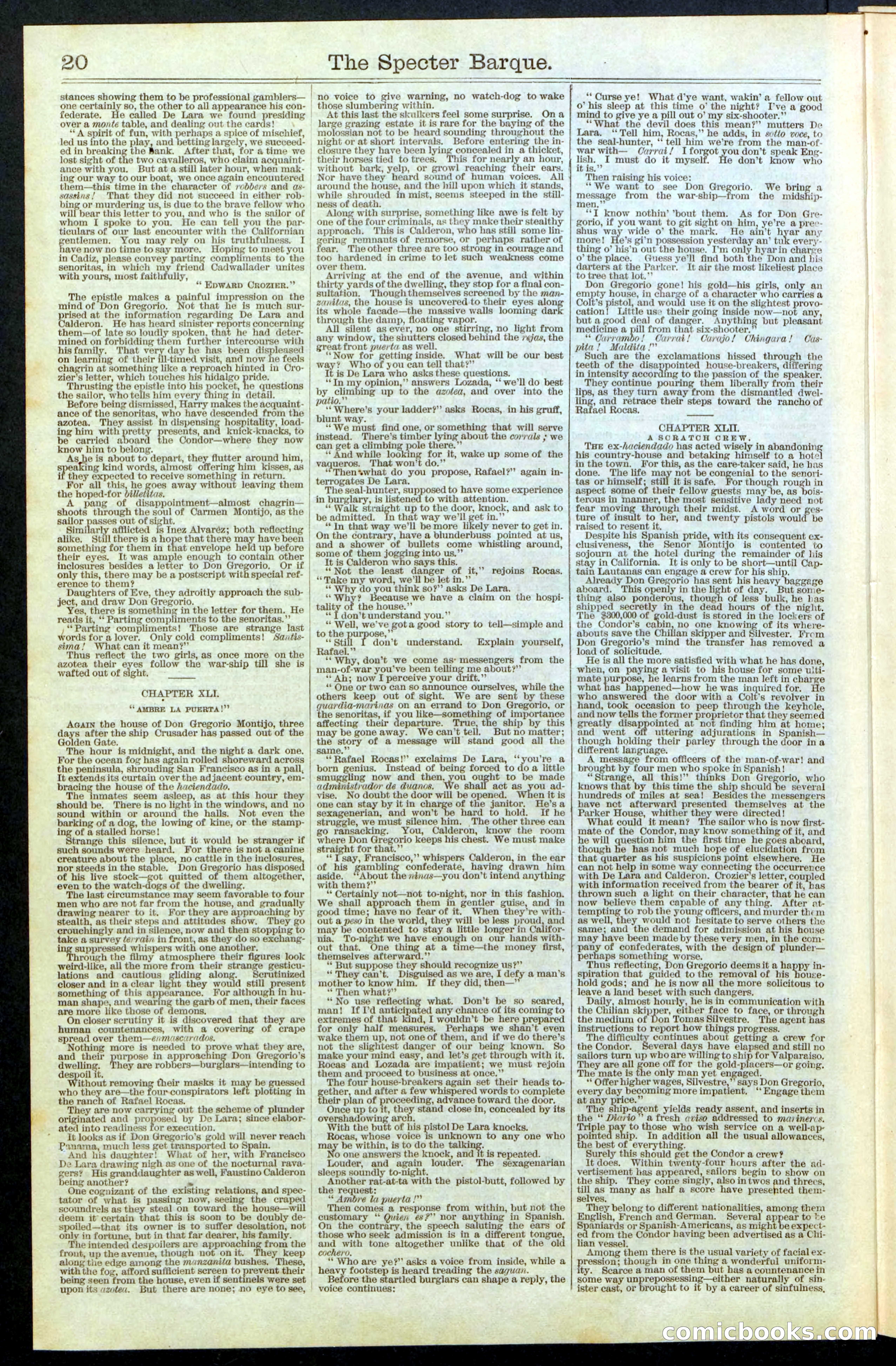
A restored page from Pulp Fiction, 1879. Page through the whole issue in the reader above.
📄 Transcribed text from this page (OCR, searchable)
Machine-transcribed from the original scan — historical spelling and the odd misread are preserved.
— stances showing them to be professional gamblers— one certainly so, the other to all appearance his con- federate. He called De Lara we found presiding over a monte table, and dealing out the cards! ‘A spirit of fun, with perhaps a spice of mischief, led us into the play, and betting largely, we succeed- ed in breaking the Bank. After that, for a time we lost sight of the two cavalleros, who claim acquaint- ance with you. But at a still later hour, when mak- ing our way to our boat, we once again encountered them—this time in the character of robbers and as- sassins | That they did not succeed in either rob- bing or murdering us, is due to the brave fellow who will bear this letter to you, and who is the sailor of whom I spoke to you. He can tell you the par- ticulars of our last encounter with the Californian gentlemen. You may rely on his truthfulness. I have now no time tosay more. Hoping to meet you in Cadiz, please convey parting compliments to the senoritas, in which my friend Cadwallader unites | with yours, most faithfully, ** EDWARD CROZIER.” The epistle makes a painful impression on the mind of Don Gregorio. Not that he is much sur- yrised at the information regarding De Lara and alderon. He has heard sinister reports concerning them—of late so loudly spoken, tha mined on forbidding them further intercourse with hisfamily, That very day he has been displeased on learning of their ill-timed visit, and now he feels chagrin at something like a reproach hinted in Cro- zier’s letter, which touches his hidalgo pag Thrusting the epistle into his pocket, he questions the sailor, who tells him every thing in detail. Before being dismissed, Harry makes the acquaint- ance of the senoritas, who have descended from the azotea, They assist in dispensing hospitality, load- ing him with soa resents, and knick-knacks, to be carried aboard the Condor—where they now know him to belong. As he is about to depart, they flutter around him, speaking kind words, almost offering him kisses, as | if they expected to receive something in return. For all this, he goes away without leaving them the hoped-for billetitas. A pang of disappointment—almost chagrin— shoots through the soul of Carmen Montijo, as the sailor passes out of sight. Similarly afflicted is Inez Alvaréz; both reflecting alike. Still there is a hope that there may have been something for them in that envelope held up before their eyes. It was ample enough to contain other inclosures besides a letter to Don Gregorio, Or if only this, there may be a postscript with special ref- erence to them? Daughters of Eve, they adroitly approach the sub- ject, and draw Don Gregorio. Yes, there is something in the letter for them. He reads it, ‘‘ Parting compliments to the senoritas.”’ “Parting compliments! Those are strange last ords for a lover, Only cold compliments! Sajtis- sima! What can it mean?” Thus reflect the two girls, as once more on the azotea their eyes follow the war-ship till she is wafted out of sight. CHAPTER XLI. ‘“ AMBRE LA PUERTA!”’ Aaatn the house of Don Gregorio Montijo, three days after the ship Crusader has passed out of the Golden Gate. The hour is midnight, and the night a dark one. For the ocean fog has again rolled shoreward across the peninsula, shrouding San Francisco as in a pall, It extends its curtain over the adjacent country, em- bracing the house of the haciendado. The inmates seem asleep, as at this hour they should be. There is no light in the windows, and no sound within or around the halls. Not even the barking of a dog, the lowing of kine, or the stamp- | of a stalled horse! trange this silence, but it would be stranger if | such sounds were heard. For there is not a canine creature about the place, no cattle in the inclosures nor steeds in the stable. Don Gregorio has disposed of his live vit quitted of them altogether, even to the watch-dogs of the dwelling. The last circumstance may seem favorable to four men who are not far from the house, and gradually drawing nearer to it. For they are approaching by stealth, as their steps and attitudes show. They go crouchingly and in silence, now and then stopping to take a survey /errain in front, as they do so exchang- suppressed whispers with one another. ugh the filmy atmosphere their figures look weird-like, all the more from their strange gesticu- lations and cautious gliding along. scrutinized closer and in a clear light they would still present something of this appearance. For althougt in hu- man shape, and wearing the garb of men, their faces are more like those of demons. On closer scrutiny it is discovered that they are he had deter- | The Specter no voice to give warning, no watch-dog to wake those slumbering within. At this last the skulkers feel some surprise. Ona large grazing estate it is rare for the baying of the molossian not to be heard sounding throughout the night or at short intervals. Before entering the in- closure they have been lying concealed in a thicket, their horses tied to trees. This for nearly an hour, without bark, yelp, or growl reaching their ears. Nor have they heard sound of human voices. All around the house, and the hill upon which it stands, while shrouded in mist, seems steeped in the still- ness of death. Along with surprise, something like awe is felt by one of the four criminals, as they make their stealthy approach. This is Calderon, who has still some lin- gering remnants of remorse, or perhaps rather of fear. Theother three are too strong in courage and too hardened in crime to let such weakness come over them. Arriving at the end of the avenue, and within thirty yards of the dwelling, they stop for a final con- sultation. Thoughthemselves screened by the man- zanilas, the house is uncovered to their eyes along its whole facade—the massive walls looming dark through the damp, floating vapor. All silent as ever, no one stirring, no light from any window, the shutters closed behind the 7¢jas, the great front puerta as well. ‘Now for getting inside. What will be our best way? Who of you can tell that?” It is De Lara who asks these questions. ‘*In my opinion,’’ answers Lozada, ‘‘ we'll do best by climbing up to the azofea, and over into the | patio.” | lt human countenances, with a covering of crape | spread over them—enmuscarados. Nothing more is needed to prove what they are, and their purpose in approaching Don Gregorio’s ee . They are robbers—burglars—intending to — espoil it, ithout removing their masks it essed who they are—the four conspirators the ranch of Rafael Rocas. ma originated and proposed by De Lara; since elabor- ated into readiness for execution. ‘*Where’s your ladder?’ asks Rocas, in his gruff, blunt way. ‘“*We must find one, or something that will serve instead. There’s timber lying about the corrals ; we can get a climbing pole there.” ty nd while looking for it, wake up some of the vaqueros. That won't do.” *Thenswhat do you propose, Rafael?” again in- terrogates De Lara, The seal-hunter, supposed to have some experience in burglary, is listened to with attention. “ Walk straight up to the door, knock, and ask to be admitted. In that way we'll get in.” “In that way we'll be more likely never to get in. On the contrary, have a blunderbuss pointed at us, and a shower of bullets come whistling around, some of them jogging into us.” It is Calderon who says this. **Not the least danger of it,’ rejoins Rocas. ‘Take my word, we'll be let in.” ‘* Why do you think so?”’ asks De Lara. “Why? Because we have a claim on the hospi- tality of the house.” “7 don’t understand you.”’ * Well, we’ve gota good story to tell—simple and to the Ses ogee ** Sti don’t understand. Rafael.” ‘* Why, don’t we come as* messengers from the man-of-war you've been telling me about?” ‘* Ah; now I perceive your drift.” ‘* One or two can so announce ourselves, while the others keep out of sight. We are sent by these quardia-marinas on an errand to Don Gregorio, or the senoritas, if you tke seen of importance affecting their departure. True, the ship by this may be goneaway. Wecan't tell. But no matter; the story of a message will stand good all the Explain yourself, **Rafael Rocas!’’ exclaims De Lara, ‘“‘you're a born genius. Instead of being forced to do a little smuggling now and then, you ought to be made administrador de duanos. e shall act as you ad- vise. No doubt the door will be opened. When it is one can stay by it in charge of the janitor. He’sa sexagenerian, and won't hard to hold. If he struggle, we must silence him. The other three can go ransacking. You, Calderon, know the room where Don Gregorio keeps his chest. We must make straight for that.”’ “Tsay, Francisco,’’ whispers Calderon, in the ear of his gambling confederate, having drawn him aside. ‘About the vinas—you don’t intend anything with them?” “ Certainly not—not to-night, nor in this fashion. We shall approach them in gentler guise, and in good time; have no fear of it. When they’re with- out a peso in the world, they will be less proud, and may be contented to stay a little longer in Califor- nia. To-night we have enough on our hands with- out that. One thing at a time—the money first, themselves afterward.” ‘** But suppose they should recognize us?” “They can’t. Disguised as we are, I defy a man’s mother to know him. If they did, then—” * Then what?” “No use reflecting what. Don’t be so scared, man! If Id anticipated any chance of its coming to extremes of that kind, I wouldn’t be here prepared for only half measures. Perhaps we shan’t even wake them up, not one of them, and if we do there’s not the slightest danger of our being known. So make your mind easy, and let’s get through with it. Rocas and Lozada are impatient; we must rejoin | them and proceed to business at once.” y be left plotting in | y are now carrying out the scheme of plunder | It looks as if Don Gregorio’s gold will never reach | may be within, is to do the ) Panama, much less get transported to ote And his daughter! What of her, with Francisco De Lara drawing nigh as one of the nocturnal rava- gers? His granddaughter as well, Faustino Calderon being another? -. One cognizant of the existing relations, and spec- tator of what is passing now, seeing the craped scoundrels as they steal on toward the house—will | deem it certain that this is soon to be doubly de- spoiled—that its owner is to suffer desolation, not a in fortune, but in that far dearer, his family. he intended despoilers are approaching from the front, up the avenue, though not onit. They keep along the edge among the manzanita bushes, These, with the fog, afford sufficient screen to prevent their being seen from the house, even if sentinels were set upon its «zotec. But there are none; no eye to see, The four house-breakers again set their heads to- oener and after a few whispered words to complete heir plan of proceeding, advance toward the door. Once up to it, they stand close in, concealed by its overshadowing arch, With the butt of his pistol De Lara knocks. Rocas, whose voice is unknown to any one who one answers the knock, and ft is repeated. Louder, and again louder. The sexagenarian sleeps soundly to-night. Another rat-at-ta with the pistol-butt, followed by the request: “ Ambre la puerta !” Then comes a response from within, but not the customary “ Quien es?’’ nor anything in Spanish. On the contrary, the speech saluting the ears of those who seek admission is in a different tongue and with tone altogether unlike that of the ol cochero. ‘** Who are ye?” asks a voice from inside, while a _ heavy footstep is heard treading the saguan. Beto Before the startled burglars can shape a reply, the voice continues: Barque, “Curse ye! What d’ye want, wakin’ a fellow out 0’ his sleep at this time 0’ the night? I’ve a good mind to give ye a pill out 0’ my six-shooter.”’ “What the devil does this mean?’ mutters De Lara. ‘Tell him, Rocas,” he adds, in sctio voce, to the seal-hunter, ‘‘ tell him we’re from the man-of- war with— Carrai/ Iforgot you don’t speak Ene- ta must do it myself. fe don’t know who it is.’ Then raising his voice: ‘We want to see Don Gregorio. message from the war-ship—from men,” ‘*I know nothin’ ‘bout them. As for Don Gre- gorio, if you want to git sight on him, ye’re a pree- Shus way wide o’ the mark. He ain’t hyar any more! He’s gi’n possession yesterday an’ tuk every- thing o’ his’n out the house. I'm only hyarin charee o’ the place. Guess ye'll find both the Don and his darters at the Parker. It air the most likeliest place to tree that lot.”’ Don Gregorio gone! his gold—his girls, only an empty house, in charge of a character who carries a Colt’s pistol, and would use it on the slightest provo- cation! Little use their going inside now—not any, but a good deal of danger. Anything but pleasant medicine a ee from that six-shooter,” * Carrambo! Carrat! Carajo! Chingara! pita! Maldita !” Such are the exclamations hissed through the teeth of the disappointed house-breakers, differing in intensity according to the passion of the speaker. They continue pouring them liberally from their lips, as they turn away from the dismantled dwel- ling, and retrace their steps toward the rancho of Rafael Rocas. We bring a the midship- Cas- CHAPTER XLI. A SCRATCH CREW. THE ex-/aciendado has acted wisely in abandoning his country-house and betaking himself to a hotel in the town. For this, as the care-taker said, he has done. The life may not be congenial to the senori- tas or himself; still itis safe. For though rough in aspect some of their fellow guests sting be. as bois- terous in manner, the most sensitive lady need not fear moving through their midst. A word or ges- ture of insult to her, and twenty pistols would be raised to resent it. Despite his Spanish pride, with its consequent ex- clusiveness, the Senor Mont Ho is contented to sojourn at the hotel during the remainder of his stay in California. It is only to be short—until Cap- tain Lautanas can engage a crew for his ship. Already Don Gregorio has sent his heavy bagsiire aboard. This openly in the light of day. But some- thing also ponderous, though of less bulk, he has shipped secretly in the dead hours of the night. The $300,000 of gold-dust is stored in the lockers of the Condor’s cabin, no one knowing of its where- abouts save the Chilian skipper and Silvester. From Don Gregorio’s mind the transfer has removed a load of solicitude. He is all the more satisfied with what he has done, when, on paying a visit to his house for some ulti- mate ei he learns from the man left in charge what has happened—how he was inquired for. He who answered the door with a Colt’s revolver in hand, took occasion to peep through the keyhole, and now tells the former proprietor that they seemed greatly disappointed at not finding him at home; and went off uttering adjurations in Spanish— though holding their parley through the door ina different language. A message from officers of the man-of-war! and brought by four men who spoke in Spanish! “Strange, all this!” thinks Don Gregorio, who knows that by this time the ship should be several hundreds of miles at sea! Besides the messengers have net afterward presented themselves at the Parker House, whither they were directed! What could it mean? The sailor who is now first- mate of the Condor, may know something of it, and he will question him the first time he goes aboard, though he has not much hope of elucidation from that quarter as his suspicions point elsewhere. He can not help in some way connecting the occurrence with De Lara and Calderon. Crozier’s letter, coupled with information received from the bearer of it, has thrown such a light on their character, that he can now believe them capable of any thing. After at- tempting to rob the young officers, and murder them as well, they would not hesitate to serve others the same; and the demand for admission at his house may have been made by these very men, in the com- pany of confederates, with the design of plunder— perhaps something worse. Thus reflecting, Don Gregorio deems it a happy in- spiration that guided to the removal of his house- hold gods; and he is now all the more solicitous to leave a land beset with such dangers, Daily, almost hourly, he is in communication with the Chilian skipper, either face to face, or through the medium of Don Tomas Silvestre. The agent has instructions to report how things progress. The difficulty continues about getting a crew for the Condor. veral days have elapsed and still no sailors turn up who are willing to ship for Valparaiso, They are all gone off for the gold-placers—or going. The mate is the only man yet engaged. * Offer higher wages, Silvestre,’ says Don Gregorio, every day becoming more impatient, ‘ Engage them at any price.” The ship-agent yields ready assent, and inserts in the “ Diario” a fresh aviso addressed to marinercs. be ps hay those who wish service on a well-ap- poin ship. In addition all the usual allowances, the best of everything. Surely this should get the Condor a crew? It does. Within twenty-four hours after the ad- vertisement has appeared, sailors begin to show on the ship. They come singly, also intwos and threcs, pa as Many as half a score have presented them- selves, They belong to different nationalities, among them English, French and German. Several ep year to he gen or Spanish-Americans, as might be expect- i from the Condor having been advertised as a Chi- lian vessel. ’ Among them there is the usual variety of facial ex- pression; though in one thing a wonderful uniform- ity. Scarce a man of them but has a countenance in some way un Po Seewnegag BOS ar naturally of sin- ister cast, or brought to it by a career of sinfulness, iio Eomicboc (G