
Pulp Fiction, 1879 · page 21 of 40
Beadle's New York Dime Library, No. 66 — page 21: what you’re looking at
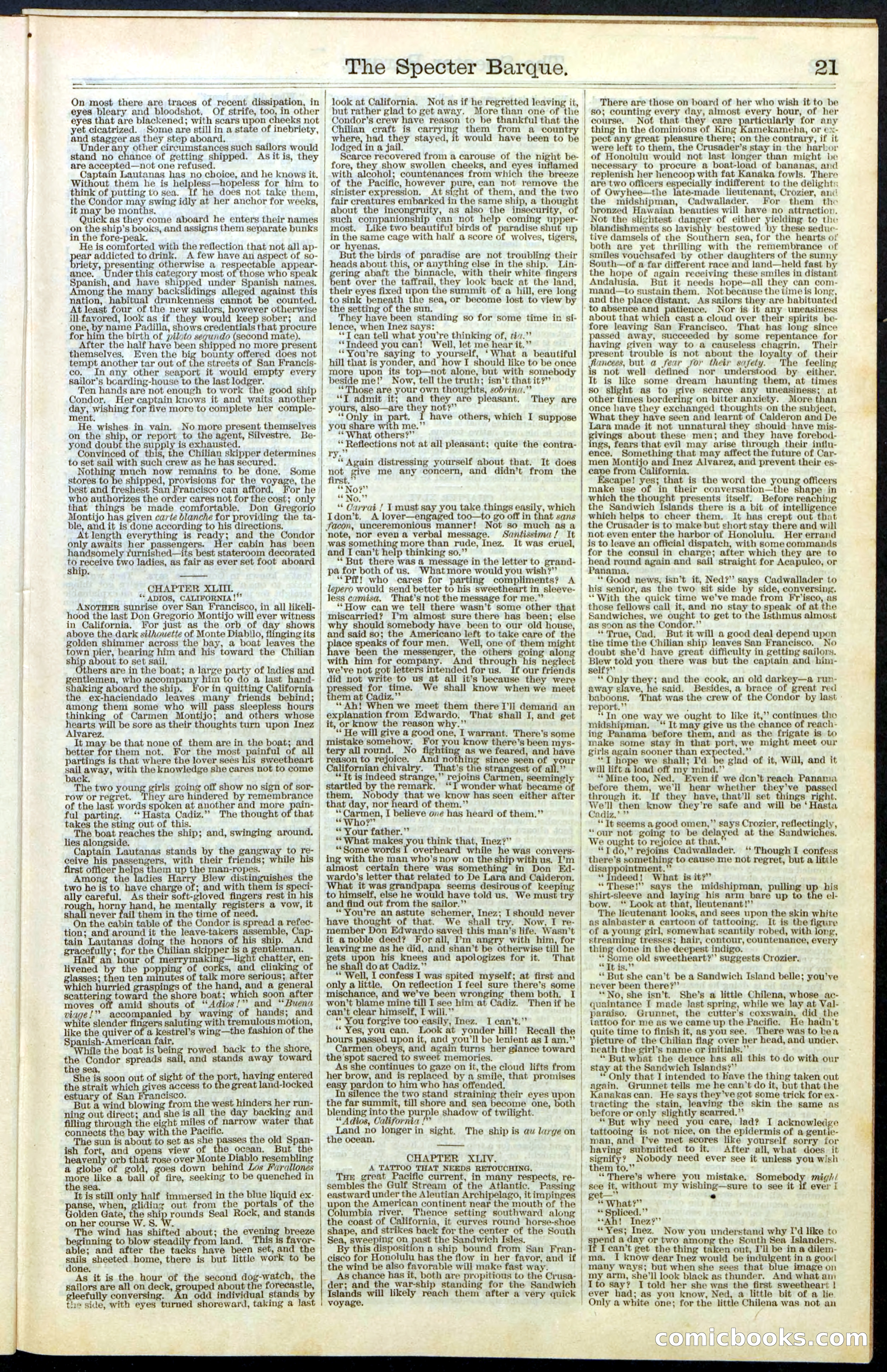
A restored page from Pulp Fiction, 1879. Page through the whole issue in the reader above.
📄 Transcribed text from this page (OCR, searchable)
Machine-transcribed from the original scan — historical spelling and the odd misread are preserved.
— ——_—__ —————— — On most there are traces of recent dissipation, in eyes bleary and bloodshot. Of strife, too, in other eyes that are blackened; with scars upon cheeks not yet cicatrized. Some are still in a state of inebriety, and stagger as they step aboard. f Under any other circumstances such sailors would stand no chance of getting shipped. Asitis, they are accepted—not one refused. Captain Lautanas has no choice, and he knows it. Without them he is helpless—hopeless for him to think of putting to sea. If he does not take them, the Condor may swing idly at her anchor for weeks, it may be months. Quick as they come aboard he enters their names on the ship’s books, and assigns them separate bunks in the fore-peak. He is comforted with the reflection that not all ap- rd addicted to drink. A few have an aspect of so- riety, presenting otherwise a sare aie ® appear- ance. Under this category most of those who speak Spanish, and have ene under Spanish names. Among the many backslidings alleged against this nation, habitual drunkenness cannot be counted. At least four of the new sailors, however otherwise il-favored, look as if they would keep sober; and one, by name Padilla, shows credentials that procure for him the birth of piloto segundo (second mate). After the half have been shipped no more present themselves. Even the big bounty offered does not tempt another tar out of the streets of San Francis- co. In any other seaport it would empty every sailor’s boarding-house to the last lodger. Ten hands are not enough to work the good ship Condor. Her captain knows it and waits another day, wishing for five more to complete her comple- ment. He wishes. in vain. on the arp or report to the agent, Silvestre. yond doubt the supply is exhausted. No more present barr ag e- Convinced of this, the Chilian skipper determines | to set sail with such crew as he has secured. Nothing much now remains to be done. Some stores to be shipped, provisions for the voyage, the best and freshest San Francisco can afford. For he who authorizes the order cares not for the cost; only that things be made comfortable. Don Gregorio Montijo has given carte blanche for providing the ta- ble, and it is done according to his directions. At length everything is ready; and the Condor only awaits her passengers. er cabin has been handsomely rurnished—its best stateroom decorated to receive two ladies, as fair as ever set foot aboard ship. 5 CHAPTER XLIL * ADIOS, CALIFORNIA!” ANOTHER sunrise over San Francisco, in all likeli- hood the last Don Gregorio Montijo will ever witness in California. For just as the orb of day shows above the dark silhouette of Monte Diabllo, flinging its golden shimmer across the bay, a boat leaves the town pier, bearing him and his toward the Chilian out to set sail. ship a Others are in the boat; a large panty of ladies and © do a last hand- | or in quitting California | gentlemen, who cosas ca him Shaking aboard the ship. IF the ex-haciendado leaves many friends behind; among them some who will pass sleepless hours thinking of Carmen Montijo; and others whose hearts will be sore as their thoughts turn upon Inez Alvarez. It may be that none of them are in the boat; and better for them not. For the most painful of all partings is that where the lover sees his sweetheart pa prey with the knowledge she cares not to come ack. The two young girls going off show no sign of sor- row or regret. 1ey are hindered by remembrance of the last words spoken at another and more pain- ful parting. ‘* Hasta Cadiz.” The thought of that takes the sting out of this. The boat reaches the ship; and, swinging around. | lies sn a pe Captain Lautanas stands by the RANERAY U0 re- ceive his panscnaers, with their friends; while his first officer pare hem up the man-ropes. Among the ies Harry Blew dist es the two he is to have charge of; and with them is speci- ally careful. As their soft-gloved fingers rest in his rough, horny hand, he mentally registers a vow, it shall never fail them in the time of need. On the cabin table of the Condor is spread a refec- tion; and around it the leave-takers assemble, Cap- tain ga Saag jane ats :- his att. And gracefully; for the ian skipper is a gentleman. Half ai hour of Ey et ee chatter, en- livened by the popping of corks, and clinking of glasses; then ten minutes of talk more serious; after which hurried graspings of the hand, and a general scattering toward the shore boat; which soon after amid shouts of ‘“Adios/*’ and “Buena moves 0 i viage!” accompanied by MSs) ty of hands; and white slender ers saluting with tremulous motion, like the quiver of a kestrel’s wing—the fashion of the bs} ish-American fair. While the boat is being rowed back to the shore the Condor spreads sail, and stands away toward the sea, She is soon out of sight of the port, having entered the strait which fran Rocese to the great land-locked estuary of San Francisco. But a wind blowing from the west. hinders her run- ning out direct; and she is all the day backing and filling through the eight miles of narrow water that connects the bay with the Pacific. The sun is about to rd as agh ee _ the e Spa ish fort, and opens view 0 ean. Bu e eekly orb that rose over Monte Diablo resembling a globe of gold, goes down behind Los Farallones more like a ball of fire, seeking to be quenched in the sea. It is still only half immersed in the blue liquid ex- , When, gliding out from the portals of the Iden Gate, the ship rounds Seal Rock, and stands on her course W. S. W. The wind has shifted about; the evening breeze nning to blow steadily from land. is favor- able; and after the tacks have been set, and the sails sheeted home, there is but little work to be done. = it is me mont Ps the Le tte Se eae ne sailors are all on dec uped about the forecastle, gleefully conversing. i og odd individual stands by the side, with eyes turned shoreward, taking a last ~* ST | | | | | | | | | 2 ee look at California. Not as if he regretted leaving it, The Specter Barque, —_ — | but rather glad to get away. More than one of the Condor’s crew have reason to be thankful that the Chilian craft is carrying them from a country where, had they stayed, it would have been to be lodged in a jail. Scarce recovered from a carouse of the night be- fore, they show swollen cheeks, and eyes inflamed with alcohol; countenances from which the breeze of the Pacific, however pure, can not remove the sinister expression. At sight of them, and the two | fair creatures embarked in the same ship, a thought about the incongruity, as also the insecurity, of such companionship can not help coming upper- most. Like two beautiful birds of paradise shut up in the same cage with half a score of wolves, tigers, | or hyenas, But the birds of paradise are not troubling their heads about this, or anything else in the ship. Lin- | gering abaft the binnacle, with their white fingers ent over the taffrail, they look back at the land, their eyes fixed upon the summit of a hill, ere long to sink beneath the sea, or become lost to view by the setting of the sun. They have been standing so for some time in si- lence, when Inez says: ‘**T can tell what you're thinking of, tiv.” **Indeed you can! Well, let me hear it.” “You're saying to yourself, ‘What a beautiful hill that is yonder, and how I should like to be once more upon its top—not alone, but with somebody beside me!’ Now, tell the truth; isn’t thatit?”’ “Those are your own thoughts, sobring.” “T admit it; and they are pleasant. They are yours, also—are wed not?" art. I have others, which I suppose ‘* Reflections not at all pleasant; quite the contra- “Again distressing yourself about that. It does ant give me any concern, and didn’t from the rst. No?” ‘* Oarrat |! T must say you take things easily, which Idon’t. A lover—engaged too—to go off in that sans facon, unceremonious manner! Not so much as a note, nor even a verbal message. Santissima/ It | was something more than rude, Inez, It was cruel, | and I can’t help thinking so.” ‘**But there was a message in the letter to grand- | pa for both of us. Whatmore would you wish?” ‘“Pff! who cares for parting compliments? A | lepero would send better to his sweetheart in sleeve- less camisa. That’s not the message for me.” ‘*How can we tell there wasn’t some other that | miscarried? I’m almost sure there has been; else why should somebody have been to our old house, and said so; the Americano left to take care of the | lace speaks of four men. Well, one of them might | ve been the messenger, the others going alon with him for company. And through his neglec we've not got letters intended for us. If our friends did not write to us at all it’s because they were | pressed for time. We shall know when we meet | them at Cadiz.” “Ah! When we meet them there I'll demand an explanation from Edwardo. That shall I, and get it, or know the reason why.” ‘“* He will give a good one, I warrant. There’s some mistake somehow. For you know there’s been mys- | tery allround. No figh 7 2 we feared, and have | reason to rejoice. And nothing since seen of your Californian chivalry. That’s the strangest of all. “Tt is indeed strange,” rejoins Carmen, seemingly | startled by the remark. “I wonder what became of | them, Nobody that we know has seen either after | that day, nor heard of them.” “Carmen, I believe one has heard of them.” “Who?” “Your father.” “What makes you think that, Inez?” “Some words [ overheard while he was convers- ing with the man who's now on the ship with us. I’m almost certain there was something in Don Ed- wardo’s letter that related to De Lara and Calderon. What it was grandpapa seems desirousof keeping to himself, else he would have told us. We must try and find out from the sailor.” “You’re an astute schemer, Inez; I should never have thought of that. We shall try. Now, I re- member Don Edwardo saved this man’s life. Wasn't it anoble deed? Forall, ’'m angry with him, for lea me as he did, and shan’t be otherwise till he ets upon his knees and apologizes for it. That es do at Cadiz.” * Well, I confess I was spited myself; at first and only a little, On reflection I feel sure there’s some mischance, and we've been wronging them both. I T) won't blame mine till I see him at Cadiz. Thenif he can't clear himself, I will.” ** You forgive too easily, Inez. I can't.” ** Yes, you can. Look at yonder hill! Recall the hours passed upon it, and you'll be lenient as I am.” Carmen obeys, and again turns her glance toward the spot sacred to sweet memories. As she continues to gaze on it, the cloud lifts from her brow, and is replaced by a smile, that promises easy pardon to him who has offended. In silence the two stand straining their eyes upon the far summit, till shore and sea become one, both | blending into the purple shadow of twilight. Adios, California !” Land no longerin sight. The ship is au large on the ocean. ooo CHAPTER XLIV. A TATTOO THAT NEEDS RETOUCHING. THe great Pacific current, in many respects, re- sembles the Gulf Stream of the Atlantic. Passing eastward under the Aleutian Archipelago, it impinges apap the American continent near the mouth of the olumbia river. Thence setting southward along the coast of California, it curves round horse-shoe shape, and strikes back for the center of the South Sea, sweeping on past the Sandwich Isles. By this disposition a ship bound from San Fran- | cisco for Honolulu has the flow in her favor, and if | the wind be also favorable will make fast way. As chance has it, both are HO bean to the Crusa- der; and the war-ship standing for the Sandwich Islands will likely reach them after a very quick voyage. ree _ will lift a load off m 21 There are those on board of her who wish it to be so; counting every day, almost every hour, of her course. Not that they care particularly for any thing in the dominions of King Kamekameha, or ex- t any great pleasure there; on the contrary, if it were left to them, the Crusader’s stay in the harbor of Honolulu would not last longer than might be necessary to procure a boat-load of bananas, and replenish her hencoop with fat Kanaka fowls. There are two officers especially indifferent to the delights of Owyhee—the late-made lieutenant, Crozier, ani! the midshipman, Cadwallader. For them the bronzed Hawaian beauties will have no attraction. Not the slightest danger of either yielding to the blandishments so lavishly bestowed by these seduc- tive damsels of the Southern sea, for the hearts of both are yet thrilling with the remembrance of smiles vouchsafed by other daughters of the sunny South—of a far different race and land—held fast by the hope of again receiving these smiles in distant Andalusia. But it needs hope—all they can com- mand—to sustain them. Not because the time is long, and the place distant. As sailors they are habituated to absence and patience. Nor is it any uneasiness about that which cast a cloud over their spirits be- fore leaving San Francisco. That has long since one away, succeeded by some repentance for iaving given way to a causeless chagrin. Their present trouble is not about the loganty of their Jjiancees, but a fear jor their safety. The feeling is not well defined nor understood by either, It is like some dream haunting them, at times so slight as to give scarce any uneasiness; at other times bordering on bitter anxiety. More than once have they exchanged thoughts on the subject, What they have seen and learnt of Calderon and De Lara made it not unnatural they should have mis- ivings about these men; and they have forebod- gs, fears that evil may arise through their influ- ence. Something that may affect the future of Car- men Montijo and Inez Alvarez, and prevent their es- cape from California. cape! yes; that is the word the young officers make use of in their conversation—the shape in which the thought presents itself. Before reaching the Sandwich Islands there is a bit of intelligence which helps to cheer them. It has crept out that the Crusader is to make but short stay there and will not even enter the harbor of Honolulu. Her errand is to leave an official dispatch, with some commands _ for the consul in charge; after which they are to —_ round again and sail straight for Acapulco, or -anama. “Good news, isn’t it, Ned?” says Cadwallader to his senior, as the two sit side by side, conversing. | “With the quick time we've made from Fr‘isco, as those fellows call it, and no stay to speak of at the Sandwiches, we ought to get to the Isthmus almost as soon as the Condor.” “True, Cad, But it will a good deal depend upon the time the Chilian ship leaves San Francisco. No doubt she'd have great difficulty in getting sailors. ed told you there was but the captain and him- se | “Only they; and the cook, an old darkey—a run- away slave, he said. Besides, a brace of great red baboons. That was the crew of the Condor by last - report.” : ‘*In one way we ought to like it,” continues tho midshipman. “ It may give us the chance of reach- ing Panama before them, and as the frigate is to make some stay in that port, we might meet our girls again sooner than expected.” “T hope we shall; = ey glad of it, Will, and it mind.” ““Mine too, Ned. Even if we don’t reach Panama before them, we'll hear whether they've passec| through it. If they have, that'll set things right. yng then know they're safe and will be ‘ Hasta ‘ac Zz. 7” “It seems a good omen,” says Crozier, reflectingly, “our not going to be delayed at the Sandwiches. We ought to rejoice at that.” “T do,” rejoins Cadwallader. “ Though 1 confess there’s something to cause me not regret, but a litile disappointment.” sf yma What = ne nlite 4s “ These!’ says the midshipman, u 8 shirt-sleeve and laying his arm mend up to the el- bow. “ Look at that, lieutenant!”’ The lieutenant looks, and sees upon the skin white as alabaster a cartoon of tattooing. It is the figure of a young girl, somewhat scantily robed, with long, streaming tresses; hair, contour, countenance, every thing done in the deepest indigo. . - —_ old sweetheart?’ suggests Crozier. “ t . ‘** But she can't be a Sandwich Island belle; you've never been there?” **No, she isn’t. She’s a little Chilena, whose ac- quaintance I made Jast spring, while we lay at Val- paraiso. Grunnet, the cutter’s coxswain, did the tattoo for me as we came up the Pacific. He hadn't quite time to finish it, as you see. There was to hea pieture of the Chilian fag over her head, and under, neath the girl’s name or initials.” “ But what the deuce has all this to do with our stay at the Sandwich Islands?" * Only that 1 intended to have the thing taken out again. Grunnet tells me he can’t do it, but that the nakas can. He says they’ve got some trick for ex- tracting the stain, leaving the skin the same as before or only slightly scarred.” “But why need you care, lad? I acknowledge tattooing is not nice, on the epidermis of a gentie- man, and I’ve met scores like yourself sorry for having submitted to it. After all, what does it ee ? Nobody need ever see it unless you wish em yy? - “There’s where you mistake. Somebod see it, without my wishing—sure to see it tt “What?” ? “ li ys? OER Inez?’ “Yes; Inez. Now you understand why I'd like to 193 be a day or two among the South Sea Islanders. Tean’t get the thing taken out, I'll be in a dilem- ma. I know dear Inez would be indulgent in a good many Weys; but when she sees that blue image on my arm, she'll look black as thunder. And what am Ito say? I told her she was the first sweetheart | ever had; as you know, Ned, a little bit of a lie Only a white one; for the little Chilena was not an / mig! ever | GEomichbooks.co Sg ee