
Pulp Fiction, 1879 · page 19 of 40
Beadle's New York Dime Library, No. 66 — page 19: what you’re looking at
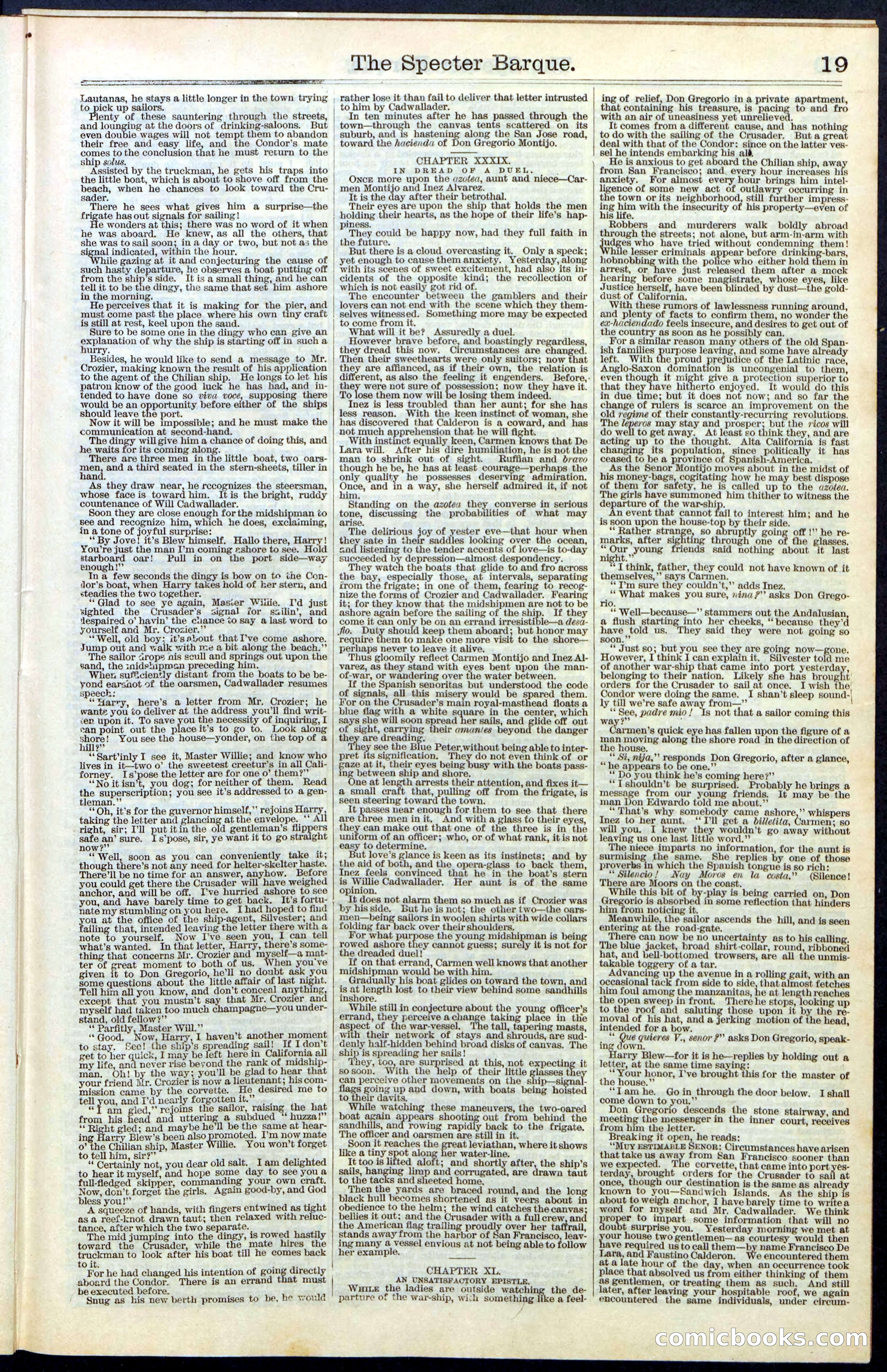
A restored page from Pulp Fiction, 1879. Page through the whole issue in the reader above.
📄 Transcribed text from this page (OCR, searchable)
Machine-transcribed from the original scan — historical spelling and the odd misread are preserved.
ee ° —_-—------ ore EER ne ae 5 a ws Lautanas, he stays a little longer in the town trying , to pick up sailors. enty of these sauntering through the streets, and lounging at the doors of drinking-saloons. But even double wages will not tempt them to abandon their free and easy life, and the Condor’s mate comes to the conclusion that he must return to the ship solus. : ; Assisted by the truckman, he gets his traps into the little boat, which is about to shove off from the beach, when he chances to look toward the Cru- sader. There he sees what gives him a surprise—the frigate has out signals for sailing! ; e wonders at this; there was no word of it when | he was aboard. He knew, as all the others, that she was to sail soon; in a day or two, but not as the | signal indicated, within the hour. ile gazing at it and conjecturing the cause of such eet departure, he observes a boat putting off | from the ship's side. It is a small thing, and he can tell it to be the dingy, the same that set him ashore in the morning. He perceives that it is making for the pier, and must come past the place where his own tiny craft is still at rest, keel upon the sand. ‘ Sure to be some one in the dingy who can give an og aaa of why the ship is starting off in such a urry. Besides, he would like to send a message to Mr. Crozier, making known the result of his Sper enenn to the agent of the Chilian ship. He longs to let his patron know of the good luck he has had, and in- tended to have done so viva voce, supposing there would be an opportunity before either of the ships should leave the port. Now it will be impossible; and he must make the communication at second-hand. . f The dingy will give him a chance of doing this, and he waits for its coming along. There are three men in the little boat, two oars- wen and a third seated in the stern-sheets, tiller in and. As they draw near, he recognizes the steersman, whose face is toward him. Itis the bright, ruddy countenance of Will Cadwallader. Soon they are close enough forthe midshipman to see and recognize him, which he does, exclaiming, in a tone of joyful surprise: ‘* By Jove! it’s Blew himself, Hallo there, Harry! You’re just the man I’m coming eshore to see. Hold starboard oar! Pull in on the port side—way enough!” ; In a few seconds the dingy is bow on toe the Con- dor’s boat, when Harry takes hold of her stern, and steadies the two together. a “Glad to see ye again, Masver Wiliie. I’d just nighted the Crusader’s signal for sailin’, and lespaired o’ havin’ the chance to say a last word to yourself and Mr. Crozier.”’ “Well, old boy: it’s aLout that ’'ve come ashore. Jump out and walk with me a bit along the beach.” The sailor crops ais scull and springs out upon the sand, the inidstupman preceding him. When sufficiently distant from the boats to be be- yond earsaot of the oarsmen, Cadwallader resumes speech: RK Harry, here’s a letter from Mr. Crozier; he wants you to deliver at the address you'll find writ- ver upon it. To save See the necessity of inquiring, I ran point out the placeit’s to go to. Look along shore! You see the house—yonder, on the top of a hill?” ‘‘Sart’inly I see it, Master Willie; and know who lives in it—two o’ the sweetest creetur’s in all Cali- forney. Is’pose the letter are for one 0’ them? ‘No it isn’t, you dog; for neither of them. Read the mereription: you see it’s addressed to a gen- tleman.” : ¥: ‘Oh, it’s for the guvernor himself,” rejoins Harry, taking the letter and glancing at the envelope. Al right, sir; I'll put itin the old gentleman's pippers saf . spose, sir, ye want it to go straight ‘“ Well, soon as you can conveniently take it; though there’s not any need for helter-skelter haste. There'll be no time for an answer, anyhow. Before you could get there the Crusader will have weighed anchor, and will be off. I’ve hurried ashore to see you, and have barely time to get back. It’s fortu- rou at the office of the ship-agent, Silvester; and ailing that, intended leaving the letter there with a note to yourself. Now I’ve seen you, L can tell what’s wanted. In that letter, Harry, there's some- thing that concerns Mr. Crozier and m self—a mat- ter of great moment to both of us. When you ve given if to Don Gregorio, he’ll no doubt ask you some questions about the little affair of last night. Tell him all you know, and don’t conceal anything, except that’ you mustn’t say that Mr. Crozier an myself had taken too much champagne—you under- stand, old fellow?” ‘* Parfitly, Master Will.”’ Now, Harry, I haven't another moment See! the ship's spreading sail! If I don’t get to her quick, I may be left here in California all my life, and never rise beyond the rank of midship- man. Oh! by the way; you'll be glad to hear that your friend Mr. Crozier is now a lieutenant; his com- mission came by the corvette. He desired me to tell you, and I’d nearly forgotten it.” |. ef am gied,’ rejoins the sailor, raising the hat from his head an ener aehanes ‘ mys on vr . ‘be he ethe samea - fiat gegen romoted. I’m now mate illie. You won’t forget ‘* Good, to stay. ing rry Blew’s been also ns 5 2 ag oe Master uim, sir?”’ % Certainly not, you dear old salt. I am delighted to hear it myself, and hope eine it xO Bee you. & full-fledged skipper, comman ; as: don’t forget the girls. Again good-by, and God ess you!” j A Pity of hands, with fingers entwined as tight asa aes Soest Hates then eso) with reluc- tance, after whic e two separate. The mid jumping into the dingy, is rowed hastily toward the Crusader, while the mate hires the truckman to look after his boat till he comes back t aboard the Condor. There is an errand be executed before. oO it. ‘or is tion of going directly © For he had changed his inten g na atev'f | Snug as his new berth promises to be, he vould Ges | suburb, and is hastenin Jio. Dut | | | | | nate my stumbling on you here. I had hoped to find ‘The Specter Barque. re rather lose it than fail to deliver that letter intrusted to him by Cadwallader. In ten minutes after he has passed through the town—through the canvas tents scattered on its along the San Jose road, toward the hacienda of Don Gregorio Montijo. CHAPTER XXXIX. IN DREAD OF A DUEL, ' ONCE more upon the «zolea, aunt and niece—Car- men Montijo and Inez Alvarez. It is the day after their betrothal. Their eyes are upon the ship that holds the men holding their hearts, as the hope of their life’s hap- iness. 2 They could be happy now, had they full faith in the future. : But there is a cloud overcasting it. Only a speck; yet enough to cause them anxiety. Yesterday, along with its scenes of sweet excitement, had also its in- cidents of the opposite kind; the recollection of which is not easily got rid of. The encounter between the gamblers and their lovers can not end with the scene which they them- selves witnessed. Something more may be expected to come from it. What will it be? Assuredly a duel. However brave before, and boastingly regardless, they dread this now. Circumstances are changed. Then their sweethearts were only suitors; now that they are affianced, as if their own, the relation is different, as also the feeling it engenders. they were not sure of poet now they have it. To lose them now will be losing them indeed. Inez is less troubled than her aunt; for she has less reason. With the keen instinct of woman, she has discovered that Calderon is a coward, and has not much apprehension that he will fight. With instinct equally keen, Carmen knows that De Lara will. After his dire humiliation, he is not the man to shrink out of sight. Ruffian and bravo though he be, he has at least courage—perhaps the only quality he possesses deserving admiration. Once, and in a way, she herself admired it, if not him, Standing on the azotea they converse in serious tone, discussing the probabilities of what may arise. The delirious joy of yester eve—that hour when they sate in their saddles looking over the ocean, aad listening to the tender accents of love—is to-day succeeded by depression—almost despondency. They watch the boats that glide to and fro across the bay, especially those, at intervals, separating from the frigate; in one of them, fearing to recog- nize the forms of Crozier and Cadwallader. Fearing it; for they know that the midshipmen are not to be ashore again before the sailing of the ship. If they come it can oy be on an errand irresistible—a desa- should keep them aboard; but honor may require them to make one more visit to the shore— perhaps never to leave it alive. Thus gloomily reflect Carmen Montijo and Inez Al- varez, as they stand with eyes bent upon the man- of-war, or wandering over the water between. If the Spanish senoritas but understood the code of signals, all misery would be spared them. For on the Crusader’s main royal-masthead floats a blue flag with a white square in the center, which says she will soon spread her sails, and glide off out of sight, carrying their amanies beyond the danger they are dreading. ey see the Blue Peter,without being able to inter- pret its signification. They do not even think of or aze at it, their eyes being busy with the boats pass- ng between ship and shore, One at length arrests their attention, and fixes it— a small craft that, pulling off from the frigate, is seen steering toward the town. It passes near enough for them to see that there are three men init. And with a glass to their eyes, they can make out that one of the three is in the uniform of an officer; who, or of what rank, it is not easy to determine. But love's glance is keen as its instinets; and by the aid of both, and the opera-glass to back them, Inez feels convinced that he in the boat’s stern is Willie Cadwallader. Her aunt is of the same opinion. It does not alarm them so much as if Crozier was by his side. But he is not; the other two—the oars- men—being sailors in woolen shirts with wide collars percing tar ack over their ae AE ee ‘or what purpose the young n an is g rowed ashore thay cannot guess; aa op it is not for the dreaded duel! If on that errand, Carmen well knows that another midshipman would be with him. Gradually his boat glides on toward the town, and is at length lost to their view behind some sandhills ore. While still in conjecture about the young officer's errand, they perceive achange taking place in the aspect of the war-vessel. é tall, tapering masts, with their network of stays and shrouds, are sud- denly half-hidden behind broad disks of canvas. The ship is spreading her sails! They, too, are ag tap at this, not expecting it sosoon. With the elp of their little glasses the can perceive other movements on the ship—signal- going up and down, with boats being hoisted to their davits. While watching these maneuvers, the two-oared boat again appears peters 3 out from behind the sandhills, and rowing rapidly back to the frigate. The officer and oarsmen are still in it. Soon it reaches the t leviathan, where it shows like a tiny spot alo er water-line. after, the ship’s tne i bone, Sed Bs. short s, han p and corrugated, are drawn taut to the nen oop Ee sheeted home, Then the yards are braced round, and the long black hull becomes shortened as it veers about in obedience to the helm; the wind catches the canvas: bellies it out: and the Crusader with a full crew, an the American flag trailing proudly over her taffrail, stands away from the harbor of San Francisco, leav- ing many & vessel envious at not being able to follow her example, CHAPTER XL, AN UNSATISFACTORY EPISTLE. Waite the ladies are outside watch the de- parture of the war-ship, with something like a feel- Before, - meme Ee 19 ing of relief, Don Gregorio in a private apartment, that containing his treasure, is pacing to and fro with an air of uneasiness yet unrelieved. It comes from a different cause, and has nothin to do with the sailing of the Crusader. But a great deal with that of the Condor: since on the latter ves- sel he intends embarking his ald, He is anxious to get aboard the Chilian ship, awa from San Francisco; and. every hour increases his anxiety. For almost every hour brings him intel- ligence of some new act of outlawry occurring in the town or its neighborhood, still further impress- efi aay with the insecurity of his property—even of 8 life. Robbers and murderers walk boldly abroad through the streets; not alone, but arm-in-arm with qu es who have tried without condemning them! hile lesser criminals appear before drinking-bars, hobnobbing with the police who either hold them in arrest, or have just released them after a mock hearing before some magistrate, whose eyes, like Justice herself, have been blinded by dust—the gold- dust of California. With these rumors of lawlessness running around, and plenty of facts to confirm them, no wonder the ex-hauciendado feels insecure, and desires to get out of the country as soon as he possibly can. For a similar reason many others of the old Span- ish families purpose leaving, and some have already left. With the proud peeiuaice of the Latinie race, Anglo-Saxon domination is uncongenial to them, even though it might give a protection superior to that they have hitherto enjoyed. It would do this in due time; but it does not now; and so far the change of rulers is scarce an improvement on the old regime of their constantly-recurring revolutions. The os ekg may stay and prosper; but the vicos will do well to get away. At least so think they, and are acting up to the thought. Alta California is fast changing its population, since politically it has ceased to be a province of Spanish-America, i 7 the raion teh eh i gat in ae eth of money- 8, CO, ng how he may best dispose of them for safety, he is called up to the anaden. The girls have summoned him thither to witness the 5 cope of the hint 9 n event that cannot fail to interest him; and he is soon upon the house-top by their side. ** Rather gy 8 s0 abruptly going off!” he re- marks, after sigt ting through one of the glasses. sie ee friends said nothing about it last ‘I think, father, they could not have known of it themselves,’’ says Carmen. **T’m sure they couldn't,’’ adds Inez. * What makes you sure, ina ?”’ asks Don Grego- 0. ** Well—because—”’ stammers out the Andalusian a flush starting into her cheeks, “‘ because they'd have told us, They said they were not going so soon.”’ ** Just so; but you see they are going now—gone. However, I think I can explain it. Silvester told me of another war-ship that came into port yesterday, belonging to their nation. Likely she has brou ht! orders for the Crusader to sail at once. I wish the’ Condor were doing the same. I shan’t sleep sound:| ly till we’re safe away from—” os Ree, padre mio ! not that a sailor coming this way?” Carmen’s quick eye has fallen upon the figure of a man moving along the shore road in the direction of the house. * Si, nija,”’ responds Don Gregorio, after a glance, “he appears to be one.” ** Do you think he’s coming here?” ‘IT shouldn't be surprised. Probably he brings a message from our young friends. It may be the man Don Edwardo told me about.” “ That's why somebody came ashore,” whispers Inez to her aunt. ‘Ill get a dilletita, Carmen; 50 will you. I knew they wouldn’t go away without leaving us one last little word.” The niece imparts no information, for the aunt is sul the same. She replies by one of those proverbs in which the Spanish tongue is so rich: ** Silencio! Nay Moros en la costa.” (Silence! There are Moors on the coast. While this bit of by-play is being carried on, Don hig teat is absorbed in some reflection that hinders him from noticing it, Meanwhile, the sailor ascends the hill, and is seen entering at the road -gate. There can now be no uncertainty as to his calling. The blue jacket, broad shirt-collar, round, ribboned hat, and bell-botiomed trowsers, are all the unmis- takable toggery of a tar. Advancing up the avenue in a rolling gait, with an occasional tack from side to side, that almost fetches him foul among the manzanitas, he at length reaches the open sweep in front, There he stops, looking up to the roof and saluting those upon it by the re- moval of his hat, and a jerking motion of the head, intended for a bow. * Que quieres V., senor ?” asks Don Gregorio, speak- ing down. Harry Blew—for it is he—replies by holding out a letter, at the same time ep ey ‘Your honor, I’ve brought this for the master of the house.” “Tam he. Goin through the door below. I shall come down to you.” Don Gregorio descends the stone stairway, and meeting the messenger in the inner court, receives from the letter. Breaking it open, he reads: “Muy ESTIMABLE SENOR: Circumstances have arisen that take us away from San Francisco sooner than we expected. The corvette, that came into port yes- terday, brought orders for the Crusader to sail at once, though our destination is the same as alrea known to you—Sandwich Islands. As the shi about to weigh anchor, I have barely time to writea word for myself and Mr. Cadwallader. We think Broper to impart some information that will no oubt surprise you. Yesterday morning we met at your house two gentlemen— as courtesy would then ave required us to call them—by name Francisco De Lara, and Faustino Calderon. e encountered them at alate hour of the day, when an occurrence took place that absolved us from either thinking of them as gentlemen, or treating them as such, And still later, after leaving your hospitable roof, we again encountered the same individuals, under circum- Gomicbooks aA) iGO