
Pulp Fiction, 1879 · page 1 of 40
Beadle's New York Dime Library, No. 66 — page 1: what you’re looking at
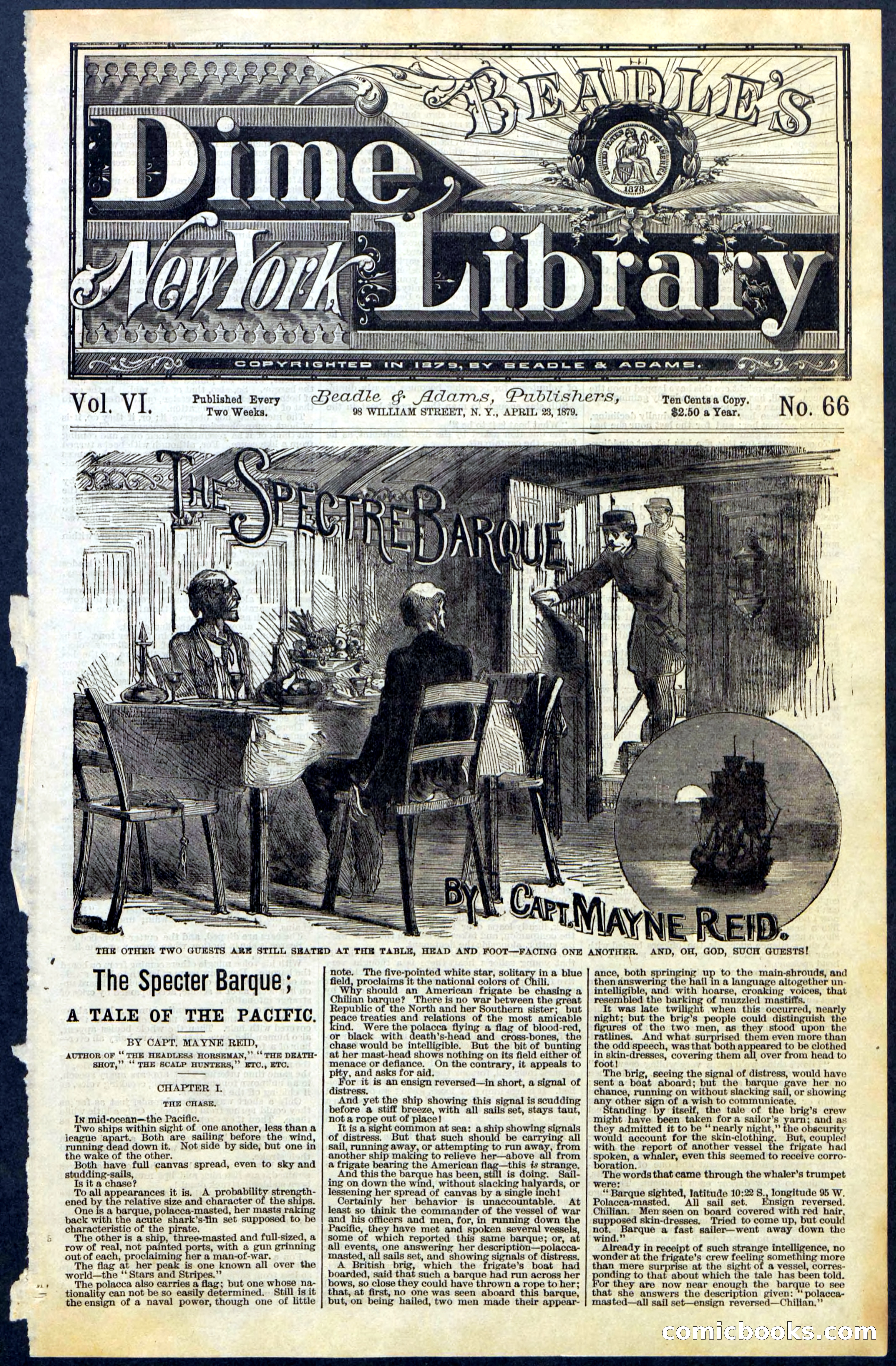
A restored page from Pulp Fiction, 1879. Page through the whole issue in the reader above.
📄 Transcribed text from this page (OCR, searchable)
Machine-transcribed from the original scan — historical spelling and the odd misread are preserved.
| ai — | SHAME. °) yo) ™~ ——— CCT RR ti fl ie Bilt" SS a ee . ee Fam " i : iil wy A COPYRIGHTED IN I18793,8Y BEADLE & ADAMS. PPADAT SL bs Of Published Every Two Weeks. Beadle g¢ Adams, | BY, me. 98 WILLIAM STREET, N. Y., APRIZ 23, 1879. a feds 8) yi YZ, _,. 4 i ym (if Publishers, Ten Cents a Copy. $2.50 a Year. p CDs bbe ton by . —_ | { ie whe) PMSF ee OPN Hee | aiciill | | | 4 | | An ii} i! Ma { \ Hi) eb, TW Wey) i TM | | | | | | | | Whi | ) THE OTHER TWO GUESTS ARE STILL SBATED AT THE TABLE, HEAD AND FOOT—FACING ONE ANOTHER. AND, OH, GOD, SUCH GuEsSTS! The Specter Barque ; A TALE OF THE PACIFIC. BY CAPT, MAYNE REID, AUTHOR OF “‘ THE HEADLESS HORSEMAN,”’ “ THE DEATH- sHOT,”’ ‘‘ THE SCALP HUNTERS,” ETC., ETC. CHAPTER I. THE CHASE, In mid-ocean—the Pacific. Two ships within sight of one another, less than a league apart. Both are sailing before the wind, runni ead down it. Not side by side, but one in the wake of the other. Both have full canvas spread, even to sky and studding-sails, Is it a chase? To all ps eagle hg it is. A probability strength- ened by the relative size and character of the ships. One is a barque, polacca-masted, her masts r back with the acute shark’s-fin set supposed to be characteristic of the pirate. The other is a ship, three-masted and full-sized, a row of real, not ee nted ports, with a gun grinning out of each, proclaiming her a man-of-war. The flag at her peak is one known all over the world—the ‘‘ Stars and Stripes.” The polacca also carries a flag; but one whose na- tionality can not be so easily determined. Still is it the ensign of a naval power, though one of little note. The wah ti ae white star, solitary in a blue field, proclaims it the national colors of Chili, Why should an American frigate be chasing a Chilian barque? There is no war between the great Republic of the North and her Southern sister; but ace treaties and relations of the most amicable ind. Were the polacca flying a flag of blood-red, or black with death’s-head and cross-bones, the chase would be intelligible. But the bit of buntin at her mast-head shows nothing on its field either o menace or defiance. On the contrary, it appeals to pity. and asks for aid. or it is an ensign reversed—in short, a signal of distress. And yet the ship showing this signal is scudding before a stiff breeze, with all sails set, stays taut, not a rope out of place! It is a sight common at sea: a we showing signals of distress. But that such should be carrying all sail, running away, or attempting to run away, from another ship making to relieve her—above all from a frigate bearing the American flag—this is strange. And this the barque has been, still is doing. Sail- ing on down the wind, without slacking Loy Aer or lessening her spread of canvas by a single inch! Certainly her behavior is unaccountable. At least so think the commander of the vessel of war and his officers and men, for, in running down the Pacific, ye have met and spoken several vessels, some of which reported this same barque; or, at all events, one answering her description—polacca- masted, all sails set, and showing signals of distress. A British brig, which the frigate’s boat had boarded, said that such a barque had run across her bows, so close they could have thrown a rope to her; that, at first, no one was seen aboard this barque, but, on being hailed, two men made their appear- ance, both springing up to the main-shrouds, and then answering the hail in a language altogether un- intelligible, and with hoarse, croaking voices, that resembled the barking of muzzled mastiffs. It was late twilight when this occurred, nearly night; but the brig’s people could distinguish the figures of the two men, as they stood upon the ratlines. And what surprised them even more than the odd speech, was that both nt pr tit to be clothed re aoa covering them all over from head to oot The brig, seeing the signal of distress, would have sent a boat aboard; but the barque gave her no chance, running on without slacking sail, or showing —" other s of a wish to communicate. tanding by itself, the tale of the brig’s crew might have been taken fora sailor’s yarn; and as they admitted it to be “ nearly night,” the obscurity would account for the acaba pe But, coupled with the report of another vessel the frigate had spoken, a whaler, even this seemed to receive corro- boration. The words that came through the whaler’s trumpet were: ‘ Barque sighted, latitude 10:22 8., longitude 95 W. Polacca-masted. All sail set. Ensign reversed. Chilian. Men seen on board covered with red hair, SB skin-dresses. Tried to come up, but could = a Barque a fast sailer—went away down the nd.” Already in receipt of such strange intelligence, no wonder at the frigate’s crew feeling something more than mere surprise at the sight of a vessel, corres- nding to that about which the tale has been told. or they are now near enough the barque to see that she answers the description given: “ polacca- masted—all sail set—ensign reversed—Chillan.”’ Eomichbooks.Go