
Pulp Fiction, 1879 · page 18 of 40
Beadle's New York Dime Library, No. 66 — page 18: what you’re looking at
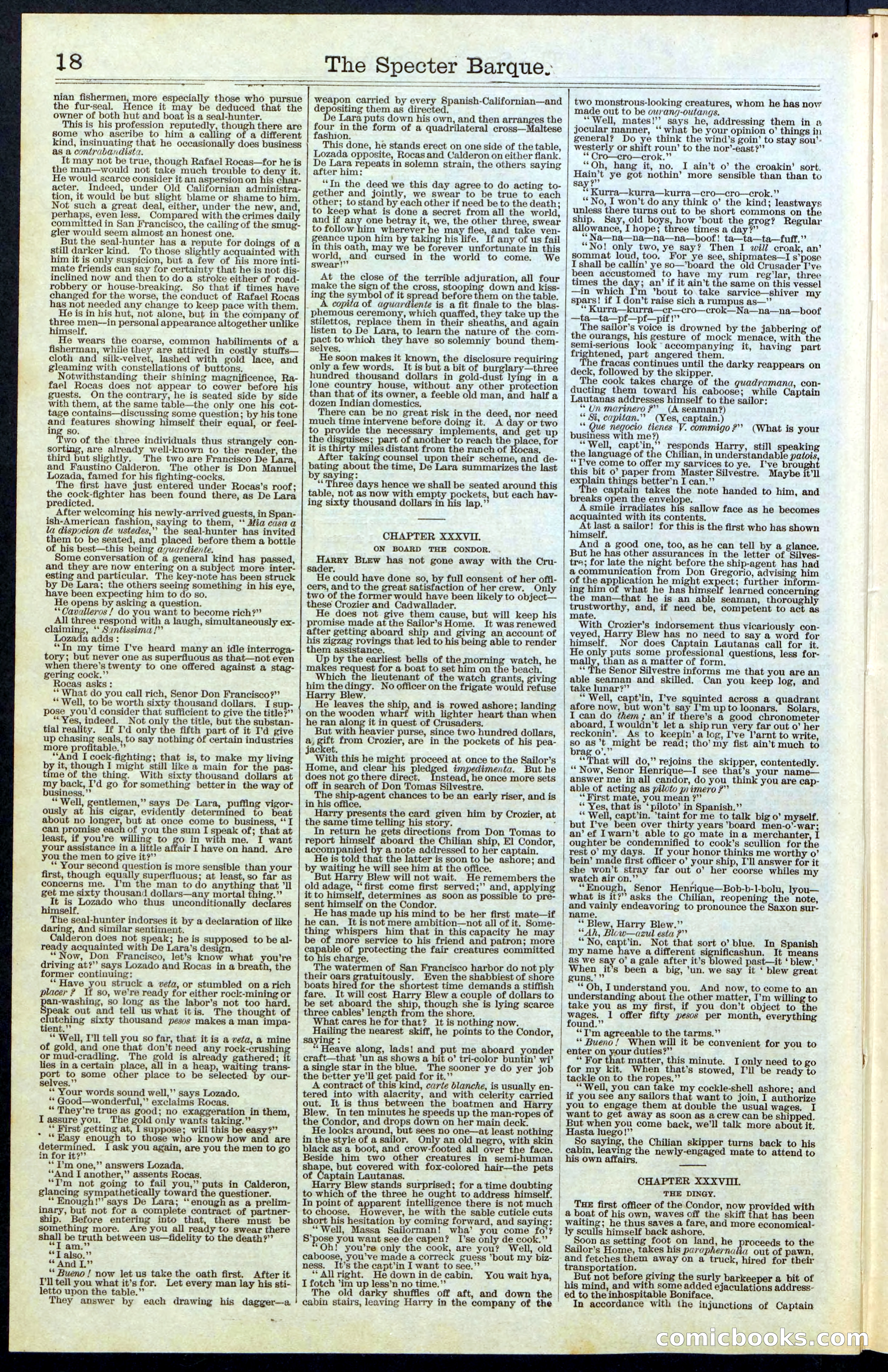
A restored page from Pulp Fiction, 1879. Page through the whole issue in the reader above.
📄 Transcribed text from this page (OCR, searchable)
Machine-transcribed from the original scan — historical spelling and the odd misread are preserved.
18 nian fisherme the fur-seal. owner of both hut and boat is a seal-hunter. This is his profession reputedly, though there are him a calling of a different kind, insinuating that he occasionally does business some who ascribe to as a contrabandista. It may not be true, though Rafael Rocas—for he is the man—would not take much trouble to ge it. He would scarce consider it an aspersion on his ¢ acter. gler would seem almost an honest one. But the seal-hunter has a repute for doings of a still darker kind. To those slightly acquainted with is more inti- mate friends can say for certainty that he is not dis- inclined now and then to do a stroke either of road- robbery or house-breaking. So that if times have changed for the worse, the conduct of Rafael Rocas has not needed any change to keep pace with them. him it is only suspicion, but a few of He is in his hut, not alone, but in the company of three men--in personal appearance altogether untik e himself. He wears the coarse, common habiliments of a stuffs— ce, and fisherman, while they are attired in costl cloth and silk-velvet, lashed with gold gleaming with constellations of buttons. Notwithstanding their shining magnificence, Ra- fael Rocas does not appear to cower before 75 side 8 cot- some question; by his tone mself their equal, or feel- guests. On the contrary, he is seated side b with them, at the same table—the only one tage contains—discuss and features showing & so. Two of the three individuals thus strangely con- sorting, are already well-known to the reader, the third but slightly. The two are Francisco De Lar. and Faustino Calderon. Lozada, famed for his fighting-cocks. The first have just entered under Rocas’s roof; the cock-fighter has been found there, as De Lara predicted. ; After welcoming his newly-arrived guests, in Span- ish-American fashion, eee to them, ‘‘ Mia casaa la dispocion de ustedes,” the seal-hunter has invited them to be seated, and placed before them a bottle of his best—this being ajuardiente. Some conversation of a general kind has passed, and they are now entering on a subject more inter- esting and particular. The key-note has been struck by De Lara; the others seeing something in his eye, have been expecting him to do so. He opens by asking a question. **Cavalleros / do you want to become rich?” All three respond with a laugh, simultaneously ex- claiming, ‘‘ Suntissima !”’ Lozada adds : “In my time I’ve heard many an idle interroga- tory; but never one as superfluous as that—not even when there’s twenty to one offered against a stag- gering cock,”’ Roeas asks: ** What do you call rich, Senor Don Francisco?” “* Well, to be worth sixty thousand dollars. I sup- pose you'd consider that sufficient to give the title?” “Yes, indeed. Not only the title, but the substan- tial reality. If I’d only the fifth part of it I'd give up chasing seals, to say nothing Of certain industries more profitable.” “And I cock-fighting; that is, to make m living by it, though I might still like a main for the pas- me of the thing. With sixty thousand dollars at my back, I’d go for something betterin the way of Well ¢ tl De La fing vig: e entlemen,”’ says De ra, puffing or- ously at This cigar, evidently deteeiaad to beat about no longer, but at once come to business, “I can promise each of you the sum Is of; that at least, if you're willing to go in with me. I want your assistance in a liftle affair I have on hand. Are you the men to give it?” ** Your second question is more sensible than your first, though orialy superfluous; at least,so far as concerns me. I’m the man to do anything that ‘ll get me sixty thousand dollars—any mortal thing.” It =? Lozado who thus unconditionally dec The seal-hunter indorses it by a declaration of like daring, and similar sentiment. Calderon does not speak; he is supposed to be al- ready acquainted with De Lara’s design. “Now, Don Francisco, let’s know what you're driving at?’ says Lozado and Rocas in a breath, the former continuing: “* Have a struck a veta, or stumbled on a rich placer ? 80, we're ready for either rocl:-mining or oa OnenG, so long as the labor’s not too hard. out and tell us what itis. The thought of clutching tient.” ‘Well, I'll tell you so far, that itis a veta, a mine of gold, and one that don’t need any rock-crushin or mud-cradli The gold is already gathered; it lies in a certain place, in a heap, waiting trans- port to some other place to be selected selves.” “Your words sound well,”’ says Lozado. ** G@ood—wonderful,"”’ exclaims Rocas. “ They’re true as good; no e eration in them, ITassure you. The gold only wants taking.” * First pipe ine I suppose; will this be easy?” * “*Easy enough to those who know how and are determined, I ask you again, are you the men to go in for it?’ ‘** I’m one,” answers Lozada. ‘And I another,” assents Rocas. “I’m not going to fail you,” = in Calderon, glancing We Santas reg er uestioner. ** Enough!” says De a; “enough as a prelim- inary, but not for a complete contract of ner- ship. Before entering into that, there must be something more. Are you all ready to swear there shall be truth between us—fidelity to the death?” sy ” “And I.” sixty thousand pesos makes a man impa- y our- ** Bueno ! now let us take the oath first. After it Pll tell you what it’s for. Let every man lay his sti- letto upon the table.” They answer by each drawing his dagger—a ! more especially those who pursue Hence it may be deduced that the Indeed, under Old Californian administra- tion, it would be but slight blame or shame to him. Not such a great deal, either, under the new, and, perhaps, even less. Compared with the crimes daily committed in San Francisco, the cailing of the smug- a The other is Don Manuel The Specter Barque. weapon carried by every Spanish-Californian—and depositing them as directed. e Lara puts down his own, and then arranges the four in the form of a quadrilateral cross—Maltese fashion. ; This done, he stands erect on one side of the table, Lozada opposite, Rocas and Calderon on either flank. ae ae repeats in solemn strain, the others saying after him; “In the deed we this day agree to do acting to- gether and jointly, we swear to be true to each other; to stand by each other if need be to the death; to keep what is done a secret from all the world, and if ay one betray it, we, the other three, swear to follow him wherever he may flee, and take ven- geance upon him by taking his life. If any of us fail in this oath, may we be forever unfortunate in this world, and cursed in the world to come. We swear!”’ At the close of the terrible adjuration, all four make the sign of the cross, stooping down and kiss- mee symbol of it spread before them on the table. copita of aguardiente is a fit finale to the blas- phemous ceremony, which quaffed, they take up the stilettos, replace them in their sheaths, and again listen to De Lara, to learn the nature of the com- a to which they have so solemniy bound them- selves, He soon makes it known, the disclosure requiring only afew words. It is but a bit of burglary—three hundred thousand dollars in gold-dust lying in a Jone country house, without any other protection than that of its owner, a feeble old man, and half a dozen Indian domestics. There can be no great risk in the deed, nor need much time intervene before doing it. A day or two to provide the necessary implements, and get up the disguises; part of another to reach the place, for it is thirty miles distant from the ranch of Rocas. After taking counsel upon their scheme, and de- bating about the time, De Lara summarizes the last by ga aoe. © ‘* Three days hence we shall be seated around this table, not as now with empty pockets, but each hay- ing sixty thousand dollars in his lap,”’ ——. CHAPTER XXXVI. ON BOARD THE CONDOR. cook BLew has not gone away with the Cru- er. He could have done so, by full consent of her offi- cers, and to the great satisfaction of her crew. Only two of the former would have been likely to object— these Crozier and Cadwallader. He does not give them cause, but will keep his promise made at the Sailor’s Home. It was renewed after getting aboard ship and giving an account of his zi rovings that led to his being able to render them assistance. Up by the earliest bells of the morning watch, he makes tg ge for a boat to set him on the beach. Which the lieutenant of the watch grants, giving a beget peek No officer on the frigate would refuse arry Blew. He leaves the ship, and is rowed ashore; landing on the wooden wharf with lighter heart than when he ran along it in quest of Crusaders. But with heavier purse, since two hundred dollars, a, gift from Crozier, are in the pockets of his pea- jacket. With this he ins th proceed at once to the Sailor’s Home, and clear his pledged impedimenta. But he does not go there direct. stead, he once more sets off in search of Don Tomas Silvestre. The ship-agent chances to be an early riser, and is HReey te ts the card given him by Crozier, at presen 6 car ven y Crozier, a the same time telling his story. . In return he gets directions from Don Tomas to report himself aboard the Chilian ship, El] Condor, accompanied by a note addressed to her captain. He is told that the latter is soon to be ashore; and by waiting he will see him at the office. But Harry Blew will not wait. He remembers the old adage, “first come first served;”’ and, applyin it to himself, determines as soon as possible to pre- sent himself on the Condor. . He has made up his mind to be her first mate—if he can. It isnot mere ambition—not all of it. Some- thing whispers him that in this capacity he may be of more service to his friend and patron; more ca vars protecting the fair creatures committed s charge. The watermen of San Francisco harbor do not ply their oars | Pingel ote . Even the shabbiest of shore boats hired for the shortest time demands a stiffish fare. It will cost Harry Blew a couple of dollars to be set aboard the ship, though she is lying scarce three cables’ length from the shore. t cares he for that? lt is nothing now. Hailing the nearest skiff, he points to the Condor, saying : ‘Heave along, lads! and put me aboard yonder craft—that ‘un as shows a bit o’ tri-color buntin’ wi’ a single star in the blue. The sooner ye do yer job the better ye’ll get paid for it.” A contract of this kind, carte blanche, is usually en- tered into with alacrity, and with celerity carried out. It is thus between the boatmen and Harry Blew. T ten minutes he speeds up the man-ropes of the Condor, and drops down on her main deck. He looks around, but sees no one—at least nothing in the style of a sailor. Only an old negro, with skin black as a boot, and crow-footed all over the face. Beside him two other creatures in semi-human shape, but covered with fox-colored hair—the pets of Captain Lautanas. Harry Blew stands surprised; for a time doubtin to which of the three he ought to address himself. In point of apparent intelligence there is not much to choose. However, he with the sable cuticle cuts short his hesitation by coming forward, and saying: “Well, Massa Sailorman! wha’ you come fo’? S’pose you want see de capen? I’se only de cook.” ‘Oh! you’re only the cook, are you? Well, old caboose, you’ve made a correck guess “bout my biz- ness. It’s the capt’in I want to see.” 4 “Allright. He downinde cabin, You wait hya, I fotch *im up less’n no time.” The old darky shuffles off aft, and down the : cabin stairs, leaving Harry in the company of the | two monstrous-looking creatures, whom he has nov made out to be owrang-outangs. ‘Well, mates!’’ says he, addressing them in a jocular manner, “‘ what be your opinion o’ things in general? Do ye think the wind’s goin’ to stay sou’- westerly or shift roun’ to the nor’-east?”’ ** Cro—cro—crok.”’ “Oh, hang it, no. I ain’t o’ the croakin’ sort. Hain’t ye got nothin’ more sensible than than to Say?”’ f Kurra—kurra—kurra—cro—cro—crok.”’ ‘No, I won’t do any think o’ the kind; leastways unless there turns out to be short commons on the ship. Say, old boys, how "bout the grog? Regular allowance, I hope; three times a day?” ** Na—na—na—na—na—boof! ta—ta—ta—fuff.”’ “No! only two, ye say? Then I will croak, an’ sommat loud, too. For ye see, shipmates—I s’pose I shall be callin’ ye so—’board the old Crusader I’ve been accustomed to have my rum reg’lar, three times the day; an’ if it ain’t the same on this vessel —in which I’m ’bout to take sarvice—shiver my spars! if I don’t raise sich a rumpus as—”’ ** Kurra—kurra—cr—cro—crok—Na—na—na—boof —ta—ta—pf—pf—pif!”’ The sailor’s voice is drowned by the jabbering of the ourangs, his gesture of mock menace, with the Semi-serious look accompanying it, having part frightened, part angered them. he fracas continues until the darky reappears on deck, followed by the skipper. The cook takes charge of the guadramana, con- ducting them toward his caboose; while Captain Lautanas addresses himself to the sailor: “ Un marinero 2?” (A seaman?) ** Si, capitan.”’ (Yes, captain.) * Que negocio tienes V. commigo ?” business with me?) “Well, capt’in,” responds Harry, still speaking the language of the Chi ian, in understandable patois ‘‘ ve come to offer my sarvices to ye. I’ve brou t this bit o’ paper from Master Silvestre. Maybe it’ll explain things better’n I can.”’ e captain takes the note handed to him, and breaks open the envelope. A smile irradiates his sallow face as he becomes acquainted with its contents. At last a sailor! for this is the first who has shown (What is your ‘himself. And a good one, too, as he can tell by a glance. But he has other assurances in the letter of Silves- tre; for late the a before the ship-agent has had a communication from Don Gregorio, advising him of the application he might expect; further inform- ing him of what he has himself learned concerning the man—that he is an able seaman, thoroughly che iid and, if need be, competent to act as mate. With Crozier’s indorsement thus vicariously con- veyed, Harry Blew has no need to say a word for himself. or does Captain Lautanas call for it. He only puts some professional questions, less for- mally, than as a matter of form. ‘“ The Senor Silvestre informs me that you are an able seaman and skilled. Can you keep log, and take lunar?” ‘Well, capt’in, I’ve squinted across a quadrant afore now, but won’t fey: I’m up to loonars. Solars, I can do them; an’ if there’s a good chronometer aboard, I wouldn't let a ship run very far out o’ her reckonin’. As to keepin’ a log, I’ve l’arnt to write, = as’t might be read; tho’ my fist ain’t much to rag o’.”’ ‘That will do,” rejoins the skipper, contentedly. ‘Now, Senor Henrique—I see that’s your name— answer me in all candor, do you_think you are cap- able of acting as piloto pimero ?” ‘First mate, you mean ?”’ ** Yes, that is ‘ piloto’ in Spanish.” “Well, capt’in. ‘taint for me to talk big o’ myself. but I’ve been over thirty years board men-o’-war: an’ ef Iwarn’t able to go mate ina merchanter. I oughter be condemnified to cook’s scullion for the vest o’ my days. If your honor thinks me worthy o’ bein’ made first officer o’ your ship, I'll answer for it she won't stray far out o’ her coorse whiles my watch air on.”’ > “Enough, Senor Henrique—Bob-b-l-bolu, lyou— what is it?” asks the i reopening the note, and vainly endeavoring to pronounce the Saxon sur- e. ‘** Blew, Harry Blew.” “Ah, Blow—azul esta ?” * No, capt'in. Not that sort o’ blue. In Spanish my name have a different op (RE It means as we say 0’ a gale after it’s blowed past—it ‘ blew.’ en it s been a big, ‘un. we say it ‘* blew great na? ‘** Oh, I understand oe And now, to come to an understanding about the other matter, I'm willing to take you as my first, if you don’t object to the babi dary 1 offer fifty pesos per month, everything ound.” “I’m agreeable to the tarms.” “Bueno! When will it be convenient for you to enter on yourduties?” “ For that matter, this minute. I only need to go for my kit. When that’s stowed, I’ll be ready to tackle on to the ropes.”’ “Well, you can take my cockle-shell ashore; and if you see any sailors that want to join, I authorize you to engage them at double the usual wages, I want to get away as soon as a crew can be shipped. But when you come back, we'll talk more about it. Hasta luego!”’ So sa , the Chilian skipper turns back to his cabin, leaving the newly-engaged mate to attend to his own affairs. CHAPTER XXXVIII. THE DINGY. THE first officer of the Condor, now provided with a boat of his own, waves off the skiff that has been waiting; he thus saves a fare, and more economical- ly sculls himself back ashore. Soon as setting foot on land, he proceeds to the Sailor’s Home, takes his paraphernalia out of pawn, and fetches them away on a truck, hired for their transportation. But not before giving the surly barkeeper a bit of his mind, and with some added ejaculations address- ed to the inhospitable Boniface, In accordance with the injunctions of Captain ES EOomicboo SS