
Pulp Fiction, 1879 · page 15 of 40
Beadle's New York Dime Library, No. 66 — page 15: what you’re looking at
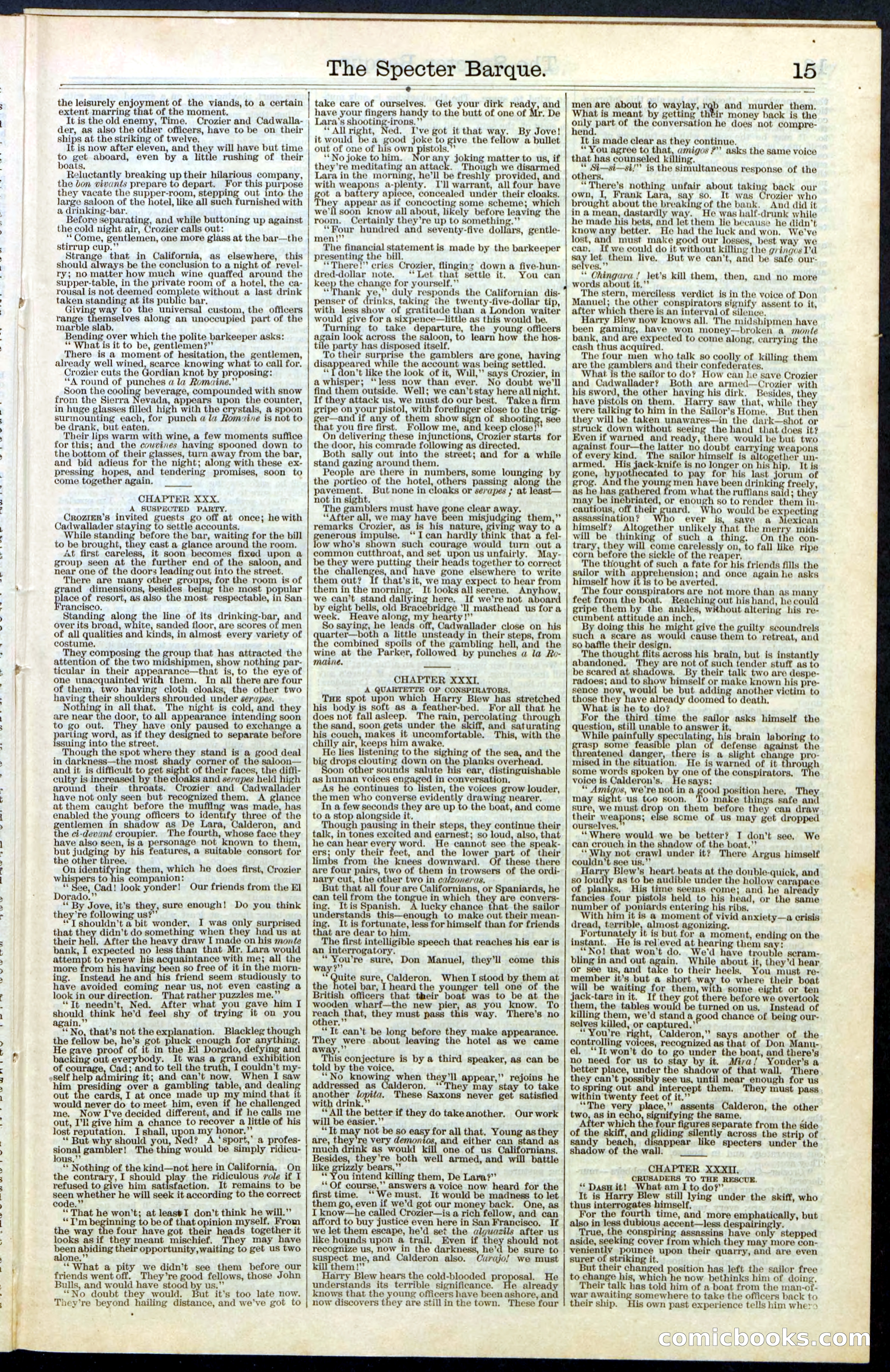
A restored page from Pulp Fiction, 1879. Page through the whole issue in the reader above.
📄 Transcribed text from this page (OCR, searchable)
Machine-transcribed from the original scan — historical spelling and the odd misread are preserved.
ee ae fe © > ee ee i ! “oa Om Ft wem~ e 5's. Ww =. 2 oo an =) ae eek rae a ee. i ies eee i the leisurely enjoyment of the viands, to a certain extent marring that of the moment. It is the old enemy, Time. Crozier and Cadwalla- der, as also the other officers, have to be on their ships at the striking of twelve. It is now after eleven, and they will have but time ee get aboard, even by a little rushing of their oats, Reluctantly breaking up their hilarious company, the bon vivants prepare to depart. For this purpose they vacate the supper-room, stepping out into the large saloon of the hotel, like all such furnished with a drinking-bar. Before separating, and while buttoning up against the cold night air, Crozier calls out: ‘*Come, gentlemen, one more glass at the bar—the stirrup cup.” Strange that in California, as elsewhere, this should always be the conclusion to a night of revel- ry; no matter how much wine quaffed around the supper-table, in the private room of a hotel, the ca- rousal is not deemed complete without a last drink taken standing at its public bar. Giving way to the universal custom, the officers range thamincl ves along an unoccupied part of the marble slab. Bending over which the polite barkeeper asks: ‘** What is it to be, gentlemen?” There is a moment of hesitation, the gentlemen, already well wined, scarce knowing what to call for. Crozier cuts the Gordian knot by proposing: ‘A round of punches a la Romaine.” Soon the cooling beverage, compounded with snow from the Sierra Nevada, appears upon the counter, in huge glasses filled high with the crystals, a spoon surmounting each, for punch @ la Romaine is not to be drank, but eaten. Their lips warm with wine, a few moments suffice for this; and the couvines having spooned down to the bottom of their glasses, turn away from the bar, and bid adieus for the night; along with these ex- pressing hopes, and tendering promises, soon to come together again. CHAPTER XXX. A SUSPECTED PARTY. Crozier’s invited guests go off at once; he with Cadwallader staying to settle accounts. While es ig before the bar, waiting for the bill to be brought, they cast a glance around the room, At first careless, it soon becomes fixed upon a group seen at the further end of the saloon, and near one of the doors leading out into the street. There are many other groups, for the room is of grand dimensions, besides being the most popular Xlace of resort, as also the most respectable, in San rancisco. Standing along the line of its drinking-bar, and over its broad, white, sanded floor, are scores of men of all qualities and kinds, in almost every variety of costume, They composing the group that has attracted the attention of the two midshipmen, show nothing par- ticular in their appearance—that is, to the eye of one unacquainted with them. In all there are four of them, two having cloth cloaks, the other two having their shoulders shrouded under serapes. Nothing in all that. The night is cold, and they are near the door, to all appearance intending soon to go out. They have only paused to exchange a arting word, as if they designed to separate before ssuing into the street. Though the spot where they stand is a good deal in darkness—the most may corner of the saloon— and it, is difficult to get sight of their faces, the diffi- culty is increased by the cloaks and serapes held high around their throats. Crozier and Cadwallader have not only seen but recognized them. A glance at them caught before the muffing was e, has enabled the young officers to identify three of the entlemen in shadow as De Lara, Calderon, and the ci-devant croupier. The fourth, whose face they have also seen, is a personage not known to them, but judging by his features, a suitable consort for the other three. . On identifying them, which he does first, Crozier whispers to his companion: ** See, Cad! look yonder! Dorado.” ‘* By Jove, it’s they, sure enough! Do you think they’re following us?”’ ; ‘“T shouldn’t a bit wonder, I was only surprised that they didn’t do something when they had us at their hell. After the heavy draw I made on his monte bank, I expected no less than that Mr. Lara would attempt to renew his acquaintance with me; all the more from his having been so free of it in the morn- ing. Instead he and his friend seem studiously to have avoided coming near us, not even casting a look in our direction. That rather puzzles me. “Tt needn't, Ned. After what you gave him I should think he’d feel shy of trying it on you ain.” ‘* No, that’s not the explanation. Blackleg though the fellow be, he’s got pluck enough for anything. He gave proof of it in the El Dorado, defying and backing out everybody. It was a nd exhil ition of courage, Cad; and to tell the truth, I couldn't my- »self help admiring it; and can’t now. When I saw him presi over a gambling table, and dealing out the cards, I at once made up my mind that it would never do to meet him, even if he challenged me. Now I’ve decided different, and if he calls me out, I'l give him a chance to recover a little of his lost reputation, I shall, upon my honor,” ‘“* But why should you, Ned? A ‘sport,’ a profes- sional gambler! The thing would be simply ridicu- lous."’ " : ; ‘‘ Nothing of the kind—not here in California, On the con , I should play the ridiculous ole if I refused to give him satisfaction. It remains to be SF whether he will seek it according to the correct code.” “That he won't; at leaseI don't think he will.” “Tm ning to be of that opinion myself. From the way the four have got their heads together it looks asif they meant mischief. They may have i abiding their opportunity, waiting to get us two one.’ ‘What a pity we didn’t see them before our friends went off. They’re good fellows, those John Bulls, and would have stood by us.” “No doubt they would. But it’s too late now. They’re beyond hailing distance, and we've got to Our friends from the El _ The Specter Barque. | take care of ourselves. Get your dirk ready, and have your fingers handy to the butt of one of Mr. De Lara's shooting-irons,”’ * Allright, Ned. I’ve got it that way. By Jove! it would bea good joke to give the fellow a bullet out of one of his own pistols.” ‘**No joke tohim. Nor ne! joking matter to us, if they're meditating an attack. Though we disarmed Lara in the morning, he'll be freshly provided, and with weapons a-plenty. Ill warrant, all four bave xot a battery apiece, concealed under their cloaks. hey appear as if concocting some scheme; which we'll soon know all about, likely before leaving the room. Certainly they’re up to something.” “Four hundred and seventy-five dollars, gentle- men!” The financial statement is made by the barkeeper presenting the bill. There!” cries Crozier, flinging down a five-hun- dred-dollar note. ‘Let that settle it. You can keep the change for yourself,” * Thank yer duly responds the Californian dis- penser of drinks, taking the twenty-five-dollar tip, with less show of gratitude than a London waiter would give for a sixpence—little as this would be. Turning to take departure, the young officers again look across the saloon, to learn how the hos- tile party has disposed itself, To their surprise the gamblers are gone, having disappeared while the account was being settled. ‘| don't like the look of it, Will,”’ says Crozier, in a whisper; “less now than ever. No doubt we'll find them outside. Well; we can'tstay here all night. If they attack us. we must do our best. Takea firm gripe on your pistol, with forefinger close to the trig- ger—and if any of them show sign of shoot , See that you fire first. Follow me, and keep close! On delivering these injunctions, Crozier starts for the door, his comrade following as directed. Both sally out into the street; and for a while stand gazing around them, People are there in numbers, some lounging by the portico of the hotel, others passing along the pavement. But none in cloaks or serapes ; at least— not in sight. The gamblers must have oe clear away. “After all, we may have n misjudging them,” remarks Crozier, as is his nature, piv ng way to a nerous impulse. “I can hardly think that a fel- ow who's shown such courage would turn out a common cutthroat, and set_upon us unfairly. May- be they were putting their heads together to correct the So a ae and have gone elsewhere to write them out? If that’s it, we may expect to hear from them in the morning. It looks all serene. Anyhow we can’t stand dallying here. If we're not a oard by eight bells, old Bracebridge ‘Il masthead us for a week. Heave along, my hearty!” So saying, he leads off, Cadwallader close on his uarter—both a little unsteady in their steps, from the combined spoils of the gambling hell, and the wie at the Parker, followed by punches a la Ro- MANE, CHAPTER XXXII. A QUARTETTE OF CONSPIRATORS. THE spot upon which Harry Blew has stretched his body is soft as a feather-bed. For all that he does not fallasleep. The rain, perpolating through the sand, soon gets under the , and saturating his couch, makes it uncomfortable. This, with the chilly air, keeps him awake. He lies listening tothe sighing of the sea, and the big drops clouting down on the planks overhead. on other sounds salute his ear, distinguishable as human voices engaged in conversation. As he continues to listen, the voices grow louder, the men who converse evidently drawing nearer, In a few seconds they are up to the boat, and come to a stop alongside it. Though pausing in their steps, they continue their talk, in tones excited and earnest; so loud, also, that he can hear every word. He cannot see the speak- ers; only their feet, and the lower of their limbs from the knees downward. Of these there are four pairs, two of them in trowsers of the ordi- nary cut, the other two in ca/zoneras. But that all four are Californians, or Spaniards, he can tell from the tongue in which wey ore convers- ing. Itis Spanish. lucky chance that the sailor understands this—enough to make out their mean- ing. It is fortunate, less for himself than for friends that are dear to him. The first intelligible speech that reaches his ear is an interrogatory. “You're sure, Don Manuel, they'll come this way?’ : ite sure, Calderon. When I stood by them at the hotel bar, I heard the younger tell one of the British officers that their boat was to be at the wooden wharf—the new pier, as you know. To nese that, they must pass this way. There's no other.” “It can’t be long before they make appearance. They were about leaving the hotel as we came away.”’ This conjecture is by a third speaker, as can be told by the voice. **No ne pg Si ace they'll appear,’ rejoins he addressed as deron, ‘‘They may stay to take another /opita, These Saxons never get satisfied with drink.” ** All the better if they do takeanother. Our work will be easier.”’ “It may not be so for all that. Young as they are, they're very demonios, and either can stand as much drink as would kill one of us Californians. Besides, they're both well armed, and will battle like Veg) bears,” “You intend killing them, De Lara?” ‘*‘Of course,’’ answers a voice now heard for the first time. ‘“‘We must. It would be madness to let them go, even if we'd got our money back. One, as I know—he called Crozier—is a rich fellow, and can afford to buy justice even here in San Francisco. If we let them escape, he’d set the alguazils after us like hounds upon @ trail. Even if they should not recognize us, now in the darkness, he’d be sure to suspect me, and Calderon also. Curajo! we must kill them!" Harry Blew hears the cold-blooded proposal. He understands its terrible significance. He already knows that the gat officers have been ashore, and now discovers they are stillin the town. These four 15 — _—————$_ +. — - — men are about to waylay, rab and murder them. What is meant by getting thtir money back is the ony part of the conversation he does not compre- end. It is made clear as they continue. “You agree to that, amigos ?”’ asks the same voice that has counseled killing. ‘* St—si—si/” is the simultaneous response of the others. “There’s nothing unfair about taking back our own, I, Frank Lara, say so. It was Crozier who brought about the breaking of the bank. And did it in a mean, dastardly way. He was half-drunk while he made his bets, and let them lie because he didn’t know any better. He had the luck and won. We've lost, and must make good our losses, best way we can, If we could do it without killing the gringos Vd oy let them live. But we can't, and be safe our- selves.” * Ohingara ! \et’s kill them, then, and no more words about it." The stern, merciless verdict is in the voice of Don Manuel; the other conspirators signify assent to it, after which there is an interval of silece. Harry Blew now knows all. The midshipmen have been gaming, have won money—broken a monte bank, and are expected to come along, carrying the cash thus acquired. The four men who talk so coolly of killing them are the gamblers and their confederates, What is the sailor to do? How can he save Crozier and Cadwallader? Both are armed—Crozier with his sword, the other having his dirk. Besides, they have pistols on them. Harry saw that, while they were talking to him in the Sailor’s Home. But then they will be taken unawares—in the dark—shot or struck down without seeing the hand that does it? Even if warned and ready, there would be but two rainst four—the latter no doubt carrying weapons of every kind. The sailor himself is altogether un- armed. His jack-knife is no longer on his hip. It is gone, hypothecated to pay for his last jorum of grog. And the young men have been drinking freely, as he has gathered from what the rufflans said; they may be inebriated, or enough so to render them in- cautious, off their guard. Who would be expecting assassination ? 10 ever is, save a Mexican himself? Altogether unlikely that the merry mids will be thinking of such a thing. On the con- trary, they will come carelessly on, to fall like ripe corn before the sickle of the reaper, The thought of such a fate for his friends fills the sailor with apprehension; and once again he asks himself how it is to be averted. The four conspirators are not more than as many feet from the boat. Reaching out his hand, he could gripe them by the ankles, without altering his re- cumbent attitude an inch, By doing this he might give the guilty scoundrels such a scare as would cause them to retreat, and so baffle their design. The thought flits across his brain, but is instantly abandoned. They are not of such tender stuff as to be scared at shadows. By their talk two are despe- radoes; and to show himself or make known his pre- sence now, would be but adding another victim to those they ‘have already doomed to death, What is he to do? For the third time the sailor asks himself the question, still unable to answer it, While painfully speculating, his brain laboring to p some feasible plan of defense against the reatened danger, there is a slight change pro- mised in the situation. He is warned of it through some words spoken by one of the conspirators. The voice is Calderon's, He says: * Amigos, we're not in a a position here, They may sight us too soon. To make things safe and sure, we must drop on them before they can draw their weapons; else some of us may get dropped ourselves.” ‘*Where would we be better? I don’t see, We can crouch in the shadow of the boat,”’ te not crawl under it? There Argus himself couldn't see us.” Harry Blew’'s heart beats at the double-quick, and so loudly as to be audible under the hollow carapace of planks. His time seems come; and he already fancies four pistols held to his head, or the same number of poniards entering his ribs. With him it is a moment of vivid anxiety—a crisis dread, terrible, almost agonizing, Fortunately it is but for a moment, ending on the instant. He is rel'eved at hearing them say: ‘““No! that won't do. We'd have trouble scram- bling in and out in. While about it, they'd hear or see us, and take to their heels. You must re- member it’s but a short way to where their boat will be waiting for them, with some eight or ten ena: init. If the t there before we overtook hem, the tables would be turned on us, Instead of killing them, we'd stand a good chance of being our- selves killed, or captured.’ ht, Calderon,” says another of the controlling voices, recognized as that of Don Manu- el, “It won't do to go under the boat, and there's no need for us to stay by it. Mira! Yonder’s a better place, under the shadow of that wall. There. ener can’t ‘ fmm us, en near Ble bs Boe us 8 out and interce em, ey mus withian'twety feet of it. Pon “The very place,’ assents Calderon, the other two, as in o ying the same. P After which the four figures separate from the side of the skiff, and gliding silently across the strip of sandy beach, disappear like specters under the shadow of the wall, _ CHAPTER XXXTI, CRUSADERS TO THE RESCUE. it te Barty Blew still lying uder’ the niilt ‘wh 8 ew 8 y under the skiff, who thus interrogates himself. For the fourth time, and more emphatically, but also in less dubious accent—less des ingly. True, the conspiring assassins have only stepped aside, seeking cover from which they may more con- veniently pounce upon their quarry, and are even surer of striking it. But their changed position has left the sailor free toc é his, which he now bethinks him of doing, Their talk has told him of a boat from the man-of- war awaiting somewhere to take the officers back to their ship. own past experience tells him wher» Eomicbooks (E(0)