
Pulp Fiction, 1879 · page 16 of 40
Beadle's New York Dime Library, No. 66 — page 16: what you’re looking at
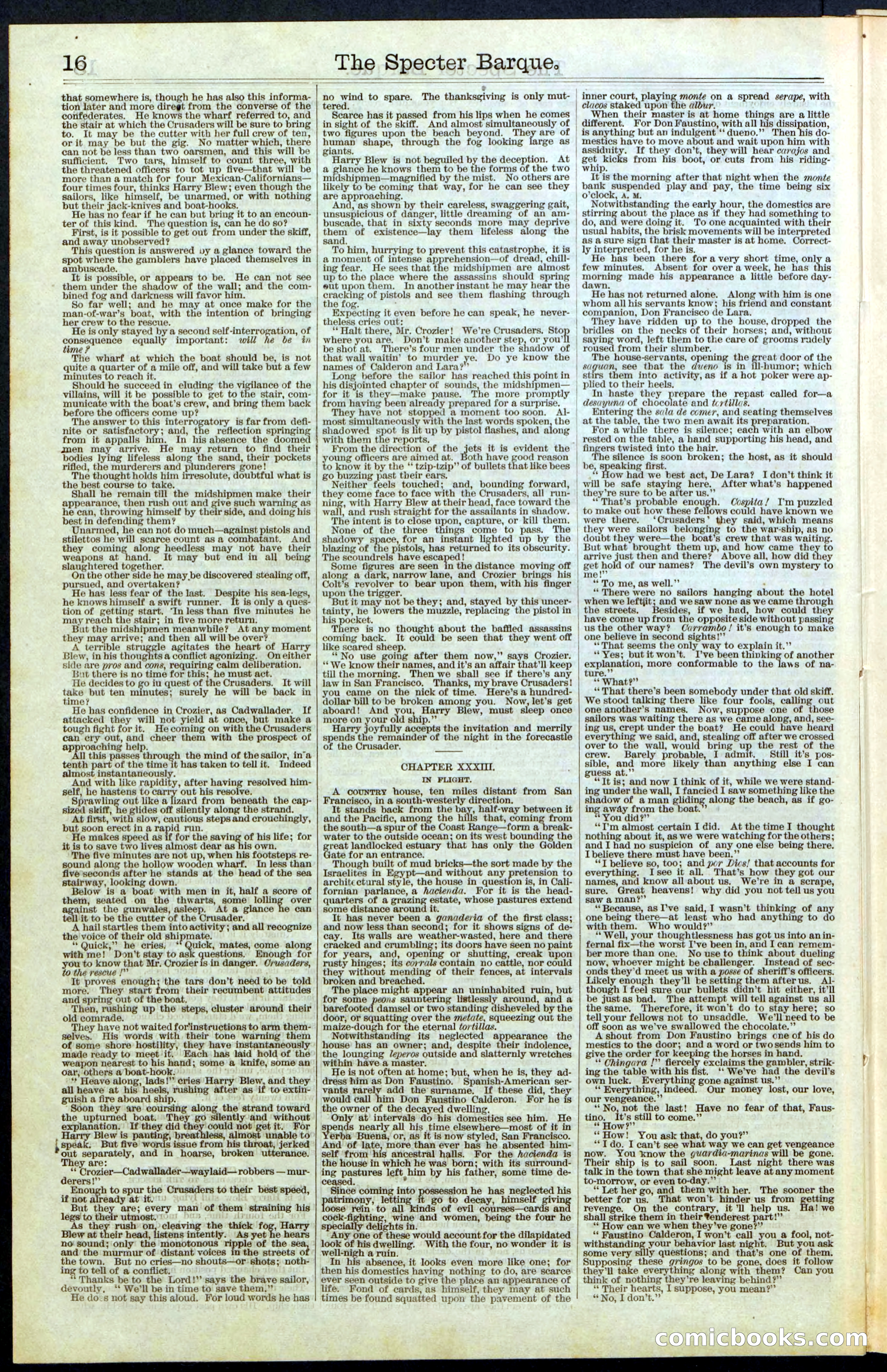
A restored page from Pulp Fiction, 1879. Page through the whole issue in the reader above.
📄 Transcribed text from this page (OCR, searchable)
Machine-transcribed from the original scan — historical spelling and the odd misread are preserved.
> we . a a — — that somewhere is, though he has also this informa- tion later and more diregt from the converse of the confederates. He knows the wharf referred to, and the stair at which the Crusaders will be sure to bring to. It may be the cutter with her full crew of ten, or it may be but the gig. No matter which, there can not be less than two oarsmen, and this will be sufficient. Two tars, himself to count three, with the threatened officers to tot up five—that will be more than a match for four Mexican-Californians— four times four, thinks Harry Blew; even though the sailors, like himself, be unarmed, or with nothing but their jack-knives and boat-hooks. He has no fear if he can but bring it to an encoun- ter of this kind. The question is, can he do so? First, is it possible to get out from under the skiff, and away unobserved? This question is answered vy a glance toward the spot where the gamblers have placed themselves in ambuscace. It is possible, or appears to be. He can not see them under the shadow of the wall; and the com- bined fog and darkness will favor him. So far well; and he may at once make for the man-of-war’s boat, with the intention of bringing her crew to the rescue. He is only stayed by a second self-interrogation, of ogy i equally important: will he be in me The wharf at which the boat should be, is not quite a quarter of a mile off, and will take but a few minutes to reach it. Should he succeed in eluding the vigilance of the villains, will it be possible to get to the stair, com- municate with the boat’s crew, and bring them back before the officers come up? The answer to this interrogatory is far from defi- nite or satisfactory; and, the reflection springin from it appalls him. In his absence the doomec gjmen may arrive. He may return to find their bodies lying lifeless along the sand, their pockets rifled, the murderers and plunderers gone! The thought holds him irresolute, doubtful what is the best course to take. Shall he remain till the midshipmen make their appearance, then rush out and give such warning as he can, throwing himself by their side, and doing his best in defending them? Unarmed, he can not do much—against pistols and stilettos he will scarce count as a combatant, And they coming along heedless may not have their weapons at hand. It may but end in all being slaughtered together. On the other side he maybe discovered stealing off, pursued, and overtaken? He has less fear of the last. Despite his sea-legs, he knows himself a swift runner. It is only a ques- tion of getting start. “In less than five minutes he may reach the stair; in five more return, But the midshipmen meanwhile? At any moment they may arrive; and then all will be over? A terrible struggle agitates the heart of Harry Blew, in his thoughts a conflict agonizing. Oneither side are pros and cons, requiring calm deliberation. But there is no time for this; he must act. He decides bea iu quest of the Crusaders. It will i but ten utes; surely he will be back in time? He has confidence in Crozier, as Cadwallader. If attacked they will not yield at once, but make a tough fight for it. He coming on with the Crusaders can cry out, and cheer them with the prospect of ef yecner 3 help. ] this passes through the mind of the sailor, in’a tenth part of the time it has taken to tell it. Indeed almos neg geen 9 And with like rapidity, after having resolved him- self, he hastens to out his resolve. we Ang, Sao like a lizard from beneath the cap- sized skiff, he glides off silently along the strand. At first, with slow, cautious steps and crouchingly, but soon erect in a rapid run. He makes speed as if for the saving of his life; for it is to save two lives almost dear as his own. The five minutes are not up, when his footsteps re- sound along the hollow wooden wharf. In less than five seconds after he stands at the head of the sea stairway, looking down. Below is a boat with men in it, half a score of them, seated on the thwarts, some lolling over ainst the gunwales, asleep. At a glance he can ‘it to be the cutter of the Crusader. A hail startles them into activity; and all recognize the voice of their old shipmate. * Quick,” he cries, uick, mates, come along with me! Don't stay to as oa ar Enough for you to know that Mr. Crozier is in danger. Orusaders, to the rescue |" ; It proves enough; the tars don't need to be told more, They start trom their recumbent attitudes and spring out of the boat, . Then, rushing up the steps, cluster around their old comrade. (yf They have not waited for‘instructions to arm them- selves. His words with their tone warning them of some shore hostility, they have instantaneously made ready to meet it. Each has laid hold of the weapon nearest to his hand; some a knife, some an oar, others a boat-hook. ' )* r, . '* Heave along, lads!” cries Harry Blew, and they all heave at his heels, rushing after as if to extin- guish a fire aboard ship. SOT Y ‘Soon they are coursing along the strand toward the upturned boat. They go ntly without explanation. If they did ‘could not get it. For Blew is panting, breathless, almost unable to i But five issue from his jerked out separately, and in hoarse, ken wu J ey are: é ie Sih a Papen en gene te mea robbers — mur- erers!” [aur ot Enough to spur the Crusaders to their best speed it uot already at po leh ine me See ¢ if 1 ey are; every man hem Be on, ¢ e thi Blew at their head, tistens in ntly. As ped Le biehes no sound; only the monotonous oo of the and the murmur of distant voices in the streets 0 the town. But no cries—no shouts—or shots; noth- ing to tell of a conflict. Thanks be to the Lord!’ says the brave sailor, devoutly, ‘* We'll be in time to save them,” He do-s not say this aloud. For loud words he has The Specter Barque. no Y fas to spare. The thanksgiving is only mut- tered. Scarce has it passed from his lips when he comes in sight of the skiff. And almost simultaneously of two figures upon the beach beyond. They are of human shape, through the fog looking large as giants. Harry Blew is not beguiled by the deception. At a glance he knows them to be the forms of the two midshipmen—magnified by the mist. No others are likely to be coming that way, for he can see they are approaching. ; And, as shown by their careless, swaggering gait, unsuspicious of danger, little dreaming of an am- buscade, that in sixty seconds more may deprive phen of existence—lay them lifeless along the sand. To him, hurrying to prevent this catastrophe, it is inner court, playing monte on a spread serape, with clacos staked upon the albur. When their master is at home things are a little different. For Don Faustino, with all his dissipation, is anything but an indulgent ‘‘ dueno.’’ Then his do- mestics have to move about and wait upon him with assiduity. If they don’t, they will hear carajos and ce kicks from his boot, or cuts from his riding- whip. It is the morning after that night when the monte bank suspended play and pay, the time being six o'clock, A, M. Notwithstanding the early hour, the domestics are | een about the place as if they had something to a moment of intense apprehension—of dread, chill- | ing fear. He sees that the midshipmen are almost up to the place where the assassins should spring eut upon them. In another instant he may hear the i om of pistols and see them flashing through 1e fog. ; Expecting it even before he can speak, he never- theless cries out: ‘** Halt there, Mr. Crozier! We're Crusaders, Sto where you are. Don’t make another step, or you'll be shot at. There’s four men under the shadow of that wall waitin’ to murder ye. Do ye know the names of Calderon and Lara?” Long before the sailor has reached this point in his disjointed chapter of sounds, the midshipmen— for it is they—make pause. The more promptly from having been already prepared for a surprise. They have not stopped a moment toosoon. A\l- most simultaneously with the last words spoken, the shadowed spot is lit up by pistol flashes, and along with them the reports. From the direction of the jets it is evident the young officers are aimed at. Both have good reason o know it by the “ tzip-tzip’’ of bullets that like bees go buzzing past their ears. Neither feels touched; and, bounding forward, they come face to face with the Crusaders, all run- ning, with Harry Blew at their head, face toward the wall, and rush straight for the assailants in shadow. The intent is to close upon, capture, or kill them. None of the three bs come to pass. The shadowy space, for an instant lighted up by the blazing of the pistols, has returned to its obscurity. The scoundrels have esca ! Some figures are seen in the distance moving off along a dark, narrow lane, and Crozier brings his Colt’s revolver to bear upon them, with his finger upon the trigger. But it may not be they; and, stayed by this uncer- tainty, he lowers the muzzle, replacing the pistol in his pocket. There is no thought about the baffled assassins coming back. It could be seen that they went off like scared sheep. ‘*No use going after them now,” says Crozier. ‘We know their names, and it’s an affair that'll keep till the morning. Then we shall see if there’s any law in San Francisco, Thanks, my brave Crusaders! you came on the nick of time. Here’s a hundred- dollar bill to be broken among you. Now, let's get aboard! And you, Harry Blew, must sleep once more on your old ship.” Harry Joyfully accepts the invitation and merrily spends the remainder of the night in the forecastle of the Crusader. CHAPTER XXXTII, IN FLIGHT. A country house, ten miles distant from San Francisco, in a south-westerly direction. It stands back from the bay, half-way between it and the Pacific, among the that, coming from the south—a spur of the Coast Range—form a break- water to the outside ocean; on its west bounding the — landlocked estuary that has only the Golden ate for an entrance. Though built of mud bricks—the sort made by the Israelites in Egypt—and without any pretension to architectural style, the house in question is, in Cali- fornian parlance, a hacienda. Yor it is the head- quarters of a grazing estate, whose pastures extend some distance around it. It has never been a ganadervia of the first class; and now less than second; for it shows signs of de- cay. Its walls are weather-wasted, here and there cracked and crumbling; its doors have seen no paint for years, and, onening or shutting, creak upon rusty hinges; its corrals contain no cattle, nor could they without mending of their fences, at intervals broken and breached. The place might appear an uninhabited ruin, but for me ted sauntering listlessly around, and a barefooted damsel or two standing disheveled by the door, or squat over the metate, squeezing out the maize-dough for the eternal /ortillas. Notwithstanding its neglected appearance the house has an owner; and, despite their indolence, the lounging /eperos outside and slatternly wretches have a master. He is not often at home; but, when he is, they ad- dress him as Don Faustino. Spanish-American ser- vants rarely add the surname, If these did, — would call him Don Faustino Calderon. For he the owner of the decayed dwelling. at intervals do his domestics see him. He spends nearly all his time elsewhere—most of it in érba Buena, or, as it is now styled, San Francisco. And of late, more than ever has he absented him- self from his ancestral halls. For the hacienda is the house in which he was born; with its surround- ing pastures left him by his father, some time de- ceased. Since co to Uae ai he has neglected his Jerre a fy go to decay, himself oose rein. nds of evil cou an in le to all elights in Any one of these would account for the dilapidated look of his dwelling. With the four, no wonder it is well-nigh a ruin. absence, it looks even more like one; for then his domestics having nothing to do, are scarce ever seen outside to give the place an appearance of life. Fond of cards, as himself, they may at such times be found squatted upon the pavement of the coek-fi nuns aan and women, being the four he | Sayin | saguan, see that the dueno is in do, and were doing it. To one acquainted with their usual habits, the brisk movements will be interpreted as a sure sign that their master is at home. Correct- ly interpreted, for he is. He has been there for avery short time, only a few minutes. Absent for over a week, he has this Lewite made his appearance a little before day- awn. He has not returned alone. Along with him is one whom all his servants know; his friend and constant companion, Don Francisco de Lara. They have ridden up to the house, dropped the bridles on the necks of their horses; and, without word, left them to the care of grooms rudely roused from their slumber. The house-servants, opening the great door of the l-humor; which stirs them into activity, as if a hot poker were ap- plied to their heels. In haste they ae bee the repast called for—a desayuna of chocolate and tortillas. Entering the sala de comer, and seating themselves at the table, the two men await its preparation. For a while there is silence; each with an elbow rested on the table, a hand supporting his head, and fingers twisted into the hair. he silence is soon broken; the host, as it should be, per first. ‘** How had we best act, De Lara? I don't think it will be safe staying here. After what’s happened they’re sure to be aiter us.” “That's probable enough. Cospita/ I’m puzzled to make out how these fellows could have known we were there. ‘Crusaders’ they said, which means they were sailors belonging to the war-ship, as no doubt they were—the boat’s crew that was waiting. But what brought them up, and how came they to arrive just then and there? Above all, how did they get hold of our names? The devil’s own mystery to me!"’ “ To me, as well.”’ . “There were no sailors hanging about the hotel when we leftjit; and we saw none as we came through the streets, besides, if we had, how could they have come up from the opposite side without passing us the other way? Carrambo/! it’s enough to make _ one believe in second sights!"’ “That seems the only sabe 3 to explain it.” “Yes; butit won't. I’ve been thinking of another explanation, more conformable to the ture.” “* What?” “That there’s been somebody under that old skiff. We stood talking there like four fools, calling out one another’s names. Now, suppose one of those sailors was waiting there as we came along, and, see- ing us, crept under the boat? He could have heard everything we said, and, stealing off after we crossed over to the wall, would bring up the rest of the crew. Barely probable, I admit, Still it’s pos- sible, and more likely than anything else I can guess at.” : “It is; and now I think of it, while we were stand- ing under the wall, I fancied 1 saw something like the shadow of a man gliding along the beach, as if go- ing away from the boat.” You did?” “T’m almost certain Idid. At the time I thought nothing about it, as we were watching for the others; and I had no suspicion of any one else being there. I believe there must have been.” “T believe so, too; and por Dics! that accounts for everything. Isee it all. That’s how they got our names, and know all about us. We're in a scrape, sure. Great heavens! why did you not tell us you saw a man?”’ “Because, as I've said, I wasn’t thinking of any one being there—at least who had anything to do with them. Who would?” “Well, your pati ng ac has got us into anin- fernal fix—the worst I’ve been in, and I can remem- ber more than one. No use to think about dueling now, whoever might be challenger. Instead of sec- onds they'd meet us with a posse of sheriff's officers. Likely enough they'll be setting them afterus. Al- though I feel sure our bullets didn’t hit either, it'll be justas bad. The attempt will tell against us all the same. Therefore, it won't do to stay here; so tell your fellows not to unsaddle. We'll need to be off soon as we've swallowed the chocolate.” A shout from Don Faustino paae one of bis do mestics to the door; and a word or twosends him to give the order for keeping the horses in hand. “ Chingara !” fiercely exclaims the gambler, strik- ing the table with his fist, ‘‘ We've had the devil's ws of na- own luck. Everything gone against us.”’ ** Everything, indeed. Our money lost, our love, our vengeance.” ‘‘No, not the last! Have no fear of that, Faus- tino. It’s still to come.” “ How ) ke ‘“‘How! You ask that, do you?” “*T do. I can’t see what way we can get vengeance now. You know the guvardia-marinas will be gone. Their ship is to sail soon. Last night there was talk in the town that she might leave at any moment to-morrow, or even y.” “ Let her go, and them with her. The sooner the better for us. That won't hinder us from getting revenge. On the contrary, it ll help us. ! we shall strike them in their tenderest part!” “How can we when they’ve gone?” “‘ Faustino Calderon, I won't call you a fool, not- withstanding your behavior last night. But you ask some very silly questions; and that’s one of them. Supposing these gringos to be gone, does it follow they'll take everything along with them? Can you think of nothing they're leaving behind?” * Their hearts, I suppose, you mean?” ** No, I don’t.” (E(0) JOOKS (€ a = . a