
Pulp Fiction, 1879 · page 14 of 40
Beadle's New York Dime Library, No. 66 — page 14: what you’re looking at
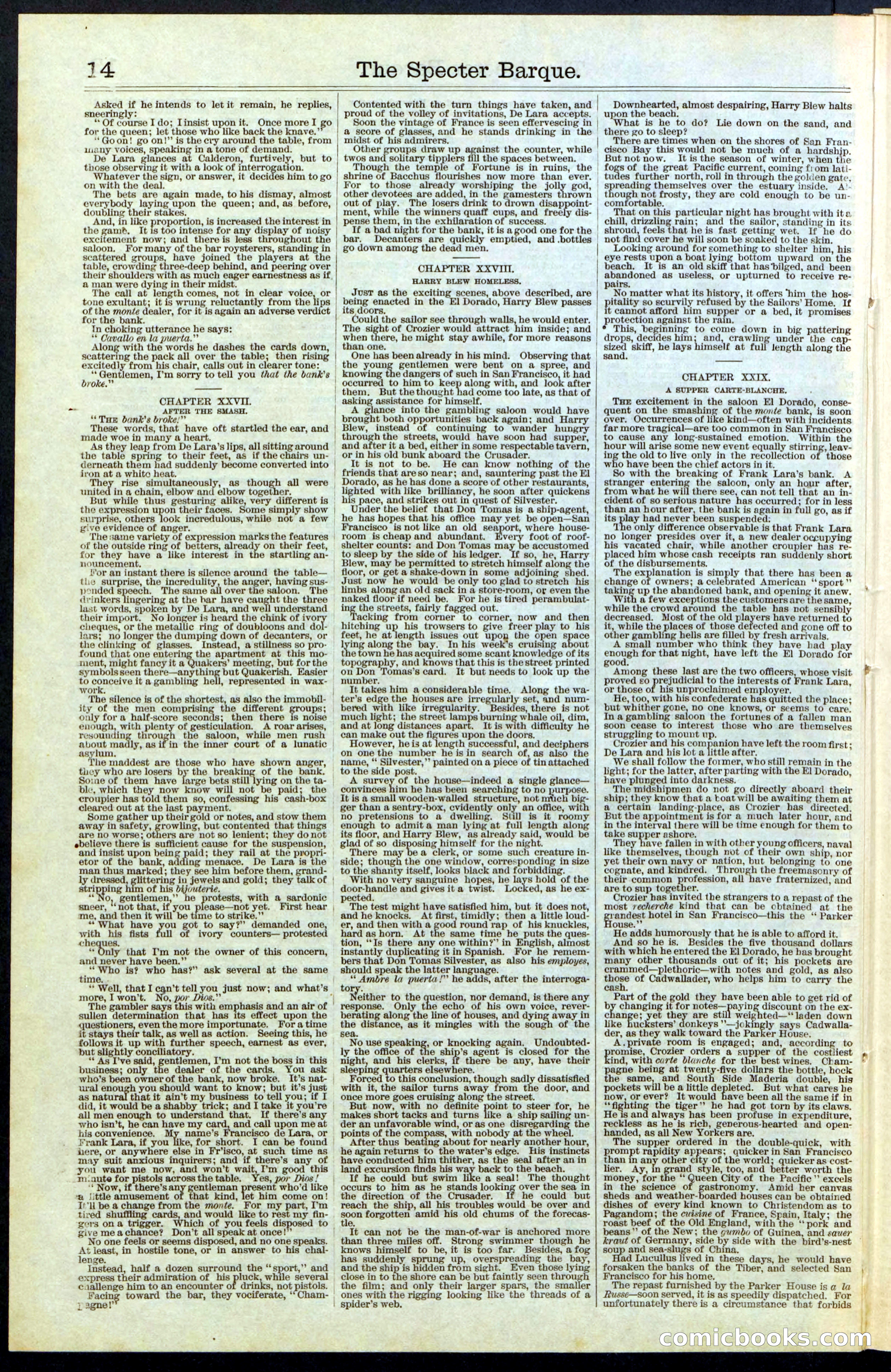
A restored page from Pulp Fiction, 1879. Page through the whole issue in the reader above.
📄 Transcribed text from this page (OCR, searchable)
Machine-transcribed from the original scan — historical spelling and the odd misread are preserved.
“ on A Asked if he intends to let it remain, he replies, BO “Goon! go on!” is the cry around the table, from sneeringly: * Of course I do; Iinsist upon it. Once more I for the queen; let those who like back the knave. many voices, speaking in a tone of demand. De Lara those observing it with a look of interrogation. Whatever the sign, or answer, it decides him to go on with the deal. lances at Calderon, furtively, but to The bets are again made, to his dismay, almost | everybody laying upon the queen; and, as before, doubling their stakes. And, in like proportion, is increased the interest in the gam, It is too intense for any display of noisy excitement now; and there is less throughout the saloon. Formany of the bar roysterers, standing in scattered groups, have joined the players at the table, crowding three-deep behind, and peering over their shoulders with as much eager earnestness as if. a man were dying in their midst. The call at length comes, not in clear voice, or tone exultant; it is wrung reluctantly from the lips of the monte dealer, for it is again an adverse verdict for the bank. In choking utterance he says: ** Cavallo en la puerta.” Along with the words he dashes the cards down, scattering the pack all over the table; then rising excitedly from his chair, calls out in clearer tone: ‘*Gentlemen, I’m sorry to tell you that the bank's broke.” CHAPTER XXVII. AFTER THE SMASH. “THE bank's broke!” These words, that have oft startled the ear, and made woe in many a heart. As they leap from De Lara’s lips, all sitting around the table spring to their feet, as if the chairs un- derneath them had suddenly become converted into | iron at a whitc heat. ate rise acprl.c memmiog as though all were united in a chain, elbow and elbow together. But while thus gesturing alike, very different is the expression atte their faces. Some simply show surprise, others look incredulous, while not a few xive evidence of anger. The same variety of expression marks the features of the outside ring of betters, already on their feet, for they have a like interest in the startling an- nouncement. lor an instant there is silence around the table— the surprise, the incredulity, the anger, having sus- ponded s th. The same all over the saloon. The drinkers lingering at the bar have caught the three last words, spoken by De Lara, and well understand their import. No longer is heard the chink of ivo cheques, or the metallic ring of doubloons and dol- lars; no longer the dumping down of decanters, or the clinking of glasses. Instead, a stillness so pro- found that one entering the apartment at this mo- ment, might fancy it a Quakers’ meeting, but for the symbols seen pin Aaa | but Quakerish, Easier to pongae ita gambling hell, represented in wax- work. The silence is of the shortest, as also the immobil- ity of the men comprisi the different groups; only for a half-score seconds; then there is noise enough, with plenty of gesticulation. A roar arises, resounding throu the saloon, while men rush about madly, as ifin the inner court of a lunatic asylum, The maddest are those who have shown anger, they who are losers by the break of the bank. So:me of them have large bets still lying on the ta- ble, which they now know will not be paid; the croupier has told them so, confessing his cash-box cleared out at the last payment. Some gather up their gold or notes, and stow them away in safety, Bead f but contented that things are no worse; others are not so lenient; they do not ebelieve there is sufficient cause for the suspension, and insist upon see Pi they rail at the ee etor of the bank, ng menace. De Lara is the man thus marked; they see him before them, Sige 5) ly dressed, glittering in jewels and gold; they a, of his bijouterie. : ‘ “ 0; gentlemen,’’ he protests, with a sardonic sneer, ‘not that, if you please—not yet. First hear me, and then it will be e to strike.” “ What have a got to say?” demanded one with his fists full of ivory counters— protested cheques. “ Only that I’m not the owner of this concern, and never have been.” ‘“Who is? who has?” ask several at the same time. . * Well, that I more, I won't. The gambler sa sullen determination that has its effect upon the apr a the more importunate. Fora time it stays their talk, as well as action. Seeing this, he follows it up with further speech, earnest as ever, but slightly conciliatory. “ As I’ve said, gentlemen, I’m not the boss in this business; only the dealer of the cards. You ask ‘'t tell you just now; and what’s 0, por Divs.” who’s been owner of the bank, now broke. It’s nat- | ural enough you should want to know; but it’s just as nat that it ain't my business to tell you; if I did, it would be a shabby trick; and I take it you're | all men enough to understand that. If there's any who isn’t, he can have my card, and call upon me at his convenience. My name’s cisco de Lara, or Frank Lara, if you here, or anywhere else in Fr’isco, at such time as may suit anxious inquirers; and if there’s any of you want me now, and won’t wait, I'm good this maute for pistols across the table. Yes, por Dios ! ‘* Now, if there’s an Sper ae resent who'd like a little amusement o t kind, let him come on! It'll be a change from the monte. For my part, I'm tired shuffling eg would like to rest my fin- goers on a trigger. ch of you feels give meachance? Don’t all speak at once!” No one feels or seems disposed, and no one speaks. ee least, in hostile tone, or in answer to his chal- enge. Instead, half a dozen surround the “sport,’’ and express their admiration of his pluck, while several caallenge him to an encounter o drinks, not pistols. Facing toward the bar, they vociferate, ‘‘Cham- | e, for short. I can be found | disposed to tl ' The Specter Barque. Contented with the turn things have taken, and proud of the volley of invitations, De Lara accepts. Soon the vintage of France is seen effervescing in a score of glasses, and he stands drinking in the midst of his admirers. Other groupe draw up oe the counter, while twos and solitary tipplers fill the spaces between. Though the temple of Fortune is in ruins, the shrine of Bacchus flourishes now more than ever. For to those already worshiping the jolly god, other devotees are added, in the gamesters thrown out of of The losers drink to drown disappoint- ment, while the winners quaff cups, and freely dis- pense them, in the exhilaration of success. | If a bad night for the bank, it is a good one for the | bar. Decanters are quickly emptied, and .bottles go down among the dead men. CHAPTER XXVIII. HARRY BLEW HOMELESS, Just as the exciting scenes, above described, are being enacted in the El Dorado, Harry Blew passes its doors. Could the sailor see through walls The sight of Crozier would attract he would enter. him inside; and when there, he might stay awhile, for more reasons | than one. One has been already in his mind. Observing that the young gentlemen were bent on a spree, and knowing the dangers of such in San Francisco, it had occurred to him to keep along with, and look after them. But the thought had come too late, as that of as assistance for himself, A glance into the gambling saloon would have brought both opportunities back again; and Harry Blew, instead of continuing to wander hungry through the streets, would have soon had supper, and after it a bed, either in some respectable tavern, or in his old bunk aboard the Crusader. It is not to be. He can know nothing of the friends that areso near; and, sauntering past the El Dorado, as he has done a score of other restaurants, lighted with like brilliancy, he soon after quickens his pace, and strikes out in quest of Silvester. Under the belief that Don Tomas is a ship-agent, he has hopes that his office may yet be open—San Francisco is not like an old seaport, where house- room is cheap and abundant. Every foot of roof- shelter counts: and Don Tomas may be accustomed to sleep by the side of his ledger. If so, he, Harry Blew, may be permitted to stretch himself along the floor, or get a shake-down in some adjoining shed. Just now he would be only too glad to stretch his limbs along an old sack in a store-room, or even the naked floor if need be. For he is tired perambulat- ing the streets, fairly fagged out. acking from corner to corner, now and then hitching a his trowsers to give freer play to his feet, he at length issues out upon the open a oe lying along the bay. In his week's cruising about the town he has acquired some scant knowledge of its topography, and knows that this is the street printed on Don Tomas’s card. It but needs to look up the number. It takes him a considerable time. Along the wa- ter’s edge the houses are irregularly set, and num- bered with like irregularity. Besides, there is not much light; the street lamps burning whale oil, dim, and at long distances a . Itis with difficulty he can make out the ty ob upon the doors. However, heis at length successful, and deciphers on one the number he isin search of, as also the name, * Silvester,’’ painted on a piece of tin attached to the side post. A survey of the house—indeed a single glance— convinces him he has been searching to no purpose. It is a small wooden-walled structure, not mich big- ger than a sentry-box, cvidently only an office, with no pretensions to a dwelling. Still is it roomy enough to admit a man lying at full length along its floor, and Harry Blew, as already said, would be glad of so disposing himself for the night. There may bea clerk, or some such creature in- side; though the one window, corresponding in size to the shanty itself, looks black and forbidding. With no very sanguine hopes, he lays hold of the a pag and gives ita twist. Locked, as he ex- The test might have satisfied him, but it does not, and he knocks. At first, timidly; then a little loud- er, and then with a ood round rap of his knuckles, hard as horn. At the same time he puts the ques- tion, “Is there any one within?’ in English, almost instantly duplicating it in Spanish. For he remem- bers that Don Tomas Silvester, as also his employes, should speak the latter language. “ Ambre la puerta!” he adds, after the interroga- tory. | Neither to the question, nor demand, is there any this with emphasis and an air of | response. Only the echo of his own voice, rever- berating along the line of houses, and dying away in the distance, as it mingles with the sough of the sea. No use spea , or knocking again. Undoubted- ly the office of the ship’s agent is closed for the night, and his clerks, if there be any, have their sleep uarters elsewhere. Forced to this conclusion, ae sadly dissatisfied with it, the sailor turns away from the door, and once more goes cruising along the street. But now, with no definite point to steer for, he makes short tacks and turns like a ship sailing un- der an unfavorable wind, or as one ding the points of the com with nobody at the wheel. After thus bea about for nearly another hour, he again returns to the water's edge. tincts have conducted him thither, as the seal after an in land excursion finds his way back to the beach. If he could but swim like a seal! The thought occurs to him as he stands looking over the sea in the direction of the er. he could but reach the ship, all his troubles would be over and soon forgotten amid his old chums of the forecas- e. It can not be the man-of-war is anchored more than three miles off. oe Ae ben though he knows himself to be, it is far. Besides, a fog has suddenly sprung up, overspreading the bay, and the ship is hidden from sight. Even those lyin close in to the shore can be but faintly seen throu the film; and only their larger spars, the s er ones with the rigging looking like the threads of a spider’s web. | Downhearted, almost despairing, Harry Blew halts upon the beach. What is he to do? Lie down on the sand, and there go to sleep? There are times when on the shores of San Fran- cisco Bay this would not be much of a hardship. But not now. Itis the season of winter, when the fogs of the great Pacific current, coming fom lati- tudes further north, roll in through the golden gate, at a themselves over the estuary inside. <A’ though not frosty, they are cold enough to be un- comfortable. That on this particular night has brought with ito chill, drizzling rain; and the sailor, standing in its shroud, feels that he is fast getting wet. If he do not find cover he will soon be soaked to the skin. Looking around for something to shelter him, his eye rests upon a boat lying bottom upward on the beach. It is an old skiff that has’bilged, and been abandoned as useless, or upturned to receive re- pairs. No matter what its history, it offers him the hos- peer. so scurvily refused by the Sailors’ Home. If t cannot afford him supper or a bed, it promises | pr tection against the rain, i 0 This, hes pat to come down in big pattering drops, decides him; and, crawling under the cap- mee skiff, he lays himself at full length along the sand. CHAPTER XXIX. A SUPPER CARTE-BLANCHE, THE excitement in the saloon El Dorado, conse- quent on the = amiga 5 of the monte bank, is soon over. Occurrences of like kind—often with incidents far more tragical—are too common in San Francisco to cause any long-sustained emotion. Within the hour will arise some new event equally stirring, leav- ing the old to live only in the recollection of those who have been the chief actors in it. So with the breaking of Frank Lara’s bank. A stranger rye; | the saloon, only an hour after, from what he will there see, can not tell that an in- cident of so serious nature has occurred; for in less than an hour after, the bank is again in full go, as if its aay had never been suspended: The only difference observable is that Frank Lara no longer U ipicase over it, a new dealer occupying his vacated chair, while another croupier has re- placed him whose cash receipts ran suddenly short of the disbursements. The explanation is oa gd that there has been a change of owners; a celebrated American “sport” taking up the abandoned bank, and opening it anew. With a few exceptions the customers are the same, while the crowd around the table has not sensibly decreased. Most of the old players have returned to it, while the places of those defected and gone off to other gambling hells are filled by fresh arrivals. A small number who think they have had play bona for that night, have left the El Dorado for good. Among these last are the two officers, whose visit proved £0 | fe eta to the interests of Frank Lara, or those of his unproclaimed employer. He, too, with his confederate has quitted the place; but whither gone, no one knows, or seems to care. In a gambling saloon the fortunes of a fallen man soon cease to interest those who are themselves struggling to mount up. Crozier and his companion have left the room first ; De Lara and bis lot a little after. We shall follow the former, who still remain in the light; for the latter, after parting with the El Dorado, have plunged into darkness, The midshipmen do not go directly aboard their ship; they know that a boat will be awaiting them at a certain landing-place, as Crozier has directed. But the appointment is for a much later hour, and in the interval there will be time enough for them to take supper ashore. They have fallen in with other young officers, nava) like themselves, though not of their own ship, nor yet their own navy or nation, but belonging to one cognate, and kindred. Through the freemasonry of their common profession, all have fraternized, and are to sup together. Crozier has invited the strangers to a repast of the most recherche kind that can be obtained at the randest hotelin San Francisco—this the ‘“‘ Parker ouse.”’ He adds humorously that he is able to afford it. And so he is. Besides the five thousand dollars with which he entered the El Dorado, he bas brought many other thousands out of it; his pockets are crammed—plethoric—with notes and gold, as also ose of Cadwallader, who helps him to carry the cash. Part of the Sa they have been able to get rid of by changing it for notes—paying discount on the ex- c ag yet they are still weighted—“ laden down like hucksters’ donkeys ’—jokingly says Cadwalla- der, as they walk toward the Parker House. A.private room is engaged; and, according to romise, Crozier orders a supper of the costliest ind, with carte blanche for the best wines. Cham- pagne being at twenty-five dollars the bottle, hock the same, and South Side Maderia double, his pockets will be a little he ee But what cares he now, or ever? It would have been all the same if in “ fighting the tiger’? he had got torn by its claws. He is and always has been profuse in expenditure, reckless as he is rich, generous-hearted and open- handed, as all New Yorkers are, The supper ordered in the double-quick, with oe rapidity appears; quicker in San Francisco than in any other city of the world; quicker as cost- lier. Ay, and style, too, and better worth the money, for the “ Queen City of the Pacific’ excels in the science of gastronomy. Amid her canvas sheds and weather-boarded houses can be obtained dishes of every kind known to Christendom as to Pagandom; the cuisine of France, Spain, Italy; the roast beef of the Old England, with the “pork and beans” of the New; the gwmnbo of Guinea, and sauer kraut of Germany, side by side with the bird’s-nest — soup and sea-slugs of China. ad Lucullus lived in these days, he would have forsaken the banks of the Tiber, and selected San Francisco for his home, The repast furnished by the Parker House is a la usse—soon served, it is as speedily dispatched. For unfortunately there is a circumstance that forbids I00KS GO (E(o) (€ mM ——