
Pulp Fiction, 1879 · page 13 of 40
Beadle's New York Dime Library, No. 66 — page 13: what you’re looking at
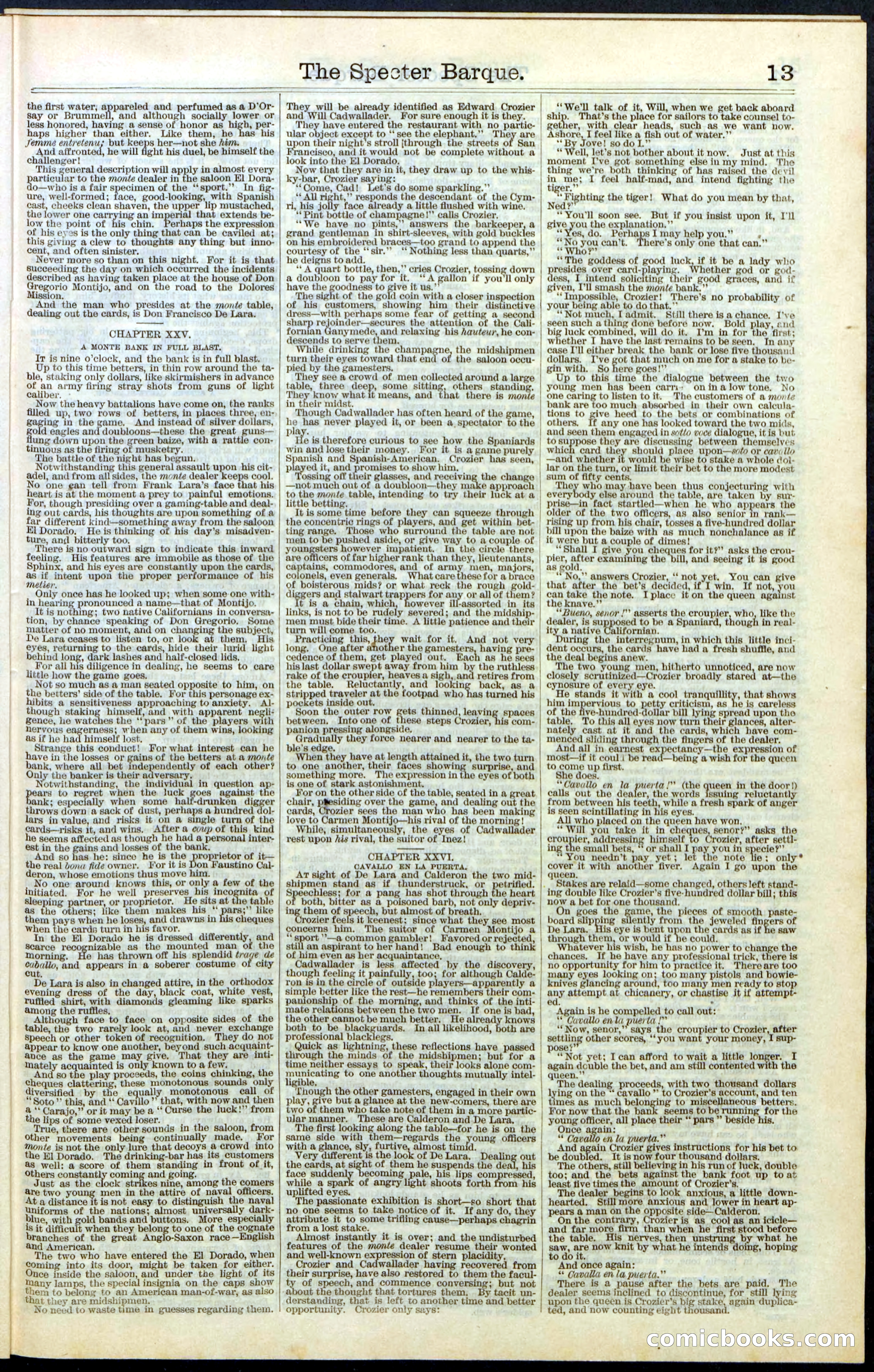
A restored page from Pulp Fiction, 1879. Page through the whole issue in the reader above.
📄 Transcribed text from this page (OCR, searchable)
Machine-transcribed from the original scan — historical spelling and the odd misread are preserved.
SSS SSS hs SSeS Sc sc enn the first water; syrescied and perfumed as a D'Or- say or Brummell, and although socially lower or less honored, having a sense of honor as high, per- haps higher than either. Like them, he has his Jemme entretenu; but keeps her—not she him. And affronted, he will fight his duel, be himself the challenger! This general description will apply in almost every pories ar to the monte dealer in the saloon El Dora- o—who is a fair specimen of the “sport.’’ In fig- ure, well-formed; face, good-looking, with Spanis cast, cheeks clean shaven, the upper lip mustached, the lower one carrying an ines that extends be- low the point of his chin. Perhaps the expression of his eyes is the only thing that can be caviled at; this giving a clew to thoughts any thing but inno- cent, and often sinister. Never more so than on this night. For it is that Succeeding the day on which occurred the incidents described as having taken place at the house of Don Gregorio Montijo, and on the road to the Dolores Mission. And the man who presides at the monte table, dealing out the cards, is Don Francisco De Lara. CHAPTER XXV. A MONTE BANK IN FULL BLAST, Ir is nine o’clock, and the bank is in full blast. Up to this time betters, in thin row around the ta- ble, staking only dollars, like skirmishers in advance of ae army firing stray shots from guns of light caliber. Now the heavy battalions have come on, the ranks filled up, two rows of betters, in places three, en- gaging in the game. And instead of silver dollars, old eagles and doubloons—these the great guns— lung down upon the green baize, with a rattle con- tinuous as the firing of musketry. The battle of the night has begun. Notwithstanding this general assault upon his cit- adel, and from all sides, the monte dealer keeps cool. No one gan tell from Frank Lara’s face that his heart is at the moment a prey to painful emotions. For, though presiding over a gaming-table and deal- g out cards, his thoughts are upon something of a far different kind—something away from the saloon 1 Dorado. He is thinking of his day’s misadven- ture, and bitterly too. There is no outward sign to indicate this inward feeling. His features are immobile as those of the Sphinx, and his eyes are constantly upon the cards, as if intent upon the proper performance of his melier. Only once has he looked up; when some one with- in hearing pronounced a name—that of Montijo. It is nothing; two native Californians in conversa- tion, by chance speaking of Don Gregorio. Some matter of no moment, and on Changing the subject, De Lara ceases to listen to, or look at them. His eyes, returning to the cards, hide their lurid light behind long, dark lashes and half-closed lids. For all his diligence in dealing, he seems to care little how the game goes. Not so much as a man seated opposite to him, on the betters’ side of the table. For this personage ex- hibits a sensitiveness approaching to anxiety. Al- though staking himself, and with apparent negli: ence, he watches the ‘‘pars” of the players with nervous eagerness; when any of them wins, looking as if he had himself lost. Strange this conduct! For what interest can he ve in the losses or gains of the betters at a monte bank, where all bet independently of each other? aay the banker is their adversary. otwithstanding, the individual in question ap- ears to regret when the luck goes against the ank; eapectally when some half-drunken digger throws down a sack of dust, perhaps a hundred dol- lars in value, and risks it on a single turn of the cards—risks 1t, and wins, After a coup of this kind he seems affected as though he had a personal inter- est in the gains and losses of the bank, And so has he: since he is the nde ince of it— the real Jona fide owner. Yor it is Don Faustino Cal- eron, whose emotions thus move him. The Spe cter Barque. and Will Cadwallader, They have entered the restaurant with no partic- ular object except to “ see the elephant,” The rancisco, and it would not be complete without a look into the El] Dorado, Now that they are in it, they draw up to the whis- ky-bar, Crozier saying: “Come, Cad! Let's do some sparkling.” ‘* All right,’ responds the descendant of the Cym- ri, his jolly face already a little flushed with wine. ‘**Pint bottle of champagne!" calls Crozier. ‘We have no pints,’ answers the barkeeper, a grand gentleman in shirt-sleeves, with gold buckles on his embroidered braces—too grand to append the courtesy of the ‘‘sir.”’ ‘* Nothing less than quarts,"’ he deigns to add. **A quart bottle, then,” cries Crozier, tossing down a doubloon to pay for it. ‘A gallon if you'll only have the goodness to give it us.” The sight of the gold coin with a closer inspection of his customers, showing him their distinctive dress—with perhaps some fear of getting a second sharp rejoinder—secures the attention of the Cali- fornian Ganymede, and relaxing his hauteur, he con- descends to serve them. While drinking the champagne, the midshipmen turn their eyes toward that en of the saloon occu- pied by the gamesters. They see a crowd of men collected around a large table, three deep, some sitting, others standing, They know what it means, and that there is monie | in their midst. Though Cadwallader has often heard of the game, he has never played it, or been a spectator to the | play. He is therefore curious to see how the Spaniards | win and lose their money. For it is a game purely | Spanish and Spanish-American. Crozier has seen, played it, and promises to show him, ossing off their glasses, and receiving the change | —not much out of a doubloon—they make approach to the monte table, intending to try their luck at a little betting. It is some time before they can squeeze through the concentric rings of players, and get within bet- ting range. Those who surround the table are not | men to be pushed aside, or give way to a couple of | youngsters however impatient. In the circle there | are officers of far higher rank than they, lieutenants, | captains, commodores, and of anny men, majors, colonels, even generals. Whatcare these for a brace of boisterous mids? or what reck the rough gold- diggers and stalwart trappers for any or all of them? t is a chain, which, however ill-assorted in its links, is not to be rudely severed; and the midship- men must bide their time. A little patience and their turn will come too. Practicing pus, hey wait for it, And not very long. One after another the gamesters, having pre- cedence of them, get played out. Each as he sees his last dollar swept away from him by the ruthless rake of the croupier, heaves a sigh, and retires from the table. Reluctantly, and looking back, as a stripped traveler at the footpad who turned his pockets inside out. Soon the outer row gets thinned, veering: spaces between, Into one of these steps Crozier, his com- panion pressing alongside. Me yy y they force nearer and nearer to the ta- e's edge. When they have at length attained it, the two turn to one another, their faces showing s . and something more. The expression in the eyes of both is one of stark astonishment. For on the other side of the table, seated in a great chair, pepeiding over the game, and dealing out the cards, Crozier sees the man who has been making love to Carmen Montijo—his rival of the morning! While, simultaneously, the eyes of Cadwallader rest upon Ais rival, the suitor of Inez! CHAPTER XXVI. CAVALLO EN LA PUERTA. At sight of De Lara and Calderon the two mid- No one around knows this, or only a few of the | shipmen stand as if thunderstruck, or petrified. initiated. For he well preserves his ineognita of | Speechless; for a pang has shot through the heart sleeping partner, or proprietor. He sits at the table | of both, bitter as a poisoned barb, not only depriy- as the others; like them makes his * pars;” like them of but almost of breath, vhom pays when he lose, and drawns in en the cards turn in avor. In the El Dorado he is dressed differently, and Scarce recognizable as the mounted man of the morning. He has thrown off his splendid ¢rage de caballo, and appears in a soberer costume of city cut. De Lara is also in changed attire, in the orthodox evening dress of the day, black coat, white vest, ruffled shirt, with diamonds gleaming like sparks among the ruffles, Although face to face on opposite sides of the table, the two rarely look at, and never exchange Speech or other token of recognition. They do not appear to know one another, beyond such acquaint- ance as the game may give. That they are inti- Matel uainted is only known to a few. And so the play proceeds, the coins chinking, the cheques clattering, these monotonous sounds only diversified by the equally monotonous call of “Soto” this, and ‘‘ Cavillo”’ that, with now and then & ‘* Carajo,” or it may be a “‘ Curse the luck!” from the lips of some vexed loser. True, there are other sounds in the saloon, from Other movements being continually made, For monte is not the only lure that decoys & crowd into the El Dorado. The drinking-bar has its customers a3 well: a score of them standing in front of it, Others constantly coming and going. Just as the clock gtrtkcan nine, among the comers are two young men in the attire of naval officers. At a distance it is not easy to distinguish the naval Uniforms of the nations; almost universally dark- blue, with gold bands and buttons. More especially is it difficult when they belong to one of the cognate branches of the great Anglo-Saxon race—Eng and American. The two who have entered the El Dorado, when Coming into its door, ht be taken for either. Once inside the saloon, and under the light of its Many lamps, the special insignia on the caps show them to belong to an American man-of-war, as also t they are midshipmen, ; o need to waste time in guesses regarding them. cheques | all edg l hl h him allad tusough th ligibl ideniy b ffi lish rozier feels it keenest: since what they see most concerns The suitor of Carmen Montijo a ir, gk "—a common gambler! Favored or rejected, still an aspirant to her hand! Bad enough to think of him even as her acquaintance, Cadw er is less affected by the discovery, though feeling it painfully, too; for although Calde- ron is in the circle of outside players—ap ntly a meals better like the rest—he remembers their com- panionship of the morning, and thinks of the inti- mate relations between the two men. If one is bad, the other cannot be much better. He already knows both to be _blackguards. In all likelihood, both are professional blacklegs. ck as lightning, these reflections have passed ug e minds of the midshipmen; but for a time neither essays to s , their looks alone com- municating to one another thoughts mutually intel- e, hough the other gamesters, e ed in their own play, gre but a glance at as Tyee there are two of them who take note of them in a more partic- ular manner. These are Calderon and De Lara. The first looking along the table—for he is on the same side with them—regards the young officers with a glance, sly, furtive, almost ti ; Very different is the look of De Lara. Dealing out ht of them he suspends the deal, his face sud oe ecoming pale, his lips compressed, while a of angry light shoots forth from his uplifted eyes. he passionate exhibition is short—so short that no one seems to take notice of it. If any do, they attribute it to some trifling cause—perhaps chagrin from a lost stake. Almost instantly it is over; and the undisturbed features of the monte dealer resume their wonted and well-known ression of stern placidity, Crozier and Cadwallader ha recovered from their surprise, have also restored to them the facul- ty of speech, and commence conve ; but not about the thought that tortures them, By tacit un- derstanding, that is left to another time and better opportunity. the cards, at Crozier only says: _ ity a native 13 They will be already identified as Edward Crozier | ‘We'll talk of it, Will, when we get back aboard For sure anova it is they. | ship. That’s the place for sailors to take counsel to- gether, with clear heads, such as we want now. are Ashore, I feel like a fish out of water.”’ upon their night's stroll {through the streets of San | . By Jove! so do 1.” * Well, let’s not bother about it now. Just at this moment [ve got something else in my mind. The thing we're both thinking of has raised the devil "9 me; I feel half-mad, and intend fighting the er.” a Fighting the tiger! What do you mean by that, Ned?’ “You'll soon see, But if you insist upon it, I'll give i the explanation,”’ ** Yes, do. Perhaps I may help you.” . * No you can’t. ere’s only one that can.” ae Who y? “The goddess of good luck, if it be a lady who resides over card-playing. Whether god or god- dess, I intend soliciting their good graces, and if given, I’ll smash the monte bank.” ‘Impossible, Crozier! There’s no probability of your being able to do that.” “Not much, Tadmit. Still there is a chance. I've seen such a thing done before now. Bold play, and big luck combined, will do it. I’m in for the first; whether I have the last remains to be seen. In any case I'll either break the bank or lose five thousand dollars. I've got that much on me for a stake to be- gin with. So here goes!” Up to this time the dialogue between the two young men has been carrie oninalowtone. No one caring to listen to it. The customers of a monte bank are too much absorbed in their own calcula- tions to give heed to the bets or combinations of others. If any one has looked toward the two mids, and seen them engaged in se¢/o voce dialogue, itis but to suppose they are discussing between themselves which card they shoulda place upon—soto or cave llo _—and whether it would be wise to stake a whole (ol- lar on the turn, or limit their bet to the more modest sum of fifty cents, They who may have been thus conjecturing with everybody else around the table, are taken by sur- prise—in fact startled—when he who appears the older of the two officers, as also senior in rank— rising up from his chair, tosses a five-hundred dollar bill upon the baize with as much nonchalance as if it were but a couple of dimes! “Shall I give you tues for it?’ asks the crou- pier, peter examining the bill, and seeing it is good as gold, ‘" No,”’ answers Crozier, ‘“‘ not yet. You can give that after the bet’s decided, if I win. If not, you can take the note. Iplace it on the queen against the knave.”’ “Bueno, senor |’ asserts the croupier, who, like the dealer, is supposed to be a Spaniard, though in real- alifornian. uring the interregnum, in which this little inci- dent occurs, the cards have had a fresh shuffle, and the deal begins anew. The two young men, hitherto unnoticed, are now closely scrutinized—Crozier broadly stared at—the cynosure of every eye. He stands it with a cool hfe a that shows him impervious to petty criticism, as he is careless of the five-hundred-dollar bill lying spread upon the table, To this all eyes now turn their glances, alter- na cast at it and the cards, which have com- menced sliding through the fingers of the dealer. And all in earnest 4 Gere uency ve expression of most—if it coul i be —being a wish for the queen to come up first. She does. “Cavallo en la puerta!” (the queen in the door!) calls out the dealer, the words issuing reluctantly from between his teeth, while a fresh spark of anger is seen scintillating in his eyes. All who placed on the queen have won, “Will you take it in cheques, senor?” asks the croupiet, addressing himself Crozier, after settl- the small bets, * or shall I pay you in specie?” You needn’t pay yet; let the note cover it with another fiver. Again I go upon the queen, Stakes are relaid—some changed, others left stand- ing double like Crozier’s five-hundred dollar bill; this now a bet for one thousand. n goes the game, the pieces of smooth paste- board slipping silently from the jeweled fingers of De Lara, eye is bent upon the cards as if he saw through them, or would if he could. Whatever his wish, he has no power to change the chances. If he have any professional trick, there is no opportunity for him to practice it. There are too many eyes looking on; too many pistols and bowie- knives glancing around, too many men ready to sto gay attempt at chicanery, or chastise it if attemp Again is he compelled to call out: * Cavallo en lu puerta |” “Now, senor,” says the cid iba to Crozier, after settling other scores, ‘‘you want your money, I sup- sey “Not yet; I can afford to wait a little ae. I again double the bet, and am still contented with the ueen.”’ . The dealing proceeds, with two thousand dollars lying on the “ cavallo”’ to Crozier’s account, and ten times as much belo gto m eous betters. For now that the seems to be te tor the young officer, all place “pars ” beside his. Once again: “* Cavallo en la puerta.” And egal Crozier gives instructions for his bet to be doubled. It is now four thousand dollars. The others, still believing in his run of luck, double too; and the bets aga the bank foot up to at least five times the amount of Crozier’s. The dealer begins to look anxious, a little down- hearted. Stillmore anxious and lower in heart ap- a man on the opposite side—Calderon. On the contrary, zier is as cool as an icicle— and far more firm than when he first stood before the table. His nerves, then unstrung by what he sou, ate now knit by what he intends doing, hoping o it. And once again: “ Cavalla en la puerta.” There is a pause after the bets are paid. The dealer seems inclined to discontinue, for still lying upon the queen is Crozier’s big stake, again duplica- ted, and now counting eight thousan e: only* Gomichboo S (E(0) * 7