
Pulp Fiction, 1879 · page 12 of 40
Beadle's New York Dime Library, No. 66 — page 12: what you’re looking at
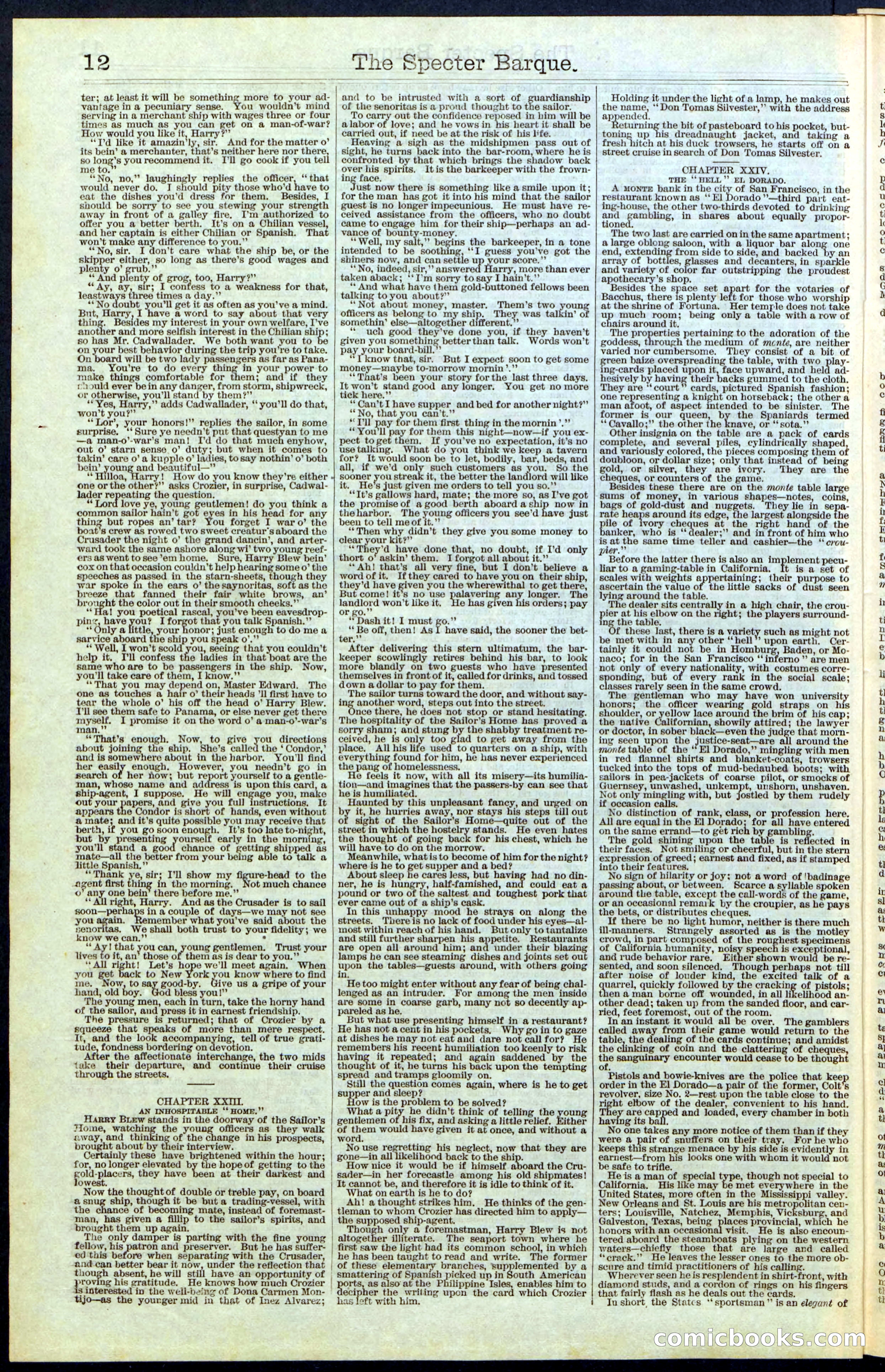
A restored page from Pulp Fiction, 1879. Page through the whole issue in the reader above.
📄 Transcribed text from this page (OCR, searchable)
Machine-transcribed from the original scan — historical spelling and the odd misread are preserved.
ter; at least it will be something more to your ad- vantage in a pecuniary sense. ou wouldn't mind serving in a merchant ship with wages three or four times as much as you can get on a man-of-war? How would you like it, Harry?” “T’d like it amazin'ly, sir. And for the matter o’ its bein’ a merchanter, that’s neither here nor there rt) longs you recommend it. I'll go cook if you tell me to.” “No, no,” laughingly replies the officer, “ that would never do. I should pity those who'd have to eat the dishes you'd dress for them. Besides, I should be sorry to see you stewing your strength away in front of a galley fire. I'm authorized to offer you a better berth. It’s on a Chilian vessel, and her captain is either Chilian or Spanish. That won't make any difference to you.” “No, sir. I don’t care what the shi skipper either, so long as there’s goo plenty o’° grub.” *‘ And plenty of grog, too, Harry?” “Ay, ay, sir; I confess to a weakness for that, leastways three times a day.” **No doubt you'll get it as often as you've a mind. But, Harry, I have a word to say about that very thing. Besides my interest in your own welfare, I’ve another and more selfish interest in the Chilian ship; so has Mr. Cadwallader. We both want you to on your best behavior during the trip you're to take. On board will be two lady passengers as far as Pana- ma. You're to do every thing in your power to make things comfortable for them; and if they chould ever bein any danger, from storm, shipwreck, or otherwise, you'll stand by them?” ‘* Yes, Harry,” adds Cadwallader, *‘ you'll do that, won’t you?” ‘*Lor’, your honors!” replies the sailor, in some surprise. ‘‘ Sure ye needn't put that questyan to me —a man-o’-war’s man! I'd do that much enyhow, out o’ starn sense o’ duty; but when it comes to takin’ care o’ a kupple o’ ladies, tosay nothin’ 0’ both bein’ Tone and beautiful—” “*Hilloa, Harry! How do you know they’re either one or the other?’’ asks Crozier, in surprise, Cadwal- lader repeating the question. _ love ye, young "Neher at do you think a common sailor hain’t got eyes in his head for any thing but ropes an’tar? You forget I waro’ the boat's crew as rowed two sweet creatur’s aboard the Crusader the night o’ the grand dancin’, and arter- ward took the same ashore along wi’ two young reef- ers as went tosee’em home. Sure, Harry Blew bein’ cox on that occasion couldn't help hearing some o’ the speeches as Daag in the starn-sheets, ongh they war spoke the ears o’ the saynoritas, soft as the breeze that fanned their fair white brows, an’ brought the color out in their smooth cheeks.” *“*Hal you poetical rascal, oth been eavesdrop- ping, have you? I forgot that you talk Spanish.” * Only a little, your honor; just enough to do me a sarvice aboard the ship you speak o’.”’ “Well, I won’t scold you, pope ror you couldn't help it. I'll confess the ladies in that boat are the same who are to be passengers in the ship. Now, you'll take care of them, I know.”’ “That you may depend on, Master Edward. The one as touches a hair o’ their heads ‘Il first have to tear the whole o’ his off the head o’ Harry Blew. T'll see them safe to Panama, or else never get there myself. I promise it on the word 0’ a man-o’-war’s man. “That's enough. Now, to give you directions about joining the ship. She’s called the ‘ Condor,’ and is somewhere about in the harbor. You'll find her easily enough. However, you needn’t go in search of her how; but Pu atk yourself to a gentle- man, whose name and ad is upon this card, a anf sie I suppose. He will engage you, make out your papers, and give you full instructions. It appears the Condor is short of hands, even without a mate; and it's quite possible you may receive that berth, if you gosoon enough. It’s too late to-night, but by presenting yourself early in the morning, you'll stand a g chance of mpg Pegrs an: as be, or the wages and mate—all the better from your being able to talk a little Spanish,” “Thank ye, sir; I'll show my head to the agent first hing in the morning. Not much chance 0 oe bein’ there before me.”’ ‘*All right, Harry. And as the Crusader is to sail recA lg A a couple of days—we may not see you again. member what you've said about the eno We shall both trust to your fidelity; we = et that vf Heckon:?) Tras =a at you can, young gentlemen. your lives to it, ant those of them as is dear to you.” “All right! Let’s hope we'll meet again. When you get k to New York nen know where to find me. Now, to say good-by. Give us a gripe of your hand, old boy. d bless you!”’ The young men, each in turn, take the horny hand of the sailor, and press it in earnest friendship. The pressure is returned; that of Crozier by a | | He has not acent in his pockets. Why go in to gaze squeeze that s of more than mere respect. It, and the look accompanying, tell of true grati- tude, fondness bordering on evotion. After the affectionate interchange, the two mids take their departure, and continue their cruise through the streets. CHAPTER XXTII. AN INHOSPITABLE ‘* HOME.”’ Harry Buiew stands in the doorway of the Sailor’s Home, watching the peg officers as they walk away, and thinking of the change in his prospects, brought about by their interview. Certainly these have brightened within the hour; for, no longer elevated Le Be e hope of getting to the gol Tiecers, they have n at their darkest and ow Now the thought of double or treble pay, on board a snug ship, though it be but a trading-vessel, with the ce of becoming mate, instead of foremast- man, has given a fillip to the sailor’s spirits, and brought them up The only damper is parting with the fine young fellow, his patron and preserver. But he has suffer- ed this ore when separating with the Crusader, and can better bear it now, under the reflection that though absent, he will still have an opportunity of proving his gratitude. He knows how much Crozier interested in the well-being of Dona Carmen Mon- tijo—as the younger mid in that of Inez Alvarez; | po as Nec er the writing upon the c The Specter Barque. and to be intrusted with a sort of ardianship of the senoritas is a prond thought to the sailor. To carry out the confidence reposed in him will be alabor of love; and he vows in his heart it shall be carried out, if need be at the risk of his l'fe. Heaving a sigh as the midshipmen pass out of sight, he turns back into the bar-room, where he is confronted by that which brings the shadow back Ais spirits. Itis the barkeeper with the frown- ng face. Just now there is something like a smile upon it; for the man has got it into his mind that the sailor guest is no longer impecunious. He must have re- ceived assistance from the officers, who no doubt came to engage him for their ship—perhaps an ad- vance of bounty-money. ‘* Well, my salt,’ begins the barkeeper, in a tone intended to be soothing, ‘‘I guess you've got the shiners now, and can settle up your score.” ** No, indeed, sir,’ answe arry, more than ever taken aback; '‘I’m sorry to say I hain’t.”’ ‘**And what have them gold-buttoned fellows been talking to you about?” *“Not about money, master. Them’s two Poe officers as belong to my ship. They was talkin’ of somethin’ else—altogether different,”’ ** uch good they've done you, if they haven't given you something better than talk. Words won't pay your board-bill.”’ “T know that, sir. But I expect soon to get some money—maybe to-morrow mornin’.”’ ‘**That’s been your story forthe last three days. It won’t stand good any longer. You get no more tick here.”’ **Can’t I have supper and bed for another night?” ‘No, that you can’t.” “TH pay for them first thing in the mornin’.”’ ‘““You’ll pay for them this night—now—if you ex- pect togetthem. If you've no expectation, it’s no use talking. What do you think we keep a tavern for? It would soon be to let, bodily, bar, beds, and all, if we'd only such customers as you. So the sooner you streak it, the better the landlord will like it. He’s just given me orders to tell you so.”’ ‘“*Tt’s gallows hard, mate; the more so, as I’ve got the promise of a good berth aboard a chip now in theharbor. The young officers you see’ ve just been to tell me of it.”’ “Then why didn’t they give you some money to clear your kit?” “They'd have done that, no doubt, if I'd only thort o’ askin’ them. I forgot all about it.” “Ah! that’s all very fine, but I don’t believe a word of it. Ifthey cared to have you on their ship, they’d have given you the wherewithal to get there, But come! it’s no use palavering any longer. The landlord won't like it, He has given orders; pay or go.”’ ** Dash it! I must go.” % Be off, then! As I have said, the sooner the bet- y After delivering this stern ultimatum, the bar- keeper scowlingly retires behind his bar, to look more blandly on two guests who have presented themselves in front of it, called for drinks, and tossed down a dollar to pay for them. The sailor turns toward the door, and without say- sr Pe ae word, steps out into the street. nce there, he does not stop or stand hesitating. The hospitality of the Sailor’s Home has proved a sorry sham; and stung by the shabby treatment re- ceived, he is only too glad to get away from the place. All his life used to quarters on a ship, with everything found for him, he has never experienced the pang of homelessness. He feels it now, with all its misery—its humilia- tion—and imagines that the passers-by can see that he is humiliated. Haunted by this unpleasant fancy, and ed on by it, he hurries away, nor stays his steps till out of sight of the Sailor’s Home—quite out of the street in which the hostelry stands. He even hates the thought of going back for his chest, which he will have to do on the morrow. Meanwhile, whatis to become of him for the night? where is he to get supper and a bed? About sleep he cares Jess, but having had no din- ner, he is hungry, half-famished, and could eat a pound or two of the saltest and toughest pork that ever came out of a ship's cask. In this unhappy mood he strays on along the streets. Thereis no lack of food under his eyes—al- most within reach of his hand. But only to tantalize and still further sharpen his appetite. Restaurants are open all around him; and under their blazi lamps he can see steaming dishes and joints set ou i the tables—guests around, with others going He too might enter without any fear of being chal- lenged as an intruder. For among the men inside are some in coarse garb, many not so decently ap- pareled as he. But what use presenting himself in a restaurant? at dishes he may not eat and dare not call for? He remembers his recent humiliation too keenly to risk hav it repeated; and again saddened by the thought of it, he turns his back upon the tempting spread and tramps gloomily on. Still the question comes again, where is he to get supper and sleep? ow is the problem to be solved? What a pity he didn’t think of telling the young gentlemen of his fix, and asking a little relief. Either of pens would have given it at once, and without a word. No use etting his neglect, now that they are gone—in all likelihood back to the spn How nice it would be if himself aboard the Cru- sader—in her forecastle among his old shipmates! It cannot be, and therefore it is idle to think of it. What on earth is he to do? Ah! a thought strikes him. He thinks of the gen- tleman to whom Crozier has directed him to apply— the supposed ship-agent, ee only a foremastman, Harry Blew is not altogether illiterate. The seaport town where he first saw the light had its common school, in which he has been taught to read and write. The former | of these element branches, supplemented by a f Spanis smattering 0 h picked up in South American ‘at the Philippine Isles, enables him to which Crozier has left with him. os Holding it under the light of a lamp, he makes out the name, ‘*‘ Don Tomas Silvester,’’ with the address appended. eturning the bit of pasteboard to his pocket, but- toning up his dreadnaught jacket, and taking a fresh hitch at his duck trowsers, he starts off on a street cruise in search of Don Tomas Silvester. CHAPTER XXIV. THE “ HELL’? EL DORADO. A MONTE bank in the city of San Francisco, in the restaurant known as ‘‘E] Dorado”’—third part eat- ing-house, the other two-thirds devoted to drinking pe rambling, in shares about equally propor- ioned. The two last are carried on in the same apartment; a large oblong saloon, with a liquor bar along one end, extending from side to side, and backed by an array of bottles, glasses and decanters, in sparkle and variety of color far outstripping the proudest apothecary’s shop. Besides the space set apart for the votaries of Bacchus, there is plenty left for those who worship at the shrine of Fortuna. Her temple does not take m much room; being only a table with a row of chairs around it. The properties pertaining to the adoration of the goddess, through the medium of mcnte, are neither varied nor cumbersome. They consist of a bit of green baize overspreading the table, with two eay- ing-cards placed upon it, face upward, and held ad- hesively by having their backs gummed to the cloth, They are “court” cards, pictured Spanish fashion; one representing a knight on horseback; the other a man afoot, of aspect intended to be sinister. The former is our queen, by the Spaniards termed ‘“*Cavallo;” the other the knave, or ‘ sota.”’ Other insignia on the table are a pack of cards complete, and several piles, cylindrically shaped and variously colored, the pieces composing them o doubloon, or dollar size; only that instead of being gold, or silver, they are ivory. They are the cheques, or counters of the game. Besides these there are on the monte table large sums of money, in various shapes—notes, coins, bags of gold-dust and nuggets. They lie in won rate pps around its edge, the largest alongside the ile of ivory cheques at the right hand of the anker, who is “‘dealer;’’ and in front of him who is at the same time teller and cashier—the “ crou- pier.” Before the latter there is also an ing pecu- liar to a gaming-table in California. It is a set of scales with weights appertaining; their purpose to ascertain the value of the little sacks of dust seen lying around the table. The dealer sits centrally in a high chair, the crou- pier at his elbow on the right; the players surround- ge table. f these last, there is a variety such as might not be met with in any other “hell” upon earth. Cer- tainly it could not be in Homburg, Baden, or Mo- naco; for in the San Francisco “inferno” are men not only of every nationality, with costumes corre- sponding, but of every rank in the social scale; classes rarely seen in the same crowd. The gentleman who may have won universit honors; the officer wearing geld straps on his shoulder, or yellow lace around the brim of his cap; the native ifornian, showily attired; the lawyer or doctor, in sober black—even the judge that morn- ing seen upon the justice-seat—are around the monte table of the “ El Dorado,” mingling with men in red flannel shirts and blanket-coats, trowsers tucked into the tops of mud-bedaubed boots; with sailors in pea-jackets of coarse pilot, or smocks of Guernsey, unwashed, unkempt, unshorn, unshaven. Not only mingling with, but jostled by them rudely if occasion calls. No distinction of rank, class, or profession here. All are equal in the El Dorado; for all have entered on the same errand—to gét ric = ag meme , The gold shining upon the table is reflected in their faces. Not smiling or cheerful, but in the stern expression of greed; earnest and fixed, as if stamped into their features. No sign of hilarity or joy; not a word of !badinage passing about, or between. Scarce a syllable spoken around the table, except the call-words of the game, or an occasional remaik by the croupier, as he pays the bets, or distributes cheques. If there be no light humor, neither is there much ill-manners. Strangely assorted as is the motley crowd, in part composed of the roughest specimens of California humanity, noisy speech is exceptional, and rude behavior rare. Either shown would be re- sented, and soon silenced. Though perhaps not till after noise of louder kind, the excited talk of a uarrel, quickly followed by the cracking of pistols; then a man borne off wounded, in all likelihood an- other dead; taken up from the sanded floor, and car- ried, feet foremost, out of the room, In an instant it would all be over. The gamblers called away from their game would return to the table, the dealing of the cards continue; and amidst the clinking of coin and the clattering of cheques, = sanguinary encounter would cease to be thought 0 ’ Pistols and bowie-knives are the police that kee order in the El Dorado—a pair of the former, Colt’s revolver, size No, 2—rest upon the table close to the right elbow of the dealer, convenient to his hand. ey are capped and loaded, every chamber in both having its F No one takes any more notice of them than if they were a pair of snuffers on their tray. For he who keeps this strange menace by his side is evidently in earnest—from his looks one with whom it would not cited pat ecole though not special to eis a man 0 ¢c , though not spec California. His ie aay Pecan everywhere in the United States, more often in the enter a valley. New Orleans and St. Louis are his metropolitan cen- ters; Louisville, Natchez, Memphis, Vicksburg, and Galveston, Texas, being places provincial, which he honors with an occasional visit. He is also encoun- tered aboard the steamboats plying on the western. waters—chiefly those that are large and called “crack.”’ He leaves the lesser ones to the more ob- scure and timid practitioners of his calling. Wherever seen he is resplendent in shirt-front, with diamond studs, and a cordon of rings on his fingers that fairly flash as he deals out the cards. Iu short, the Statcs “sportsman” is an elegant of JOO ar ea (E@) com - a SS) | | ' | : (Ssa—-10]t -Rn. ne hones Qs OF'O ood sfonrr & SaAtroo pasporoc b&