
Pulp Fiction, 1879 · page 11 of 40
Beadle's New York Dime Library, No. 66 — page 11: what you’re looking at
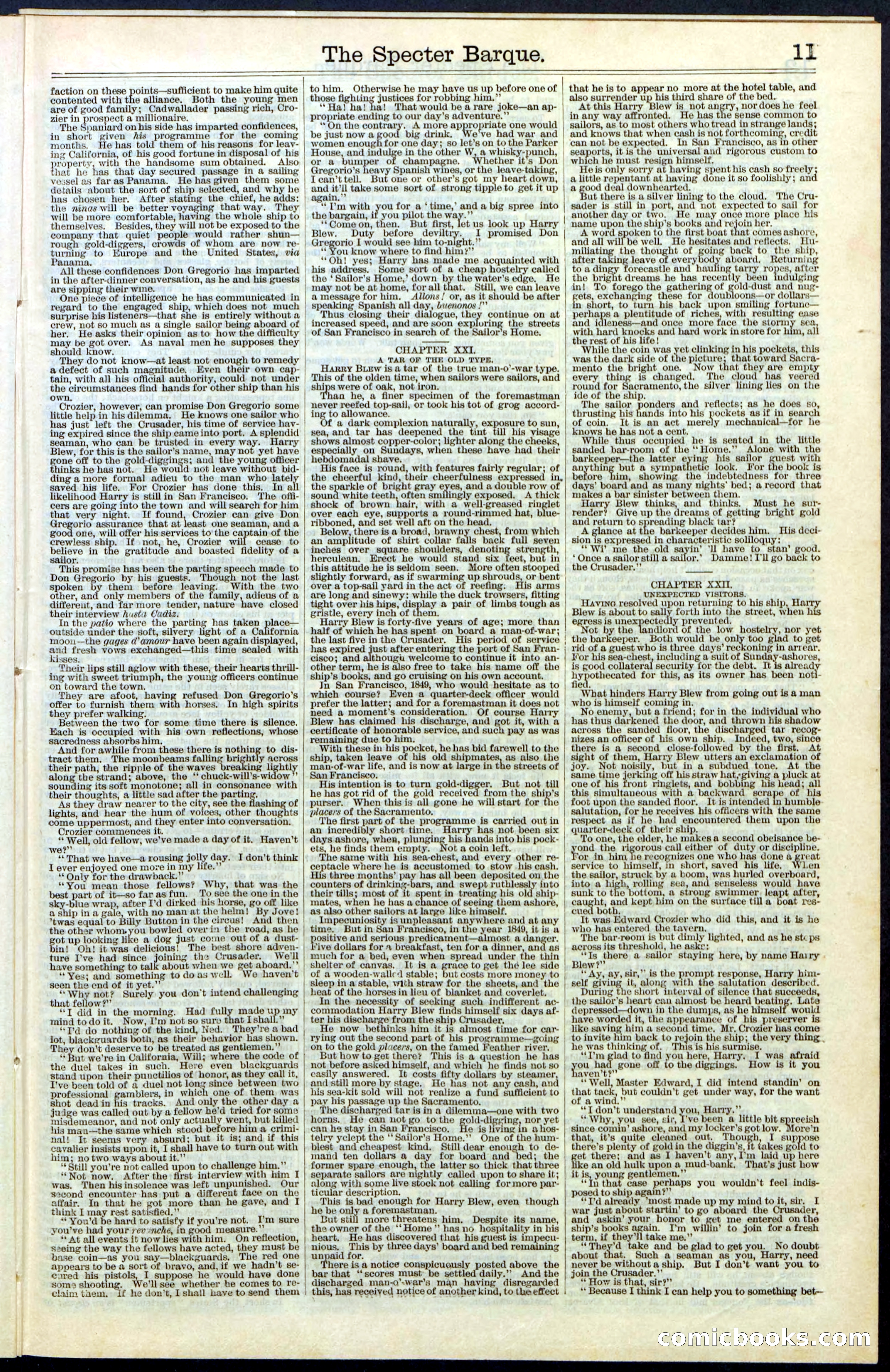
A restored page from Pulp Fiction, 1879. Page through the whole issue in the reader above.
📄 Transcribed text from this page (OCR, searchable)
Machine-transcribed from the original scan — historical spelling and the odd misread are preserved.
—_—- faction on these points—sufficient to make him quite | to him. Otherwise he may have us up before one of | contented with the alliance. Both the young men are of good family; Cadwallader passing rich, Cro- zier in prospect a millionaire. The Spaniard on his side has imparted confidences, in short given his programme for the coming months. He has told them of his reasons for leay- ing California, of his good fortune in disposal of his yoperty, with the handsome sum obtained. Also that he has that day secured passage in a sailing vessel as faras Panama. He has given them some | details about the sort of ship selected, and why he | has chosen her. After stating the chief, he adds: the ninas will be better voyaging that way. They will be more comfortable, having the whole ship to themselves. Besides, they will not be exposed to the vhidege werd that quiet people would rather shun— roug gold-diggers, crowds of whom are now re- SuanLag to Kurope and the United States, via anama. All these confidences Don Gregorio has imparted in the after-dinner conversation, as he and his guests are sipping their wine. One piece of intelligence he has communicated in regard to the engaged ship, which does not much surprise his listeners—that she is entirely without a crew, not so much as a single sailor being aboard of He asks their opinion as to how the difficulty As naval men he supposes they her. may be got over. should know. They do not know—at least not enough to remedy a defect of such magnitude, Even their own cap- tain, with all his official authority, could not under the circumstances find hands for other ship than his own. little help in his dilemma. He knows one sailor who has just left the Crusader, his time of service hav- | ing expired since the ship came into port. A splendid seaman, who can be trusted in every way. Harry Blew, for this is the sailor’s name, may not yet have Fone off to the gold-diggings; and the young officer hinks he has not. He would not leave without bid- ding a more formal adieu to the man who lately saved his life. For Crozier has done this. In a likelihood Harry is stillin San Francisco, The offi- cers are going into the town and will search for him that very night. If found, Crozier can give Don Gregorio assurance that at least one seaman, and a good one, will offer his services to the captain of the crewless gt If not, he, Crozier will cease to believe in the gratitude and boasted fidelity of a or. This promise has been the parting speech made to Don Gregorio by his guests. Though not the last an by them before leaving. With the two other, and only members of the family, adieus of a differeut, and far more tender, nature have closed their interview husta Cadiz. In the patio where the parting has taken place— outside under the soft, silvery light of a California moon-—the gages d’amour have been again displayed, - fresh vows exchanged—this time sealed with <isses. _ Their lips still aglow with these, their hearts thrill- ing with sweet triumph, the young officers continue on toward the town. They are afoot, having refused Don Gregorio’s offer to furnish them with horses. In high spirits they prefer walking. Between the two for some time there is silence. Each is occupied with his own reflections, whose sacredness absorbs him, And for awhile from these there is nothing to dis- tract them. The moonbeams falling brightly across their path, the ripple of the waves li htly along the strand; above, the ‘‘ chuck-will’s-widow ”’ sounding its soft monotone; all in consonance with their thoughts, a little sad after the parting. As they draw nearer to the city, see the flashi of lights, and hear the hum of voices, other thoughts come uppermost, and they enter into conversation. Crozier commences it. ** Well, old fellow, we’ve made a day of it. Haven't e?”” “That we have—a rousing jolly day. I don't think I ever enjoyed one more in my life.” “Only for the drawback.” * You mean those fellows? Why, that was the best part of it—so farasfun. To see the one in the sky-blue wrap, after I'd dirked his horse, go off like a ship in a gale, with no man at the helm! By Jove! *twas equal to Billy Button in the circus! And then the other whom. you bowled over in the road, as he ot up looking like a dog just come out of a dust- bin! Oh! it was delicious! The best shore adven- ture I’ve had since joining the Crusader. We'll have something to talk about when we get aboard.”’ “Yes: and something to doas well. We haven't seen the end of it yet.” er ““Why not? Surely you don't intend challenging that fellow?” “IT did in the morning. Had fully made up my mind to do it. Now, I’m not so sure that Ishall. “I'd do nothing of the kind, Ned. They're a bad lot, blackruards both, as their behavior has shown. They don't deserve to be treated as gentlemen.” * But we're in California, Will; where the code of the duel takes in such. Here even blackguards stand upon their punctilios of honor, as they call it, I’ve been told of a duel not long since between two professional gamblers, in which one of them was shot dead in tracks. And only the other day a judge was called out by a fellow he'd tried for some misdemeanor, and not only actually went, but killed his man--the same which stood before him a crimi- nal! It seems very absurd; but it is; and if this cavalier insists upon it, I shall have to turn out with him; no two ways about it.’ J * Still you're not called upon to challenge him. “Not now. After the first interview with him I was. Then hisinsolence was left unpunished. Our second encounter has put a different face on the affair. In that he got more than he gave, and I think I may rest satisfied.” : “You'd be hard to satisfy if you're not. I’m sure you've had your rev vnche, in good measure. ** At all events it now lies with him. On reflection, seeing the way the fellows have acted, they must be base coin—as you say—blackguards, The red one appears to be a sort of bravo, and, if we hadn't se- eured his a I suppose he would have done soms shooting. We’llsee whether he comes to re- claim them. if he don't, I shall have to send them Crozier, however, can promise Don Gregorio some sles Ssh | Blew. his address. The Specter Barque. those fighting justices for robbing him.” ‘*Ha! ha! ha! That would be a rare joke—an ap- propriate ending to our day’s adventure.” **On the peoples A more ap ropriate one would be just now a good b women enough for one day; so let’s on to the Parker House, and ae i in the other W, a whisky-punch, or a bumper of champagne. Whether it’s Don Gregorio’s heavy Spanish wines, or the leave-taking, Iean’ttell. But one or other’s got my heart down, and it take some sort of strong tipple to get it up ain,”’ “Tm bs aes for a ‘time,’ and a big spree into | the bargain, if you pilot the Lag Ho ‘*Come on, then. But first, let us look up Harry Duty before Core I promised Don Gregorio I would see him to-night.”’ ‘You know where to find himy”’ “Oh! yes; Harry has made me acquainted with Some sort of a cheap hostelry called the ‘ Sailor’s Home,’ down by the water's edge. He may not be at home, forall that. Still, we can leave a message for him. Allons/ or, as it should be after speaking Spanish all day, buenonos |” Thus closing their dialogue, a continue on at increased speed, and are soon exp vring the streets of San Francisco in search of the Sailor’s Home. CHAPTER XXII. A TAR OF THE OLD TYPE. Harry Buiew is a tar of the true man-o’-war type. This of the olden time, when sailors were sailors, and ships were of oak, not iron, han he, a finer specimen of the foremastman never reefed top-sail, or took his tot of grog accord- ing to allowance. a dark complexion naturally, exposure to sun, sea, and tar has deepened the tint till his visage shows almost copper-color; lighter along the cheeks, especially on Sundays, when these have had their hebdomadal shave. His face is round, with features fairly regular; of the cheerful kind, their cheerfulness expressed in, the sparkle of bright gray Payot, and a double row of sound white teeth, often s gly exposed, A thick shock of brown hair, with a well-greased ringlet over each eye, supports a round-rimmed hat, blue- ribboned, and set well aft on the head. Below, there is a broad, brawny chest, from which an amplitude of shirt collar falls back full seven inches over square shoulders, py strength, herculean. Erect he would stand six feet, but in this attitude he is seldom seen. More often stooped slightly forward, as if swarming up shrouds, or bent over a top-sail yard in the act of reefing: His arms are long and sinewy: while the duck trowsers, fitting tight over his hips, display a pair of limbs tough as gristle, every inch of them. Harry Blew is forty-five years of age; more than half of which he has spent on board a man-of-war; the last five in the Crusader. His period of service has expired just after entering the port of San Fran- cisco; and althougu welcome to continue it into an- other term, he is also free to take his name off the ship’s books, and go cruising on his own account. Jn San Francisco, 1849, who would hesitate as to which course? Even a quarter-deck officer would prefer the latter; and for a foremastman it does not need a moment’s consideration. Of course Harry Blew has claimed his discharge, and got it, with a certificate of honorable service, and such pay as was remaining due to him, With these in his pocket, he has bid farewell to the ship, taken leave of his old shipmates, as also the man-of-war life, and is now at large in the streets of San Francisco. His intention is to turn gold- r. But not till he has got rid of the gold received from the ship's purser. When this is all gone he will start for the placers of the Sacramento. The first part of the programme is carried out in an incredibly short time. yd has not been six days ashore, when, mngag. ands into his pock- rs he finds them empty. Not a coin left. he same with his sea-chest, and every other re- ceptacle where he is accustomed to stow his cash. three months’ pay has all been deposited on the counters of drinking-bars, and swept ruthlessly into their tills; most of it nt in treating his old ship- mates, when he has a chance of seeing them ashore, as other sailors at large like himself. Impecuniosity is unpleasant anywhere and at any time. But in San Francisco, in the year 1849, it is a me gape and serious predicament—almost a ‘ive dollars for © breakfast, ten for a dinner, an as ig drink, e've had war and | er. | a EEE ———————————— ————————————— | | | ' ' much for a bed, even when spread under the thin | shelter of canvas. It is a of a wooden-walicd stable; but costs more money to sleep in a stable, with straw for the sheets, and the heat of the horses in lieu of blanket and coverlet, In the necessity of seeking such indifferent ac- commodation Harry Blew finds himself six days af- ter his discharge from the ship Crusader. He now bethinks him it is almost time for car- rying out the second part of his programme—going on to the gold placers, on the famed Feather river. But how to get there? This is a question he has not before asked himself, and which he finds not so casily answered. It costs fifty dollars by steamer and still more by stage. He has not any cash, an his sea-kit sold will not realize a fund sufficient to pay rer amas a up the Sacramento. The discharged tar is in a dilemma—one with two horns. He can not go to the old-digging, nor yet can he stay in San Francisco, He is living in a hos- telry yclept the ‘‘Sailor’s Home.’ One of the hum- blest and cheapest kind, Still dear enough to de- mand ten dollars a day for board and bed; the former spare enough, the latter so thick that three separate sailors are nightly called upon to share it; along with some live stock not calling for more par- ticular description. This is bad enough for Harry Blew, even though he be only a foremastman. But still more threatens him, Despite its name, the owner of the ‘‘Home”™ has no hospitality in his heart. He has discovered that his guest is impecu- ORS pute by three days’ board and bed remaining unpaid for. here is a notice conspicueusly posted above th bar that “scores must be settled daily.”” And the discharged man-o’:wer’s man having disregarded this, has received notice of another kind, to the effect ace to get the lee side | that he is to appear no more at the hotel table, and also surrender up his third share of the bed. At this Harry Blew is not angry, nor does he feel in any way affronted. He has the sense common to sailors, as to most others who tread in strange lands; and knows that when cash is not forthcoming, credit can not be expected. In San Francisco, as in other seaports, it is the universal and rigorous custom to which he must resign himself. Heis only sorry at having spent his cash so freely; a little repentant at having done it so foolishly; an a good deal downhearted. ut there is a silver lining to the cloud. The Cru- sader is still in port, and not expected to sail for another day or two. He may once more place his name upon the ship’s books and rejoin her, A word spoken to the first boat that comes ashore, and all will be well. He hesitates and reflects. Hu- miliating the thought of poing back to the sbip, after ing leave of everybody aboard, Returning to a dingy forecastle and hauling tarry ropes, after the bright dreams he has recently been indulging in! To forego the gathering of Set eee and nug- pets, exchanging these for doubloons—or dollars— short, to turn his back upon smiling fortune— perhaps a plentitude of riches, with resulting ease and idleness—and once more face the stormy sea with hard knocks and hard work instore for him, all the rest of his life! While the coin was yet clinking in his pockets, this was the dark side of the picture; that toward Sacra- mento the bright one. Now that they are empty every thing is changed. The cloud has veered round for Sacramento, the silver lining lies on the ide of the ship. The sailor ponders and reflects; as he does so, thrusting his hands into his porns as if in search of coin. It is an act merely mechanical—for he knows he has not a cent, While thus occupied he is seated in the little sanded bar-room of the ‘‘Home.’’ Alone with the barkeeper—the latter eying his sailor est with 1etic anything but a sympa look. For the book is before him, showing the indebtedness for three days’ and as many nights’ bed; a record that makes a bar sinister between them. Harry Blew thinks, and thinks. Must he sur- render? Give up the dreams of getting bright gold and return to sprencing black tar? A glance at the barkeeper decides him. His deci- sion is expressed in characteristic soliloquy: ‘* Wi’ me the old sayin’ ‘ll have to stan’ good. ‘Once a sailor still a or.’ Damme! T'll go back to the Crusader.” CHAPTER XXII. UNEXPECTED VISITORS. Havine resolved upon returning to his ship eg rt Blew is about to sally forth into the street, when ress is unexpectedly prevented, ot by the dlord of the low eer Ri yet the barkeeper. Both would be only too g to get rid of a guest who is three days’ reckoning in arrear. Yor his sea-chest, including a suit of Seas Py yee is good collateral security for the debt. It is alread ro gemaieemome for this, as its owner has been noti- tied. What hinders Harry Blew from going out is a man who is himself coming in. No enemy, but a friend; for in the individual who has thus darkened the door, and thrown his shadow across the sanded floor, the gp oe On tar recog- nizes an officer of his own ship. Indeed, two, since there is a second close-followed by the first. At sight of them, Harry Blew utters an exclamation of joy. Not noisily, but in a subdued tone. At the same time qerking off his straw Hatssiva a pluck at one of his front ringlets, and bobbing his head; all this simultaneous with a backward scrape of his foot upon the sanded floor. It is intended in humble. salutation, for he receives his officers with the same respect as if he had encountered them upon the quarter-deck of their ship. To one, the elder, he makes a second obeisance be- ond the rigorous call either of duty or discipline. ‘or in him he recognizes one who has done a great service to himself, in short, saved his life. Len the sailor, struck by a boom, was hurled overboard, into a high, rolling sea, and senseless would have sunk to the bottom, a strong swimmer. leapt after, caught and kept him on the surface tilla boat res- cued both, It was Edward Crozier who did this, and it is he who has entered the tavern. The bar-reom is but dimly lighted, and as he stc ps across its threshold, he asker: Shoe, there a sailor staying here, by name Hairy . ew?” * Ay, ay, sir,’’ is the prompt response, Harry him- self giving it, along with the salutation described. During the short interval of silence that succeeds, the sailor’s heart can almost be heard beating. Late depressed—down in the dumps, as he himself would have worded it, the appearance of his preserver is like saving him a second time, Mr, Crozier has come to invite him back to rejoin the ship; the very thing | he was thinking of. This is his surmise. ‘I’m glad to find you here, Harry. I was afraid ou gone off to the diggings. How is it you ven’t?”’ ‘* Well, Master Edward, I did intend standin’ on that tack, but couldn’t get under way, for the want of a wind,” “T don’t understand yous Harry.”’ “Why, you see, sir, I've been a little bit spreeish since comin’ ashore, and my locker’s got low. More'n that, it’s quite cleaned out, Though I suppose there’s plenty of gold in the diggin’s, it takes gold to et there; and as I haven't any, I'm laid up here e an old hulk upon a mud- That's just how it is, young gentlemen,” “In that case perhaps you wouldn't feel indis- posed to ship ?”” “T’'d already ‘most made up my mind to it, sir, I war just about startin’ to go aboard the ler, and askin’ your honor to ket me entered on the ship’s books again. I’m willin’ to join for a fresh term, if they’)l take me.” “They'd take and be glad to get you. No doubt about t. Such a seaman as you, Harry, need never be withouta ship. But I don’t want you to join the Crusader.”’ “ How is that, sir?” ‘** Because I think I can help you to something bet- Eomichoo Cc S (E(@)