
Pulp Fiction, 1888 · page 22 of 32
Beadle's New York Dime Library, No. 500 — page 22: what you’re looking at
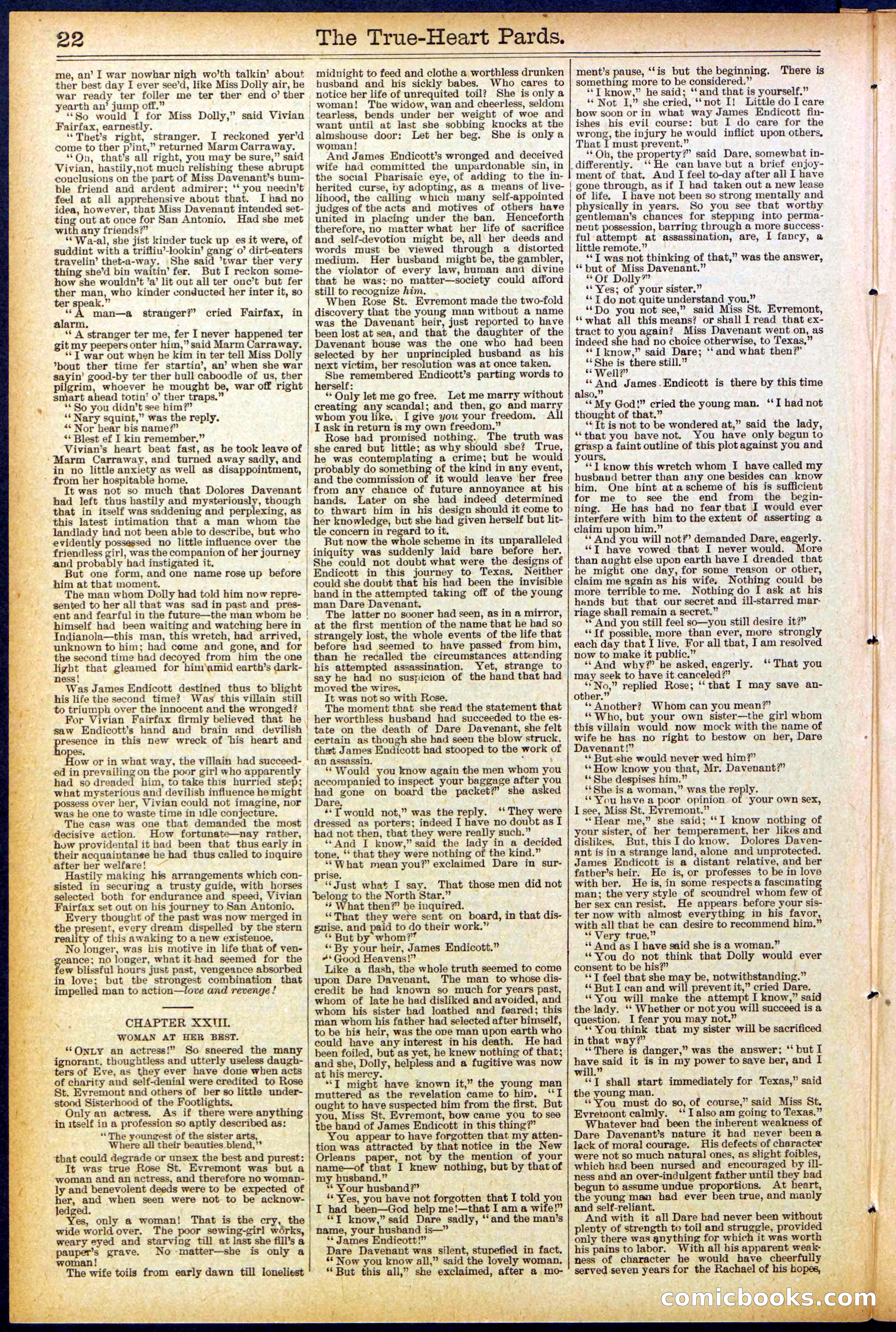
A restored page from Pulp Fiction, 1888. Page through the whole issue in the reader above.
📄 Transcribed text from this page (OCR, searchable)
Machine-transcribed from the original scan — historical spelling and the odd misread are preserved.
is Fe J ‘i : o, . -— «Ae ~~ 'Marm had so dreade me, an’ I war nowhar nigh wo’th talkin’ about ther best day I ever see’d, like Miss Dolly air, he war ready ter foller me ter ther end o’ ther . yearth an’ jump off.” **So would I for Fairfax, earnestly. “Thet’s right, stranger. I reckoned yer’d come to ther p’int,” returned Marm Carraway. “On, that’s all right, you may be sure,” said Vivian, bastily,not much relishing these abrupt conclusions on the part of Miss Davenant’s bum- ble friend and ardent admirer; *‘ you needn’t feel at all apprehensive about that. I had no idea, however, that Miss Davenant intended set- ting out at once for San Antonio, Had she met with any friends?” **Wa-al, she jist kinder tuck up es it were, of suddint with a trifliu’-lookin’ gang o’ dirt-eaters travelin’ thet-a-way. She said ’twar ther very thing she’d bin waitin’ fer. But I reckon some- how she wouldn’t ’a’ lit out all ter onc’t but fer ther man, who kinder conducted her inter it, so ter jem ? man—a stranger?’ cried Fairfax, in alarm. ‘‘ A stranger ter me, fer I never happened ter git my peepers onter him,” said Marm Carraway. ‘*]T war out when he kim in ter tell Miss Dolly ‘bout ther time fer startin’, an’ when she war sayin’ good-by ter ther bull caboodle of us, ther pilgrim, whoever he mought be, war off right smart ahead torin’ o’ ther traps.” ‘* So you didn’t see him?” ‘‘ Nary squint,” was the reply. “‘ Nor hear bis name?” ** Blest ef I kin remember.” Vivian’s heart beat fast, as he took leave of Carraway, and turned away sadly, and in no little anxiety as well as disappointment, ’ from her hospitable home. It was not so much that Dolores Davenant { Miss Dolly,” said Vivian | bad left thus hastily and mysteriously, though — that in itself was saddening and perplexing, as ‘this latest intimation that a man whom the landlady had not been able to describe, but who evidently possessed no little influence over the friendless girl, was the companion of her journey and probably had instigated it. é’ But one form, and one name rose up before him at that moment. The man whom Dolly had told him now repre- | sented to her all that was sad in past and pres- | ent and fearful iu the future—the man whom he |! himself had been waiting and watching here in Indianola—this man, this wretch, had arrived, unknown to him; had come and gone, and for | before had seemed to have midnight to feed and clothe a worthless drunken husband and his sickly babes. Who cares to notice her life of unrequited toil? She is only a woman! The widow, wan and cheerless, seldom tearless, bends under her weight of woe and want until at last she sobbing knocks at the almshouse door: Let her beg. She is only a woman! And James Endicott’s wronged and deceived wife had committed the unpardonable sin, in the social Pharisaic eye, of adding to the in- herited curse, by adopting, as a means of live- lihood, the calling which many self-appointed judges of the acts and motives of others have united in placing under the ban. Henceforth therefore, no matter what her life of sacrifice and self-devotion might be, all her deeds and words must be viewed through a distorted medium. Her busband might be, the gambler, the violator of every law, buman ana divine that he was: no matter—society could afford still to recognize him. When Rose St. Evremont made the two-fold discovery that the young man without a name was the Davenant heir, just reported to have been lost at sea, and that the daughter of the Davenant house was the one who had been selected by her be husband as his next victim, ber resolution was at once taken. She remembered Endicott’s parting words to erself: * Only let me go free. Let me marry without creating any scandal; and then, go and marr whom you like. I give you your freedom. A I ask in return is my own f om.” Rose bad promised nothing. The truth was she cared but little; as why should sbe? True, he was contemplating a crime; but he would probably do something of the kind in any event, and the commission of it would leave ‘her free from any chance of future annoyance at his hands. Later on she had indeed determined to thwart bim in his design should it come to her knowledge, but she had given herself but lit- tle concern in regard to it. Rut now the whole scheme in its unparalleled iniquity was suddenly laid bare before her. She could not doubt what were the designs of Endicott in this journey to Texas, Neither could she doubt that his had been the invisible band in the attempted taking off of the young man Dare Davenant. The latter no sooner had seen, as in a mirror, at the first mention of the name that he had so strangely lost, the whole events of the life that passed from him, the second time had decoyed from him the one | than he recalled the circumstances attending light that gleamed for him‘amid earth’s dark- ness! his attempted assassination. Yet, strange to say he had no suspicion of the hand that had Was James Endicott destined thus to blight | moved the wires. his life the second time? Was this villain still to triumph over the innocent and the wronged? For Vivian Fairfax firmly believed that he ei in this new wreck of his heart and opes. coed or in what way, the villain had succeed- ed in aria. | on the poor girl who apparently | i | him, to take this hurried step; | It was not so with Rose. The moment that sbe read the statement that , ‘ | her wortbless husband had succeeded to the es- - gaw Endicott’s hand and brain and devilish | tate on the death of Dare Davenant, she felt certain as though she had seen the blow struck, that James Endicott had stooped to the work of an assassin. ; * Would ; ae know again the men whom you accompanie to inspect your baggage after you what mysterious and devilish influence hemight | had gone on board the packet?” she asked possess over her, Vivian could not imagine, nor | Dare, was he one to waste time in idle conjecture. The case was one that demanded the most | dressed as How fortunate—nay rather, | had not then, that they were really such.” ecisive action. after her welfare! Hastily making his arrangements which con- sisted in securing a trusty guide, with horses selected both for endurance and speed, Vivian Fairfax set out on his journey to San Antonio. Every thought of the past was now merged in the present, every dream dispelled by the stern reality of this awaking to a new existenoe. ‘<i \e . . % ' “ e vue * . a ys pa es ‘af. nt ate! @ = * r = ’ No longer, was his motive in life that of ven- ance; no longer, what it had seemed for the few blissful hours just past, vengeance absorbed in love; bat the strongest combination that | impelled man to action—love and revenge ! CHAPTER XXUL WOMAN AT HER BEST. _ “Onty an actress!” So sneered the many ignorant, thoughtless and utterly useless daugh- he ters of Eve, as they ever have done when acts of aruba! and self-denial were credited to Rose St. Evremont and others of ber so little under- stood Sisterhood of the Footlights. - Only an actress. As if there were anything ‘in itself in a profession so aptly described as: “The youngest of the sister arts, Where all their beauties blend,”’ ‘that could degrade or unsex the best and purest: It was true. Evremont was but a - ‘woman and an actress, and therefore no woman- ly and benevolent deeds were to be ted of re and when Jase age not. to beatin ledged. Yes, only a woman! That is the cry, the wide world over. The poor sewing-girl works, weary eyed and starving till at last she fill’s a -pauper’s grave. No-matter—sbe is only a e , F hs - + ., - Py , & a , + Y P . " — O60 Fie atts ee of, FS > na ’ how providental it had been that thus early in | _ their acquaintance he had thus called to inquire : et The wife toils from early dawn till loneliest * +*T would not,” was the reply. ‘They were porters; indeed I have no doubt as I ‘‘*And I know,” said the lady in a decided tone, * that they were nothing of the kind.” ‘“What mean you?” exclaimed Dare in sur- prise. } “Just what I say. That those men did not ‘belong to the North Star.” ‘‘ What then?” he inquired. “That they were sent on board, in that dis- guise. and paid to do their work.” * But by whom?” ‘By your heir, James Endicott.” “* Good Heavens!” Like a flash, the whole truth seemed to come upon Dare Davenant. The man to whose dis- credit he had known so much for years past, whom of late he had disliked and avoided, and whom his sister had loathed and feared; this man whom his father had selected after himself, to be his heir, was the ope man upon earth who could have any interest in his death. He had been foiled, but as yet, he knew nothing of that; and she, Dolly, helpless and a fugitive was now at his mercy. “IT might have known it,” the young man muttered as the revelation came to him, ‘I ought to have suspected him from the first. But you, Miss St. Evremont, how came you to see the band of James Endicott in this thing?” You appear to have forgotten that my atten- tion was attracted by that notice in the New Orleans paper, not by the mention of your name—of that I knew nothing, but by that of my busband.” : ‘ Your husband?” ‘Yes, you have not forgotten that I told you ! n—God help me!—that I am a wife!” _“T know,” said Dare sadly, ‘‘and the man’s name, your husband is—” ** James Endicott!” Dare Davenant was silent, stupefied in fact. “ Now you know all,” said the lovely woman. “But this all,” she exclaimed, after a mo- 5 ie : at 4. re tov “! de | Sy ee Fy a a r +f” 4 te 2s eV Age ‘ J ne ee, 3 See ee ier ss rw ee / . oi et — ae ro Tred be ae ~ , wet = 5 + cad . * 7 “= tS. ‘ 1 a ct ae Oly = 4 rey 2 :. 7 _ differently. ee SSS lS sss SS OO —— ———— ——— ———————————————————— — Pe i See LY a. a ES a a << Pe bo he| - ee! us a - 4 AD ae ir = ment’s pause, ‘“‘is but the beginning. There is something more to be considered,” ‘‘T know,” he said; *‘ and that is yourself.” ‘* Not I,” she cried, ‘‘not I! Little do I care how soon or in what way James Endicott fin- ishes his evil course: but I do care for the wrong, the injury he would inflict upon others, That I must prevent.” ‘Oh, the property?” said Dare, somewhat in- ‘He can bave but a brief enjoy- ment of that, And I feel to-day after all I have gone through, as if I had taken out a new lease of life. I have not been so strong mentally and physically in years. So you see that worthy gentleman’s chances for stepping into perma- neut possession, barring through a more success- ful attempt at assassination, are, I fancy, a little remote.” **T was not thinking of that,” was the answer, ‘* but of Miss Davenant.” “Of Dolly” ‘*- Yes; of your sister.” ‘* 7 do not quite understand you.” ‘“‘Do you not see,” said Miss St. Evremont, “what all this means? or shall I read that ex- tract to youagain? Miss Davenant went on, as indeed she had no choice otherwise, to Texas,” ‘*T know,” said Dare; ‘‘and what then?” ‘She is there still.” Well?” cs And James .Endicott is there by this time also, ) ‘‘ My God!” cried the young man. ‘I had not thought of that.” ‘Tt is not to be wondered at,” said the lady, “that you bave not. You have only begun to grasp a faint outline of this plot against you and ours, ‘“] know this wretch whom I have called my husband better than any one besides can know him. One bint at ascheme of his is sufficient for me to see the end from _ the_begin- ning. He has had no fear that I would ever interfere with him to the extent of asserting a claim upon him.” ‘* And you will not?’ demanded Dare, eagerly. ‘“‘T have vowed that I never would. More than aught else upon earth have I dreaded that he might one day, for some reason or other, claim me again as his wife, Nothing could be more terrible tome. Nothing do I ask at his hands but that our secret and ill-starred mar- riage shall remain a secret.” ‘© And you still feel so—you still desire it?” ‘‘If possible, more than ever, more strongly each day that T live. For all that, I am resolved now to make it public.” ‘‘And why?’ be asked, eagerly. ‘ That you may seek to have it. canceled?” ‘“No,” replied Rose; ‘‘ that I may save an- other.” ‘* Another? Whom can you mean?” ‘“ Who, but your own sister—the girl whom this villain would now mock with the name of wife he has no right to bestow on her, Dare Davenant!” ‘* But she would never wed him?” ‘* How know you that, Mr. Davenant?” ** She despises him.” ‘‘She is a woman,” was the reply. ‘You have a poor opinion of your own sex, Il see, Miss St. Evremont.” ‘‘Hear me,” she said; ‘I know nothing of your sister, of her temperament, ker likes and dislikes. But, this Ido know. Dolores Daven- ant is in a strange land, alone and unprotected. James Endicott is a distant relative, and her father’s heir. He is, or professes to be in love with ber. He is, in some respects a fascinatin man; the very style of scoundrel whom few o her sex can resist. He appears before your sis- ter now with almost everything in his favor, with all that be can desire to recommend him.” “Very true.” *‘ And as I have said she is a woman.” “You do not think that Dolly would consent to be his?” ‘*T feel that she may be, notwithstanding.” “But I can and will preventit,” cried Dare. ‘You will make the attempt I know,” said the lady. ‘*‘ Whether or not you will succeed is a question. I fear you may not.” ‘‘You think that my sister will be sacrificed in that way?” ‘‘There is danger,” was the answer; *‘ but I have said it is in my power to save her, and I ‘*] shall start immediately for Texas,” said the young man. ' “You must do so, of course,” said Miss St. Evremont calmly, ‘ Ialso am going to Texas.” Whatever had been the inherent weakness of Dare Davenant’s nature it had never beena lack of moral courage. His defects of character were not so much natural ones, as slight foibles, which had been nu and encouraged by il ness and an over-indulgent father until they bad begun to assume undue proportions. At heart, ever : the young man had ever been true, and manly and self-reliant. pat . And with it all Dare had never been without plenty of strength to toil and struggle, provided only there was qnything for which it was worth his pains to labor. With all his apparent weak- ness of character he would have cheerfully served seven years for the Rachael of his hopes, i oe * 4 * i ~ ’ . 4 — ie ae 4 - + oe = P 3 * » | « es ' | pe? we gn a g ! | _ te nie tg a FY S ~