
Pulp Fiction, 1888 · page 21 of 32
Beadle's New York Dime Library, No. 500 — page 21: what you’re looking at
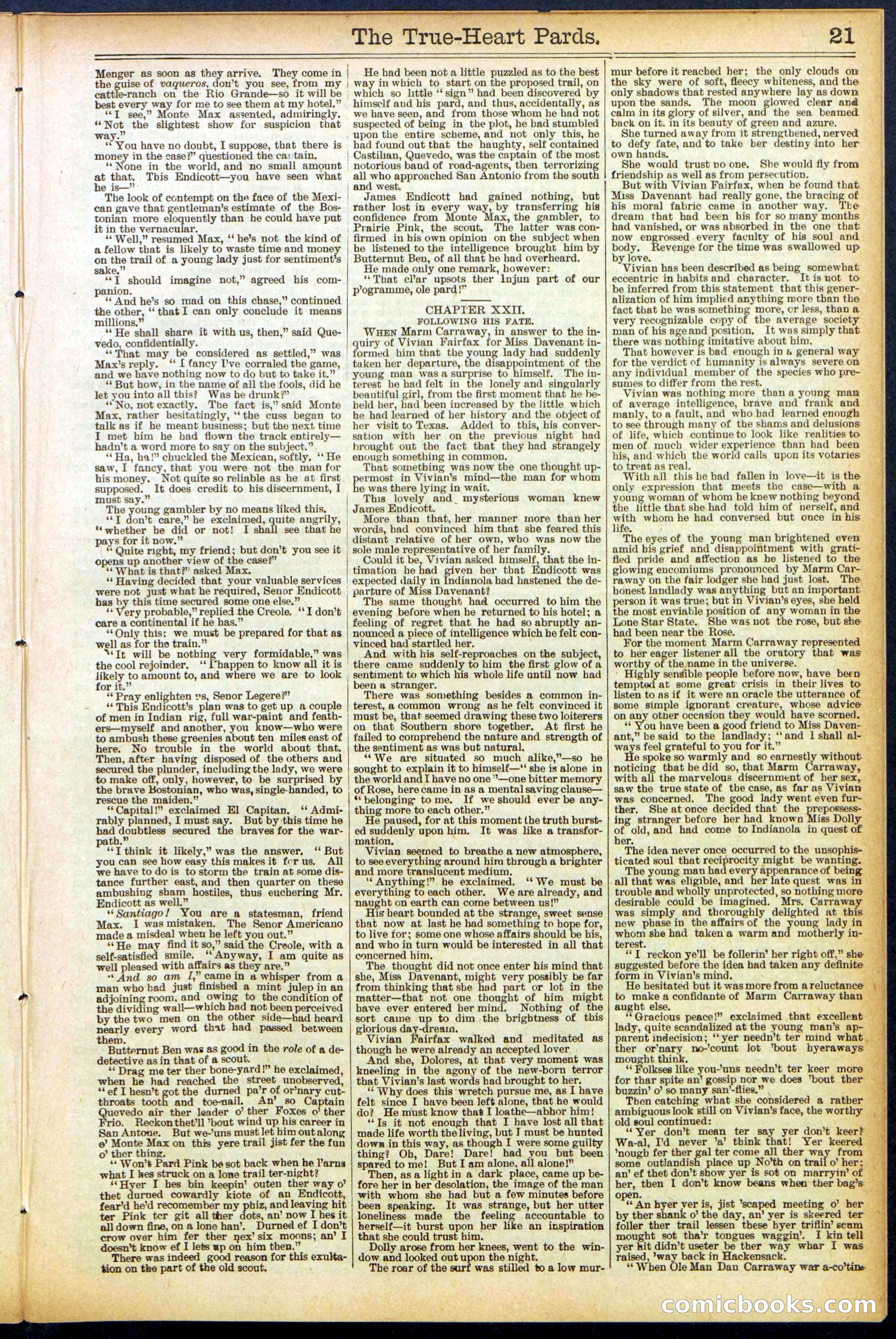
A restored page from Pulp Fiction, 1888. Page through the whole issue in the reader above.
📄 Transcribed text from this page (OCR, searchable)
Machine-transcribed from the original scan — historical spelling and the odd misread are preserved.
eet — —— . — Menger as soon as they arrive. They come in the guise of vaqueros, don’t you see, from my cattle-ranch on the Rio Grande—so it will be best every way for me to see them at my hotel.” ‘*T see,” Monte Max assented, admiringly. ‘‘Not the slightest show for suspicion that way.” ‘* You have no doubt, I suppose, that there is money in the case?” questioned the ca;:tain. ‘*None in the world, and no small amount “a that. This Endicott—you have seen what e is— The look of contempt on the face of the Mexi- can gave that gentleman’s estimate of the Bos- tonian more eloquently than he could have put it in the vernacular. “Well,” resumed Max, ‘‘ he’s not the kind of a fellow that is likely to waste time and money on the trail of a young lady just for sentiment’s sake,’ “‘T should imagine not,” agreed his com- nion. ‘“* And he’s so mad on this chase,” continued the other, “‘ that I can only conclude it means millions.” ‘‘ He shall share it with us, then,” said Que- vedo, confidentially. ‘‘That may be considered as settled,” was Max’s reply. ‘“‘ I fancy I’ve corraled the game, and we have nothing now to do but to take it.” ‘¢ But how, in the name of all the fools, did he let you into all this?) Was he drunk?” ‘*No, not exactly. The fact is,” said Monte Max, rather hesitatingly, ‘‘the cuss began to talk as if he meant business; but the next time I met him he had flown the track entirely— hadn't a word more to say on the subject.” ‘* Ha, ha!” chuckled the Mexican, softly. ‘‘ He saw, I fancy, that you were not the man for his money. Not quite so reliable as he at first supposed. It does credit to his discernment, I must say.” The young gambler by no means liked this. ‘*T don’t care,” he exclaimed, quite angrily, ‘whether he did or not! I shall see that he pays for it now.” “ Quite right, my friend; but don’t you see it opens up another view of the case?” ‘‘ What is that?’ asked Max. ‘‘ Having decided that your valuable services were not just what he required, Senor Endicott bas by this time secured some one else.” ‘* Very probable,” replied the Creole, ‘‘I don’t care a continental if he has.” ‘*Only this: we must be prepared for that as well as for the train.” “Tt will be nothin the cool rejoinder, likely to amount to, and where we are to look for it.” ‘Pray enlighten vs, Senor Legere?” ‘‘ This Endicott’s plan was to get up a couple of men in Indian rig, full war-paint and feath- ers—myself and another, you know—who were to ambush these greenies about ten miles east of here. No trouble in the world about that. Then, after having a of the others and secured the plunder, including the lady, we were to make off, only, however, to be surprised by the brave Bostonian, who was, single-handed, to rescue the maiden.” **Capital!” exclaimed El Capitan, ‘‘ Admi- rably planned, I must gr But by this time he had doubtless secured the braves for the war- th. ‘*T think it likely,” was the answer. ‘ But you can see how easy this makes it ferus, All we have to dois tostorm the train at some dis- tance further east, and then quarter on these ambushing sham hostiles, thus euchering Mr, Endicott as well.” “Santiago! You are a statesman, friend Max. I was mistaken. The Senor Americano made a misdeal when he left you out.” ‘‘He may find it so,” said the Creole, with a self-satisfied smile. “‘ Anyway, I am quite as well pleased with affairs as they are.” * And so am I,” came in a whisper from a man who had just finished a mint julep in an adjoining room, and owing to the condition of the dividing wall—which had not been perceived by the two men on the other side—had heard nearly every word that had passed between them. ; Butternut Ben was as good in the role of a de- detective asin that of ascout. ‘Drag me ter ther bone-yard!” he exclaimed, when he had reached the street unobserved, ‘‘ ef I hesn’t got the durned pa’r of or’nary cut- throats tooth and toenail, An’ so Captain ple air ther leader o’ ther Foxes o’ ther io. Reckonthet’ll bout wind up his career in San Antone. But we-~uns must let him out along o’ Monte Max on this yere trail jist fer the fun o’ ther thing. ‘* Won’t Pard Pink be sot back when he l’arns what I kes struck on a lone trail ter-night? ‘“Hyer I hes bin keepin’ outen ther way o’ thet durned cowardly kiote of an Endicott fear’d he’d recomember my phiz, and leaving hit very formidable,” was | | ~The True-Heart Pards. — He had been not a little puzzled as to the best way in which to start on the proposed trail, on which so httle ‘‘ sign” had been discovered by himself and his pard, and thus, accidentally, as we have seen, and from those whom he had not suspected of being in the plot, he bad stumbled upon the entire scheme, and not only this, he had found out that the haughty, self contained | Castilian, Quevedo, was the captain of the most notorious band of road-agents, then terrorizing all who approached San Antonio from the south and west, James Endicott had gained nothing, but rather lost in every way, by transferring his confidence from Monte Max, the gambler, to Prairie Pink, the scout. The latter was con- firmed in his own opinion on the subject when he listened to the intelligence brought him by Butternut Ben, of all that he had overheard. He made only one remark, however: “That car upsots ther Injun part of our p’ogramme, ole pard!” CHAPTER XXII. FOLLOWING HIS FATE. Wuen Marm Carraway, in answer to the in- 'quiry of Vivian Fairfax for Miss Davenant in- | | ‘* "happen to know all it is | i formed him that the young lady had suddenly taken her departure, the disappointment of the young man wasa surprise to himself. The in- terest he had felt in the lonely and singularly beautiful girl, from the first moment that he he- beld her, bad been increased by the little which he had learned of her history and the object of her visit to Texas. Added to this, his conver- sation with her on the previous night had brought out the fact that they had strangely enough something in common, That sometbing was now the one thought up- ermost in Vivian’s mind—the man for whom e was there lying in wait. This lovely and_ mysterious woman knew James Endicott. More than that, her manner more than her words, had convinced him that she feared this distant relative of her own, who was now the sole male representative of her family. Could it be, Vivian asked himself, that the in- timation he had given her that Endicott was expected daily in Indianola had hastened the de- parture of Miss Davenant? The same thought had occurred to him the evening before when he returned to his hotel; a feeling of regret that he had so abruptly an- nounced a piece of intelligence which he felt con- vinced had startled her, , And with his self-reproaches on the subject, there came suddenly to him the first glow ofa sentiment to which his whole life until now had been a stranger. There was something besides a common in- terest, a common wrong as he felt convinced it must be, that seemed drawing these two loiterers on that Southern shore together, At first he failed to comprehend the nature and strength of the sentiment as was but natural. ‘‘We are situated so much alike,”—so he sought to explain it to himself—“ she is alone in the world and I have no one ’—one bitter memory of Rose, here came in as a mental saving clause— “belonging tome. If weshould ever be any- thing more to each other.” He panded, for at this moment the truth burst- ed suddenly upon him. It was like a transfor- mation. Vivian seerned to breathe a new atmosphere, to see everything around him through a brighter and more translucent medium. ‘* Anything!” he exclaimed, ‘‘We must be everything to each other. We are already, and naught on earth can come between us!” His heart bounded at the strange, sweet sense that now at last he bad something to hope for, to live for; some one whose affairs should be his, and who in turn would be interested in all that concerned him. The thought did not once enter his mind that she, Miss Davenant, might very possibly be far from thinking that sbe had part or lot in the matter—that not one thought of him might have ever entered her mind, Nothing of the sort came up to dim the brightness of this glorious day earn, ; Vivian Fairfax walked and meditated as though he were already an accepted lover And she, Dolores, at that very moment was kneeling in the agony of the new-born terror that Vivian’s last words bad brought to her. ‘* Why does this wretch pursue me, as I have felt since I have been left alone, that he would do? He must know that I loathe—abhor him! ‘Ts it not enough that I have lost all that made life worth the living, but J must be hunted down in this way, as though I were some guilty thing? Oh, Dare! Dare! had you but been spared to me! But I am alone, all alone!” Then, asa light in a dark place, came up be- fore her in ber desolation, the image of the man with whom she had but a few minutes before been speaking. It was strange, but her utter ter Pink ter git all ther dots, an’ now [hes it | loneliness made the feeling accountable to all down fine, on a lone han’, Durned ef I don’t | herself—it burst upon her like an inspiration crow over him fer ther nex’ six moons; an’ I | that she could trust him. doesn’t know ef I lets up on him then.” Dolly arose from her knees, went to the win- There was indeed good reason for this exulta- | dow and looked out upon the night. tion on tke part of the old scout. The roar of the surf was stilled to a low mur- or ad ; = — ? : ’ ] Soe ae ‘ ih ae die ar DD erie J: “Nie 34 ws tks 3% : \- . € mur before it reached her; the only clouds on ~ the sky were of soft, fleecy whiteness, and the only shadows that rested anywhere lay as down upon the sands. The moon glowed clear an@ calm in its glory of silver, and the sea beamed back on it, in its beauty of green and azure. She turned away from it strengthened, nerved to defy fate, and to take ber destiny into her ~ own hands. She would trust no one, She would fly from friendship as well as from persecution. aX But with Vivian Fairfax, when he found that — Miss Davenant had really gone, the bracing of — his moral fabric came in another way. The dream that had been bis for so many months had vanished, or was absorbed in the one that now engrossed every faculty of his soul and — eng h venge for the time was swallowed up — y love. Vivian has been described as being somewhat eccentric in habits and character. Itis not to | be inferred from this statement that this gener- alization of him implied anything more than the © fact that he was something more, cr less, thana — very recognizable copy of the average society — man of his ageand position, It was simplythat — there was nothing imitative about him. ' That however is bad enough in & general way — for the verdict of humanity is always severeomn any individual member of the species who pre- — sumes to differ from the rest. : Vivian was nothing more than a young man — of average intelligence, brave and frank and — manly, to a fault, and who had learned enough — to see through many of the shams and delusions of life, which continue to look like realities to — men of much wider experience than had been > his, and which tbe world calls upon its votaries to treat as real. ph With all this he had fallen in love—it is the only expression that meets the case—with a young woman of whom he knew nothing beyond the little that she had told him of herself, and — be whom he had conversed but ouce in his ife. r The eyes of the young man brightened even — amid bis grief and disappointment with grati- fied pride and affection as he listened to the glowing encomiums pronounced by Marm Car- raway on the fair lodger she had just lost. The honest landlady was anything but an important person it was true; but in Vivian’s eyes, she held the most enviable position of aay woman in the Lone Star State. She was not the rose, but she had been near the Rose. ; For the moment Marm Carraway represented to her eager listener all the oratory that wa cee oO orate in the universe. rs ' Highly sensible people before now, have bee tempted at some great crisis in their lives to listen to as if it were an oracle the utterance of some simple ignorant creature, whose advice on any other occasion they would have scorned. ‘¢ You have been a good friend to Miss Dave ant,” he said to the landlady; ‘‘and 1 shall al- ways feel grateful to you for it.” e spoke so warmly and so earnestly without noticing that he did so, that Marm Carraway, | with all the marvelous discernment of her sex, saw the true state of the case, as far as Vivian was concerned, The good lady went even fur- ther. She at once decided that the iene ing stranger before her had known Miss Dolly se old, and had come to Indianola in quest of er. : The idea never once occurred to the unsophis- ticated soul that asin, Ghent might be wanting. The young man ha ig appearance of being all that was eligible, and her late quest was in trouble and wholly unprotected, so nothing mo: desirable could be imagined, Mrs, Carraway was simply and thoroughly delighted at this new pbasein the affairs of the young lady way she had taken a warm and motherly in- terest. Ne **T reckon ye'll be follerin’ her right off,” s suggested before the idea had taken any definite form in Vivian’s mind. a He hesitated but it was more from a reluctanc to make a confidante of Marm Carraway tha aught else. ‘ 4 ‘“Gracious peace!” exclaimed that excelle lady, quite scandalized at the young man’s a parent indecision; ‘‘ yer needn’t ter mind wha ther or’nary no-count lot “bout byeraways watt think. en ** Folkses like you~uns needn’t ter keer mort for thar spite an’ gossip nor we does "bout the buzzin’ o’ so many san’-flies,” es Then catching what she considered a rath ambiguous look still on Vivian's face, the worth old soul continued: y ae ‘“‘Yer don’t mean ter say yer don’t keer Wa-al, I'd never ’a’ think that! Yer keer *nough fer ther gal ter come all ther way fro some outlandish place up No’th on Oo’ her an’ ef thet don’t show yer is sot on marryin’ < her, then I don’t know beans when ther bag’: open. : 1% ee An hyer ver is, jist ’scaped meeting 0’ by ther o’ the day, an’ yer is skeered te foller ther trail lessen these hyer triflin’ seum mought sot tha’r tongues waggin’. I kin te yer hit didn’t useter be ther way whar I w. raised, way back in Hackensack. es “When Ole Man Dau Carraway war a-co"t 7 ‘ GC Gomicbooks oe sr