
Pulp Fiction, 1888 · page 18 of 32
Beadle's New York Dime Library, No. 500 — page 18: what you’re looking at
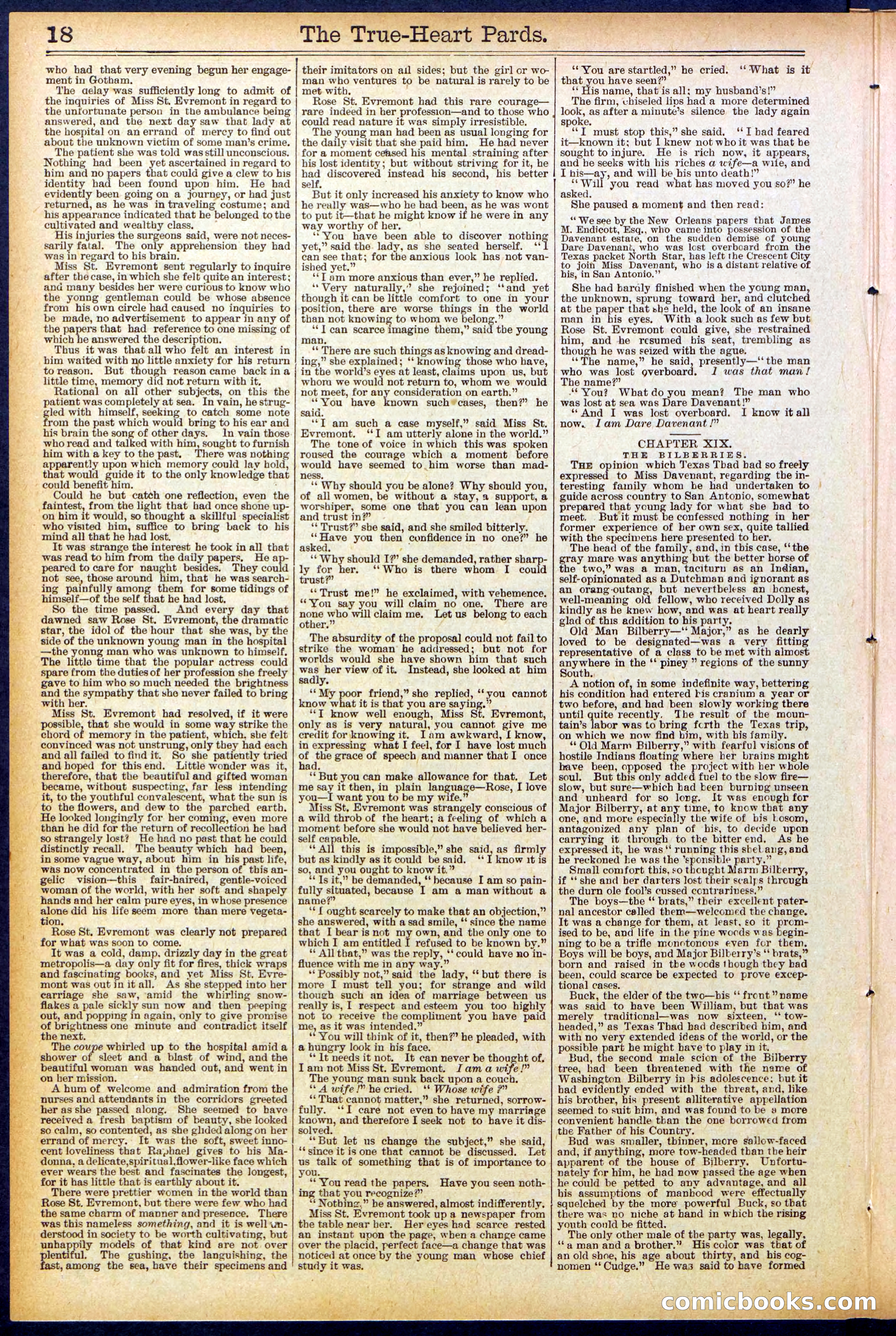
A restored page from Pulp Fiction, 1888. Page through the whole issue in the reader above.
📄 Transcribed text from this page (OCR, searchable)
Machine-transcribed from the original scan — historical spelling and the odd misread are preserved.
Th c fo» _ and all failed to find it. and hoped - of - hands and her calm pure eyes, in whose presence my ‘The True-Heart Pards nn ee who had that very evening begun her engage- ment in Gotham. The delay was sufficiently long to admit of the inquiries of Miss St. Evremont in regard to the unfortunate person in the ambulance being answered, and the next day saw that ladv at the hospital on anerrand of mercy to find out about the unknown victim of some man’s crime, The patient she was told was still unconscious. Nothing had been yet ascertained in regard to him and no papers that could give a clew to his identity had been found upon him. He had evidently been going on a journey, or had just _ returned, as he was in traveling costume; and his appearance indicated that he belonged to the cultivated and wealthy class, His injuries the surgeons said, were not neces- sarily fatal. The only apprehension they had was in regard to bis brain. Miss St. Evremont sent regularly to inquire after the case, in which she felt quite an interest; and many besides her were curious to know who the yonng gentleman could be whose absence from his own circle had caused no inquiries to be made, no advertisement to appear in any of the papers that had reference to one missing of which he answered the description. Thus it was that all who felt an interest in him waited with no little anxiety for his return toreason. But though reason came back ina little time, memory did not return with it, Rational on all other subjects, on this the patient was completely at sea. In vain, he strug- led with himself, seeking to catch some note rom the past which would bring to his ear and his brain the song of other days. In vain those who read and talked with him, sought to furnish him with a key to the past, There was nothing apparently upon which memory could lay hold, that would guide it to the only knowledge that - could benefit him. Could he but catch one reflection, even the faintest, from the light that had once shone up- on him it would, so thought a skillful specialist ’ who visited him, suffice to bring back to his mind all that he had lost. It was strange the interest he took in all that was read to him from the daily papers, He ap- peared to care for naught besides. They could not see, those around him, that he was search- ing painfully among them for some tidings of So the time passed. And every day that dawned saw Rose St. Evremont, the dramatic star, the idol of the hour that she was, by the ‘side of the unknown young man in the hospital —the yonng man who was unknown to himself, _ himself—of the self that he had lost, : The little time that the popular actress could spare from the duties of her profession she freely gave to him who so much needed the brightness and the sympathy that she never failed to bring 5 with her. Miss St. Evremont had resolved, if it were 3 possible, that she would in some way strike the chord of memory in the patient, which, she felt convinced was not unstrung, only they had each So she patiently tried for thisend. Little wonder was it, therefore, that the beautiful and gifted woman pr became, without suspecting, far less intending it, to the youthful convalescent, what the sun is _ to the flowers, and dew to the _ He looked longingly for her coming, even more than he did for the return of recollection he had _ so strangely lost? He had no past that he could arched earth. distinctly recall. The beauty which had been, _ Insome vague way, about him in his past life, ‘was now concentrated in the person of this an- pets vision—this fair-haired, gentle-voiced woman of the world, with her soft and shapely alone did his life seem more than mere vegeta- ‘ a) on. Rose St. Evremont was clearly not prepared _ for what was soon to come. - Itwas a cold, damp, drizzly day in the great - metropolis—a day only fit for fires, thick wraps and fascinating books, and yet Miss St, Evre- - mont was out initall. As she stepped into her -earriage she saw, amid the whirling snow- flakes a pale sickly sun now and then peeping _ out, and popping in again, only to give promise _of brightness one minute and contradict itself the next. The coupe whirled up to the hospital amid a shower of sleet and a blast of wind, and the _ beautiful woman was handed out, and went in on her mission. _ Abum of welcome and admiration from the nurses and attendants in the corridors greeted her as she passed along. She seemed to have received a fresh baptism of beauty, she looked _ so calm, so contented, as she glided along on her errand of mercy. It was the soft, sweet inno- cent loveliness that Raphael gives to his Ma- - donna, a delicate,spiritual,flower-like face which ever wears the best and fascinates the longest, for it has little that is earthly about it. __ There were prettier women in the world than _ Rose St. Evremont, but there were few who had e same charm of manner and presence, There was this nameless something, and it is wellim- derstood in society to be worth cultivating, but bomen models of that kind are not over plenti The gushing, the languishing, the ast, among the sea, have their specimens and = * 4 . . - e TT. A Ae te bes 7 = dl d T Miss 8 name? solved their imitators on ail sides; but the girl or wo- man who ventures to be natural is rarely to be met with, Rose St. Evremont had this rare courage— rare indeed in her profession—and to those who could read nature it was simply irresistible. The young man had been as usual longing for the daily visit that she paid him. He had never for a moment ceased his mental straining after his lost identity; but without striving for it, he had discovered instead his second, his better self, But it only increased his anxiety to know who he really was—who he had been, as he was wont to put it—that he might know if he were in any way worthy of her, ‘**‘You have been able to discover nothing yet,” said the. lady, as she seated herself. “tT can see that; for the anxious look has not van- ished yet.” ‘‘T am more anxious than ever,” he replied. ‘*Very naturally,” she rejoined; ‘‘and yet though it can be little comfort to one in your position, there are worse things in the world than not knowing to whom we cert ‘‘T can scarce imagine them,” said the young man, ‘* There are such things as knowing and dread- ing,” she explained; ‘‘ knowing those who have, in the world’s eyes at least, claims upon us, but whora we would not return to, whom we would not meet, for any consideration on earth.” ‘You bave known suchcases, then?” he said. ‘‘T am such a case myself,” said Miss St. Evremont. “I am utterly alone in the world.” The tone of voice in which this was spoken roused the courage which a moment before would have seemed to_him worse than mad- ness, ‘* Why should you be alone? Why should you, of all women, be without a stay, a support, a worshiper, some one that you can lean upon and trust in?” ‘** Trust?” she said, and she smiled bitterly. ‘‘Have you then confidence in no one?” he asked, ; ‘* Why should I?’ she demanded, rather sharp- ly for her. ‘*‘Who is there whom I could trust?” ‘* Trust me!” he exclaimed, with vehemence. “You say you will claim no one, There are ae who will claim me. Let us belong to each other. The absurdity of the proposal could not fail to strike the woman he addressed; but not for worlds would she have shown him that such was her view of it. Instead, she looked at him sadly. “* My pode friend,” she replied, ‘‘ you cannot know what it is that you are saying.” ‘*T know well enough, Miss St. Evremont, only as is very natural, you cannot give me credit for knowing it. Iam awkward, [ know, in expressing what I feel, for I have lost much a the grace of speech and manner that I once ad, ‘* But you can make allowance for that. Let me say it then, in plain language—Rose, I love you—I want you to be my wife.” iss St, Evremont was strangely conscious of a wild throb of the heart; a feeling of which a moment before she would not have believed her- self capable, ‘* All this is impossible,” she said, as firmly but as kindly as it could be said. ‘ I know itis so, and you ought to know it.” : ** Is it,” he demanded, ** because I am so pain- fully situated, because I am a man without a m ‘* f ought scarcely to make that an objection,” she answered, with asad smile, ‘‘ since the name that I bear is not my own, and the only one to which I am entitled I refused to be known by.” ** All that,” was the reply, ‘‘could have no in- fluence with me in any way.’ ** Possibly not,” said the lady, ‘‘ but there is more I must tell you; for strange and wild though such an idea of marriage between us really is, I respect and esteem you too highly not to receive the compliment you have paid me, as it was intended.” ** You will think of it, then?” he pleaded, with a hungry look in his face. ** It needs it not. It can never be thought of, Iam not Miss St. Evremont. Jama wife!” The young man sunk back upon a couch, ‘A wife!” he cried. ‘* Whose wife ?” ““That cannot matter,” she returned, sorrow- fully. ‘‘I care not even to have my marriage known, and therefore I seek not to have it dis- “But let us change the subject,” she said, ** since it is one that cannot be discussed. Let us talk of something that is of importance to you. ‘You read the papers. Have you seen noth- ing that you recognize?” ‘“* Nothing,” be answered, almost indifferently, Miss St. Evremont took up a newspaper from the table near her. Her eyes had scarce rested an instant upon the page, when a change came over the placid, perfect face—a change that was noticed at once by the young man whose chief study it was. * hte (oe i ‘pa . $y if f es e “ Seo peor i Va ad She had baraly finished when the young man, the unknown, sprung toward her, and clutched i ‘‘-You are startled,” he cried. ‘‘ What is it that you have seen?” ‘* His name, that is all; my husband’s!” The firm, chiseled lins had a more determined look, as after a minute’s silence the lady again spoke. ‘‘T must stop this,” she said. ‘I bad feared it—known it; but I knew not who it was that he sought to injure. He is rich now, it appears, and he seeks with his riches a wife—a wile, and I his—ay, and will be his unto death!” “Will you read what has moved you so?” he asked, She paused a moment and then read: ‘“Wesee by the New Orleans papers that James M. Endicott, Esq., who came into possession of the Davenant estate, on the sudden demise of young Dare Davenant, who was lost overboard from the Texas packet North Star, has left the Crescent City to join Miss Davenant, who is a distant relative of his, in San Antonio.”’ at the paper that she held, the look of an insane man in his eyes. With a look such as few but Rose St. Evremont could give, she restrained him, and he resumed his seat, trembling as though he was seized with the ague. ‘‘The name,” he said, presently—‘‘ the man who was lost overboard. I was that man! The name?” “* You? What do you mean? The man who was lost at sea was Dare Davenant!” ** And I was lost overboard. I know it all now. lam Dare Davenant !” CHAPTER XIX. THE BILBERRIES. THE opinion which Texas Tbad had so freely atoredind: to Miss Davenant, regarding the in- teresting family whom he had undertaken to guide across country to San Antonio, somewhat prepared that young lady for what she had to meet, But it must be confessed nothing in her former experience of her own sex, quite tallied with the specimens here presented to her. The head of the family, and, in this case, ‘‘ the gray mare was anything but the better horse of the two,” was a man, taciturn as an Indian, self-opinionated as a Dutchman and ignorant as an orang-outang, but nevertbeless an honest, well-meaning old fellow, who received Dolly as kindly as he knew how, and was at heart really glad of this addition to his party. Old Man Bilberry—‘‘ Major,” as he dearly loved to be designated—was a very fitting representative of a class to be met with almost anywhere in the ‘‘ piney ” regions of the sunny South,, A notion of, in some indefinite way, bettering his condition had entered bis cranium a year or two before, and had been slowly working there until quite recently. The result of the moun- tain’s labor was to bring fcrth the Texas trip, on which we now find bim, with his family. ** Old Marm Bilberry,” with fearful visions of hostile Indians floating where her brains might have been, opposed the Proce with her whole soul, But this only added fuel to the slow fire— slow, but sure—which had been burping unseen and unheard for so long. It was enough for Major Bilberry, at any time, to know that any one, and more especially the wife of bis Losom, antagonized any plan of his, to decide upon carrying it through to the bitterend, As he expressed it, he was “‘ running this shel ang, and he reckoned he was the ’sponsible party.” | Small comfort this, so thought Marm Bilberry, if ‘‘ she and ber darters lost their scalps through the durn ole fool’s cussed contrariness,” The boys—the ‘ brats,” their excellent pater- nal ancestor called them—welcomed the change. It was a change for them, at least, so it prom- ised to be, and life in the pine woods was begin- ning to be a trifle monotonous even for them. Boys will be boys, and Major Bilberry’s *‘ brats,” born and raised in the woods though they kad been, could scarce be expected to prove excep- tional cases. Buck, the elder of the two—his ‘‘ front» name was said to have been William, but that was merely traditional—was now sixteen, ‘* tow- headed,” as Texas Thad had described bim, and with no very extended ideas of the world, or the possible part he might bave'to play in it. Bud, the second male scion of the Bilberry tree, had been threatened with the name of Washington Bilberry in his adolescence; but it had evidently ended with the threat, and, like his brother, bis present alliterative appellation seemed to suit him, and was found to be » more convenient handle than the one borrowed from the Father of his Country. Bud was smaller, thinner, more sallow-faced and, if anything, more tow-headed than the heir apparent of the house of Bilberry. Unfortu- et for him, he bad now passed the age when he could be petted to any advantage, and all his assumptions of manhood were seectuey squelched by the more powerful Buck, so that there was no niche at hand in which the rising youth could be fitted. The only other male of the party was, legally. at o ‘¢s man and a brother.” His color was t an old shoe, his age about thirty, and his cog-_ nomen ‘‘Cudge.” He was said to have formed hey ols : | rma s a ii © * ww areal om =DOC a genes $50 TE - ' | ] |