
Pulp Fiction, 1888 · page 17 of 32
Beadle's New York Dime Library, No. 500 — page 17: what you’re looking at
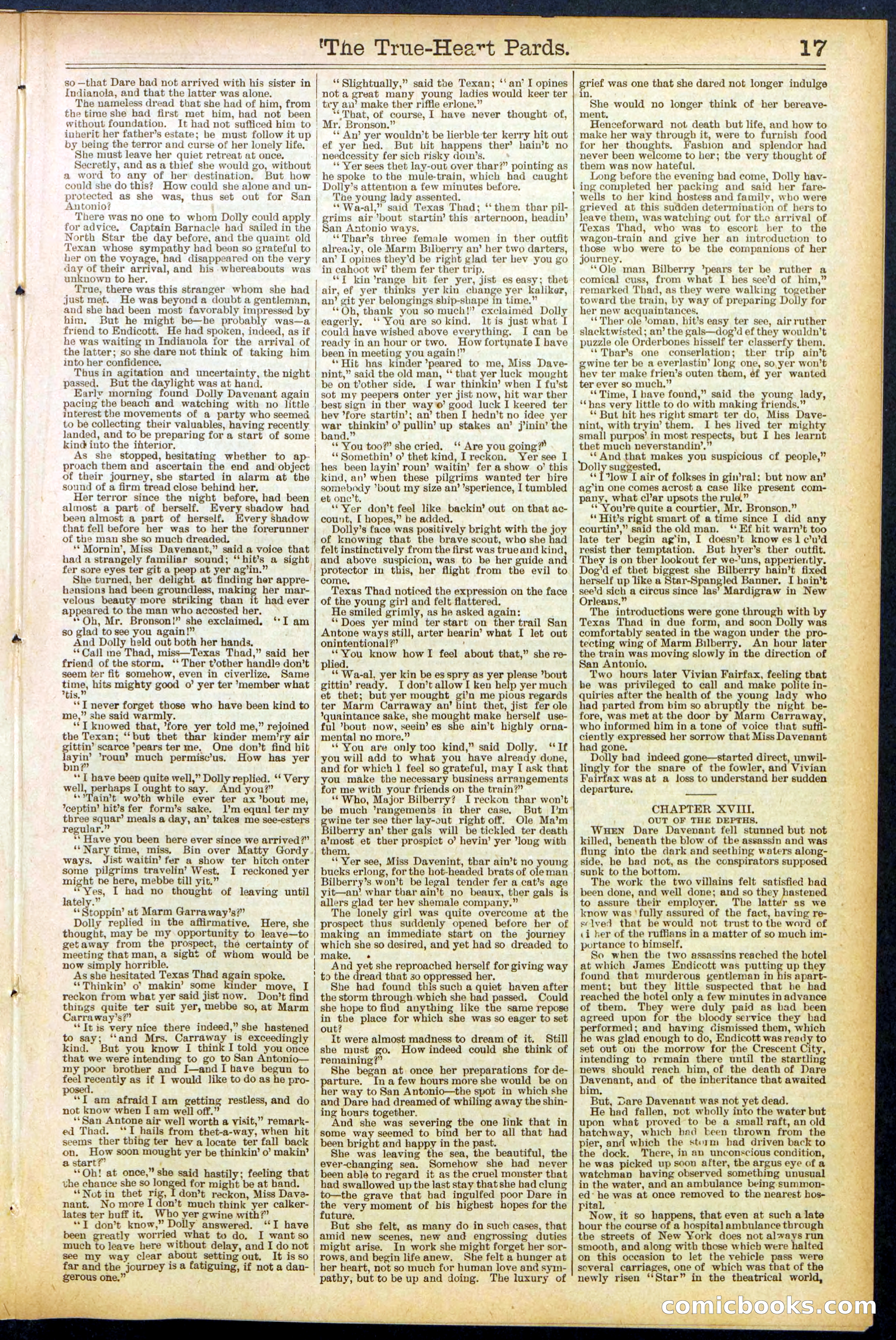
A restored page from Pulp Fiction, 1888. Page through the whole issue in the reader above.
📄 Transcribed text from this page (OCR, searchable)
Machine-transcribed from the original scan — historical spelling and the odd misread are preserved.
a7) >" ( . - A. ‘ * + « *~ TA. : . i. 2 bi oe i. ’ : : ‘ , “eas _ 'The True-Heart Pards. . are. ; Ve ae se . ted as = ._- ah ‘ys ’ so —that Dare had not arrived with his sister in Indianola, and that the latter was alone. The nameless dread that she had of him, from the time she had first met him, had not been | without foundation. It had not sufficed him to inherit her father’s estate; be must follow it up by being the terror and curse of her lonely life. She must leave her quiet retreat at once. Secretly, and as a thief she would go, without a word to any of her destination. But how could she do this? How could she alone and un- protected as she was, thus set out for San | Antonio? There was no one to whom Dolly could apply for advice, North Star the day before, and the quaint old Texan whose sympathy had been so grateful to her on the voyage, had disappeared on the very | day of their arrival, and his .whereabouts was unknown to her. True, there was this stranger whom she had just met. him, Captain Barnacle had sailed in the | ‘* Slightually,” said tae Texan; ‘‘ an’ I opines nota great many young ladies would keer ter | tey an’ make ther riffle erlone.” ‘*That, of course, I have never thought of, ' Mr. Bronson.” ‘* An’ yer wouldn’t be lierble ter kerry hit out ef yer hed. But bit happens ther’ hain’t no needcessity fer sich risky doin’s. ‘* Yer sees thet lay-out over thar?” pointing as he spoke to the mule-train, which had caught Dolly’s attention a few minutes before. The young lady assented. ‘*Waz-al,” said Texas Thad; ‘‘ them thar pil- grims air’bout startin’ this arternoon, headin’ San Antonio ways. ““Thar’s three female women in ther outfit alreauy, ole Marm Bilberry an’ her two darters, an’ I opines they'd be right glad ter hev you go in cahoot wi’ them fer ther trip. “fT kin’range bit fer yer, jist es easy; thet air, ef yer thinks yer kin change yer kaliker, He was beyond a doubt a gentleman, | an’ git yer belongings ship-shape in time.” and she had been most favorably impressed by | But he might be—he probably was—a | eagerly. friend to Endicott. He had spoken, indeed, as if | could have wished above everything. “Ob, thank you so much!” exclaimed Dolly ‘*You are so kind, lt is just what I I can be he was waiting in Indianola for the arrival of | ready in an hour or two. How fortunate I bave the latter; so she dare not think of taking him | been in meeting you again!” into her confidence, ‘Hit has kinder peared to me, Miss Dave- Thus in agitation and uncertainty, the night | nint,” said the old man, “ that yer luck mought passed. But the daylight was at hand. Early morning found Dolly Davenant again be on t’other side, { war thinkin’ when I fu’st sot my peepers onter yer jist now, bit war ther pacing the beach and watching with no little | best sign in ther way’ good luck I keered ter interest the movements of a party who seemed | hev ’fore startin’; an’ then I hedn’t no idee yer to be collecting their valuables, having recently | war thinkin’ o’ pullin’ up stakes an’ j’inin’ the landed, and to be preparing for a start of some | band.” | ** You too?’ she cried. ‘ Are you going” kind into the interior, As she stopped, hesitating whether to ap- ‘* Somethin’ o’ thet kind, Ireckon. Yer see I proach them and ascertain the end and object | hes been layin’ roun’ waitin’ fer a show 0’ this of their journey, she started in alarm at the sound of a firm tread close behind her, Her terror since the night before, had been almost a part of berself. Every shadow had been almost a part of herself. Every Shadow that fell before her was to her the forerunner of the man she so much dreaded. ‘* Mornin’, Miss Davenant,” said a voice that had a strangely familiar sound; “‘hit’s a sight fer sore eyes ter git a peep at yer ag’in.” She turned, her delight at finding her appre- hensions had been groundless, making her mar- velous beauty more striking than it had ever appeared to the man who accosted her. **Oh, Mr. Bronson!” she exclaimed, so glad to see you again!” And Dolly held out both her hands, **Call me Thad, miss—Texas Thad,” said her friend of the storm, ‘‘ Ther t?other handle don’t seem ter fit somehow, even in civerlize. Same time, hits mighty good o’ yer ter ’member what tis, **T am ‘*T never forget those who have been kind to me,” she said warmly. ‘*T knowed that, fore yer told me,” rejoined the Texan; ‘“‘but thet thar kinder mem’ry air ittin’ scarce ‘pears terme, One don’t find hit swale ’roun’ much permisc’us. How has yer in? ** [ have beep quite well,” Dolly replied. ‘‘ Very well, perhaps I ought to say. And you?” *“"Tain’t wo’th while ever ter ax ’bout me, *ceptin’ hit’s fer form’s sake. 1’m equal ter my three squar’ meals a day, an’ takes me see-esters regular.” | ‘Have you been here ever since we arrived?” Bs time, miss, Bin over Matty Gordy ways. Jist waitin’ fer a show ter hitch onter some pilgrims travelin’ West, might be here, mebbe till yit.” ‘Yes, I had no thought of leaving until lately.” ** Stoppin’ at Marm Garraway’s?” Dolly replied in the affirmative. Here, she thought, may be my opportunity to leave—to getaway from the prospect, the certainty of meeting that man, a sight of whom would be now simply horrible. As she hesitated Texas Thad again spoke. “‘Thinkin’ o’ makin’ some kinder move, I reckon from what yer said jist now. Don’t find things quite ter suit yer, mebbe so, at Marm Carraway’s?” ‘It is very nice there indeed,” she hastened to say; ‘“‘and Mrs. Carraway 1s exceedingly kind. But you know I think I told you once that we were intending to go to San Antonio— my poor brother and I—and I have begun to feel recently as if I would like to do as he pro- posed, “Tf am afraid I am getting restless, and do not know when I am well off.” ‘‘San Antone air well worth a visit,” remark- ed Thad. “T hails from thet-a-way, when hit seems ther thing ter hev a locate ter fall back on. How soon mought yer be thinkin’ o’ makin’ a start?” : ‘‘Oh! at once,” she said hastily; feeling that the chance she so ie for might be at hand. ‘*Not in thet rig, [don’t reckon, Miss Dava- nant. No morel don’t much think yer calker- lates ter buff it. Who yer gwine with?’ **I don’t know,” Dolly answered. ‘I have been greatly worried what to do, I want so I reckoned yer oa ee EE ———E—— ————— a kind, an’ when these pilgrims wanted ter bire somebody *bout my size an’ ’sperience, I tumbled et onc’t. ‘Yer don’t feel like backin’ out on that ac- count, [ hopes,” be added. Dolly’s face was positively bright with the joy of knowing that the brave scout, who she had felt instinctively from the first was true and kind, and above suspicion, was to be her guide and protector in this, ber flight from the evil to come, Texas Thad noticed the expression on the face of the young gir] and felt flattered. He smiled grimly, as he asked again: **Does yer mind ter start on ther trail San Antone ways still, arter hearin’ what I let out onintentional?”’ ‘You know how I feel about that,” she re- ed. ** Wa-al, yer kin be es spry as yer please ’bout gittin’ ready. I don’tallowI ken help yer much et thet; but yer mought gi’n me pious regards ter Marm Carraway an’ bint thet, jist fer ole *quaintance sake, she mought make herself use- ful ‘bout now, seein’es she ain’t highly orna- mental no more.” ‘*'You are only too kind,” said ai lS you will add to what you have already done, and for which ] feel so grateful, may I ask that you make the necessary business arrangements for me with your friends on the train?” " 0, Major Bilberry? [reckon thar won’t be much ’rangements in ther case, But I’m wine ter see ther lay-out right off. Ole Ma’m ilberry an’ ther gals will be tickled ter death feet et ther prospict o’ hevin’ yer ‘long with them, ‘* Yer see, Miss Davenint, thar ain’t no young bucks erlong, for the hot-headed brats of oleman Bilberry’s won’t be legal tender fer a cat’s age yit—an’ whar thar ain’t no beaux, ther gals is allers glad ter hev shemale company,” making an immediate start on the journey which she so desired, and yet had so dreaded to make, . And Pie she reproached herself for giving way to the dread that 30 oppressed her. She had found this such a quiet haven Nessie Cou she hope to find ape So Se like the same repose ich she was so eager to set the storm through which she had passed. in the place for w out? it were almost madness to dream of it. she must go. remaining?” : She began at once her preparations for de- porate. In a few hours more she would be on er way to San Antonio—the spot in which she and Dare had dreamed of whiling away the shin- ing hours together. ‘ And she was severing the one link that in some way seemed to bind ber to all that had been bright and happy in the past. She was leaving the sea, the beautiful, the ever-changing sea. Somehow she had never been able to regard it as the cruel monster that had swallowed up the last stay that she had clung to—the grave that had ingulfed poor Dare in the very moment of bis highest hopes for the future. But she felt, as many do in such cases, that amid new scenes, new and engrossing duties Still much to leave here without delay, and I do not | might arise. In work she might forget her sor- see my way clear about setting out. It is so pe the journey is a fatiguing, if not a dan- gerous one.” ‘ 2 oe si - rows, and begin life anew. She felt a hunger at her heart, not so much for human love an@ syin- pathy, but to be up and doing. The luxury of i, o a — on The lonely girl was quite overcome at the prospect thus suddenly opened before her of How indeed could she think of ¢ grief was one that she dared not longer indulge in. She would no longer think of her bereave- ment. Henceforward not death but life, and how to make her way through it, were to furnish food for her thoughts. Fashion and splendor had never been welcome to her; the very thought of them was now hateful. Long before the evening bad come, Dolly hav- ing completed her packing and said her fare- wells to her kind hostess and family, who were grieved at this sudden determination of hers to leave them, was watching out for the arrival of Texas Thad, who was to escort her to the wagon-train and give her an introduction to those wbo were to be the companions of her journey, “Ole man Bilberry ‘pears ter be ruther a comical cuss, from what I hes see’d of him,” remarked Thad, as they were walking together toward the train, by way of preparing Dolly for her new acquaintances, ‘Ther ole oman, hit’s easy ter see, air ruther slacktwisted; an’ the gals—dog’d ef they wouldn't puzzle ole Orderbones hisself ter classerfy them. ‘*Tbhar’s one conserlation; ther trip ain’t gwine ter be a everlastin’ long one, so,yer won't hev ter make frien’s outen them, éf yer wanted ter ever so much,” ‘*Time, I bave found,” said the young lady, ‘has very little to do with making friends,” ** But hit hes right smart ter do, Miss Dave- nint, with tryin’ them. I hes lived ter mighty small purpos’ in most respects, but I hes learnt thet much neverstandin’.” ‘* And that makes you suspicious of people,” Doll y. suggested, **T low I air of folkses in gin’ral: but now an’ ag’in one comes acrost a case like present com- pany, what cl’ar upsots the rule.” ‘* You’re quite a courtier, Mr. Bronson.” * Hit’s right smart of a time since I did any courtin’,” said the old man. ‘ Ef hit warn’t too late ter begin ag'in, I doesn’t know es 1 c’u’d resist ther temptation. But hyer’s ther outfit. They is on ther lookout fer we-’uns, apperiently. Dog'd ef thet biggest she Bilberry hain’t fixed herself up like a Star-Spangled Banner, I bain’t see’d sich a circus since las’ Mardigraw in New Orleans.” The introductions were gone through with by Texas Thad in due form, and soon Dolly was comfortably seated in the wagon under the pro- tecting wing of Marm Bilberry. An bour later the train was moving slowly in the direction of San Antonio, Two hours later Vivian Fairfax, feeling that be was privileged to call and make polite in- quiries after the health of the ones lady who had parted from bim so abruptly the night be- fore, was met at the door by Marm Carraway, who informed him in a tone of voice that sutftfi- ciently expressed her sorrow that Miss Davenant had gone. Dolly bad indeed gone—started direct, unwil- lingly for the snare of the fowler, and Vivian Fairfax was at a loss to understand ber sudden departure. CHAPTER XVIII. | OUT OF THE DEPTHS. WueEn Dare Davenant fell stunned but not killed, beneath the blow of the assassin and was flung into the dark and seething waters along- side, he bad not, as the conspirators supposed sunk to the bottom. Ce oe ol The work the two villains felt satisfied had 5 been done, and well done; and so they hastened © to assure their employer. The latter as we know was ‘fully assured of the fact, baving re- s‘lved that be would not trust to the word of ii ker of the ruffians in a matter of so much im- portance to himself, So when the two assassins reached the hotel at which James Endicott was poring up they found that murderous gentleman in hi ment; but they little suspected that he had reached the hotel only a few minutes in advance of them. They were duly paid as bad been agreed upon for the bloody service they bad rformed; and having dismissed them, which © was glad enough to do, Endicott was ready to set out on the morrow for the Crescent City, intending to remain there until the startling news should reach him, of the death of Dare “a Met al and of the inheritance that awaited im. But, Dare Davenant was not yet dead. He had fallen, not wholly into the waterbut _ upon what proved to be a small raft, an old hatchway, which bad been thrown from the pier, and which the sterm had driven back to the dock. There, in an unconscious condition, he was picked up soon after, the argus eye of a watchman baving observed something unusual in the water, and an ambulance being summon- ed* he was at once removed to the nearest hos- — pital, Now, it so happens, that even at such a late hour the course of a hospital ambulance through © the streets of New York does not always run smooth, and along with those which were halted on this occasion to let the vehicle pass were several carriages, one of which was that of the newly risen ‘‘Star” in the theatrical world, — ee Sapart- _ ~