
Pulp Fiction, 1888 · page 11 of 32
Beadle's New York Dime Library, No. 500 — page 11: what you’re looking at
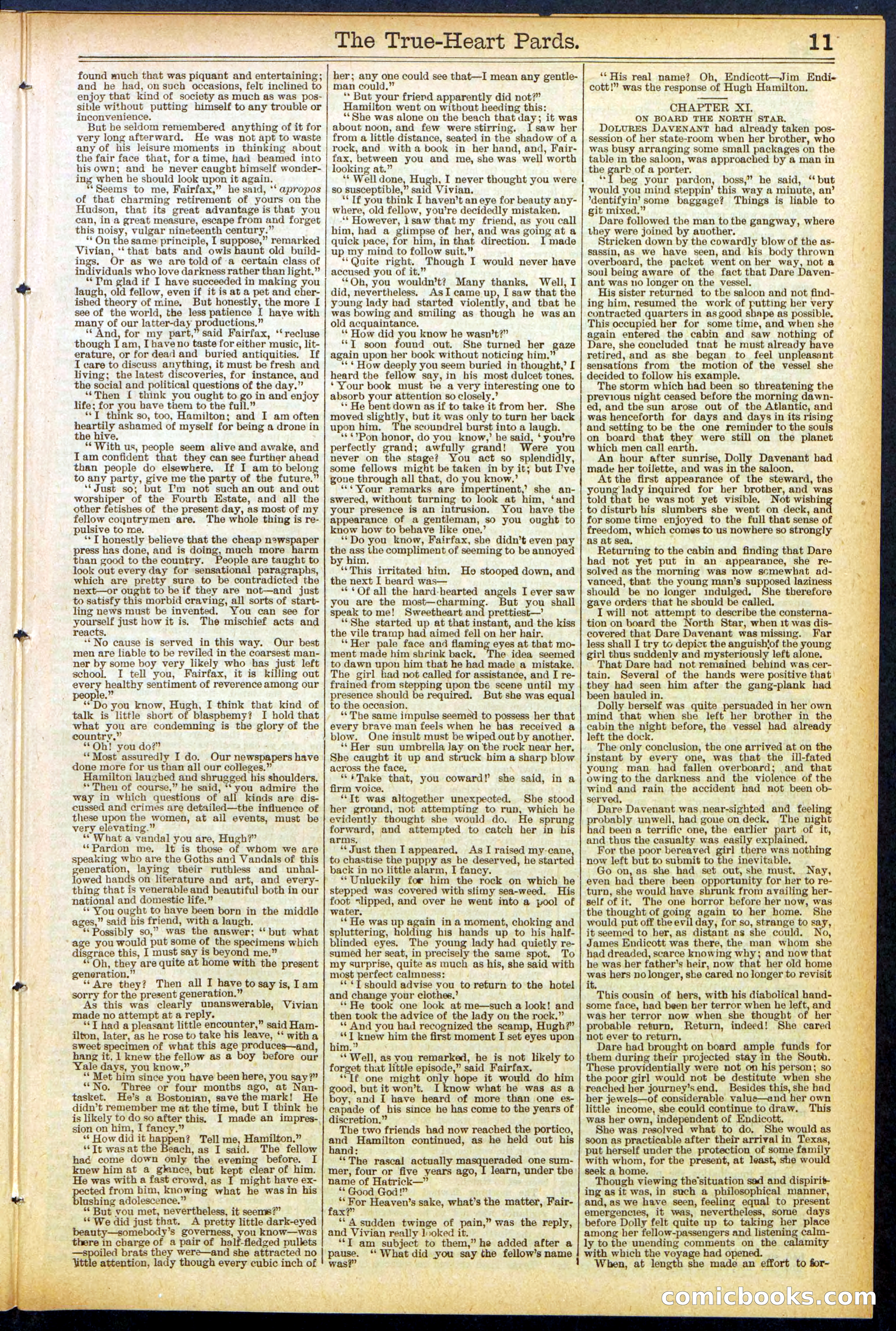
A restored page from Pulp Fiction, 1888. Page through the whole issue in the reader above.
📄 Transcribed text from this page (OCR, searchable)
Machine-transcribed from the original scan — historical spelling and the odd misread are preserved.
a ee ee eee — ——— —— , Xs tis ® ~ «wa « wh wa, cee “> i ee « Ay bmn ~~ =} -. =. h ea 2 z " “ ‘a> ‘i. on, + wt * F 5 wala Baby or Ae The True-Heart Pards. found much that was piquant and entertaining; and he had, on such occasions, felt inclined to enjoy that kind of society as much as was pos- sible without putting himself to any trouble or inconvenience. But he seldom remembered anything of it for very long afterward. He was not apt to waste any of his leisure moments in thinking about the fair face that, for a time, had beamed into his own; and he never caught himself wonder- ing when he should look upon it again. **Seems to me, Fairfax,” he said, **‘ apropos of that charming retirement of yours on the Hudson, that its great advantage is that you can, in a great measure, escape from and forget this atk vulgar nineteenth century.” ‘** On the same principle, I suppose,” remarked Vivian, ‘‘ that bats and owls haunt old build- ings. Or as we are told of a certain class of individuals who love darkness rather than light.” *““[’'m glad if I have succeeded in making you laugh, old fellow, even if it is at a pet and cher- ished theory of mine. But honestly, the more [ see of the world, the less patience I have with many of our latter-day productions.” ‘‘ And, for my part,” said Fairfax, ‘‘ recluse though I am, I have no taste for either music, lit- erature, or for dead and buried antiquities. If I eare to discuss anything, it must be fresh and living; the latest discoveries, for instance, and the social and political questions of the day.” “Then { think you ought to go in and enjoy life; for you have them to the full.” **T think so, too, Hamilton; and I am often heartily ashamed of myself for being a drone in the hive. “With us, people seem alive and awake, and Iam confident that they can see further ahead than people do elsewhere. If I am to belong to any party, give me the party of the future.” ‘* Just so; but I’m not such an out and out worshiper of the Fourth Estate, and all the other fetishes of the present day, as most of my fellow coyntrymen are. The whole thing is re- pulsive to me. ‘**T honestly believe that the cheap newspaper press has done, and is doing, much more harm than good to the country. People are taught to look out every day for sensational paragraphs, which are pretty sure to be contradicted the next—or ought to be if they are not—and just to satisfy this morbid craving, all sorts of start- ling news must be invented. You can see for yourself just how it is. The mischief acts and reacts. ‘*No cause is served in this way. Our best men are liable to be reviled in the coarsest man- ner by some boy very likely who has just left school. I tell you, Fairfax, it is killing out oresy healthy sentiment of reverence among our people.” ** Do you know, Hugh, I think that kind of talk is little short of blaspbemy? I hold that what you are condemning is the glory of the country,” **Oh! you do?” **Most assuredly I do. Our newspapers have done more for us than all! our colleges.” Hamilton laughed and shrugged his shoulders. **'Then of course,” he said, ‘* you admire the way in which questions of all kinds are dis- cussed and crimes are detailed—the influence of these upon the women, at all events, must be very elevating.” ““ What a vandal you are, Hugh?” ‘*Pardon me, lt is those of whom we are speaking who are the Goths and Vandals of this generation, laying their ruthless and unhal- lowed hands on literature and art, and every- thing that is venerable and beautiful both in our national and domestic life.” ‘““-You ought to have been born in the middle ages,” said bis friend, with a laugh. ‘Possibly so,” was the answer; ‘*‘ but what ‘age you would put some of the specimens which disgrace this, I must say is beyond me.” ‘Oh, they are quite at home with the present generation.” ‘Are they? Then all I have to say is, I am sorry for the present generation.” As this was clearly unanswerable, Vivian made no attempt at a reply. ‘**T had a pleasant little encounter,” said Ham- ilton, later, as he rose to take his leave, ‘‘ witha sweet specimen of what this age produces—and, hang it, 1 knew the fellow as a boy before our Yale days, you know.” ‘ ‘* Met him since you have been here, you say?” “No. Three or four months ago, at Nan- tasket. He’s a Bostonian, save the mark! He didn’t remember me at the time, but I think he is likely to do so after this, I made an impres- sion on him, I fancy.” “‘ How did it happen? Tell me, Hamilton.” “Tt was at the Beach, as I said. The fellow had come down only the evening before. I knew him at a gknce, but kept clear of him. He was with a fast crowd, as I might have ex- ted from him, knowing what he was in his lushing adolescence.” “ But vou met, nevertheless, it seems?” “We did just that. A pretty little dark-eyed beauty—somebody’s governess, you know—was there in charge of a pair of half-fledged pullets a epee brats they were—and she attracted no _ Vittle attention, lady though every cubic inch of nerre -, % ’ * ~ — / a ea Pere a Srey On f o pt oR a | ne aD ly =i 5 ~ » ’ : : %, <- o ‘ - ma ‘ her; any one could see that—I mean any gentle- man could.” ** But your frierd apparently did not?” Hamilton went on without heeding this: ‘**She was alone on the beach that day; it was about noon, and few were stirring. Isaw her from a little distance, seated in the shadow of a rock, and with a book in her hand, and, Fair- fax, between you and me, she was well worth looking at.” ‘* Well done, Hugh, I never thought you were so susceptible,” pee Vivian. ‘* If you think I haven’t an eye for beauty any- where, old fellow, you’re decidedly mistaken. ‘* However, l saw that my friend, as you call him, had a glimpse of her, and was going at a quick pace, for him, in that direction. I made up my mind to follow suit.” “Quite right. Though I would never have accused you of it.” “Oh, you wouldn’t? Many thanks, Well, I did, nevertheless. AsI came up, I saw that the young lady had started violently, and tbat he was bowing and smiling as though he was an old acquaintance. ‘** How did you know he wasn’t?” **T soon found out. She turned her gaze again upon her book without noticing him,” ‘** * How deeply you seem buried in thought,’ I heard the fellow say, in his most dulcet tones. ‘Your book must be a very interesting one to absorb your attention so closely.’ ‘* He bent down as if to take it from her. She moved slightly, but it was only to turn her back upon him, The scoundrel burst into a laugh. ‘****Pon honor, do you know,’ he said, ‘ you’re perfectly grand; awfully grand! Were you never on the stage? You act so splendidly, some fellows might be taken in by it; but I’ve gone through all that, do you know.’ ‘** Your remarks are impertinent,’ she an- swered, without turning to look at him, ‘and your presence is an intrusion. You have the appearance of a gentleman, so you ought to know how to behave like one.’ ‘*Do you know, Fairfax, she didn’t even pay a Aa the compliment of seeming to be annoyed y him. ‘*This irritated him. Hoe stooped down, and the next I heard was— *** Of all the hard-bearted angels I ever saw you are the in ys uae ut you shall speak tome! Sweetheart and prettiest—’ ‘“She started up at that instant, and the kiss the vile tramp had aimed fell on her hair. ‘*Her pale face and flaming eyes at that mo- ment made him shrink back, The idea seemed to dawn upon him that he had made a mistake. The girl kad not called for assistance, and I re- frained from stepping upon the scene until my presence should be required. But she was equal to the occasion. ‘* The same impulse seemed to possess her that every brave man feels when he has received a blow. One insult must be wiped out by another. ‘* Her sun umbrella Jay on the ruck near her. Sbe caught it up and struck bim a sharp blow across the face, ‘“‘’Take that, you coward!’ she said, in a firm voice. “It was altogether unexpected. She stood her ground, not attempting to run, which he evidently thought she would do. He sprung forward, and attempted to catch her in his arms, “* Just then I appeared, As I raised my-cane to chastise the puppy as he deserved, he started back in no little alarm, I fancy. ‘*Unluckily for him the rock on which he stepped was covered with slimy sea-weed. foot “lipped, and over he went into a pool of ‘* He was up again in a moment, choking and luttering, holding his hands up to his half- blinded eyes. The young lady had quietly re- sumed her seat, in precisely the same spot. To my surprise, quite as much as his, she said with most perfect calmness: ** *T should advise you to return to the hotel and change your clothes.’ **He took one look at me—such a look! and then took the advice of the lady on the rock.” ‘** And you had recognized the scamp, Hugh?” rh 1 knew him the first moment I set eyes upon im.’ ‘* Well, as you remarked, he is not likely to forget that little episode,” said Fairfax. “If one might on hope it would do him good, but it won’t. ow what he was as a boy, and I have heard of more than one es- capade of his since he has come to the years of discretion.” : The two friends had now reached the portico, ae Hamilton continued, as he held out his and: ‘The rascal actually masqueraded one sum- mer, four or five years ago, I learn, under the name of Hatrick—” | ** Good God!” : caer Heaven's sake, what’s the matter, Fair- ax **A sudden twinge of pain,” was the reply, and Vivian sintty hiked it. . ‘*T am subject to them,” he added after a reg ** What did you say the fellow’s name was ( a Wel RAY ’ . & . mA ‘ A \ wt’ " - F wh c. pe A RS ; “iy is, “* His real name? Oh, Endicott—Jim Endi- cott!” was the response of Hugh Hamilton. CHAPTER XI. ON BOARD THE NORTH STAR, DOLURES DAVENANT had already taken pos- session of her state-room when her brother, who was busy arranging some small packages on the table in the saloon, was approached by a man in the gare of a porter. ‘*I beg your pardon, boss,” he said, ‘ but would you mind steppin’ this way a minute, an’ ‘dentifyin’some baggage? Things is liable to git mixed.” Dare followed the man to the gangway, where they were joined by another. Stricken down by the cowardly blow of the as- Sassin, as we have seen, and kis body thrown overboard, the packet went on her way, not a soul being aware of the fact that Dare Daven- ant was no longer on the vessel. His sister returned to the saloon and not find- ing him, resumed the work of putting her very contracted quarters in as good shape as possible. This occupied her for some time, and when she . again entered the cabin and saw a of Dare, she concluded tnat he must already have retired, and as she began to feel unpleasant sensations from the motion of the vessel she decided to follow his example. The storm which had been so threatening the previous night ceased before the morning dawn- ed, and the sun arose out of the Atlantic, and was henceforth for days and days in its rising and setting to be the one reminder to the souls on board that they were still on the planet which men call earth. c An hour after sunrise, Dolly Davenant had | made her toilette, and was in the saloon. = At the first appearance of the steward, the aS young lady inquired for her brother, and was told that be was not yet visible. Not wishin : to disturb his slumbers she went on deck, an ae for some time enjoyed to the fullthatsenseof | freedom, which comes to us nowhere so strongly ite as at sea. oe Returning to the cabin and finding that Dare ay. had not ‘Se put in an appearance, she re- ae solved as the morning was now scmewhat ad- Con vanced, that the young man’s oe laziness should be no longer indulged. She therefore i? gave orders that he sbould be called, oe I will not attempt to describe the consterna- tion on board the North Star, when 1t was dis- covered that Dare Davenant was missing. Far less shall I try to depict the anguishiof the young girl thus suddenly and mysteriously left alone. That Dare had not remained behind was cer- tain. Several of the hands were positive that: they had seen him after the gang-plank had been hauled in. Dolly berself was quite persuaded inherown | mind that when she left her brother in the —-_ cabin the night before, the vessel had already left the dock. a The only conclusion, the one arrived aton the =| instant by every one, was that the ill-fated young man had fallen overboard; and that owing to the darkness and the violence of the wind and rain the accident had not been ob- , served, ie. Dare Davenant was near-sighted and feeling robably unwell, had gone on deck, The night — ad been a terrific one, the earlier part of it, and thus the casualty was easily explained. For the poor bereaved girl there was nothing __ now left but to submit to the inevitable. a Go on, as she had set out, she must, Nay, . even had there been opportunity for her to re- turn, she would have shrunk from availing her- self of it. The one horror before her now, was the thought of going again to her home. She would put off the evil day, for so, strange tosay, it seemed to her, as distant as she could. No, James Endicott was there, the man whom she had dreaded, scarce knowing why; andnowthat he was her father’s heir, now that herold home = was hers no longer, she cared nolongerto revisit This cousin of hers, with his diabolical hand- ; ‘ some face, had been her terror when he left, and ‘sae was her terror now when she thought of her rd probable return, Return, indeed! She cared ~ not ever to return, \ . ‘on Dare had brought on board ample funds for them during their projected stay in the South. ._ These providentially were not on his person; so the r girl would not be destitute when sho reached her journey’send, Besides this,she had = her jewels—of considerable value—and herown little income, she could continue todraw. This was her own, independent of Endicott. ‘Sean She was resolved what to do. She wouldas © soon as practicable after their arrivalin Texas, | put herself under the protection of somefamily with whom, for the present, at least, she would > seek a home. Mar) i a Though viewing the’situation sad and dispirie ing as it was, in such a philosophical manner, and, as we have seen, feeling equal to present . emergencies, it was, nevertheless, some days ia before Dolly felt quite up to taking her place = insite; Sora fellow-passengers and Ne ee ry ly to the unending sear Y on the calamity 5 . with which the voyage pened. lap When, at length she made an effort to for~ ns te Eomicbooks:.co! « fs tw « ae aa ea) Pe i. y OA ay «