
Pulp Fiction, 1888 · page 10 of 32
Beadle's New York Dime Library, No. 500 — page 10: what you’re looking at
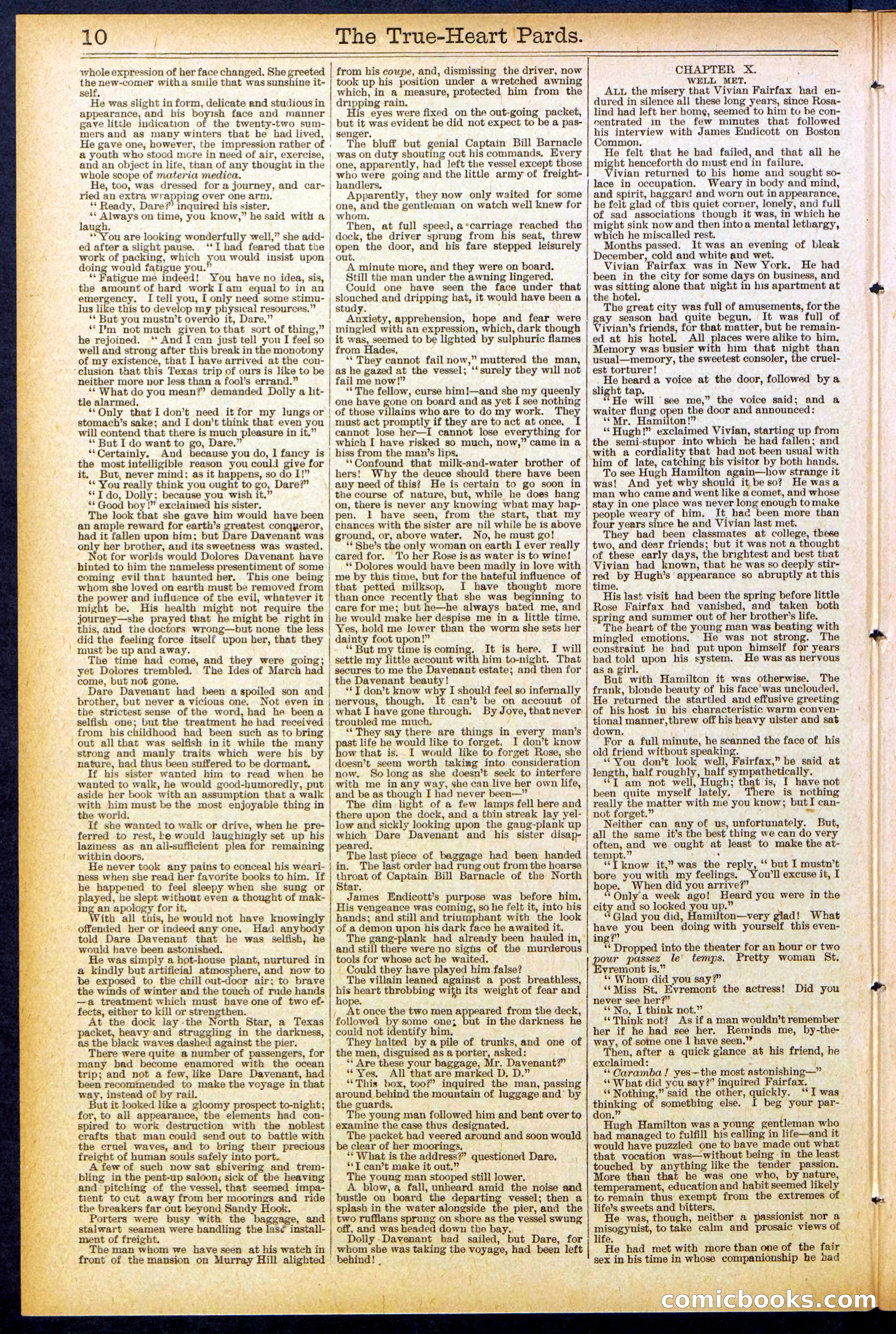
A restored page from Pulp Fiction, 1888. Page through the whole issue in the reader above.
📄 Transcribed text from this page (OCR, searchable)
Machine-transcribed from the original scan — historical spelling and the odd misread are preserved.
1 - whole expression of her face changed, She greeted the new-comer witha smile that was sunshine it- self, He was slight in form, delicate and studious in appearance, and his boyish face and manner gave little indication of the twenty-two sum- mers and as many winters that he had lived, He gave one, however, the impression rather of , a youth who stood more in need of air, exercise, | and an object in life, than of any thought in the | whole scope of materia medica. He, too, was dressed for a journey, and car- ried an extra wrapping over one arn. ‘* Ready, Dare?’ inquired his sister. ‘* Always on time, you know,” he said with a | laugh. “You are looking wonderfully well,” she add- ed after a slight pause. ‘‘I had feared that the work of packing, which you would insist upon doing would fatigue you.” ‘* Fatigue me indeed! You have no idea, sis, the amount of hard work Iam equal to in an | emergency. I tell you, [ only need some stimu- lus like this to develop my pbysical resources.” ‘* But you mustn’t overdo it, Dare.” *‘T’m not much given to that sort of thing,” he rejoined. ‘And I can just tell you I feel so well and strong after this break in the monotony of my existence, that 1 have arrived at the con- clusion that this Texas trip of ours is like to be neither more nor less than a fool’s errand.” ‘¢ What do you mean?” demanded Dolly a ht- tle alarmed. **Only that I don’t need it for my lungs or stomach’s sake; and I[ don’t think that even you will contend that there is much pleasure in it.” ‘** But I do want to go, Dare.” ‘Certainly, And because you do, | fancy is the most intelligible reason you could give for it. But, never mind: as it happens, so do 1!” ** You really think you ought to go, Dare?” **T do, Dolly: because you wish it.” ** Good boy !” exclaimed his sister. The look that she gave him would have been an ample reward for earth’s greatest conqyeror, had it fallen upon bim; but Dare Davenant was only her brother, and its sweetness was wasted. ot for worlds would Dolores Davenant have hinted to him the nameless presentiment of some coming evil that haunted her. This one being whom she loved on earth must be removed from the power and influence of the evil, whatever it mizht be. His health might not require the journey—she prayed that he might be right in | | | ! | The True-Heart Pards. from his coupe, and, dismissing the driver, now took up his position under a wretched awning which, in a measure, protected him from the dripping rain. His eyes were fixed on the out-going packet, but it was evident he did not expect to be a pas- senger. The bluff but genial Captain Bill Barnacle was on duty shouting out his commands. Every one, apparently, had left the vessel except those who were going and the little army of freight- handlers. Apparently, they now only waited for some | one, and the gentleman on watch well knew for whom. Then, at full speed, a*carriage reached the dock, the driver sprung from his seat, threw open the door, and his fare stepped leisurely out. A minute more, and they were on board. Still the man under the awning lingered. Could one have seen the face under that slouched and dripping hat, it would have been a study. Anxiety, apprehension, hope and fear were | mingled with an expression, which, dark though j | | | | | it was, seemed to be lighted by sulphuric flames from Hades, ‘* They cannot fail now,” muttered the man, as he gazed at the vessel; ‘‘surely they will not fail me now!” ‘* The fellow, curse him!—and she my queenly one bave gone on board and as yet [ see nothing of those villains who are to do my work. rey must act promptly if they are to act at once. cannot lose her—I cannot lose everything for which I have risked so much, now,” came in a hiss from the man’s lips, ‘*Confound that milk-and-water brother of hers! Why the deuce should there have been any need of this? He is certain to go soon in the course of nature, but, while he does hang on, there is never any knowing what may bap- pen. 1 have seen, from the start, that my chances with the sister are nil while be is above ground, or, above water. No, he must go! ‘** She’s the only woman on earth I ever really cared for. To her Rose is as water is to wine! ** Dolores would have been madly in love with me by this time, but for the hateful influence of that petted milksop. I have thought more than once recently that she was beginning to care for me; but he—he always bated me, and he would make her despise me in a little time. this, and the doctors wrong—but none the less | Yes, hold me lower than the worm she sets her did the feeling force itself upon her, that they rmoust be up and away. The time had come, and they were going; yet Dolores trembled. come, but not gone. Dare Davenant had been aspoiled son and brother, but never a vicious one. Not even in | nervous, though. dainty foot upon!” ‘* But my time iscoming. It is here. I will settle my little account with him to-night. That The Ides of March had | secures to me the Davenant estate; and then for the Davenant beauty! **T don’t know why I should feel so infernally It can’t be on accouut of the strictest sense of the word, had he been a | what I have gone through, By Jove, that never selfish one; but the treatment he had received from his childhood had been such as to bring out all that was selfish init while the many strong and manly traits which were his by nature, had thus been suffered to be dormant. If his sister wanted him to read when he wanted to walk, he would good-humoredly, put aside her book with an assumption that a walk with him must be the most enjoyable thing in the world. If she wanted to walk or drive, when he pre- ferred to rest, ke would laughingly set up his laziness as an all-sufficient plea for remaining within doors. He never took any pains to conceal his weari- ness when she read her favorite books to him. If he happened to feel sleepy when she sung or played, he slept without even a thought of mak- ing an apology for it. Vith all this, he would not have knowingly offended her or indeed any one. Had anybody told Dare Davenant that he was selfish, he would have been astonished. He was simply a hot-house plant, nurtured in a kindly but artificial atmosphere, and now to be exposed to the chill out-door air; to brave the winds of winter and the touch of rude hands —a treatment which must have one of two ef- fects, either to kill or strengthen. At the dock lay-the North Star, a Texas packet, heavy and struggling in the darkness, as the black waves dashed against the pier. There were quite a number of passengers, for many bad become enamored with the ocean trip; and not a few, like Dare Davenant, had been recommended to make the voyage in that way, instead of by rail. But it looked like a gloomy prospect to-night; for, to all appearance, the elements had con- spired to work destruction with the noblest crafts that man could send out to battle with the crnel waves, and to bring their precious freight of human souls safely into port. A few of such now sat shivering and trem- bling in the pent-up saloon, sick of the heaving and pitching of the vessel, that seemed impa- tient tocut away from her moorings and ride the breakers far out beyond Sandy Hook. Porters were busy with the baggage, and stalwart seamen were handling the las¢ install- ment of freight. The man whom we have seen at his watch in front of the mansion on Murray Hill alighted cl OT tS troubled me much. ‘‘ They say there are things in every man’s ast life he would like to forget. I don’t know ow that is. I would like to forget Rose, she doesn’t seem worth taking into consideration now. Solongas she doesn’t seek to interfere with me in any way, she can live her own life, and be as though I had never been—” The dim light of a few lamps fell here and there upon the dock, and a thin streak lay yel- low and sickly looking upon the gang-plank up which Dare Davenant and his sister disap- peared, The last piece of baggage had been handed in. The last order had rung out from the hoarse Hy eat of Captain Bill Barnacle of the North tar. James Endicott’s purpose was before him, His vengeance was coming, so he felt it, into bis hands; and still and triumphant witb the look of a demon upon his dark face he awaited it. The gang-plank had already been hauled in, and still there were no sighs of the murderous tools for whose act he waited. Could they have plexed him false? The villain leaned against a post breathless, be heart throbbing with its weight of fear and ope. At once the two men appeared from the deck, followed by some one; bat in the darkness he could not identify him, They halted by a pile of trunks, and one of the men, disguised as a porter, asked: ‘** Are these your baggage, Mr. Davenant?” “Yes, All that are marked D, D.” ‘‘This box, too?” inquired the man, passing around behind the mountain of luggage and’ by the guards. The young man followed him and bent over to examine the case thus designated. The packet had veered around and soon would be clear of her moorings. ‘What is the address?” questioned Dare. **T can’t make it out.” The young man stooped still lower, A blow, a fall, unheard amid the noise and bustle on board the departing vessel; then a splash in the water alongside the pier, and the two ruffians sprung on shore as the vessel swung off, and was headed down the bay. Dolly -Davenant had sailed, but Dare, for whom she was taking the voyage, had been left behind! | NN a e CHAPTER X. WELL MET. ALL the misery that Vivian Fairfax had en- dured in silence all these long years, since Rosa- lind had left her home, seemed to him to be con- centrated in the few minutes that followed his interview with James Endicott on Boston Common. He felt that he had failed, and that all he might henceforth do must end in failure. Vivian returned to his home and sought so- lace in occupation. Weary in body and mind, and spirit, haggard and worn out in appearance, he felt glad of this quiet corner, lonely, and full of sad associations though it was, in which he might sink now and then intoa mental lethargy, which he miscalled rest. Months passed. It was an evening of bleak December, cold and white and wet, Vivian Fairfax was in New York. He had been in the city for some days on business, and was sitting alone that night in his apartment at the hotel. The great city was full of amusements, for the ay season had quite begun. It was full of ‘ivian’s friends, for that matter, but be remain- ed at his hotel. All places were alike to him. Memory was busier with him that night than usual—memory, the sweetest consoler, the cruel- est torturer! He heard a voice at the door, followed by a slight tap. ‘‘He will see me,” the voice said; and a waiter flung open the door and announced: ‘‘Mr. Hamiiton!” “ Hugh!” exclaimed Vivian, starting up from the semi-stupor into which he had fallen; and with a cordiality that bad not been usual with him of late, catching bis visitor by both hands. To see Hugh Hamilton again—how strange it was! And yet why should it beso? He wasa man who came and went like a comet, and whose stay in one place was never long enough tomake people weary of him, It hac been more than four years since he and Vivian last met. They had been classmates at college, these two, and dear friends; but it was not a thought of these early days, the brightest and best that Vivian had known, tbat he was so deeply stir- red by Hugh’s appearance so abruptly at this time. His last visit had been the spring before little Rose Fairfax had vanished, and taken both spring and summer out of her brother’s life, The heart of the young man was beating with mingled emotions. He was not strong. The constraint he had put upon himself for years had told upon his system. He was as nervous as a girl. But with Hamilton it was otherwise. The frank, blonde beauty of bis face’ was unclouded. He returned the startled and effusive greeting of his host in his characteristic warm conven- tional manner,threw off his heavy ulster and sat down, For a full minute, he scanned the face of his old friend without speaking. “You don’t look well, Fairfax,” be said at length, half roughly, half sympathetically. ‘““T am not well, Hugh; that is, [ have not been quite myself lately. ere is nothing really the matter with me you know; butI can- not forget.” | ee Neither can any of us, unfortunately. But, all the same it’s the best thing we can do very often, and we ought at least to make the at- tempt.” ' ‘‘T know it,” was the reply, ‘* but I mustn’t bore you with my feelings. You'll excuse it, I hope. When did you arrive?” ‘“‘Only'a week ago! Heard you were in the city and so locked you up.” “Glad you did, Hamilton—very glad! What have you been doing with yourself this even- ing?” m Dropped into the theater for an hour or two r passez le’ temps. Pretty woman St. vremont is,” ‘* Whom did you say?” ‘Miss St. Evremont the actress! never see her?” ** No, I think not.” “Think not? As if a man wouldn’t remember her if he had see her. Reminds me, by-the- way, of some one Ll have seen,”” ; Then, after a quick glance at his friend, he exclaimed: ** Caramba! yes—the most astonishing—” ‘¢ What did you say?” inquired Fairfax. ‘‘ Nothing,” said the other, quickly. ‘I was thinking of something else. I beg your par- don,” Hugh Hamilton was a young gentleman who had managed to fulfill his calling in life—and it would have puzzled one to have made out what that vocation was—without being -in the least touched by anything like the tender passion. More than that he was one who, by nature, temperament, education and habit seemed likely to remain thus exempt from the extremes of life’s sweets and bitters. aA He was, though, neither a passionist nor a misogynist, to take calm and prosaic views of life, He had met with more than one of the fair sex in his time in whose companionship he had Did you NiG¢bDoo (ele) (E : ‘ 7