
Pulp Fiction, 1888 · page 21 of 32
Beadle's New York Dime Library No. 482 — page 21: what you’re looking at
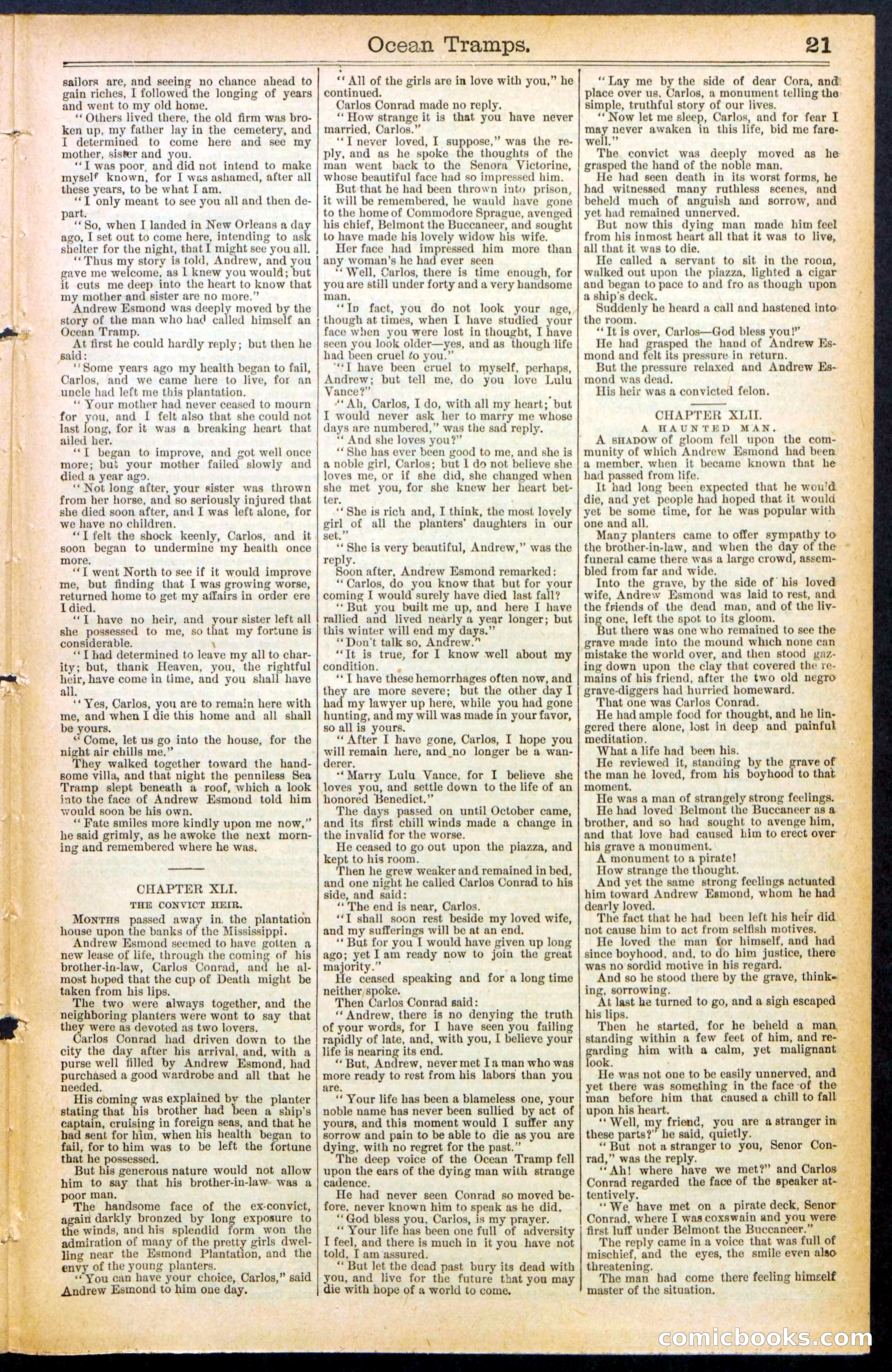
A restored page from Pulp Fiction, 1888. Page through the whole issue in the reader above.
📄 Transcribed text from this page (OCR, searchable)
Machine-transcribed from the original scan — historical spelling and the odd misread are preserved.
al a aE etal a — — - ~~ ~ 7 as .& > « ao Coe sailors are, and seeing no chance ahead to ™~ 7 wre th Ev 4 —_~ <4 — P “se : ns _ Ocean retipe” mp" eo “All of the girls are in love with you,” he gain riches, I followed the longing of years | continued. and went to my old home. ‘* Others lived there, the old firm was bro- ken up, my father lay in the cemetery, and I determined to come here and see my mother, sister and you. ‘‘T was poor, and did not intend to make myself known, for I was ashamed, after all these years, to be what I am. ‘“‘T only meant to see you all and then de- art. ‘*So, when I landed in New Orleans a day ago, I set out to come here, intending to ask shelter for the night, that I might see you all. «Thus my story is told, Andrew, and you gave me welcome, as L knew you would; but it cuts me deep into the heart to know that my mother and sister are no more.’ Andrew Esmond was deeply moved by the story of the man who had called himself an Ocean Tramp. At first he could hardly reply; but then he said: ‘Some years ago my health began to fail, Carlos, and we came here to live, for an uncle had left me this plantation. ** Your mother had never ceased to mourn for you, and I felt also that she could not last long, for it was a breaking heart that ailed her. **[ began to improve, and got well once more; bu! your mother failed slow ly and died a year ago. ‘* Not long after, your sister was thrown from her horse, and so seriously injured that she died soon after, and I was left alone, for we have no children. **1 felt the shock keenly, Carlos, and it soon began to undermine my health once more. ‘*T went North to see if it would improve me, but finding that I was growing worse, returned home to get my affairs in order ere I died. ‘‘T have no heir, and your sister left all she possessed to me, so rip my fortune is considerable. ‘‘T had determined to leave my all to char- ity; but, thank Heaven, you, the rightful heir, have come in lime, and you shall have all. ‘* Yes, Carlos, you are to remain here with me, and when I die this home and all shall be yours. “ Come, let us gO into the house, for the night air chills me.’ They walked together toward the hand- some ie and that night the penniless Sea Tramp slept beneath a roof, which a look into the face of Andrew Esmond told him would soon be his own. “Wate smiles more kindly upon me now,’ he said grimly, as he awoke the next morn- ing and remembered where he was. CHAPTER XLI. THE CONVICT HEIR. Montus passed away in. the plantation house upon the banks of the Mississippi. Andrew Esmond seemed to have gotten a new lease of life, through the coming of his brother-in-law, Carlos “Conrad, and he al- most hoped that the cup of Death might be taken from his lips. The two were always together, and the neighboring planters were wont to say that ee were as devoted as two lovers. arlos Conrad had driven down to the city the day after his arrival, and, with a purse well filled by Andrew Esmond, had purchased a good wardrobe and all that he needed. His coming was explained by the planter stating that his brother had been a ship’s captain, cruising in foreign seas, and that he bad sent for him, when his health be an to fail, for to him was to be left he ortune that he possessed. But his generous nature would not allow him to say that his brother-in-law was a or man, The handsome face of the ex-convict, again darkly bronzed by long exposure to the winds, and his splendid Join won the admiration of many of the pretty girls dwel- ling near the Esmond Plantation, and the envy of the young planters. «“You can have your choice, Carlos,” said Andrew Esmond to him one day. ‘ > ye ems nef. Y. AS Carlos Conrad made no reply. ** How strange it is that you have never married, Carlos.” ‘“‘T never loved, I suppose,” was the re- ply, and as he spoke the thoughts of the man went back to the Senora. Victorine, whose beautiful face had so impressed him. But that he had been thrown into prison, it will be remembered, he wauld have gone to the home of Commodore Sprague, avenged his chief, Belmont the Buccaneer, and sought to have made his lovely widow his wife. Her face had impressed him more than any woman’s he had ever seen ‘* Well, Carlos, there is time enough, for youare still under forty and a very handsome man, ‘‘Ip fact, you do not look your age, though at times, when I have studied your face when you were lost in thought, I have seen you look older—y es, and as though life had been cruel fo you. ‘“*T have been cruel to myself, perhaps, Andrew; but tell me, do you love Lulu Vance?” ‘Ah, Carlos, I do, with all my heart; but I would never ask her to marry me whose di ys are numbered,” was the sad reply. ‘And she loves you?” ‘She has ever been good to me, and she is a noble girl, Carlos; but 1 do not believe she loves me, or if she did, she changed when she met you, for she knew her heart bet- ter. ‘* She is rich and, I think, the most lovely girl of all the planters’ daughters in our set.’ ‘* She is very beautiful, Andrew,” was the reply. Soon after, Andrew Esmond remarked: ‘‘Carlos, do you know that but for your coming I would surely have died last fall? Ps But you built me up, and here I have rallied and lived nearly a year longer; but this winter will end my days.” **Don't talk so, Andrew “It is true, for I know well about my condition. , ‘*L have these hemorrhages often now, and they are more severe; but the other day I had my lawyer up here, while you had gone hunting, and my will was made in your favor, so all is yours. “‘ After I have gone, Carlos, I hope you will remain here, and no longer be a wan- derer. **Marry Lulu Vance, for I believe she loves you, and settle down to the life of an honored Benedict.” The days passed on until October came, and its first chill winds made a change in the invalid for the worse. He ceased to go out upon the piazza, and kept to his room. Then he grew weaker and remained in bed, and one meee he called Carlos Conrad to his side, and said “The end is near, Carlos. “T shall soon rest beside my loved wife, and my sufferings will be at an end, ‘* But for you I would have given up long ago; yet I am ready now to join the great majority.’ He ceased speaking and for a long time neither, spoke. Then Carlos Conrad said: ‘* Andrew, there is no denying the truth of your words, for I have seen you failing rapidly of late, and, with you, I believe your life is nearing its end. ‘* But, Andrew, never met Ia man who was more ready to rest from his labors than you are. ‘* Your life has been a blameless one, your noble name has never been sullied by act of yours, and this moment would I suffer any sorrow and pain to be able to die as you are dying, with no regret for the past.” The deep voice of the Ocean Tramp fell upon the ears of the dying man wilh strange cadence. He had never seen Conrad so moved be- fore, never known him to speak as he did, “God bless you, Carlos, is my prayer. ‘Your life has been one full of adversity I feel, and there is much in it you have not told, T am assured. “But let the dead past bury its dead with you, and live for the future that you may die with hope a a world to come, : eee ee a ee eee a ee. ee ee ee Se ee ee ee - Sas Se eT es . — 21 “Lay me by the side of dear Cora, and place over us, Carlos, a monument telling the: simple, truthful story of our lives. ‘* Now let me sleep, Carlos, and for fear I may never awaken in this life, bid me fare- well.”’ The convict was deeply moved as he grasped the hand of the noble man. He had seen death in its worst forms, he had witnessed many ruthless scenes, and beheld much of anguish and sorrow, and yet, had remained unnerved. 3ut now this dying man made him feel from his inmost heart all that it was to live, all that it was to die. He called a servant to sit in the roo:n, walked out upon the piazza, lighted a cigar and began to pace to and fro as though upon a ship’s deck. Suddenly he heard a call and hastened into the room. ‘*Tt is over, Carlos—God bless you!” He had grasped the hand of Andrew Es- mond and felt its pressure in return. But the pressure relaxed and Andrew KEs- mond was dead. a His heir was a convicted felon. Ss CHAPTER XLII. A HAUNTED MAN. A sHapow of gloom fell upon the com- munity of which Andrew Esmond had been a member, when it became known that he had passed from life. It had long been expected that he would die, and yet people had hoped that it would "s yet be some time, for he was popular with one and all. Many planters came to offer sympathy to the brother-in-law, and when the day of the funeral came there was a large crowd, assem- bled from far and wide. Into the grave, by the side of his loved wife, Andrew Esmond was laid to rest, and the friends of the dead man, and of the liv- ing one, left the spot to its gloom. ‘But there was one who remained to see the grave made into the mound which none can mistake the world over, and then stood yaz- ing down upon the clay that covered the re- mains of his friend, after the two old negro grave-diggers had hurried homeward. “a That one was Carlos Conrad. Dr He had ample food for thought, and he line gered there alone, lost in deep and painful meditation. What a life had been his. He reviewed it, standing by the grave of the man he loved, from his boyhood to that moment. As He was a man of strangely strong feelings. He had loved Belmont the Buccaneer as @ brother, and so had sought to avenge him, ~ and that love had caused him to erect over / aa his grave a monument, A monument to a pirate! : How strange the thought. And vet the same strong feelings actuated — him toward Andrew Esmond, whom he had — dearly loved. The fact that he had been left his heir did not cause him to act from selfish motives. er t He loved the man for himself, and had | since boyhood, and, to do him justice, there — oh was no sordid motive in his regard. a And so he stood there by the grave, thinke AN ing, sorrowing. At last he turned to go, and a sigh escapedas his lips. Then he started, for he beheld a man standing within a few feet of him, and re- a arding him with a calm, yet malignant : ook. te He was not one to be easily unnerved, and yet there was something in the face -of the | man before him that caused a chill to fall — upon his heart. ‘* Well, my these parts?’ he said, quietly. bs “But not a stranger to you, Senor Con- . rad,” was the reply. “Ah! where have we met?” and Carlos — Conrad regarded the face of the speaker at x 2 tentively. | ‘‘We have met on a pirate deck, Senor e:. Conrad, where I was coxswain and you. were — first luff under Belmont the Buccaneer.” The reply came in a voice that was full ofS Bs, mischief, and the eyes, the smile even anona threatening. The man had come there feeling bineal master of the situation. | friend, yeu are a stranger in — | of, : c = ar ¥ uf . id 6S JOO ihe m (C Ol - ({s) ~