
Pulp Fiction, 1888 · page 20 of 32
Beadle's New York Dime Library No. 482 — page 20: what you’re looking at
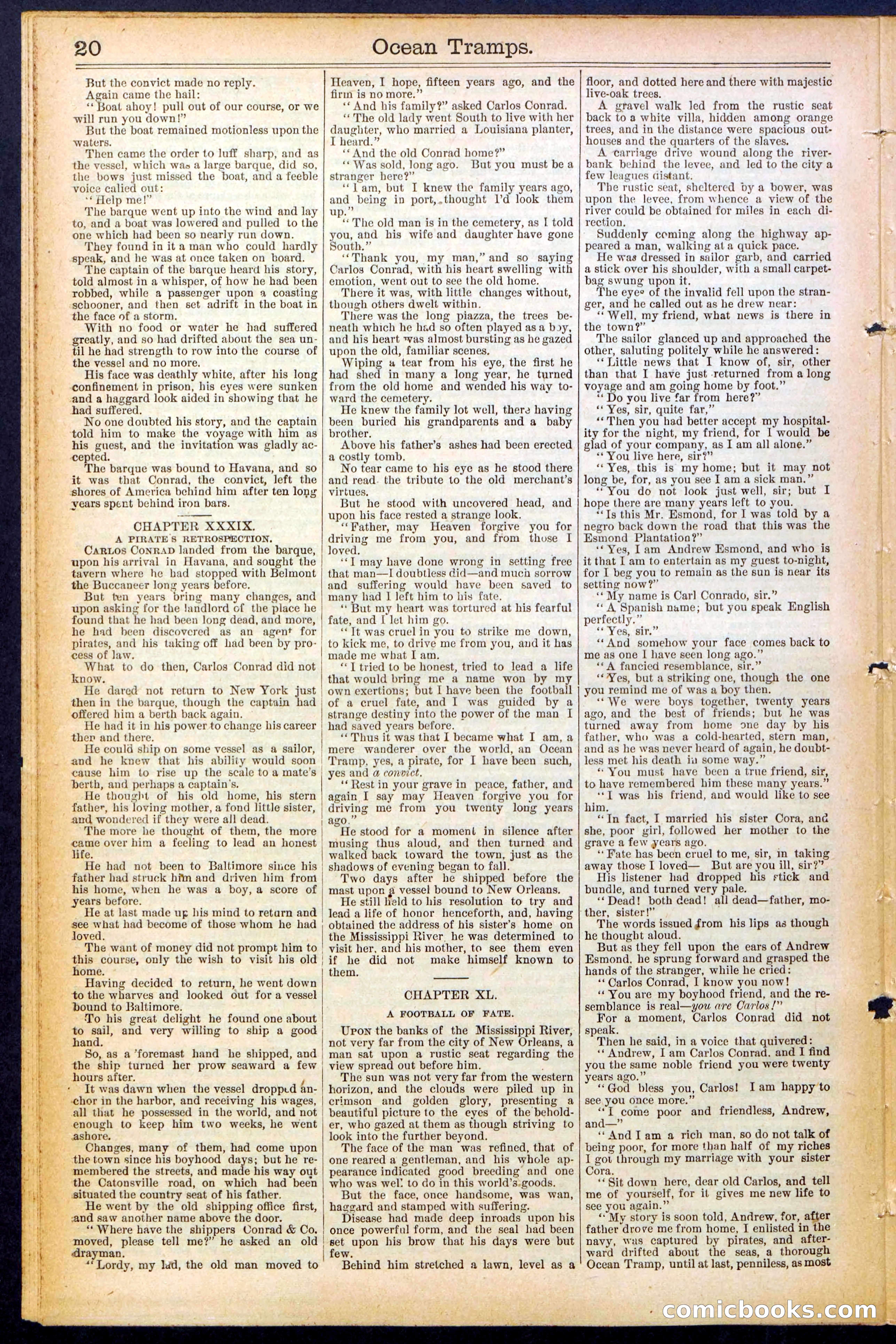
A restored page from Pulp Fiction, 1888. Page through the whole issue in the reader above.
📄 Transcribed text from this page (OCR, searchable)
Machine-transcribed from the original scan — historical spelling and the odd misread are preserved.
But the convict made no reply. Again came the hail: ‘* Boat ahoy! pull out of our course, or we will run you down!” But the boat remained motionless upon the waters. Then came the order to luff sharp, and as the vessel, which was a large barque, did so, the bows just missed the boat, and a feeble voice calied out: ‘* flelp me!” The barque went up into the wind and lay to, and a boat was lowered and pulled to the one which had been so nearly run down. They found in it a man who could hardly speak, and he was at once taken on board. The captain of the barque heard his story, told almost in a whisper, of how he had been robbed, while a passenger upon 1 coasting sschooner, and then set adrift in the boat in the face of a storm, With no food or water he had suffered greatly, and so had drifted about the sea un- til he had strength to row into the course of the vessel and no more, His face was deathly white, after his long confinement in prison, his eyes were sunken and a haggard look aided in showing that he had suffered. No one doubted his story, and the captain told him to make the voyage with him as his guest, and the invitation was gladly ac- cepted. The barque was bound to Havana, and so it was that Conrad, the convict, left the shores of America behind him after ten long years spent behind iron bars. CHAPTER XXXIX. A PIRATE 8 RETROSPECTION. Cartos Conrab landed from the barque, upon his arrival in Havana, and sought the tavern where he bad stopped with Belmont the Buccaneer long years before. But ten years bring many changes, and upon asking for the Jandlord of the place he found that he had been long dead, and more, he had been discovered as an agent for pirates, and his taking off had been by pro- cess of law. What to do then, Carlos Conrad did not know. He dared not return to New York just | then in the barque, though the captain had | offered him a berth back again. He had it in his power to change his career ther and there. He could ship on some vessel as a sailor, and he knew that his ability would soon _ cause him to rise up the scale to a mate’s | berth, and perhaps a captain's. He thought of his old home, his stern father, his loving mother, a fond little sister, uf and wondered if they were all dead. The more he thought of them, the more _ ¢ame over him a feeling to lead an honest | wy Vite. He had not been to Baltimore since his father had struck him and driven him from his home, when he was a boy, a score of _ years before. - He at last made ug his mind to retarn and gee what had become of those whom he had loved. - The want of money did not prompt him to ; _ this course, only the wish to visit his old home. - Having decided to return, he went down - to the wharves and looked out for a vessel pound to Baltimore. Yo his great delight he found one about to sail, and very willing to ship a good hand. So, as a ’foremast hand he shipped, and the ship turned her prow seaward a few ¥ ¥ ¥ > . hours after. + Jt was dawn when the vessel dropped an- _ chor in the harbor, and receiving his wages, all that he possessed in the world, and not _ enough to keep him two weeks, he went _ Changes, many of them, had come upon the town since his boyhood days; but he re- ; membered the streets, and made his way out the Catonsville road, on which had been _ situated the country seat of his father. _ He went by the old shipping office first, _ and saw another name above the door. ** Where have the shippers Conrad & Co. ‘moved, please tell me?” he asked an old ” ““Lordy, my Idd, the old man moved to . i » n= a P| y “e Ocean Tramps. Heaven, I hope, fifteen years ago, and the firm is no more.” ‘* And his family?” asked Carlos Conrad. ‘The old lady went South to live with her daughter, who married a Louisiana planter, I heard.” ‘*And the old Conrad home?” ‘* Was sold, long ago. But you must be a stranger here?” ‘“lam, but I knew the family years ago, and being in port,.thought I’d look them ip.” re The old man is in the cemetery, as I told you, and his wife and daughter have gone South.” “Thank you, my man,” and so saying Carlos Conrad, with his heart swelling with emotion, went out to see the old home. There it was, with little changes without, though others dwelt within. There was the long piazza, the trees be- neath which he hed so often played asa boy, and his heart *vas almost bursting as he gazed upon the old, familiar scenes, Wiping « tear from his eye, the first he had shed in many a long year, he turned from the old home and wended his way to- ward the cemetery. He knew the family lot well, there having been buried his grandparents and a baby brother. Above his father’s ashes had been erected a costly tomb, No tear came to his eye as he stood there and read. the tribute to the old merchant’s virtues. But he stood with uncovered head, and upon his face rested a strange look. ‘‘Father, may Heaven forgive you for driving me from you, and from thuse | loved. ‘‘T may have done wrong in setting free that man—I doubtless did—and muci sorrow and suffering would have been saved to many had | left him to his fate, ‘* But my heart was tortured at his fearful fate, and I let him go. ‘*Tt was cruel in you to strike me down, to kick me, to drive me from you, and it has made me what I am. ‘‘T tried to be honest, tried to lead a life that would bring me a name won by my own exertions; but | have been the football of a cruel fate, and I was guided by a strange destiny into the power of the man | had saved years before. “Thus it was that I became what I am, a mere wanderer over the world, an Ocean Tramp, yes, a pirate, for I have been such, yes and @ convict, ‘* Rest in your grave in peace, father, and again I say may Heaven forgive you for driving me from you twenty long years ago.” “He stood for a moment in silence after musing thus aloud, and then turned and walked back toward the town, just as the shadows of evening began to fall. Two days after he shipped before the mast upon g vessel bound to New Orleans. He still held to his resolution to try and lead a life of honor henceforth, and, having obtained the address of his sister’s home on the Mississippi River, he was determined to visit her, and his mother, to see them even if he did not make himself known to them. 4 CHAPTER XL. A FOOTBALL OF FATE. Upon the banks of the Mississippi River, not very far from the city of New Orleans, a man sat upon a rustic seat regarding the view spread out before him. The sun was not very far from the western horizon, and the clouds were piled up in crimson and golden glory, presenting a beautiful picture to the eyes of the behold- er, who gazed at them as though striving to look into the further beyond. The face of the man was refined, that of one reared a gentleman, and his whole ap- pearance indicated good breeding and one who was wel! to do in this world’s.goods. But the face, once handsome, was wan, haggard and stamped with suffering. Disease had made deep inroads upon his once powerful form, and the seal had been set upon his brow that his days were but ew. Behind him stretched a lawn, level as a floor, and dotted here and there with majestic live-oak trees. A gravel walk led from the rustic seat back to a white villa, hidden among orange trees, and in the distance were spacious out- houses and the quarters of the slaves. A carriage drive wound along the river- bank behind the levee, and led to the city a few leagues distant. The rustic seat, sheltered Dy a bower, was upon the levee, from whence a view of the river could be obtained for miles in each di- rection. Suddenly coming along the highway ap- peared a man, walking ata quick pace. He was dressed in sailor garb, and carried a stick over his shoulder, with a small carpet- bag swung upon it. The eyes of the invalid fell upon the stran- ger, and he called out as he drew near: ‘‘ Well, my friend, what news is there in the town?” The sailor glanced up and approached the other, saluting politely while he answered: ‘* Little news that I know of, sir, other than that I have just returned from a long voyage and am going home by foot.” ‘*Do you live far from here?” ‘* Yes, sir, quite far,” ‘‘Then you had better accept my hospital- ity for the night, my friend, for I would be glad of your company, as I am all alone.” ‘*'You live here, sir?” ‘‘Yes, this is my home; but it may not long be, for, as you see I am a sick man.” “You do not look just well, sir; but I hope there are many years left to you. ‘Ts this Mr. Esmond, for I was told by a negro back down the road that this was the Esmond Plantation?” ‘¢Yes, [am Andrew Esmond, and who is it that I am to entertain as my guest to-night, for I beg you to remain as the sun is near its setting now?” ‘*My name is Carl Conrado, sir.” ‘A Spanish name; but you speak English perfectly.” ‘* Yes, sir.” ‘‘And somehow your face comes back to me as one | have seen long ago.” ‘*A fancied resemblance, sir.” ‘‘¥Ves, but a striking one, though the one you remind me of was a boy then. ‘““We were boys together, twenty years ago, and the best of friends; but he was turned away from home one day by his father, who was a cold-hearted, stern man, . and as he was never heard of again, he doubt- less met his death iu some way.” * You must have been a true friend, sir, to have remembered him these many years.” ‘*T was his friend, and would like to see him. “Tn faet, I married his sister Cora, and she, poor yirl, followed her mother to the grave a few years ago. ‘Fate has been cruel to me, sir, m taking away those I loved— But are you ill, sir?” His listener had dropped his stick and bundle, and turned very pale. ‘*Dead! both dead! all dead—father, mo- ‘ther, sister!” The words issued from his lips as though he thought aloud. But as they fell upon the ears of Andrew Esmond, he sprung forward and grasped the hands of the stranger, while he cried: ‘*Carlos Conrad, I know you now! ‘“You are my boyhood friend, and the re- semblance is real—you are Carlos /” For a moment, Carlos Conrad did not speak. Then he said, in a voice that quivered: ‘* Andrew, I am Carlos Conrad. and I find you the same noble friend you were twenty years ago.” ‘God bless you, Carlos! see you once more.” “I come poor and friendless, Andrew, and—” ‘And Iam a rich man, so do not talk of being poor, for more than half of my riches I got through my marriage with your sister Cora. ‘«Sit down here, dear old Carlos, and tell me of yourself, for it gives me new life to see you again.” ‘* My story is soon told, Andrew, for, after father drove me from home, I enlisted in the navy, Was captured by pirates, and after- ward drifted about the seas, a thorough Ocean Tramp, until at last, penniless, as most Iam happy to