
Pulp Fiction, 1888 · page 22 of 32
Beadle's New York Dime Library No. 482 — page 22: what you’re looking at
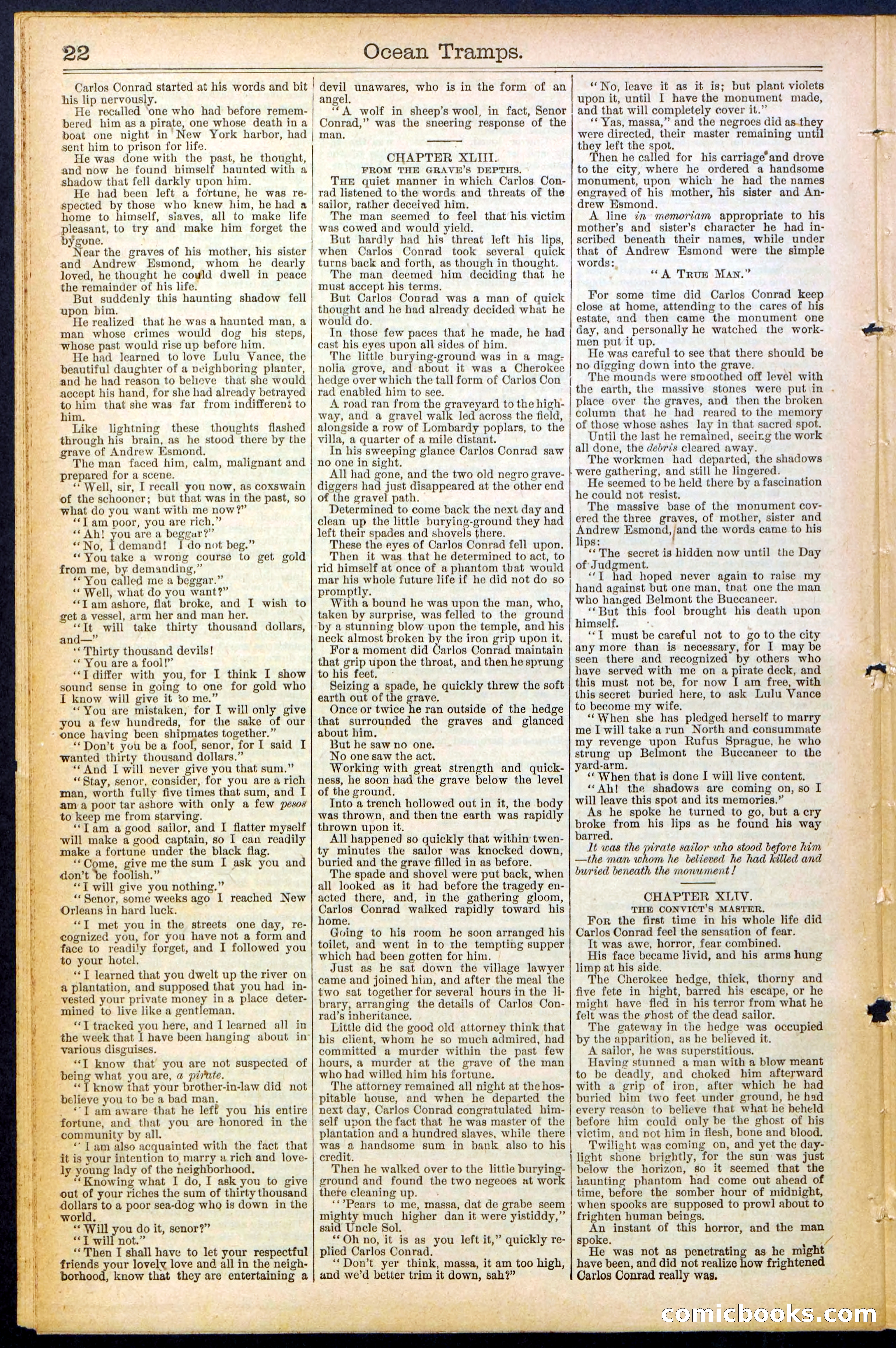
A restored page from Pulp Fiction, 1888. Page through the whole issue in the reader above.
📄 Transcribed text from this page (OCR, searchable)
Machine-transcribed from the original scan — historical spelling and the odd misread are preserved.
—__ — at e+ a Ne er a - tie sere ye — wy 8 +4 a : “paa “y ad i - > > * rr fr 22 ey Ocean Tramps. Carlos Conrad started at his words and bit | devil unawares, who is in the form of an his lip nervously. He recalled ‘one who had before remem- bered him as a pirate, one whose death in a boat one night in New York harbor, had sent him to prison for life. He was done with the past, he thought, and now he found himself haunted with a shadow that fell darkly upon him. He had been left a fortune, he was re- spected by those who knew him, he had a home to himself, siaves, all to make life pleasant, to try and make him forget the bygone. Doar the graves of his mother, his sister and Andrew Esmond, whom he dearly loved, he thought he cowld dwell in peace the remainder of his life. But suddenly this haunting shadow fell upon bim. He realized that he was a haunted man, a man whose crimes would dog his steps, whose past would rise up before him. - p- He had learned to love Lulu Vance, the beautiful daughter of a neighboring planter, and he had reason to believe that she would accept his hand, for she had already betrayed to him that she was far from indifferent to him. Like lightning these thoughts flashed through his brain, as he stood there by the grave of Andrew Esmond. " The man faced him, calm, malignant and _ prepared for a scene. ‘* Well, sir, I recall you now, as coxswain of the schooner; but that was in the past, so what do you want with me now?” **T am poor, you are rich.” ‘‘ Ah! you are a beggar?” ‘No, I demand! Tae not beg.” ‘“‘You take a wrong course to get gold from me, by demanding,” ‘© You called me a beggar.” ‘* Well, what do you want?” “Tam ashore, flat broke, and I wish to et a vessel, arm her and man her. Tt will take thirty thousand dollars, - and—” ** Thirty thousand devils! “You are a fool!” ‘“‘T differ with you, for I think I show - gound sense in going to one for gold who _ I know will give it to me.” — “You are mistaken, for I will only give you a few hundreds, for the sake of our - once having been shipmates together.” Don’t you be a fool, senor, for I said I - wanted thirty thousand dollars.” And I will never give you that sum.” _ $tay, senor, consider, for you are a rich man, worth fully five times that sum, and I - am a poor tar ashore with only a few pesos _ to keep me from starving. Tam a good sailor, and I flatter myself will make a good captain, so I can readily make a fortune under the black flag. =) ** Come, give me the sum I ask you and don’t be foolish.” “J will give you nothing.” Senor, some weeks ago I reached New Orleans in hard luck. _ “T met you in the streets one day, re- -cognized you, for you have not a form and face to readily forget, and I followed you to your hotel. “T learned that you dwelt up the river on ‘a plantation, and supposed that you had in- vested your private money ina place deter- “mined to live like a gentleman. “T tracked te here, and I learned all in the week that various disguises. _ “T know that you are not suspected of eing what you are, @ piy'ute. ‘©T know that your brother-in-law did not believe you to be a bad man. - ©T am aware that he leff you his entire fortune, and that you are honored in the munity by all. © Tam also acquainted with the fact that is your intention to, marry a rich and love- dy young lady of the neighborhood, ~ Knowing what I do, I ask you to give ut of your riches the sum of thirty thousand dollars to a poor sea-dog who is down in the orld. — * Will you do it, senor?” _ “Twill not.” — Then I shall have to let your respectful friends your lovely love and all in the neigh- petted: know that they are entertaining a Fe: { : : * ¢ ‘ * way ee . *. 3 have been hanging about in angel. ‘“No, leave it as it is; but plant violets upon it, until I have the monument made, “A wolf in sheep’s wool, in fact, Senor ! and that will completely cover it.” Conrad,’’ was the sneering response of the man. CHAPTER XLII. FROM THE GRAVE’S DEPTHS. THe quiet manner in which Carlos Con- rad listened to the words and threats of the sailor, rather deceived him. The man seemed to feel that his victim was cowed and would yield. But hardly had his threat left his lips, when Carlos Conrad took several quick turns back and forth, as though in thought. The man deemed him deciding that he must accept his terms. But Carlos Conrad was a man of quick thought and he had already decided what he would do. In those few paces that he made, he had cast his eyes upon all sides of him. The little burying-ground was in a mag- nolia grove, and about it was a Cherokee hedge over which the tall form of Carlos Con rad enabled him to see. A road ran from the graveyard to the high- way, and a gravel walk led across the field, alongside a row of Lombardy poplars, to the villa, a quarter of a mile distant. In his sweeping glance Carlos Conrad saw no one in sight. All had gone, and the two old negro grave- diggers had just disappeared at the other end of the gravel path. Determined to come back the next day and clean up the little burying-ground they had left their spades and shovels there. These the eyes of Carlos Conrad fell upon. Then it was that he determined to act, to rid himself at once of a phantom that would mar his whole future life if he did not do so promptly. With a bound he was upon the man, who, taken by surprise, was felled to the ground by a stunning blow upon the temple, and his neck almost broken by the iron grip upon it. For a moment did Carlos Conrad maintain that grip upon the throat, and then he sprung to his feet, ~ Seizing a spade, he quickly threw the soft earth out of the grave. Once or twice he ran outside of the hedge that surrounded the graves and glanced about him, But he saw no one. No one saw the act, Working with great strength and quick- ness, he soon had the grave below the level of the ground. Into a trench hollowed out in it, the body was thrown, and then tne earth was rapidly thrown upon it. All happened so quickly that within twen- ty minutes the Malo was knocked down, buried and the grave filled in as before. The spade and shovel were put back, when all looked as it had before the tragedy en- acted there, and, in the gathering gloom, Carlos Conrad walked rapidly toward his home. Going to his room he soon arranged his toilet, and went in to the tempting supper which had been gotten for him. | Just as he sat down the village lawyer came and joined him, and after the meal the two sat together for several hours in the li- brary, arranging the details of Carlos Con- rad’s inheritance. Little did the good old attorney think that his client, whom he so much admired, had committed a murder within the past few hours, a murder at the grave of the man who had willed him his fortune. The attorney remained all night at the hos- pitable house, and when he departed the next day, Carlos Conrad congratulated him- self upon the fact that he was master of the plantation and a hundred slaves, while there was a handsome sum in bank also to his credit. Then he walked over to the little burying- ground and found the two negeoes at work there cleaning up. ‘*°’Pears to me, massa, dat de grabe seem mighty much higher dan it were yistiddy,” said Uncle Sol. **Oh no, it is as you left it,” quickly re- plied Carlos Conrad. ‘‘Don’t yer think, massa, it am too high, and we’d better trim it down, sah?” ‘* Yas, massa,” and the negroes did as.they were directed, their master remaining until they left the spot. Then he called for his carriage’and drove to the city, where he ordered a handsome monument, upon which he had the names engraved of his mother, his sister and An- drew Esmond. A line in memoriam appropriate to his mother’s and sister’s character he had in- scribed beneath their names, while under that of Andrew Esmond were the simple words:. ‘“A True MAN.” For some time did Carlos Conrad keep close at home, attending to the cares of his estate, and then came the monument one day, and personally he watched the work- men put it up. He was careful to see that there should be no digging down into the grave. The mounds were smoothed off level with place over the graves, and then the broken column that he had reared to the memory of those whose ashes lay in that sacred spot. Until the last he remained, seeing the work all done, the debris cleared away. The workmen had departed, the shadows were gathering, and still he lingered. He seemed to be held there by a fascination he could not resist. The massive base of the monument cov- ered the three graves, of mother, sister and Andrew Esmond, jand the words came to his lips: ‘‘The secret is hidden now until the Day of Judgment. ‘‘T had hoped never again to raise my hand against but one man, that one the man who hanged Belmont the Buccaneer. ‘But this fool brought his death upon himself. ‘“1 must be careful not to go to the city any more than is necessary, for I may be seen there and recognized by others who have served with me on a pirate deck, and this must not be, for now I am free, with this secret buried here, to ask Lulu Vance to become my wife. “When she has pledged herself to marry me I will take arun North and consummate my revenge upon Rufus Sprague, he who strung up Belmont the Buccaneer to the ard-arm. ‘« When that is done I will live content. ‘“Ah! the shadows are coming on, so I will leave this spot and its memories.” As he spoke he turned to go, but a cry broke from his lips as he found his way barred. It was the pirate sailor who stood before him — —the man whom he believed he had killed and buried beneath the monument ! CHAPTER XLIV. THE CONVICT’S MASTER. For the first time in his whole life did Carlos Conrad feel the sensation of fear. It was awe, horror, fear combined. His face became livid, and his arms hung limp at his side. The Cherokee hedge, thick, thorny and five fete in hight, barred his escape, or he might have fled in his terror from what he felt was the ghost of the dead sailor. The gateway in the hedge was occupied by the apparition, as he believed it. A sailor, he was superstitious. Having stunned a man with a blow meant to be deadly, and choked him afterward with a grip of iron, after which he had buried him two feet under ground, he had every reason to believe that what he beheld before him could only be the ghost of his victim, and not him in flesh, bone and blood. Twilight was coming on, and yet the day- light shone brightly, for the sun was just below the horizon, so it seemed that the haunting phantom had come out ahead of time, before the somber hour of midnight, when spooks are supposed to prowl about to frighten human beings. An instant of this horror, and the man spoke. have been, and did not realize how frightened Carlos Conrad really was. | od + 4 ei | @ O) @) im C nen le . the earth, the massive stones were put in . rey He was not as panei tne as he might 0 A . “nina * a > - + * ~ * 2 . ef ma “ ule i , '