
Pulp Fiction, 1888 · page 19 of 32
Beadle's New York Dime Library No. 482 — page 19: what you’re looking at
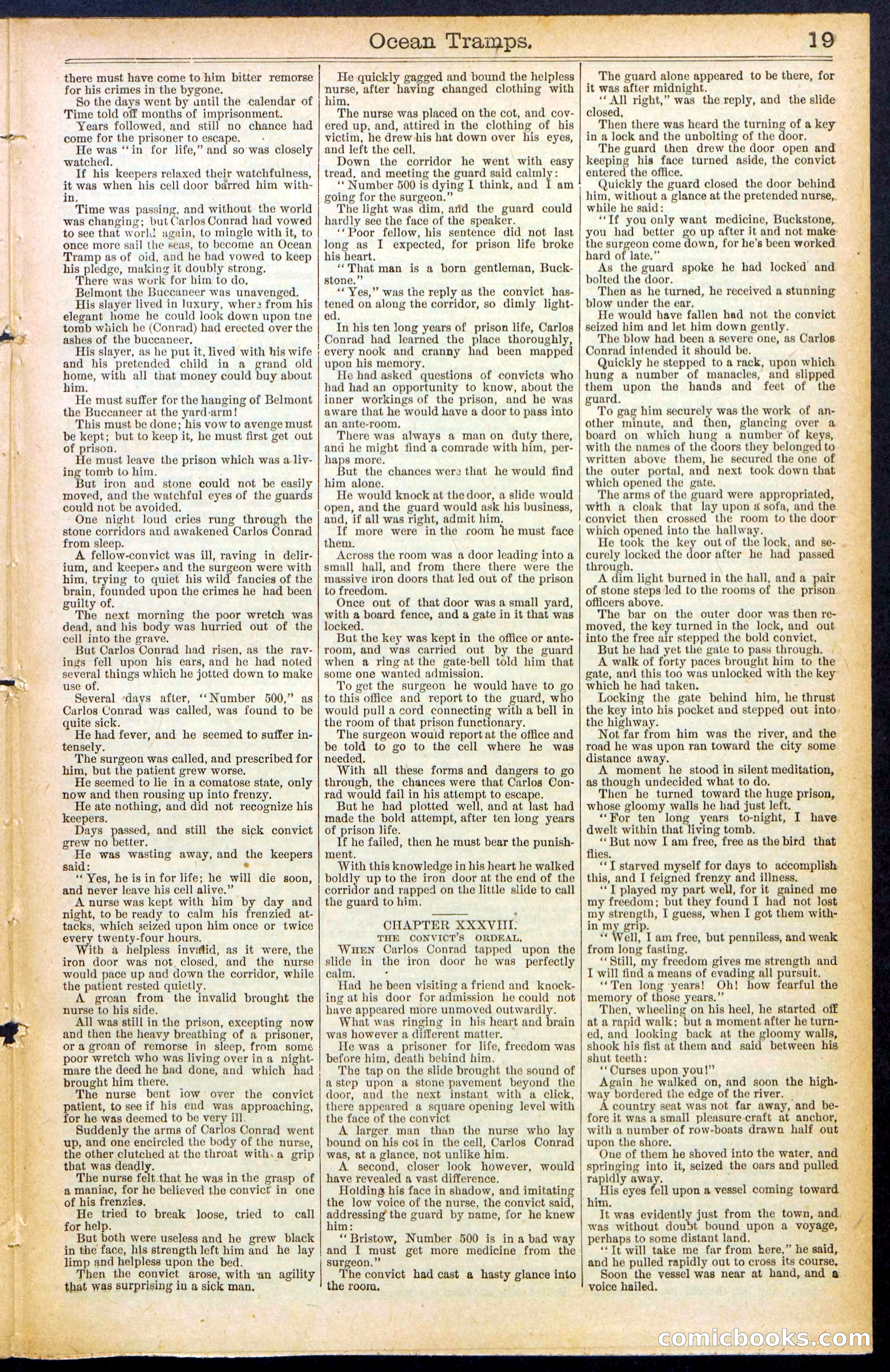
A restored page from Pulp Fiction, 1888. Page through the whole issue in the reader above.
📄 Transcribed text from this page (OCR, searchable)
Machine-transcribed from the original scan — historical spelling and the odd misread are preserved.
ae A cei, Ble ; a — 2 ~ - ~*~ rs - 8 eee ~ — e-< ae et aera = 2 > - ~ there must have come to him bitter remorse for his crimes in the bygone, So the days went by until the calendar of Time told off months of imprisonment. Years followed, and still no chance had come for the prisoner to escape, He was ‘‘in for life,” and so was closely watched. If his keepers relaxed their watchfulness, it was when his cell door barred him with- in. Time was passing, and without the world was changing; but Carlos Conrad had vowed to see that world again, to mingle with it, to once more sail the seas, to become an Ocean Tramp as of oid, and he had vowed to keep his pledge, making it doubly strong. There was work for him to do, Belmont the Buccaneer was unavenged. His slayer lived in luxury, wher: from his elegant home he could look down upon tne tomb which he (Conrad) had erected over the ashes of the buccaneer, His slayer, as he put it, lived with his wife and his pretended child in a grand old home, with all that money could buy about him. He must suffer for the hanging of Belmont the Buccaneer at the yard-arm! This must be done; his vow to avenge must be kept; but to keep it, he must first get out of prison. He must leave the prison which was a. liv- ing tomb to him. But iron and stone could not be easily moved, and the watchful eyes of the guards could not be avoided. One night loud cries rung through the stone corridors and awakened Carlos Conrad from sleep. A fellow-convict was ill, raving in delir- ium, and keepers and the surgeon were with him, trying to quiet his wild fancies of the brain, founded upon the crimes he had been guilty of. The next morning the poor wretch was dead, and his body was hurried out of the cell into the grave. But Carlos Conrad had risen, as the rav- ings fell upon his ears, and he had noted several things which he jotted down to make use of. Several ‘days after, ‘‘Number 500,” as Carlos Conrad was called, was found to be quite sick. He had fever, and he seemed to suffer in- tensely. The surgeon was called, and prescribed for him, but the patient grew worse. He seemed to lie in a comatose state, only now and then rousing up into frenzy. He ate nothing, and did not recognize his keepers. Days passed, and still the sick convict grew no better. He was wasting away, and said: ‘* Yes, he is in for life; he will die soon, and never leave his cell alive.” A nurse was kept with him by day and night, to be ready to calm his frenzied at- tacks, which seized upon him once or twice aie twenty-four hours. ith a helpless invatid, as it were, the iron door was not closed, and the nurse would pace up and down the corridor, while the patient rested quietly. A groan from the invalid brought the nurse to his side. All was still in the prison, excepting now and then the heavy breathing of a prisoner, or a groan of remorse in sleep, from some poor wretch who was living over in a night- mare the deed he had done, and which had brought him there, — The nurse bent iow over the convict patient, to see if his end was approaching, for he was deemed to be very ill, Suddenly the arms of Carlos Conrad went up, and one encircled the body of the nurse, the other clutched at the throat with,a grip tbat was deadly. The nurse felt that he was in the grasp of a maniac, for he believed the convict in one of his frenzies. He tried to break loose, tried to call for help. But both were useless and he grew black in the face, his strength left him and he lay limp and helpless upon the bed. Then the convict arose, with ‘an agility that was surprising in a sick man, the keepers o i ry ‘ Ocean Tramps. He quickly gagged and bound the helpless nurse, after having changed clothing with him, The nurse was placed on the cot, and cov- ered up, and, attired in the clothing of his victim, he drew-his hat down over his eyes, and left the cell. Down the corridor he went with easy tread, and meeting the guard said calmly: ‘Number 500 is dying I think, and I am going for the surgeon.” The light was dim, arid the guard could hardly see the face of the speaker. ‘*Poor fellow, his sentence did not last long as I expected, for prison life broke his heart. ‘That man is a born gentleman, Buck- stone.” ‘* Yes,” was the reply as the convict has- tened on along the corridor, so dimly light- ed. In his ten long years of prison life, Carlos Conrad had learned the place thoroughly, every nook and cranny had been mapped upon his memory. He had asked questions of convicts who had had an opportunity to know, about the inner workings of the prison, and he was aware that he would have a door to pass into an ante-room, There was always a man on duty there, and he might find a comrade with him, per- haps more. But the chances were that he would find him alone. He would knock at the door, a slide would open, and the guard would ask his business, aud, if all was right, admit him. If more were inthe room ‘he must face them. Across the room was a door leading into a small hall, and from there there were the massive iron doors that led out of the prison to freedom. Once out of that door was a small yard, with a board fence, and a gate in it that was locked. But the key was kept in the office or ante- room, and was carried out by the guard when a ring at the gate-bell told him that some one wanted admission. To get the surgeon he would have to go to this office and report to the guard, who would pull a cord connecting with a bell in the room of that prison functionary. The surgeon would report at the office and be told to go to the cell where he was needed. With all these forms and dangers to go through, the chances were that Carlos Con- rad would fail in his attempt to escape. But he had plotted well: and at last had made the bold attempt, after ten long years of prison life. If he failed, then he must bear the punish- ment. With this knowledge in his heart he walked boldly up to the iron door at the end of the corridor and rapped on the little slide to call the guard to him. CHAPTER XXXVIHTI: THE CONVICT’S ORDEAL, WuaeEn Carlos Conrad tapped upon the slide in the iron door he was _ perfectly calm, Had he been visiting a friend and knock- ing at his door for admission he could not have appeared more unmoved outwardly. What was ringing in his heart and brain was however a different matter. He was a prisoner for life, freedom was before him, death bebind him. The tap on the slide brought the sound of astep upon a stone pavement beyond the door, and the next instant with a click, there appeared a square opening level with the face of the convict A larger man than the nurse who lay bound on his cot in the cell, Carlos Conrad was, at a glance, not unlike him. A second, closer look however, would have revealed a vast difference. Holding his face in shadow, and imitating the low voice of the nurse, the convict said, eco Teaene. the guard by name, for he knew im: ‘Bristow, Number 500 is in a bad way and I must get more medicine from the surgeon.” The convict had cast a hasty glance into the room, a we . re +* - ali = * 1 19 me ee The guard alone appeared to be there, for it was after midnight. ‘‘ All right,” was the reply, and the slide closed, Then there was heard the turning of a key in a lock and the unbolting of the door. The guard then drew the door open and keeping his face turned aside, the convict entered the office. Quickly the guard closed the door behind him, without a glance at the pretended nurse,, while he said: ‘If you only want medicine, Buckstone,. you had better go up after it and not make the surgeon come down, for he’s been worked hard of late.” As the guard spoke he had locked and bolted the door. Then as he turned, he received a stunning blow under the ear. He would have fallen had not the convict seized him and let him down gently. The blow had been a severe one, as Carlos Conrad intended it should be. Quickly he stepped to a rack, upon which hung a number of manacles, and slipped them upon the bands and feet of the guard. To gag him securely was the work of an- other minute, and then, glancing over a board on which hung a number of Keys, with the names of the coors they belonged to written above them, he secured the one of the outer portal, and next took down that which opened the gate. The arms of the guard were appropriated, with a cloak that lay upon a sofa, and the convict then crossed the room to the door which opened into the hallway. He took the key out of the lock, and se- curely locked the door after he had passed through. A dim light burned in the hall, and a pair of stone steps led to the rooms of the prison. officers above. The bar on the outer door was then re- moved, the key turned in the lock, and out into the free air stepped the bold convict, But he had yet the gate to pass through. A walk of forty paces brought him to the gate, and this too was unlocked with the key” which he had taken. ' Locking the gate behind him, he thrust the key into his pocket and stepped out into, the highway. Not far from him was the river, and the road he was upon ran toward the city some. distance away. A moment he stood in silent meditation, — as though undecided what to do. Then he turned toward the huge prison, whose gloomy walls he had just left. ‘For ten long years to-night, I have. dwelt within that living tomb. : ‘‘But now I am free, free as the bird that flies. ‘*T starved myself for days to accomplish this, and I feigned frenzy and illness, ‘*T played my part well, for it gained me my freedom; but they found I had not lost my strength, I guess, when I got them with- in my grip. ‘Well, Iam free, but penniless, and weak from long fasting. ‘Still, my freedom gives me strength and — 2 I will find a means of evading all pursuit. ‘Ten long years! Oh! how fearful the memory of those years.” Then, wheeling on his heel, he started off om at arapid walk; but a moment after heturn- ed, and looking back at the gloomy walls, shook his fist at them and said between h shut teeth: ‘*Ourses upon you!” Again he walked on, and soon the highe | way bordered the edge of the river. | A country seat was not far away, and be-— fore it was a small pleasure-craft at anchor, with a number of row-boats drawn half out upon the shore. Oue of them he shoved into the water, and springing into it, seized the oars and pulled rapidly away. . Ua His eyes fell upon a vessel coming toward him, ® was without doubt bound upon a voyage, perhaps to some distant land. “Tt will take me far from here,” he said, and he pulled rapidly out to cross its course, Soon the vessel was near at hand, and @ voice hailed. It was evidently just from the town, and, 4 ~* fr =< v? wih * ‘ & Cae a “* Hy ff é - - * & af » eee . ia ' <F) a ‘ 9 “4 ” Gom eboo! cS eh a . ‘ eal v aay) \\ J\1 LI | >