
Pulp Fiction, 1888 · page 18 of 32
Beadle's New York Dime Library No. 482 — page 18: what you’re looking at
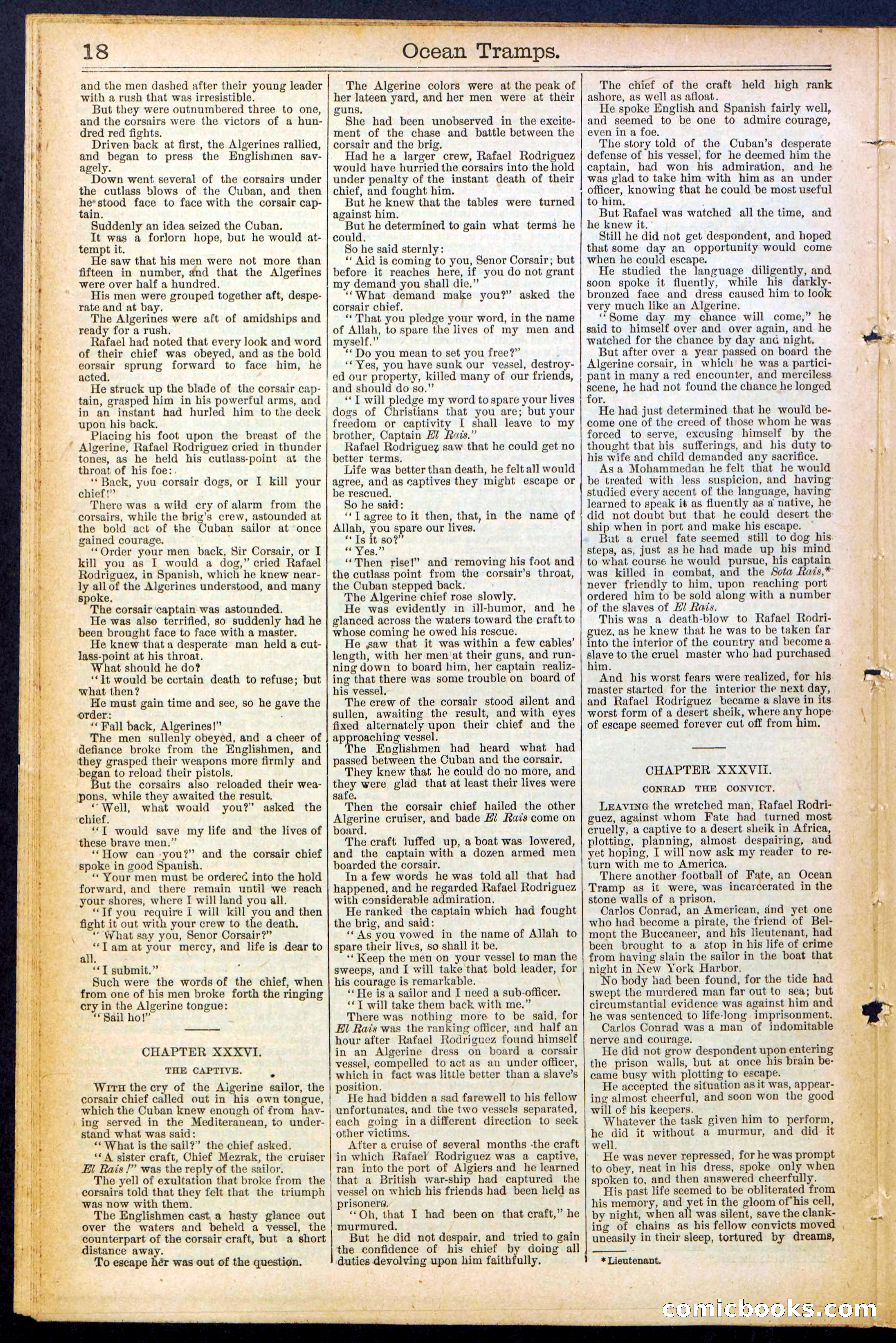
A restored page from Pulp Fiction, 1888. Page through the whole issue in the reader above.
📄 Transcribed text from this page (OCR, searchable)
Machine-transcribed from the original scan — historical spelling and the odd misread are preserved.
Ws pan oy chief. ° +" and the men dashed after their young leader with a rush that was irresistible. But they were outnumbered three to one, and the corsairs were the victors of a hun- dred red fights. Driven back at first, the Algerines rallied, and began to press the Englishmen sav- agely. Down went several of the corsairs under the cutlass blows of the Cuban, and then Sie stood face to face with the corsair cap- ain. Suddenly an idea seized the Cuban. It was a forlorn hope, but he would at- tempt it. He saw that his men were not more than fifteen in number, dnd that the Algerines were over half a hundred. His men were grouped together aft, despe- rate and at bay. The Algerines were aft of amidships and ready for a rush. Rafael had noted that every look and word of their chief was obeyed, and as the bold eorsair sprung forward to face him, he acted. He struck up the blade of the corsair cap- tain, grasped him in his powerful arms, and in an instant had hurled him to the deck upon his back. Placing his foot upon the breast of the ’ Algerine, Rafael Rodriguez cried in thunder tones, as he held his cutlass-point at the throat of his foe:. ‘* Back, you corsair dogs, or I kill your chief!” There was a wild cry of alarm from the corsairs, while the brig’s crew, astounded at the bold act of the Cuban sailor at once gained courage. ‘Order your men back, Sir Corsair, or I kill you as I would a dog,” cried Rafael Rodriguez, in Spanish, which he knew near- ly os of the Algcrines understood, and many spoke, The corsair captain was astounded. He was also terrified, so suddenly had he been brought face to face with a master. He knew that a desperate man held a cut- lass-point at his throat. hat should he do? ‘*It would be certain death to refuse; but what then? He must gain time and see, so he gave the order: ; ‘* Fall back, Algerines!” The men sullenly obeyed, and a cheer of defiance broke from the Englishmen, and they grasped their weapons more firmly and ‘began to reload their pistols. ut the corsairs also reloaded their wea- ‘pons, while they awaited the result. ‘Well, what would you?” asked the ‘*T would save my life and the lives of ‘these brave men.” ‘‘How can you?” and the corsair chief "de spoke in good Spanish. ** Your men must be orderec into the hold forward, and there remain until we reach your shores, where I will land you all. “Tf you require i will kill you and then “ | fight it out with your crew to the death. ~¥ a, bj at 1 ae at “ a 4 “ What say you, Senor Corsair?” ~ Iam at your mercy, and life is dear to all. : **T submit.” . Such were the words of the chief, when from one of his men broke forth the ringing cry in the Algerine tongue: ** Sail ho!” CHAPTER XXXVI. THE CAPTIVE. : Wiru the cry of the Aigerine sailor, the corsair chief called out in his own tongue, which the Cuban knew enough of from hav- , ing served in the Mediteranean, to under- stand what was said: ‘« What is the sail?” the chief asked. ‘* A sister craft, Chief Mezrak, the cruiser Ei Rais /” was the reply of the sailor. The yell of exultation that broke from the _corsairs told that they felt that the triumph was now with them. The Englishmen cast, a hasty glance out over the waters and beheld a vessel, the counterpart of the corsair craft, but a short distance away. To escape hér was out of the questidn. Pel ~ Ocean Tramps. The Algerine colors were at the peak of her lateen yard, and her men were at their runs, She had been unobserved in the excite- ment of the chase and battle between the corsair and the brig. Had he a larger crew, Rafael Rodriguez would have hurried the corsairs into the hold under penalty of the instant death of their chief, and fought him. But he knew that the tables were turned against him. But he determined to gain what terms he could. So he said sternly: ‘** Aid is coming to you, Senor Corsair; but before it reaches here, if you do not grant my demand you shall die.” ‘‘What demand make you?” asked the corsair chief. ** That you pledge your word, in the name of Allah, to spare the lives of my men and myself.” ‘Do you mean to set you free?” ‘‘Yes, you have sunk our vessel, destroy- ed our property, killed many of our friends, and should do so.” ‘‘T will pledge my word to spare your lives dogs of Christians that you are; but your freedom or captivity I shall leave to my brother, Captain #7 Rais.” Rafael Rodriguez saw that he could get no better terms. Life was better than death, he felt all would agree, and as captives they might escape or be rescued. So he said: ‘‘T agree to it then, that, in the name of Allah, you spare our lives. ‘Is it so?” ¥en.” “Then rise!” and removing his foot and the cutlass point from the corsair’s throat, the Cuban stepped back. The Algerine chief rose slowly. He was evidently in ill-humor, and he glanced across the waters toward the craft to whose coming he owed his rescue. He saw that it was within a few cables’ length, with her men at their guns, and run- ning down to board him, her captain realiz- ing that there was some trouble on board of his vessel, The crew of the corsair stood silent and sullen, awaiting the result, and with eyes fixed alternately upon their chief and the approaching vessel. The Englishmen had heard what had passed between the Cuban and the corsair. They knew that he could do no more, and they were glad that at least their lives were safe. Then the corsair chief hailed the other Algerine cruiser, and bade #7 Ravs come on board. The craft luffed up, a boat was lowered, and the captain with a dozen armed men boarded the corsair. In a few words he was told all that had happened, and he regarded Rafael Rodriguez with considerable admiration. He ranked the captain which had fought the brig, and said: ‘‘As you vowed in the name of Allah to spare their lives, so shall it be. ‘‘ Keep the men on your vessel to man the sweeps, and I will take that bold leader, for his courage is remarkable. ‘‘He is a sailor and I need a sub-officer. ‘7 will take them back with me.” There was nothing more to be said, for El Rais was the ranking officer, and half an hour after Rafael Rodriguez found himself in an Algerine dress on board a corsair vessel, compelled to act as an under officer, which in fact was little better than a slave’s position. He had bidden a sad farewell to his fellow unfortunates, and the two vessels separated, each going ina different direction to seek otber victims. After a cruise of several months -the craft in which Rafael Rodriguez was a captive, ran into the port of Algiers and he learned that a British war-ship had captured the vessel on which his friends had been held as prisoners, ‘Oh, that I had been on that craft,” he murmured, But he did not despair, and tried to gain the confidence of his chief by doing all duties devolving upon him faithfully. The chief of the craft held high rank ashore, as well as afloat. He spoke English and Spanish fairly well, and seemed to be one to admire courage, even in a foe. The story told of the Cuban’s desperate defense of his vessel, for he deemed him the captain, had won his admiration, and he was vlad to take him with him as an under officer, knowing that he could be most useful to him. But Rafael was watched all the time, and he knew it. Still he did not get despondent, and hoped thut some day an opportunity would come when he could escape. He studied the language diligently, and soon spoke it fluently, while his darkly- bronzed face and dress caused him to look very much like an Algerine. ‘‘Some day my chance will come,” he said to himself over and over again, and he watched for the chance by day and night. But after over a year passed on board the Algerine corsair, in which he was a partici- pant in many a red encounter, and merciless scene, he had not found the chance he longed for. He had just determined that he would be- come one of the creed of those whom he was forced to serve, excusing himself by the thought that his sufferings, and his duty to his wife and child demanded any sacrifice. Asa Mohammedan he felt that he would be treated with less suspicion, and having studied every accent of the language, having learned to speak it as fluently as a native, he did not doubt but that he could desert the ship when in port and make his escape. — But a cruel fate seemed still to dog his steps, as, just as he had made up his mind to what course he would pursue, his captain was killed in combat, and the Sota Rais,* never friendly to him, upon reaching port ordered him to be sold along with a number of the slaves of H/ Rais. This was a death-blow to Rafael Rodri- guez, as he knew that he was to be taken far into the interior of the country and becomea slave to the cruel master who had purchased him. And his worst fears were realized, for his master started for the interior the next day, and Rafael Rodriguez became a slave in its. worst form of a desert sheik, where any hope of escape seemed forever cut off from him. CHAPTER XXXVI. CONRAD THE CONVICT. LEAVING the wretched man, Rafael Rodri- guez, against whom Fate had turned most cruelly, a captive to a desert sheik in Africa, plotting, planning, almost despairing, and yet hoping, I will now ask my reader to re- turn with me to America, There another football of Fate, an Ocean -Tramp as it were, was incarcerated in the stone walls of a prison. Carlos Conrad, an American, dnd yet one who had become a pirate, the friend of Bel- mont the Buccaneer, and his lieutenant, had been brought to a atop in his life of crime from having slain the sailor in the boat that night in New York Harbor. No body had been found, for the tide had swept the murdered man far out to sea; but circumstantial evidence was against him and he was sentenced to life-long imprisonment. Carlos Conrad was a man of indomitable nerve and courage. : He did not grow despondent upon entering the prison walls, but at once his brain be- came busy with plotting to escape. He accepted the situation as it was, appear- ing almost cheerful, and soon won the good will of his keepers. Whatever the task given him to perform, he did it without a murmur, and did it well, to obey, neat in his dress, spoke only when spoken to, and then answered cheerfully. His past life seemed to be obliterated from — his memory, and yet in the gloom of his cell, by night, when all was silent, save the clank- * Lieutenant. He was never repressed, forhewasprompt ing of chains as his fellow convicts moved ra 2 uneasily in their sleep, tortured by dreams, ~~