
Pulp Fiction, 1878 · page 15 of 32
Beadle's Dime Library No. 42 — page 15: what you’re looking at
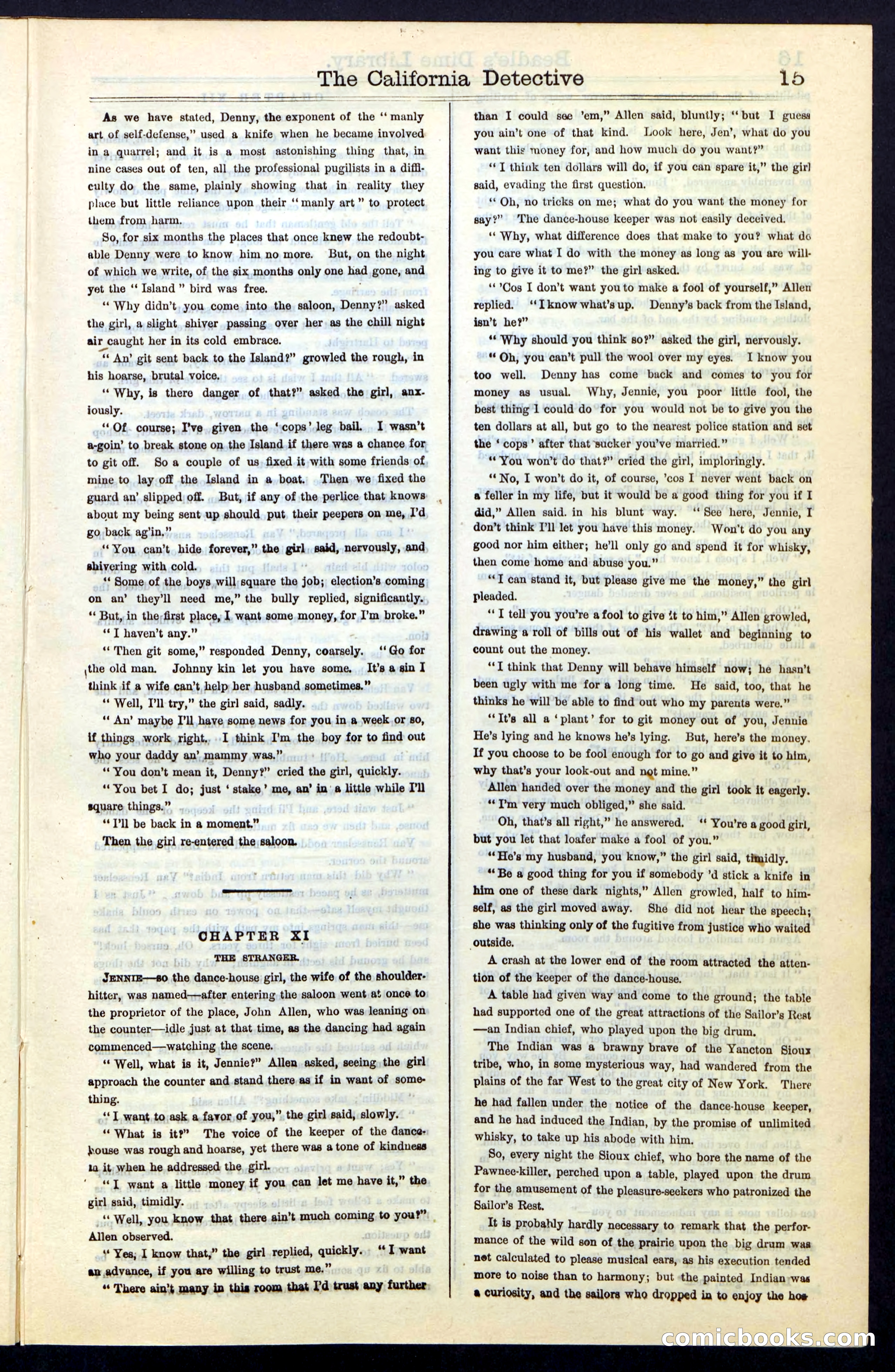
A restored page from Pulp Fiction, 1878. Page through the whole issue in the reader above.
📄 Transcribed text from this page (OCR, searchable)
Machine-transcribed from the original scan — historical spelling and the odd misread are preserved.
The Califo As we have stated, Denny, the exponent of the ‘* manly art of self-defense,” used a knife when he became involved in a quarrel; and it is a most astonishing thing that, in nine cases out of ten, all the professional pugilists in a difll- culty do the same, plainly showing that in reality they pluce but little reliance upon their ‘‘manly art” to protect them from harm, So, for six months the places that once knew the redoubt- able Denny were to know him no more. But, on the night of which we write, of the six months only one had gone, and yot the ‘‘ Island” bird was free. : ‘Why didn’t. you come into the saloon, Denny?” asked the girl, a slight shiver passing over her as the chill night air caught her in its cold embrace. “ Ap? git sent back to the Island?” growled the rough, in his hoarse, brutal voice, ‘Why, is there danger of that?” asked the girl, anx- iously. ‘‘ Of. course; I’ve given, the ‘cops’ Jeg bail. I wasn’t a-goin’ to break stone on the Island if there was a chance for to git off. Soa couple of us fixed it with some friends of mine to lay off the Island in a boat. Then we fixed the guard an’ slipped off. But, if any of the perlice that knows about my being sent up should put. their peepers on me, I'd go back ag’in,” ‘You can’t hide forever,” the girl, said, nervously, and shivering with cold. ** Some. of the boys will square the job; election’s coming on an’ they’ll need me,” the bully replied, significantly. ‘‘ But, in therfirst place, I want some money, for I’m broke.” ‘*] haven’t any.” “‘Then git some,” responded Denny, coarsely. ‘‘Go for ithe old man. Johnny kin let you have some, It’s a sin I think if a wife can’t help ber husband sometimes.” ‘* Well, [ll try,” the girl said, sadly. ‘* An’ maybe I’ll have some news for you in a week or 80, if things work right, I think I’m the boy for to find out who your daddy an’ mammy was.” ‘You don’t mean it, Denny?” cried the girl, quickly. ‘“You bet I do; just ‘ stake’ me, an’ ina little while Pll square things.” **Pll be back in a moment.” Then the girl re-entered the saloon. CHAPTER XI THE STRANGER. JENNIE—#0 the dance-house girl, the wife of the shoulder- hitter, was named-—after entering the saloon went at once to the proprietor of the place, John Allen, who was leaning on the counter—idle just at that time, as the dancing had again commenced—watching the scene. “Well, what is it, Jennie?” Allen asked, seeing the girl approach the counter and stand there as if in want of some- thing. ‘‘T want to ask, a favor of you,” the girl said, slowly. ‘What is it?’ The voice of the keeper of the dance- house was rough and hoarse, yet there was a tone of kindness ta it, when he addressed the. girl. “J want a little money if you can let me have it,” the girl said, timidly. Well, you know that there ain’t much coming to yout” | Allen observed. ‘ Yes; I know that,” the girl replied, quickly. an advance, if you are willing to trust me.” ‘“T want 15 than I could see ’em,” Allen said, bluntly; “but I guesa you ain’t one of that kind. Look here, Jen’, what do you want this money for, and how much do you want?” ‘*] thiak ten dollars will do, if you can spare it,” the gir) said, evading the first question. ‘‘ Oh, no tricks on me; what do you want the money for say?” The dance-house keeper was not easily deceived, ‘‘ Why, what difference does that make to you? what do you care what I do with the money as long as you are will- ing to give it to me?” the girl asked. ‘Cos I don’t want youto make a fool of yourself,” Allen replied. ‘I know what’sup. Denny’s back from the Island, isn’t he?” ‘* Why should you think so?” asked the girl, nervously. “Oh, you can’t pull the wool over my eyes. I know you too well. Denny has come back and comes to you for money as usual. Why, Jennie, you poor little fool, the best thing 1 could do for you would not be to give you the ten dollars at all, but go to the nearest police station and set the ‘ cops’ after that sucker you’ve married.” “You won’t do that?” cried the girl, imploringly. ‘* No, I won’t do it, of course, ’cos I never went back on a feller in my life, but it would be a good thing for you if I did,” Allen said. in his blunt way. ‘See here, Jennie, I don’t think I'll let you have this money. Won't do you any good nor him either; he’ll only go and spend it for whisky, then come home and abuse you.” “T can stand it, but please give me the money,” the girl pleaded. ‘‘T tell you you're a fool to give it to him,” Allen growled, drawing a roll of bills out of his wallet and beginning to count out the money. “I think that Denny will behave himself now; he hasn't been ugly with me fora long time. He said, too, that he thinks he will be able to find out who my parents were.” ‘It’s all a ‘plant’ for to git money out of you, Jennie He’s lying and he knows he’s lying. But, here’s the money, If you choose to be fool enough for to go and give it to him, why that’s your look-out and not mine.” Allen handed over the money and the girl took it eagerly. ‘*['m very much obliged,” she said. Oh, that’s all right,” he answered. ‘ You're a good girl, but you let that loafer make a fool of you,” “‘He’s my husband, you know,” the girl said, timidly. “Be a good thing for you if somebody ’d stick a knife in him one of these dark nights,” Allen growled, half to him- self, as the girl moved away. She did not hear the speech; she was thinking only of the fugitive from justice who waited outside, A crash at the lower end of the room attracted the atten- tion of the keeper of the dance-house. A table had given way and come to the ground; the table had supported one of the great attractions of the Sailor’s Rest —an Indian chief, who played upon the big drum, The Indian was a brawny brave of the Yancton Sioux tribe, who, in some mysterious way, had wandered from the plains of the far West to the great city of New York. There he had fallen under the notice of the dance-house keeper, and he had induced the Indian, by the promise of unlimited whisky, to take up his abode with him. So, every night the Sioux chief, who bore the name of the Pawnee-killer, perched upon a table, played upon the drum for the amusement of the pleasure-seekers who patronized the Sailor’s Rest. It is probahly hardly necessary to remark that the perfor- mance of the wild son of the prairie upon the big drum waa _ net calculated to please musical ears, as his execution tended “There ain’ many in this room that I'd trust any further, more to noise than to harmony; but the painted Indian was a curiosity, and the sailors who dropped in to enjoy the hoe OMILEDOOKS (lO)