
Pulp Fiction, 1878 · page 14 of 32
Beadle's Dime Library No. 42 — page 14: what you’re looking at
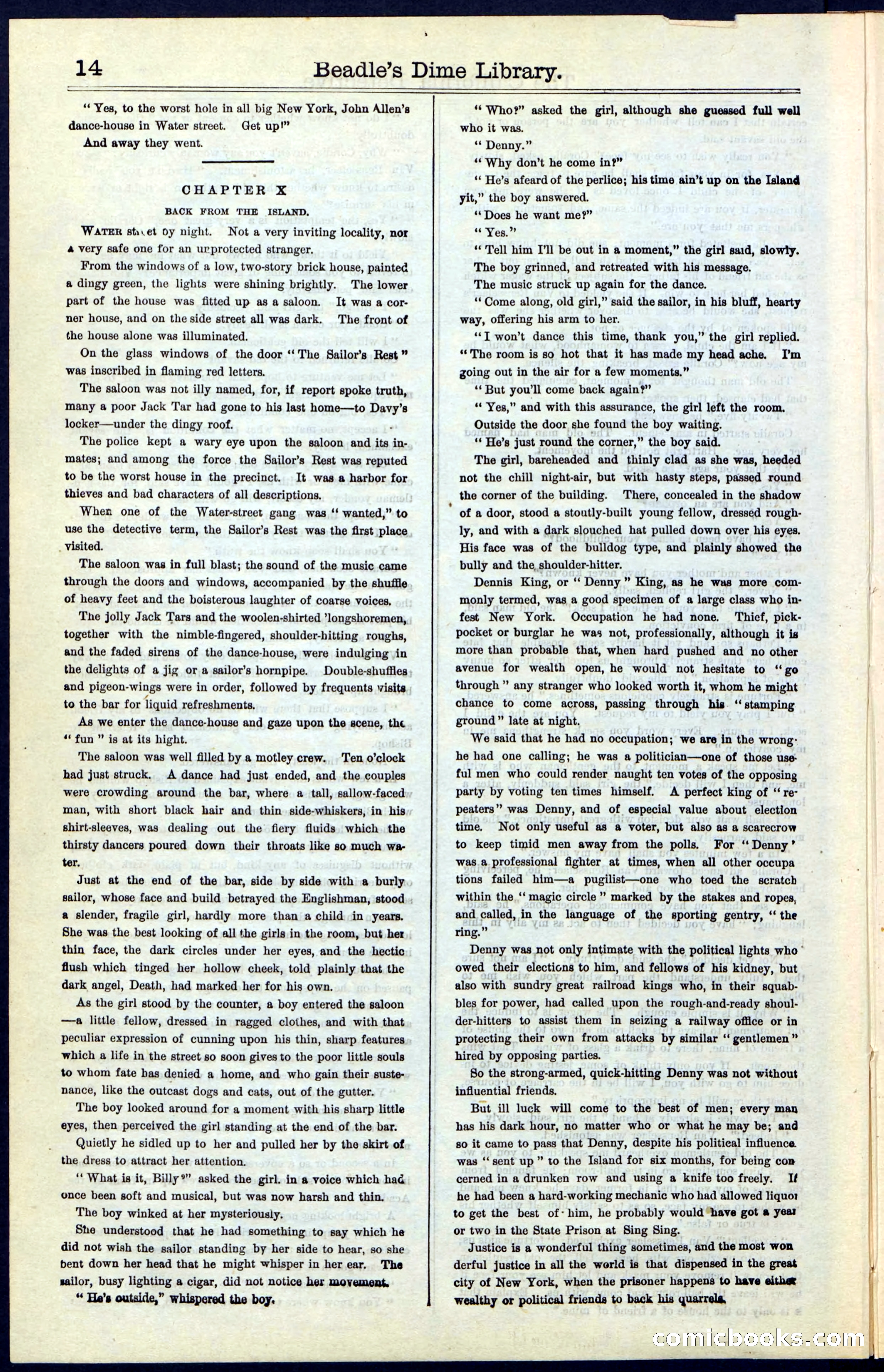
A restored page from Pulp Fiction, 1878. Page through the whole issue in the reader above.
📄 Transcribed text from this page (OCR, searchable)
Machine-transcribed from the original scan — historical spelling and the odd misread are preserved.
- “Yes, to the worst hole in all big New York, John Allen’s dance-house in Water street. Get up!” And away they went. CHAPTER X BACK FROM THE ISLAND, WATER stivet Oy night. Not a very inviting locality, nor 4 very safe one for an urprotected stranger. From the windows of a low, two-story brick house, painted a dingy green, the lights were shining brightly. The lower part of the house was fitted up asa saloon. It was a cor- ner house, and on the side street all was dark. The front of the house alone was illuminated. On the glass windows of the door “‘ The Sailor’s Rest ” was inscribed in flaming red letters. The saloon was not illy named, for, if report spoke truth, many a poor Jack Tar had gone to his last home—to Davy’s locker—under the dingy roof. ‘ The police kept a wary eye upon the saloon and its in- mates; and among the force the Sailor’s Rest was reputed to be the worst house in the precinct. It was a harbor for thieves and bad characters of all descriptions. When one of the Water-street gang was ‘‘ wanted,” to use the detective term, the Sailor’s Rest was the first place _ Visited. The saloon was in full blast; the sound of the music came through the doors and windows, accompanied by the shufile of heavy feet and the boisterous laughter of coarse voices, The jolly Jack Tars and the woolen-shirted ’longshoremen, together with the nimble-fingered, shoulder-bitting roughs, and the faded sirens of the dance-house, were indulging in the delights of a jig or a sailor’s hornpipe. Double-shuffles and pigeon-wings were in order, followed by frequents visits to the bar for liquid refreshments, As we enter the dance-house and gaze upon the scene, the “fun ” is at its hight. The saloon was well filled by a motley crew.. Ten o’clock had just struck. A dance had just ended, and the couples were crowding around the bar, where a tall, sallow-faced man, with short black hair and thin side-whiskers, in his shirt-sleeves, was dealing out the fiery fluids which the thirsty dancers poured down their throats like so much wa- ter. Just at the end of the bar, side by side with a burly sailor, whose face and build betrayed the Englishman, stood a slender, fragile girl, hardly more than a child in years. She was the best looking of all the girls in the room, but her thin face, the dark circles under her eyes, and the hectic flush which tinged her hollow cheek, told plainly that the dark angel, Death, had marked her for his own. As the girl stood by the counter, a boy entered the saloon —a little fellow, dressed in ragged clothes, and with that peculiar expression of cunning upon his thin, sharp features which a life in the street so soon gives to the poor little souls to whom fate bas denied a home, and who gain their suste- nance, like the outcast dogs and cats, out of the gutter. The boy looked around for a moment with his sharp little eyes, then perceived the girl standing at the end of the bar. Quietly he sidled up to her and pulled her by the skirt of the dress to attract her attention. ‘‘ What is it, Billy®” asked the girl. in a voice which had once been soft and musical, but was now harsh and thin. The boy winked at her mysteriously, She understood that he had something to say which he did not wish the sailor standing by her side to hear, so she bent down her head that he might whisper in her ear. The sailor, busy lighting a cigar, did not notice her movement. “* He’s outside,” whispered the boy. 14 Beadle’s Dime Library. ** Who?” asked the girl, although she guessed full well who it was. ‘** Denny.” ‘*' Why don’t he come in?” ‘‘ He’s afeard of the perlice; his time ain’t up on the Island yit,” the boy answered. ‘* Does he want me?” 4 Weaz ‘Tell him I’ll be out in a moment,” the girl said, slowly. The boy grinned, and retreated with his message. The music struck up again for the dance. ‘*Come along, old girl,” said the sailor, in his bluff, hearty way, offering his arm to her. ‘‘IT won’t dance this time, thank you,” the girl replied. ‘‘The room is so hot that it has made my head ache. I’m going out in the air for a few moments,” ‘* But you'll come back again?” ‘“‘ Yes,” and with this assurance, the girl left the room. Outside the door she found the boy waiting. ‘* He’s just round the corner,” the boy said. The girl, bareheaded and thinly clad as she was, heeded not the chill night-air, but with hasty steps, passed round the corner of the building. There, concealed in the shadow of a door, stood a stoutly-built young fellow, dressed rough- ly, and with a dark slouched hat pulled down over his eyes. His face was of the bulldog type, and plainly showed the bully and the, shoulder-hitter. Dennis King, or ‘‘ Denny” King, as he was more com- monly termed, was a good specimen of a large class who in- fest New York. Occupation he had none. Thief, pick- pocket or burglar he was not, professionally, although it is more than probable that, when hard pushed and no other avenue for wealth open, he would not hesitate to ‘go through” any stranger who looked worth it, whom he might chance to come across, passing through his “ stamping ground” late at night. We said that he had no occupation; we are in the wrong: he had one calling; he was a politician—one of those use- ful men who could render naught ten votes of the opposing party by voting ten times himself. A perfect king of “re- peaters” was Denny, and of especial value about election time. Not only useful as a voter, but also as a scarecrow to keep timid men away from the polls, For ‘Denny’ was a professional fighter at times, when all other occupa tions failed him—a pugilist—one who toed the scratch within the ‘‘ magic circle” marked by the stakes and ropes, and called, in the language of the sporting gentry, ‘‘ the ring.” Denny was not only intimate with the political lights who’ owed their elections to him, and fellows of his kidney, but also with sundry great railroad kings who, in their squab- bles for power, had called upon the rough-and-ready shoul- der-hitters to assist them in seizing a railway office or in protecting their own from attacks by similar ‘‘ gentlemen” hired by opposing parties. So the strong-armed, quick-hitting Denny was not without influential friends. But ill luck will come to the best of men; every man has his dark hour, no matter who or what he may be; and so it came to pass that Denny, despite his political influence was ‘‘sent up” to the Island for six months, for being con cerned in a drunken row and using a knife too freely. If he had been a hard-working mechanic who had allowed liquor to get the best of: him, he probably would have got a year or two in the State Prison at Sing Sing. Justice is a wonderful thing sometimes, and the most won derful justice in all the world is that dispensed in the great city of New York, when the prisoner happens to have either wealthy or political friends to back his quarrels, comicbooks /