
Pulp Fiction, 1878 · page 16 of 32
Beadle's Dime Library No. 42 — page 16: what you’re looking at
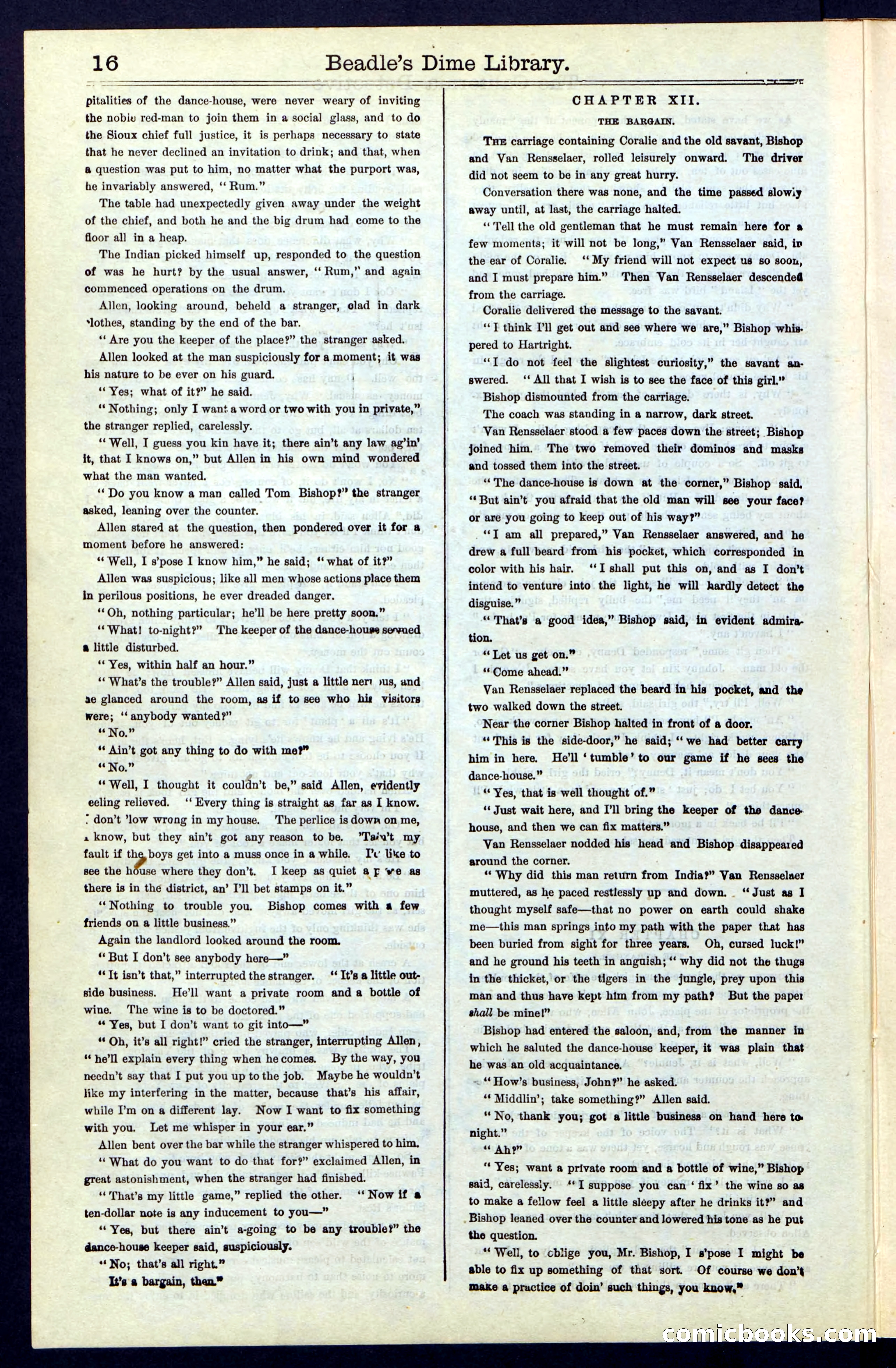
A restored page from Pulp Fiction, 1878. Page through the whole issue in the reader above.
📄 Transcribed text from this page (OCR, searchable)
Machine-transcribed from the original scan — historical spelling and the odd misread are preserved.
16 Be pitalities of the dance-house, were never weary of inviting the nobis red-man to join them in a social glass, and to do the Sioux chief full justice, it is perhaps necessary to state that he never declined an invitation to drink; and that, when & question was put to him, no matter what the purport was, he invariably answered, ‘‘ Rum.” The table had unexpectedly given away under the weight of the chief, and both he and the big drum had come to the floor all in a heap. The Indian picked himself up, responded to the question of was he hurt? by the usual answer, ‘‘ Rum,” and again commenced operations on the drum, Allen, looking around, beheld a stranger, olad in dark ‘lothes, standing by the end of the bar. ‘* Are you the keeper of the place?” the stranger asked. Allen looked at the man suspiciously for a moment; it was his nature to be ever on his guard. ‘Yes; what of it?” he said. ** Nothing; only I want a word or two with you in private,” the stranger replied, carelessly. ‘Well, I guess you kin have it; there ain’t any law ag’in’ it, that I knows on,” but Allen in his own mind wondered what the man wanted. ‘*Do you know a man called Tom Bishop?” the stranger asked, leaning over the counter. Allen stared at the question, then pondered over it for a moment before he answered: ‘* Well, I s’pose I know him,” he said; *‘ what of it?” Allen was suspicious; like all men whose actions place them in perilous positions, he ever dreaded danger. **Oh, nothing particular; he’ll be here pretty soon.” “What! to-night?” The keeper of the dance-house sevaed a little disturbed. ‘* Yes, within half an hour.” ‘* What’s the trouble?” Allen said, just a little ner: »us, and ae glanced around the room, as if to see who his visitors were; ‘“‘ anybody wanted?” é“ No. ”» ‘* Ain’t got any thing to do with me?” 4 No. ” ‘Well, I thought it couldn't be,” said Allen, evidently eeling relieved. ‘‘ Every thing is straight as far as I know. . don’t low wrong in my house. The perlice is down on me, a know, but they ain’t got any reason tobe. "Taiv’t my fault if the boys get into a muss once in awhile. Tv like to see the house where they don’t. I keep as quiet af we as there is in the district, an’ I'll bet stamps on it.” ‘‘Nothing to trouble you. Bishop comes with a few friends on a little business.” Again the landlord looked around the room. ‘*‘ But I don’t see anybody here—” ‘It isn’t that,” interrupted the stranger. ‘‘ It’s a little out- side business. He’ll want a private room and a bottle of wine. The wine is to be doctored.” *“* Yes, but I don’t want to git into—” ‘Oh, it’s all right!” cried the stranger, interrupting Allen, ‘“* he'll explain every thing when hecomes. By the way, you needn’t say that I put you up tothe job. Maybe he wouldn't like my interfering in the matter, because that’s his affair, while I’m on a different lay. Now I want to fix something with you. Let me whisper in your ear.” Allen bent over the bar while the stranger whispered to him, ‘‘ What do you want to do that for?” exclaimed Allen, in great astonishment, when the stranger had finished. “'That’s my little game,” replied the other. ‘‘ Now if a ten-dollar note is any inducement to you—” ‘“'Yes, but there ain’t a-going to be any trouble?” the dance-house keeper said, suspiciously. ** No; that’s all right.” It’s a bargain, then.” adle’s Dime Library. < CHAPTER XII. THE BARGAIN. Tne carriage containing Coralie and the old savant, Bishop and Van Rensselaer, rolled leisurely onward. The driver did not seem to be in any great hurry. Conversation there was none, and the time passed slowiy away until, at last, the carriage halted. ‘‘Tell the old gentleman that he must remain here for a few moments; it will not be long,” Van Rensselaer said, ip the ear of Coralie. ‘‘ My friend will not expect us s0 soon, and I must prepare him.” Then Van Rensselaer descended from the carriage. Coralie delivered the message to the savant. ‘“‘T think [ll get out and see where we are,” Bishop whis- pered to Hartright. ‘‘T do not feel the slightest curiosity,” the savant an- swered. ‘‘ All that I wish is to see the face of this girl.” Bishop dismounted from the carriage. The coach was standing in a narrow, dark street. Van Rensselaer stood a few paces down the street; Bishop joined him. The two removed their dominos and masks and tossed them into the street. “The dance-house is down at the corner,” Bishop said, ‘* But ain’t you afraid that the old man will see your face? or are you going to keep out of his way?” _**T am all prepared,” Van Rensselaer answered, and he drew a full beard from his pocket, which corresponded in color with his hair. ‘‘I shall put this on, and as I don’t intend to venture into the light, he will hardly detect the disguise.” “That’s a good idea,” Bishop said, in evident admira- tion. ‘Let us get on.” ‘* Come ahead.” Van Rensselaer replaced the beard in his pocket, and the two walked down the street. Near the corner Bishop halted in front of a door. “This is the side-door,” he said; ‘‘we had better carry him in here. He'll ‘tumble’ to our game if he sees the dance-house.” “Yes, that is well thought of.” ‘¢ Just wait here, and I'll bring the keeper of the dance house, and then we can fix matters.” Van Rensselaer nodded his head and Bishop disappeared around the corner. “‘'Why did this man return from India?” Van Rensselaer muttered, as he paced restlessly up and down... ‘“‘ Just as I thought myself safe—that no power on earth could shake me—this man springs into my path with the paper that has been buried from sight for three years. Oh, cursed luck!” and he ground his teeth in anguish; ‘‘ why did not the thugs in the thicket, or the tigers in the jungle, prey upon this man and thus have kept him from my path? But the paper shall be mine!” Bishop had entered the saloon, and, from the manner in which he saluted the dance-house keeper, it was plain that he was an old acquaintance. ~ “ How’s business, John?” he asked. “* Middlin’; take something?” Allen said. “No, thank you; got a little business on hand here to night.” we Ah?” “Yes; want a private room and a bottle of wine,” Bishop said, carelessly. ‘*I suppose you can ‘ fix’ the wine so as to make a fellow feel a little sleepy after he drinks it?’ and . Bishop leaned over the counter and lowered his tone as he put the question. ** Well, to cblige you, Mr. Bishop, I s’pose I might be able to fix up something of that sort. Of course we don’t make a practice of doin’ such things, you know,” SFOMIEDOOK —(E(0)) 4g