
Pulp Fiction, 1886 · page 4 of 32
Beadle's New York Dime Library No. 383 — page 4: what you’re looking at
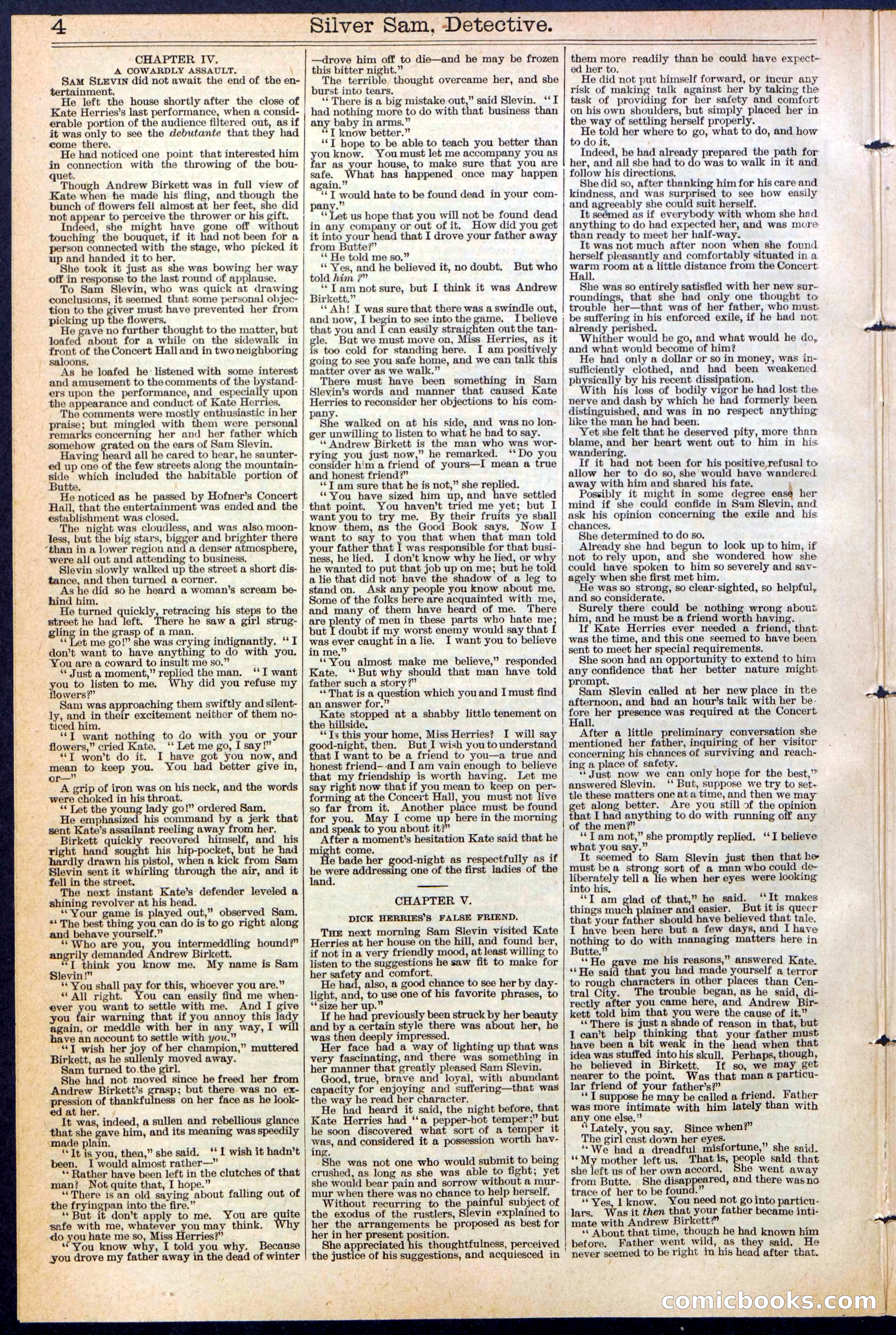
A restored page from Pulp Fiction, 1886. Page through the whole issue in the reader above.
📄 Transcribed text from this page (OCR, searchable)
Machine-transcribed from the original scan — historical spelling and the odd misread are preserved.
“ly CHAPTER IV. A COWARDLY ASSAULT. \ Sam SLEVIN did not await the end of the en- tertainment. He left the house shortly after the close of Kate Herries’s last performance, when a consid- erable portion of the audience filtered out, as if it was only to see the debutante that they had come there. He had noticed one ert that interested him in connection with t 1e throwing of the bou- uet,. : Though Andrew Birkett was in full view of Kate when he made his fling, and though the bunch of flowers fell almost at her feet, she did not appear to perceive the thrower or his gift. Indeed, she might have gone off without touching the bouquet, if it had not been for a person connected with the stage, who picked it up and handed it to her, She took it just as she was bowing her way off in response to the last round of applause. To Sam Slevin, who was quick at drawing conclusions, it seemed that some personal objec- tion to the giver must have prevented her from picking up the flowers. He gave no further thought to the matter, but loafed about for a while on the sidewalk in front of the Concert Hall and in two neighboring saloons. As he loafed he: listened with some interest and amusement to the comments of the bystand- ers upon the performance, and especially upon the appearance and conduct of Kate Herries. The comments were mostly enthusiastic in her praise; but mingled with them were personal remarks concerning her and her father which somehow grated on the ears of Sam Slevin. Having heard all he cared to hear, he saunter- ed up one of the few streets along the mountain- | side which included the habitable portion of Butte. He noticed as he passed by Hofner’s Concert Hall, that the entertainment was ended and the estublishment was closed. The night was cloudless, and was also moon- less, but the big stars, bigger and brighter there “than in a lower region and a denser atmosphere, were all out and attending to business. Slevin slowly walked up the street a short dis- tance, and then turned a corner. As he did so he heard a woman’s scream be- Se ee end Guicity. rotiactiig Be’ ato th e turn uickly, retracing his to the street he had Heft. There he saw a ee strug- gling in the grasp of a man. _ “Let me go!” she was crying indignantly. “I don’t want to have anything to do with you. You are a coward to insult me so.” ** Just a moment,” ri theman. “I want you to listen to me. Why did you refuse my flowers?” Sam was approaching them swiftly and silent- ly, and in their excitement neither of them no- ticed him. ‘*T want nothing to do with you or your flowers,” cried Kate. ‘‘ Let me go, I say!” *‘T won't do it. I have got you now, and p mean to keep you. You had better give in, or— A grip of iron was on his neck, and the words were choked in his throat. Let the yo lady go!” ordered Sam, He emphasi his command by a jerk that sent Kate’s assailant reeling away from her. I Birkett quickly recovered himself, and his | right hand sought his hip-pocket, but he had hardly drawn his pistol, when a kick from Sam _- Slevin sent it whirling through the air, and it _ fell in the street. P The next instant Kate’s defender leveled a shining revolver at his head. L ‘““Your game is played out,” observed Sam. . “The best thing you can do is to go right along . and behave yourself.” * ‘* Who are you, you intermeddling hound?” wt, angrily demanded Andrew Birkett. I think you know me. My name is Sam Slevin!” si ** You shall pay for this, whoever y * All right. You can easily fin hs ever you want to see Bela me. Poe a eos u fair warning if you annoy this la As aopin, or meddle with her in any way, I will have an account to settle with you.” if “J wish her joy of her champion,” muttered Birkett, as he sullenly moved away. _ $Sam turned to.the girl. he She had not moved since he freed her from Andrew Birkett’s p; but there was no ex- _ pression of t ess on her face as he look- edather. | : _ It was, indeed, a sullen and rebellious glance _ that she gave him, and its meaning was speedily “made plain. ss Iti you, then,” she said. ** I wish it hadn’t . n. would almost rather—” ** Rather have been left in the clutches of that a —— eee F Ga are.” me when- And I give man? Not quite that, I hope.” “There is an old saying about falling out of the fryingpan into the fire.” _ “But it don’t apply to me. You are quite safe with me, whatever you may think. y do you hate me so, Miss Herries?” a ‘You know why, I told you why. Because you drove my father away in the dead of winter uu es $e Silver Sam, Detective. —drove him off to die—and he may be frozen this bitter night.” The terrible thought overcame her, and she burst into tears. ‘‘ There is a big mistake out,” said Slevin. “I had nothing more to do with that business than any baby in arms.” “*T know better.” ‘‘T hope to be able to teach you better than you know. You must let me accompany you as far as your house, to make sure that you are safe. What has happened once may happen again.” ~. would hate to be found dead in your com- ’ ny. ‘Let us hope that you will not be found dead in any company or out of it. How did you get it into your head that I drove your father away from Butte?’ ‘** He told me so.” ‘** Yes, and he believed it, no doubt. But who told him ?” ‘*T am not sure, but [ think it was Andrew Birkett.” ‘* Ah! I was sure that there was a swindle out, and now, I begin to see into the game. Ibelieve that you and I can easily straighten out the tan- xle. But we must move on, Miss Herries, as it is too cold for standing here. I am positivel going to see you safe home, and we can talk this matter over as we walk.” There must have been something in Sam Slevin’s words and manner that caused Kate Herries to reconsider her objections to his com- any. . She walked on at his side, and was no lon- ger unwilling to listen to what he had to say. ** Andrew ‘Birkett is the man who was wor- rying you just now,” he remarked. ‘‘Do you consider him a friend of yours—I mean a true and honest friend?” ‘“T am sure that he is not,” she replied. ‘‘You have sized him up, and have settled that point. You haven’t tried me yet; but I want you to try me. By their fruits ye shall know them, as the Good Book says. Now I want to say to you that when that man told your father that I was responsible for that busi- ness, he lied. I don’t know why he lied, or why he wanted to put that job up on me; but he told a lie that did not have the shadow of a leg to stand on. Ask any people you know about me. Some of the folks here are acquainted with me, and many of them have heard of me. There are plenty of men in these parts who hate me; but I doubt if my worst enemy would say that i was ever caught ina lie. I want you to believe in me.” ‘“You almost make me believe,” responded Kate. ‘But why should that man have told father such a story?” ‘That is a question which you and I must find an answer for.” Kate stopped at a shabby little tenement on the hillside. ‘Ts this your home, Miss Herries? I will say good-night, then. But I wish you to understand that I want to be a friend to you—a true and honest friend—-and I am vain enough to believe that my friendship is worth having. Let me say right now that if you mean to keep on — forming at the Concert Hall, you must not live so far from it. Another place must be found for you. May I come up here in the morning and to you about it?” After a moment’s hesitation Kate said that he oat come, t e bade her good-night as respectfully as if he we addressing one of the first ladies of the land. CHAPTER V. DICK HERRIES’S FALSE FRIEND. THE next morning Sam Slevin visited Kate Herries at her house on the hill, and found her, if not in a very friendly mood, at least willing to listen to the suggestions he saw fit to make for her pelery. and comfort. He had, also, a good chance to see her by day- light, and, to use one of his favorite phrases, to ‘size her up.” If he had previously been struck by her beauty and by a certain style there was about her, he was then nage impressed. Her face had a way of lighting up that was very fascinating, and there was something in her manner that greatly pleased Sam Slevin. Good, true, brave and loyal, with abundant capacity for enjoying and suffering—that was the way he read her character. He had heard it said, the night before, that Kate Herries had ‘ta pepper-hot temper ;” but he soon discovered what sort of a temper it was, and considered it a possession worth hav- ing. : ‘ ‘She was not one who would submit to being crushed, as long as she was able to fight; yet she would bear pain and sorrow without a mur- mur when there was no chance to help herself. Without recurring to the painful subject of the exodus of the rustlers, Slevin explained to her the arrangements he proposed as best for her in her present position. the justice of his suggestions, and acquiesced in a7 % See ee | SS “ ° <n nat tt I EM She appreciated his thoughtfulness, perceived | _-_-—— them more readily than he could have expect- ed her to. He did not put himself forward, or incur any risk of making talk against her by taking the task of providing for her safety and comfort on his own shoulders, but simply placed her in the way of settling herself properly. He told her where to go, what to do, and how to do it, Indeed, he had already prepared the path for her, and all she had to do was to walk in it and follow his directions. She did so, after thanking him for his care and kindness, and was surprised to see how easily and agreeably she could suit herself. It seémed as if everybody with whom she had anything to do had expected her, and was more than ready to meet her half-way. It was not much after noon when she found herself pleasantly and comfortably situated in a a Ti room at a little distance from the Concert She was so entirely satisfied with her new sur- ron that she had only one thought to trouble her—that was of her father, who must. be suffering in his enforced exile, if he had not already perished. Whither would he go, and what would he do, and what would become of him? He had only a dollar or so in money, was in- sufficiently clothed, and had been weakened physically by his recent dissipation. With his loss of bodily vigor he had lost the nerve and dash by which he had formerly been distinguished, and was in no respect anything like the man he had been. Yet she felt that he deserved pity, more tham blame, and her heart went out to him in his wandering. If it had not been for his positive refusal to allow her to do so, she would have wandered away with him and shared his fate. Possibly it might in some degree easé her mind if she could confide in Sam Slevin, and ask his opinion concerning the exile and his chances. She determined to do so, Already she had begun to look up to him, if not torely upon, and she wondered how she could have spoken to him so severely and say- agely when she first met him. He was so strong, so clear-sighted, so helpful, and so considerate. Surely there could be nothing wrong about him, and he must be a friend worth having. | lf Kate Herries ever needed a friend, that was the time, and this one seemed to have been sent to meet her special requirements. She soon had an opportunity to extend to him any confidence that her better nature might prompt. Sam Slevin called at her new place in the afternoon, and had an hour’s talk with her be. fore her presence was required at the Concert all. After a little preliminary conversation she mentioned her father, inquiring of her visitor concerning his chances of surviving and reach- ing a place of safety. *¢ Just now we can only hope for the best,” answered Slevin. ‘‘ But, suppose we try to set- tle these matters one at a time, and then we may get along better. Are you still of the opinion at I had anything to do with running off any of the men?” ‘*T am not,” she promptly replied. ‘‘I believe what you say.” It seemed to Sam Slevin just then that he must bea strong sort of a man who could de- liberately tell a lie when her eyes were looking into his. “T am glad of that,” be said. “It makes things much plainer and easier. But it is queer that your father should have believed that tale. I have been here but a few days, and I have nothing to do with managing matters here in Butte.’ ‘‘He gave me his reasons,” answered Kate, ‘‘He said that you had made yourself a terror to rough characters in other places than Cen- tral City. The trouble began, as he said, di- rectly after you came here, and Andrew ’Bir- kett told him that you were the cause of it.” ‘‘There is just a shade of reason in that, but I can’t help thinking that your father must have been a bit weak in the head when that idea was stuffed into his skull, Perhaps, though, he believed in Birkett. If so, we may get nearer to the point. Was that man a particu- lar friend of your father’s?” ‘* T suppose he may be called a friend. Father was more intimate with him lately than with any one else,” “Lately, you say. Since when?” The girl cast down her eyes. é ‘“We had a dreadful misfortune,” she said. ‘‘My mother left us. That is, “Sg said that she left us of her own accord, She went away from Butte. She disappeared, and there was no trace of her to be found.” “Yes, | know. You need not go into particu- lars. Was it then that your father became inti- mate with Andrew Birkett?” ‘* About that time, though he had known him before. Father went wild, as they said. He never seemed to be right im his head after that. (ECO AM Ebool