
Pulp Fiction, 1886 · page 5 of 32
Beadle's New York Dime Library No. 383 — page 5: what you’re looking at
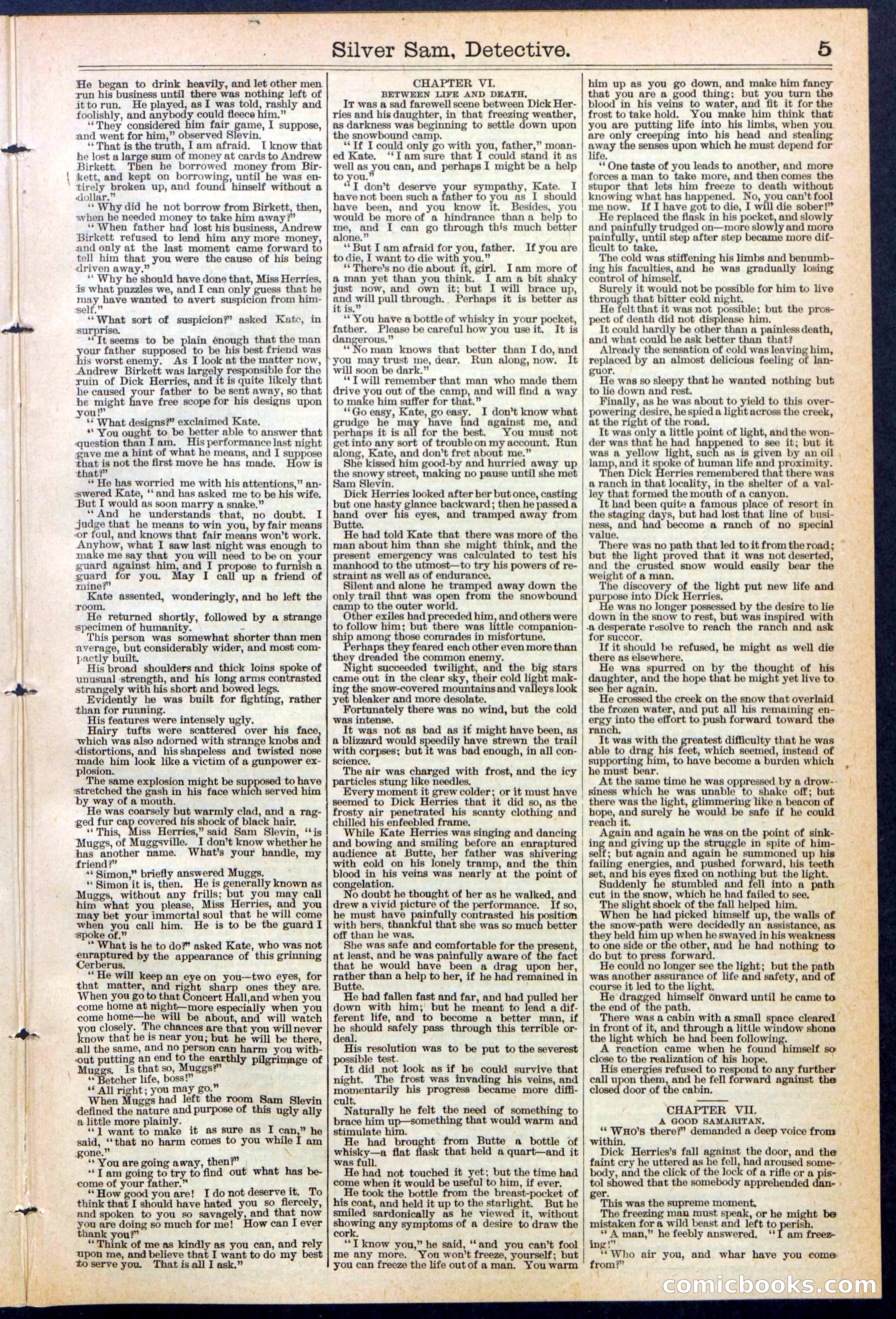
A restored page from Pulp Fiction, 1886. Page through the whole issue in the reader above.
📄 Transcribed text from this page (OCR, searchable)
Machine-transcribed from the original scan — historical spelling and the odd misread are preserved.
7? Silver Sam, Detective. 5 He began to drink heavily, and let other men run his business until there was nothing left of ittorun. He played, as I was told, rashly and foolishly, and anybody could fleece him.” ‘‘They considered him fair game, I suppose, and went for him,” observed Slevin. ‘‘ That is the truth, lam afraid. I know that he lost a large sum of money at cards to Andrew Birkett. Then he borrowed money from Bir- kett, and kept on borrowing, until he was en- ' tirely broken up, and found hinself without a dollar.” ‘‘ Why did he not borrow from Birkett, then, when he needed money to take him away?” ‘* When father had lost his business, Andrew Birkett refused to lend him any more money, and only at the last moment came forward to tell him that you were the cause of his being driven away.” ‘‘ Why he should have dons that, Miss Herries, is what puzzles we, and I can only guess that he ann have wanted to avert suspicion from him- se ih ‘*What sort of suspicion?” asked Kate, in surprise. ‘*It seems to be Noe énough that the man our father supposed to be his best friend was his worst enemy. As I look at the matter now, Andrew Birkett was largely responsible for the ruin of Dick Herries, and it is quite likely that he caused your father to be sent away, so that he might have free scope for his designs upon ou!” oar What designs?” exclaimed Kate, ‘“ You ought to be better able to answer that question than Iam. His performance last night gave me a hint of what he means, and I suppose that is not the first move he has made. ow is that?” ‘* He has worried me with his attentions,” an- swered Kate, ‘‘and has asked me to be his wife, But I would as soon marry a snake.” ‘*And he understands that, no doubt. I judge that he means to win you, by fair means or foul, and knows that fair means won’t work. Anyhow, what I saw last night was enough to make me say that you will need to be on your guard against him, and I propose to furnish a guard for you. May I call up a friend of mine?” Kate assented, wonderingly, and he left the room. He returned shortly, followed by a strange specimen of humanity. - This person was somewhat shorter than men average, but considerably wider, and most com- pactly built. His broad shoulders and thick loins spoke of unusual strength, and his long arms contrasted strangely with his short and bowed legs. Evidently he was built for fighting, rather than for running. His features were intensely ugly. Hairy tufts were scattered over his face, which was also adorned with strange knobs and distortions, and hisshapeless and twisted nose made him look like a victim of a gunpower ex- plosion. The same explosion might be su to have ‘stretched the gash in his face which served him by way of a mouth. He was coarsely but warmly clad, and a rag- ged fur cap covered his shock of black hair. ‘*This, Miss Herries,” said Sam Slevin, ‘‘is Muggs, of Muggsville. I don’t know whether he has another name. What’s your handle, my friend?” ‘‘ Simon,” briefly answered Muggs. ‘‘Simon it is, then, He is generally known as Muggs, without any frills; but you may call him what you please, Miss Herries, and you may bet your immortal soul that he will come when you call him. He is to be the guard I spoke of.” ** What is he to do?” asked Kate, who was not enraptured by the appearance of this grinning Cerberus. ‘He will keep an eye on you—two eyes, for that matter, and right sharp ones they are. When you go to that Concert Hall,and when you come home at night—more especially when you come home—he will be about, and will watch ou closely, The chances are that you will never lait that he is near you; but he will be there, all the same, and eI Perea a harm you with- out putting an en e eart igri 6 of Mu i s, Isthatso, Muggs?” viper e ‘* Betcher life, boss!” A * All right; you may go. When Muggs had left the room Sam Slevin defined the nature and purpose of this ugly ally a little more plainly. ‘‘] want to make it as sure as I can,” he said, ‘that no harm comes to you while I am are etien VE ‘* You are going away, then “Tam going to try to find out what has be- come of your father.” ‘‘ How good you are! I do not deserve it, To think that I should have hated you so fiercely, and spoken to you so savagely, and that now you are doing so much for me! How can I ever thank you?” “Think of me as kindly as you can, and rely upon me, and believe that I want to do my best to serve you. That is all I ask.” CHAPTER VI. BETWEEN LIFE AND DEATH, Ir was a sad farewell scene between Dick Her- ries and his daughter, in that freezing weather, as darkness was beginning to settle down upon the snowbound camp. ‘**Tf I could only go with you, father,” moan- ed Kate. ‘‘Ilam sure that I could stand it as well as you can, and perhaps I might be a help to you.” ““T don’t deserve your sympathy, Kate. I have not been such a father to you as I should have been, and you know it. Besides, you would be more of a hindrance than a help to me, and I can go through this much better alone.” ‘** But [ am afraid for you, father. to die, I want to die with you.” ** There’s no die about it, girl. Iam more of a man yet than you think. I am a bit shaky just now, and own it; but I will brace up, oe will pull through. Perhaps it is better as it is. ‘**'You have a bottle of whisky in your pocket, father. Please be careful how you useit, It is dangerous.” ‘*No man knows that better than I do, and you may trust me, dear, Run along, now. It will soon be dark.” **T will remember that man who made them drive you out of the camp, and will find a way to make him suffer for that.” ‘**Go easy, Kate, go easy. I don’t know what grudge he may have had against me, and perhaps it is all for the best. You must not get into any sort of troubleon my account. Run along, Kate, and don’t fret about me.” She kissed him good-by and hurried away up the snowy street, making no pause until she met Sam Slevin. Dick Herries looked after her but once, casting but one hasty glance backward; then he passed a hand over his eyes, and tramped away from utte. He had told Kate that there was more of the man about him than she might think, and the present emergency was calculated to test his manhood to the utmost—to try his powers of re- straint as well as of endurance, Silent and alone he tramped away down the only trail that was open from the snowbound camp to the outer world. Other exiles had preceded him, and others were to follow him; but there was little companion- — among those comrades in misfortune. erhaps they feared each other even more than a! dreaded the common enemy. ight succeeded twilight, and the big stars came out in the clear sky, their cold light mak- ing the snow-covered mountains and valleys look yet bleaker and more desolate. Fortunately there was no wind, but the cold was intense. : It was not as bad as it might have been, as a blizzard would s ily have strewn the trail with corpses; but it was bad enough, in all con- science, The air was charged with frost, and the icy particles stung like needles. Every moment it grew colder; or it must have seemed to Dick Herries that it did so, as the frosty air penetrated his scanty clothing and chilled his enfeebled frame. While Kate Herries was singing and dancin and bowing and smiling before an enraptur audience at Butte, her father was shivering with cold on his lonely tramp, and the thin blood in his veins was nearly at the point of congelation. o doubt he thought of her as he walked, and If you are drew a vivid picture of the performance. if SO, he must have painfully contrasted his position with hers, thankful that she was so much better off than he was, She was safe and comfortable for the present, at least, and he was painfully aware of the fact that he would have been a drag upon her, Sai than a help to her, if he had remained in utte. He had fallen fast and far, and had pulled her down with him; but he meant to lead a dif- ferent life, and to become a better man, if pea safely pass through this terrible or- His resolution was to be put to the severest ible test. It did not look as if he could survive that night. The frost was invading his veins, and momentarily his progress became more diffi- cult, Naturally he felt the need of something to brace him up—something that would warm and stimulate him. : He had brought from Butte a bottle of whisky—a flat flask that held a quart—and it was full. He had not touched it yet; but the time had come when it would be useful to him, if ever. He took the bottle from the breast-pocket of his coat, and held it up to the starlight. But he smiled sardonically as he viewed it, without Sone any symptoms of a desire to draw the cor “T know you,” he said, ‘““and you can’t fool me any more, You won’t freeze, yourself; but you can freeze the life outof a man. You warm 4 . 4 \ | i | NO LL EE EE ee ee err a desperate resolve to reach the ranc him up as you go down, and make him fancy that you are a good thing; but you turn the blood in his veins to water, and fit it for the frost to take hold. You make him think that you are putting life into his limbs, when = are only creeping into his head and stealing orAe the senses upon which he must depend for ife. ‘** One taste of you leads to another, and more forces a man to take more, and then comes the stupor that lets him freeze to death without knowing what has happened. No, you can’t fool me now. If I have got to die, I will die sober!” He replaced the flask in his pocket, and slowly and painfully trudged on—more slowly and more yainfully, until step after step became more dif- cult to take, The cold was stiffening his limbs and benumb- ing his faculties,and he was gradually losing control of himself, Surely it would not be possible for him to live through that bitter cold night. He felt that it was not possible; but the pros- pect of death did not displease him. It could poy be other than a painless death, and what could he ask better than that? Already the sensation of cold was leaving him, replaced by an almost delicious feeling of lan- guor., He was so sleepy that he wanted nothing but to lie down and rest. Finally, as he was about to yield to this over- powering desire, he spied a light across the creek, at the right of the road. It was only a little point of light, and the won- der was that he had happened to see it; but it was a yellow light, such as is given by an oil lamp, and it spoke of human life and proximity. Then Dick Herries remembered that there was a ranch in that locality, in the shelter of a val- ny that formed the mouth of a canyon. t had been quite a famous place of resort in the staging days, but had lost that line of busi- nee and “had become a ranch of no special value. There was no path that led toit from theroad; — but the light proved that it was not d > and the crusted snow would easily bear the weight of a man. The discovery of the light put new life and purpose into Dick Herries. e was no longer possessed by the desire to lie down in the snow to rest, but was inspired with and ask for succor, If it should be refused, he might as well die there as elsewhere. He was spurred on by the thought of his daughter, and the hope that he might yet live to see her again. He crossed the creek on the snow that overlaid the frozen water, and put all his remaining en- ergy into the effort to push forward tow the ranch. It was with the greatest difficulty that he was able to cog his feet, which seemed, instead of supporting him, to have become a burden which he must bear. At the same time he was oppressed by a drow-- siness which he was unable to shake off; but there was the light, glimmering like a beacon of hope, and surely he would be safe if he could reach it. Again and again he was on the point of sink- ing and giving up the struggle in spite of him- self; but again and again he summoned i he failing energies, and pushed forward, his teeth set, and his eves fixed on nothing but the light. Suddenly he stumbled and fell into a path cut in the snow, which he had failed to see, The mp shock of the fall helped him. When he had picked himself up, the walls of the snow-path were decidedly an assistance, as they held him up when he swayed in his weakness to one side or the other, and he had nothing to do but to press forward. He could no longer see the light; but the path was another assurance of life and safety, and of course it led to the light. He dragged himself Onward until he came to the end of the path. There was a cabin with a small in front of it, and through a little window shone the light which he had been pte A reaction came when he found himself so close to the realization of his hone His energies refused to respond to any further call upon them, and he fell forward against the cl door of the cabin. CHAPTER VII. A GOOD SAMARITAN. ‘* WHo’s there?’ demanded a deep voice from within, Dick Herries’s fall against the door, and the faint cry he uttered as he fell, had aroused some- - body, and the click of the lock of a rifle or a pis- tol showed that the somebody apprehended er. . This was the supreme moment, The freezing man must speak, or he might be mistaken for a wild beast and left to rish, am freez- **A man,” he feebly answered, ‘ ‘*Who air you, and whar have you come space cleared ing!” from? EGomilcbooks.¢ - f “iZ 4 » = “ (0) ‘ H 4 Ws