
Pulp Fiction, 1886 · page 3 of 32
Beadle's New York Dime Library No. 383 — page 3: what you’re looking at
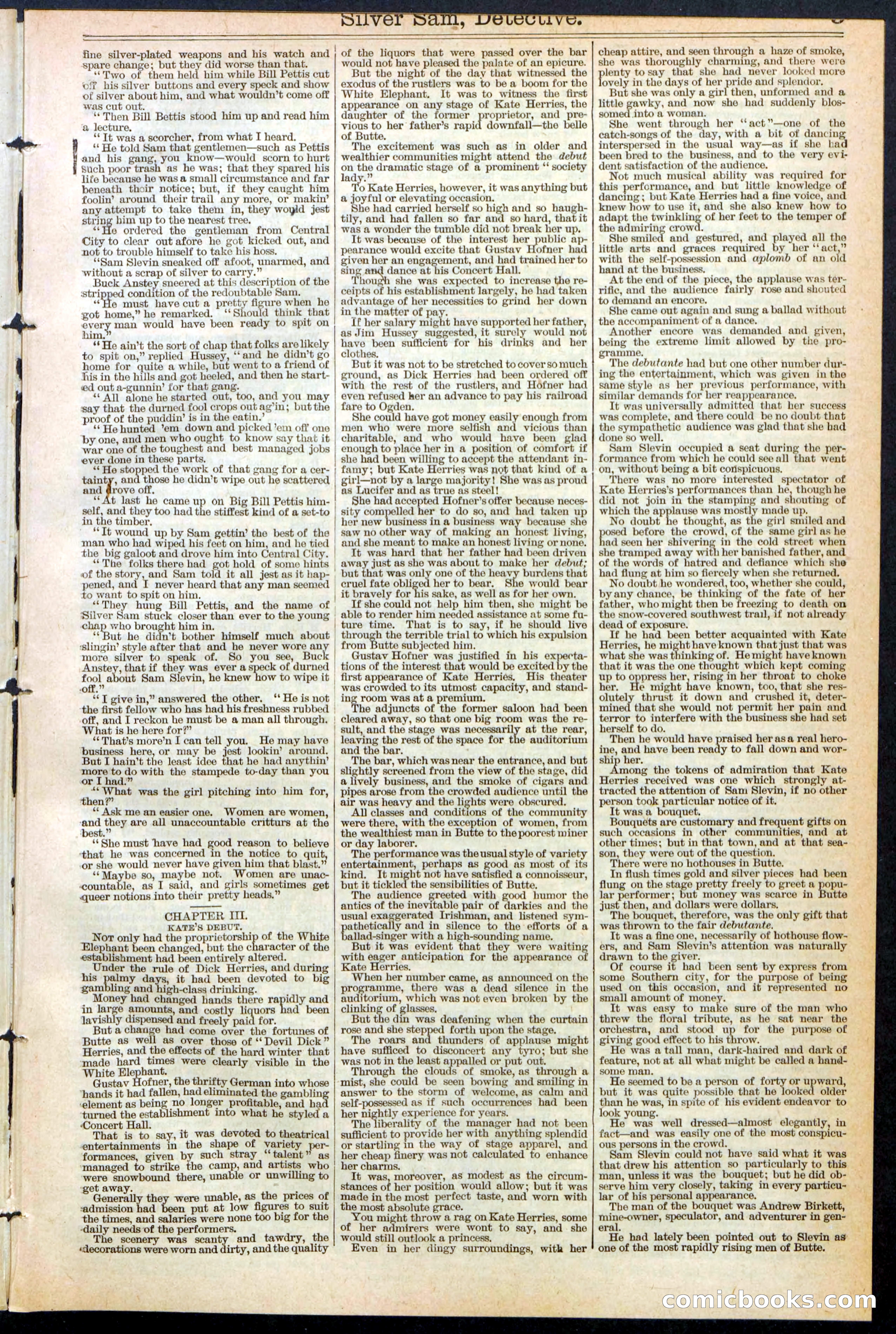
A restored page from Pulp Fiction, 1886. Page through the whole issue in the reader above.
📄 Transcribed text from this page (OCR, searchable)
Machine-transcribed from the original scan — historical spelling and the odd misread are preserved.
| 7 fine silver-plated weapons and his watch and spare change; but they did worse than that. “Two of them held him while Bill Pettis cut of his silver buttons and every speck and show of silver about him, and what wouldn’t come off was cut out. ‘*Then Bill Bettis stood him up and read him a lecture, ‘“ Tt was a secorcher, from what I heard. ‘‘ He told Sam that gentlemen—such as Pettis and his gang, you know—would scorn to hurt Such poor trash as he was; that they spared his life because he was a small circumstance and far beneath thoir notice; but, if they caught him foolin’ around their trail any more, or makin’ any attempt to take them in, they woyld jest string bim up to the nearest tree. **He ordered the gentleman from Central City to clear out afore he got kicked out, and not to trouble himself to take his hoss. ‘Sam Slevin sneaked off afoot, unarmed, and without a scrap of silver to carry.” Buck Anstey sneered at this description of the stripped condition of the redoubtable Sam. “He must have cut a pretty figure when ho got home,” he remarked. ‘‘ Should think that every man would have been ready to spit on him.” ‘‘ He ain’t the sort of chap that folks are likely to spit on,” replied Hussey, ‘‘and he didn’t go home for quite a while, but went to a friend of his in the hills and got heeled, and then he start- ed out a-gunnin’ for that gang. ‘‘ All alone he started out, too, and you may say that the durned fool crops out ag’in; but the proof of the puddin’ is in the eatin.’ ‘‘ He hunted ’em down and picked ’em off one by one, and men who ought to know say that it war one of the toughest and best managed jobs ever done in these parts. *¢ He stopped the work of that gang for a cer- tainty, and those he didn’t wipe out he scattered and Hove off, ‘**At last he came up on Big Bill Pettis him- | of the liquors that were passed over the bar would not have pleased the palate of an epicure. But the night of the day that witnessed the exodus of the rustlers was to be a boom for the White Elephant. It was to witness the first appearance on any stage of Kate Herries, the daughter of the former proprietor, and pre- vious to her father’s tanta downfall—the belle of Butte. The excitement was such as in older and wealthier communities might attend the debut on the dramatic stage of a prominent “ society lady.” To Kate Herries, however, it was anything but a joyful or elevating occasion. She had carried herself so high and so haugh- tily, and had fallen so far and so hard, that it was a wonder the tumble did not break her up. It was because of the interest her public ap- pearance would excite that Gustav Hofner had given her an engagement, and had trained her to sing and dance at his Concert Hall. Thoush she was expected to increase the re- ceipts of his establishment largely, he had taken advantage of her necessities to grind her down in the matter of pay. If her salary might have supported her father, as Jim Hussey suggested, it surely would not have been sufficient for his drinks and her clothes. But it was not to be stretched to cover so much ground, as Dick Herries had been ordered off with the rest of the rustlers, and Hofner had even refused her an advance to pay his railroad fare to Ogden. She could have got money easily enough from men who were more selfish and vicious than charitable, and who would have been glad enough to place her in a position of comfort if she had been willing to accept the attendant in- famy; but Kate Herries was not that kind of a girl—not by a large majority! She was as proud as Lucifer and as true as steel! She had accepted Hofner’s offer because neces- self, and they too had the stiffest kind of a set-to | sity compelled her to do so, and had taken up in the timber, ‘It wound up by Sam gettin’ the best of the man who had wiped his feet on him, and he tied the big galoot and drove him into Central City. ‘The folks there had got hold of some hints of the story, and Sam told it all jest as it hap- | pened, and I never heard that any man seemed to want to spit on him. ‘““They hung Bill Pettis, and the name of Silver Sam stuck closer than ever to the young | chap who brought him in, ‘*But he didn’t bother himself much about ‘slingin’ style after that and he never wore any more silver to speak of. Anstey, that if they was ever a speck of durned So you see, Buck | her new business in a business way because she saw no other way of making an honest living, and she meant to make an honest living or none. It was hard that her father had been driven away just as she was about to make her debut; but that was only one of the heavy burdens that cruel fate obliged her to bear. She would bear it bravely for his sake, as well as for her own. If she could not help him then, she might be able to render him needed assistance at some fu- ture time. That is to say, if he should live through the terrible trial to which his expulsion from Butte subjected him. Gustav Hofner was justified in his expecta- tions of the interest that would be excited by the fool about Sam Slevin, he knew how to wipe it | . was crowded to its utmost capacity, and stand- off.” ‘“‘T give in,” answered the other, ‘ He is not the first fellow who has had his freshness rubbed off, and I reckon he must be a man all through. | What is he here for?” ‘‘That’s more’n I can tell you. He may have business here, or may be jest lookin’ around. But I hain’t the least idee that he had anythin’ more to do with the stampede to-day than you or I had.” “* What was the girl pitching into him for, then?” ‘*‘ Ask me an easier one. Women are women, ‘and they are all unaccountable critturs at the ‘‘She must have had good reason to believe that he was concerned in the notice to quit or she would never have given him that blast.” ‘‘Maybe so, maybe not. Women are unac- countable, as I said, and girls sometimes get queer notions into their pretty heads.” CHAPTER ITIL KATE’S DEBUT. — Nor only had the proprietorship of the White poor been changed, but the character of the establishment had been entirely altered. Under the rule of Dick Herries, and during his palmy days, it had been devoted to big gambling and high-class drinking. _ Money had changed hands there rapidly and in large amounts, and costly liquors had been lavishly dispensed and freely paid for. But a change had come over the fortunes of Butte as well as over those of ‘‘ Devil Dick” Herries, and the effects of the hard winter that made hard times were clearly visible in the White Elephant. Gustav Hofner, the thrifty German into whose ‘hands it had fallen, had eliminated the gamblin ‘element as being no longer profitable, and h a turned the establishment into what he styled a Concert Hall. : That is to say, it was devoted to theatrical entertainments in the shape of variety per- formances, given by such stray “talent” as managed to strike the camp, and artists who were snowbound there, unable or unwilling to ‘get away. ‘ Generally they were unable, as the prices of admission had been put at low figures to suit the times, and salaries were none too big for the -daily needs of the performers. The scenery was scanty and tawdry, the ‘decorations were worn and dirty, and the quality first appearance of Kate Herries, His theater ing room was at a premium. he adjuncts of the former saloon had been cleared away, so that one big room was the re- sult, and the stage was necessarily at the rear, leaving the rest of the space for the auditorium and the bar. The bar, which was near the entrance, and but slightly screened from the view of the stage, did a lively business, and the smoke of cigars and pipes arose from the crowded audience until the air was heavy and the lights were obscured. All classes and conditions of the community were there, with the exception of women, from the wealthiest man in Butte to the poorest miner or day laborer. The performance was the usual style of variety entertainment, perhaps as good as most of its kind. It fuer not have satisfied a connoisseur, but it tickled the sensibilities of Butte. The audience greeted with good humor the antics of the inevitable pair of darkies and the usual Fe ang Irishman, and listened sym- athetically and in silence to the efforts of a allad-singer with a high-sounding name. But it was evident that they were waiting with eager anticipation for the appearance of Kate Herries. When her number came, as announced on the programme, there was a dead silence in the auditorium, which was not even broken by the clineng. of glasses. But the din was deafening when the curtain rose and she step forth upon the stage. The roars and thunders of applause might have sufficed to disconcert any tyro; but she was not in the least appalled or put out. Through the clouds of smoke, as through a mist, she could be seen bowing and smiling in answer to the storm of welcome, as calm and self-possessed as if such occurrences had been her nightly experience for years. The liberality of the manager had not been sufficient to provide her with anything splendid or startling in the way of stage apparel, and her cheap finery was not calculated to enhance her charms. It was, moreover, as modest as the circum- stances of her position would allow; but it was made in the most perfect taste, and worn with the most absolute grace. You might throw a rag on Kate Herries, some of her admirers were wont to say, and she would still outlook a princess. Even in her dingy surroundings, with her cheap attire, and seen through a haze of smoke, she was thoroughly charming, and there were lenty tosay that she had never looked more ovely in the days of her pride and splendor, But she was only a girl then, unformed and a little gawky, and now she had suddenly blos- somed into a woman. She went through her ‘‘act”—one of the catch-songs of the day, with a bit of dancing interspersed in the usual way—as if she had been bred to the business, and to the very evi- dent satisfaction of the audience. Not much musical ability was required for this performance, and but little knowledge of dancing; but Kate Herries had a fine voice, and knew how to use it, and she also knew how to adapt the twinkling of her feet to the temper of the admiring crowd. She smiled and gestured, and played all the little arts and graces required by her ‘‘ act,” with the self-possession and aplomb of an old hand at the business. At the end of the piece, the applause was ter- rific, and the audience fairly rose and shouted to demand an encore. She came out again and sung a ballad without the accompaniment of a dance. Another encore was demanded and given, being the extreme limit allowed by the pro- gramme, F The debutante had but one other number dur- ing the entertainment, which was given in the same style as her previous performance, with similar demands for her reappearance, It was universally admitted that her success was complete, and there could be no doubt that the sympathetic audience was glad that she bad done so well. Sam Slevin occupied a seat during the per- formance from which he could see all that went on, without being a bit conspicuous. There was no more interested spectator of Kate Herries’s performances than he, though he did not join in the stamping and shouting of which the applause was mostly made up. No doubt ha thought, as the girl smiled and nosed before the crowd, of the same girl as he vad seen her shivering in the cold street when she tramped away with her banished father, and of the words of hatred and defiance which she had flung at him so fiercely when she returned, No doubt he wondered, too, whether she could, by any chance, be thinking of the fate of her father, who might then be treaving to death on the snow-covered southwest trail, if not already dead of exposure. If he had been better acquainted with Kate Herries, he might have known that just that was what she was thinking of. He might have known that it was the one thought which kept coming up to oppress her, rising in her throat to choke her. He might have known, too, that she res- olutely thrust it down and crushed it, deter- mined that she would not permit her pain and — terror to interfere with the business she had set herself to do. Then he would have praised her asa real hero- ine, and have been ready to fall down and wor- ship her. mong the tokens of admiration that Kate Herries received was one which strongly at- tracted the attention of Sam Slevin, if no other person took particular notice of it. It was a bouquet. Bouquets are customary and frequent gifts on such occasions in other communities, and at other times; but in that town, and at that sea- son, they were out of the question. There were no hothouses in Butte. In flush times gold and silver pieces had been flung on the stage pretty freely to greet a Pepi lar performer; but money was scarce in Butte just then, and dollars were dollars, The bouquet, therefore, was the only gift that was thrown to the fair debutante. It was a fine one, necessarily of hothouse flow- ers, and Sam Slevin’s attention was naturally drawn to the giver. Of course it had been sent by express from some Southern city, for the purpose of being used on this occasion, and it represented no small amount of money. It was easy to make sure of the man who threw the floral tribute, as he sat near the orchestra, and stood up for the purpose of giving good effect to his throw. He was a tall man, dark-haired and dark of feature, not at all what might be called a hand- | some man. He seemed to be a person of forty or upward, but it was quite possible that he Jooked older than he was, in spite of his evident endeavor to look young. He was well dressed—almost elegantly, in fact—and was easily one of the most conspicu- ous persons in the crowd. Sam Slevin could not have said what it was that drew his attention so particularly to this man, unless it was the bouquet; but he did ob- — serve him very closely, taking in every particu~ lar of his personal appearance. The man of the bouquet was Andrew Birkett, mine-owner, speculator, and adventurer in gen- one of the most rapidly rising men of Butte. f eral. tae He had lately been pointed out to Slevin as — ie ie te fe 2 ms m “S (E(0) G oioX9) col fe)