
Pulp Fiction, 1886 · page 2 of 32
Beadle's New York Dime Library No. 383 — page 2: what you’re looking at
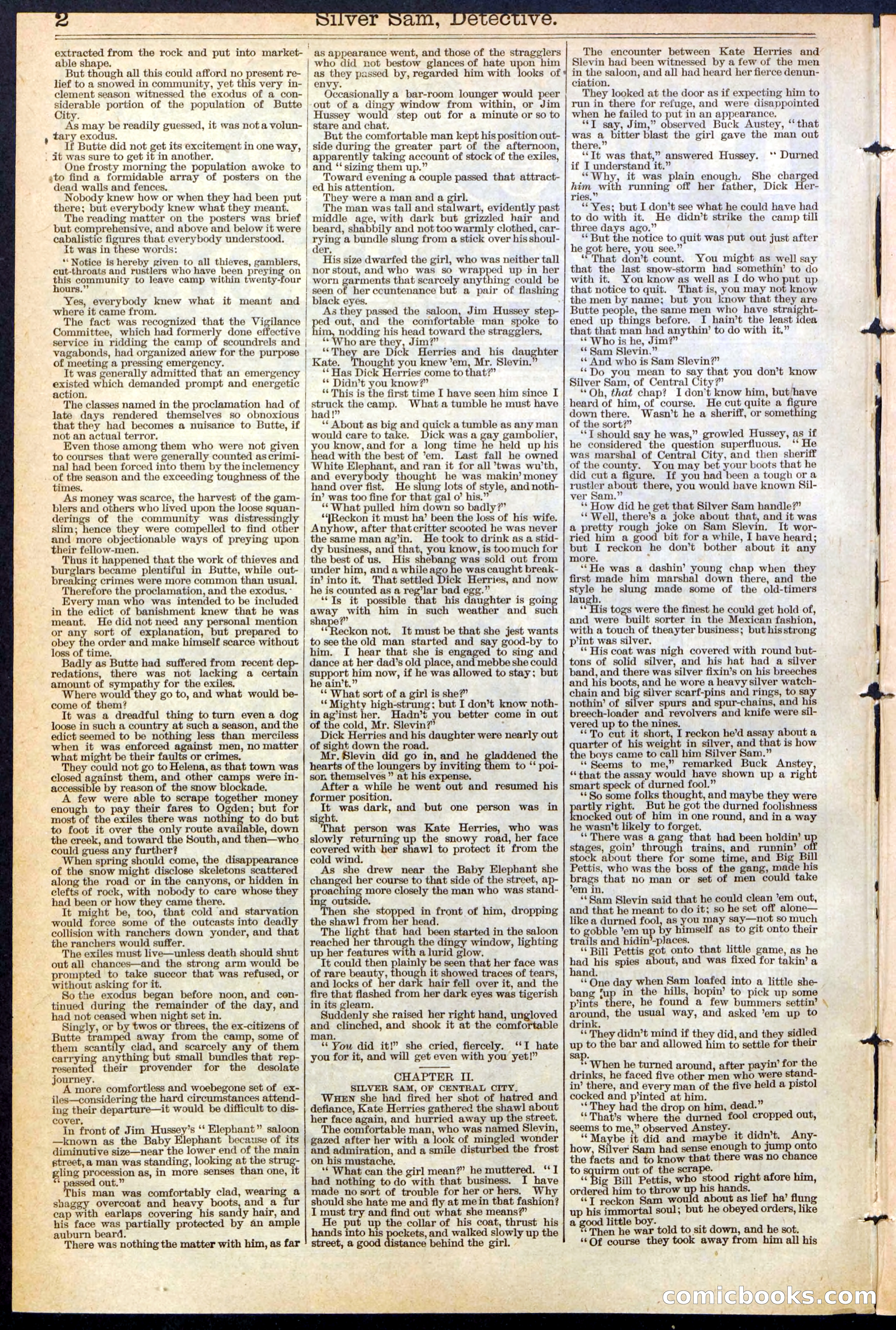
A restored page from Pulp Fiction, 1886. Page through the whole issue in the reader above.
📄 Transcribed text from this page (OCR, searchable)
Machine-transcribed from the original scan — historical spelling and the odd misread are preserved.
able shape. But though all this could afford no present re- lief to a snowed in community, yet this very in- clement season witnessed the exodus of a con- ean portion of the population of Butte ity. As may be readily guessed, it was not a volun- tary exodus. If Butte did not get its excitement in one way, . it was sure to get it in another. One frosty morning the population awoke to sto find a formidable array of posters on the dead walls and fences. Nobody knew how or when they had been put there; but everybody knew what they meant. The reading matter on the posters was brief but comprehensive, and above and below it were cabalistic figures that everybody understood. Tt was in these words: ** Notice is hereby given to all thieves, gamblers, | cut-throats and rustlers who have been preying on this community to leave camp within twenty-four hours.” Yes, everybody knew what it meant and where it came from. The fact was recognized that the Vigilance Committee, which had formerly done effective service in ridding the camp of scoundrels and vagabonds, had organized aniew for the purpose of meeting a pressing emergency. It was generally admitted that an emergency existed which demanded prompt and energetic action. The classes named in the proclamation had of late days rendered themselves so obnoxious that they had becomes a nuisance to Butte, if not an actual terror. Even those among them who were not given to courses that were generally counted as crimi- Sliver extracted from the rock and put into market- | am, By- RS rance went, and those of the stragglers id not bestow glances of hate upon him ooks of as ap who as they passed by, regarded him with envy. Occasionally a bar-room lounger would peer out of a dingy window from within, or Jim Hussey would step out for a minute or so to stare and chat. But the comfortable man kept his position out- side during the greater part of the afternoon, apparently taking account of stock of the exiles, and ‘‘ sizing them up.” _ Toward evening a couple passed that attract- ed his attention. | ‘They were a man and a girl. | The man was tall and stalwart, evidently past | middle age, with dark but grizzled hair and beard, shabbily and not too warmly clothed, car- bos a bundle slung from a stick over his shoul- der, His size dwarfed the girl, who was neither tall nor stout, and who was so eich ae up in her worn garments that scarcely anything could be ' seen of her countenance but a pair of flashing | black eyes. | As they passed the saloon, Jim Hussey step- | ped out, and the comfortable man spoke to | him, nodding his head toward the stragglers, | Who are they, Jim?” ‘They are Dick Herries and his daughter Kate. Thought you knew ’em, Mr. Slevin.” _ ** Has Dick Herries come to that?” ** Didn’t you know?” ** This is the first time I have seen him since I | ety the camp. What a tumble he must have | had! ‘* About as big and quick a tumble as any man would care to take. Dick was a gay gambolier, ou know, and for a long time he held up his | head with the best of ’em. Last fall he owned na] had been forced into them by the inclemency | White pon Se and ran it for all twas wu’th, _ of the season and the exceeding toughness of the times. As money was scarce, the harvest of the gam- blers and others who lived upon the loose squan- ih of the community was distressingly slim; hence they were compelled to find other and more objectionable ways of preying upon their fellow-men. Thus it happened that the work of thieves and burglars became plentiful in Butte, while out- breaking crimes were more common than usual, Therefore the proclamation, and the exodus. ° Every man who was intended to be included in the edict of banishment knew that he was meant. He did not need any personal mention or any sort of explanation, but prepared to obey the order and make himself scarce without loss of time, Badly as Butte had suffered from recent dep- redations, there was not lacking a certain amount of sympathy for the exiles. Where would they go to, and what would be- come of them? It was a dreadful thing to turn even a dog loose in such a country at such a season, and the edict seemed to be nothing less than merciless when it was enforced against men, no matter what might be their faults or crimes, They could not go to Helena, as that town was closed against them, and other camps were in- qovdantbie by reason of the snow blockade. A few were able to scrape together money enough to pay their fares to Ogden; but for most of the exiles there was not to do but to foot it over the only route available, down the creek, and toward the South, and then—who could guess any further? ‘ When spring should come, the disappearance of the snow might disclose skeletons scattered along the road or in the canyons, or hidden in clefts of rock, with nobody to care whose they had been or how they came there. It might be, too, that cold and starvation would force some of the outcasts into deadly collision with ranchers down yonder, and that the ranchers would suffer. The exiles must live—unless death should shut out all chances—and the strong arm would be prompted to take suceor that was refused, or without asking for it. So the exodus began before noon, and cen- tinued aon the remainder of the day, and had not c when night set in. Singly, or by twos or threes, the ex-citizens of Butte tram away from the camp, some of them scantily clad, and scarcely any of them ing anything but small bundles that rep- aeeitiod their provender for the desolate journey. " A more comfortless and woebegone set of ex- iles—considering the hard circumstances attend- ing their departure—it would be difficult to dis- cover, In front of Jim Hussey’s ‘‘ Elephant” saloon —known as the Baby Elephant because of its diminutive size—near the lower end of the main street, a man was standing, looking at the strug- pling procession as, in more senses than one, it ° si out.” his man was comfortably clad, wearing a sha overcoat and heavy boots, and a fur cap with earlaps covering his sandy hair, and his face was partially protected by an ample auburn beard. There was nothing the matter with him, as far and everybody thought he was makin’ money hand over fist. He slung lots of style, and noth- in’ was too fine for that gal o’ his.” “What pulled him down so badly?” ‘‘Reckon it must ha’ been the loss of his wife. Anyhow, after that critter scooted he was never the same man ag’in. He took to drink as a stid- dy business, and that, you know, is too much for the best of us. His shebang was sold out from under him, and a while ago he was caught break- in’ into it. That settled Dick Herries, and now he is counted as a reg’lar bad egg.” ‘Is it possible that his daughter is going away with him in such weather and such spt he ‘*Reckon not. It must be that she jest wants to see the old man started and say good-by to him. I hear that she is e ed to sing and dance at her dad’s old place, and mebbe she could support him now, if he was allowed to stay; but he ain’t.” ** What sort of a girl is she?” “Mighty high-strung: but I don’t know noth- in ag’inst her. Hadn’t you better come in out of the cold, Mr. Slevin? Dick Herries and his daughter were nearly out of sight down the road. Mr. Slevin did go in, and he gladdened the hearts of the loungers by inviting them to ‘‘ poi- son themselves ” at his expense. After a while he went out and resumed his former position, . oe was dark, and but one person was in sight. t person was Kate Herries, who was slowly returning up the snowy road, her face covered with her shawl to protect it from the cold wind. As she drew near the Baby Elephant she changed her course to that side of the street, a proaching more closely the man who was stand- ing outside. en she stopped in front of him, dropping the shawl] from her head. The light that had been started in the saloon reached her through the dingy window, lighting up her features with a lurid glow. It could then plainly be seen that her face was of rare eg eh though it showed traces of tears, and locks of her dark hair fell over it, and the fire that flashed from her dark eyes was tigerish in its gleam. : Suddenly she raised her right hand, ungloved and clinched, and shook it at the comfortable man. *‘ You did it!” she cried, fiercely. ‘‘I hate you for it, and will get even with you yet!” CHAPTER IL. SILVER SAM, OF CENTRAL CITY. WHEN she had fired her shot of hatred and defiance, Kate Herries gathered the shawl about her face again, and hurried away up the street. The comfortable man, who was named Slevin, gazed after her with a look of mingled wonder and admiration, and a smile disturbed the frost on his mustache, ‘* What can the girl mean?” he muttered. “1 had nothing to do with that business. I have made no sort of trouble for her or hers. Why should she hate me and fly at mein that fashion? I must try and find out what she means?” He up the collar of his coat, thrust his hands into his ets,and walked slowly up the street, a good di ce behind the girl. The encounter between Kate Herries and Slevin had been witnessed by a few of the men in the saloon, and all had heard her fierce denun- ciation. They looked at the door as if expecting him to run in there for refuge, and were disappointed when he failed to put in an appearance. ‘*T say, Jim,” observed Buck Austey, ‘‘ that was a bitter blast the girl gave the man out there.” ‘““Tt was that,” answered Hussey. if I understand it.” “Why, it was plain enough. She charged him with running off her father, Dick Her- ries.” ** Yes; but I don’t see What he could have had to do with it. He didn’t strike the camp till three days ago.” ‘“* But the notice to quit was put out just after he got here, you see.” “That don’t count. You might as well say that the last snow-storm had somethin’ to do with it. You know as well as I do who put up that notice to quit. That is, you may not know the men by name; but you know that they are Butte people, the same men who have straight- ened up things before. I hain’t the least idea that that man had anythin’ to do with it,” ‘* Who is he, Jim?” ‘* Sam Slevin,” ** And who is Sam Slevin?” ‘“Do you mean to say that you don’t know ** Durned Silver Sam, of Central City?’ “Oh, that chap? I don't know him, but/have heard of him, of course. He cut quite a figure down there. Wasn’t he a sheriff, or something of the sort?” ‘*T should say he was,” growled Hussey, as if he considered the question superfluous. “* He was marshal of Central City, and then sheriff of the county. You may bet your boots that he did cut a figure. If you had been a tough or a rustler about there, you would have known Sil- ver Sam.” ‘* How did he get that Silver Sam handle?” ‘¢ Well, there’s a joke about that, and it was a pretty rough joke on Sam Slevin. It wor- ried him a good bit for a while, I have heard; but I reckon he don’t bother about it any more. : ‘‘He was a dashin’ young chap when they first made him marshal down there, and the style he slung made some of the old-timers lenge. ** His re were the finest he could get hold of, and were built sorter in the Mexican fashion, with a touch of theayter business; but hisstrong pint was silver. ‘* His coat was nigh covered with round but- tons of solid silver, and his hat had a silver band, and there was silver fixin’s on his breeches and his boots, and he wore a heavy silver watch- chain and big silver scarf-pins and rings, to say nothin’ of silver spurs and spur-chains, and his breech-loader and revolvers and knife were sil- vered up to the nines. ‘To cut it short, I reckon he’d assay about a arter of his weight in silver, and that is how the boys came to call him Silver Sam.” ‘Seems to me,” remarked Buck Anstey, “that the assay would have shown up a fight smart speck of durned fool.” ‘**So some folks thought, and maybe they were pany right. But he got the durned foolishness ocked out of him in one round, and in a way he wasn’t likely to forget. ‘There was a gang that had been holdin’ u stages, goin’ throu trains, and runnin’ ©: stock about there for some time, and Big Bill Pettis, who was the boss of the gang, made his brags that no man or set of men could take em in, ‘Sam Slevin said that he could clean ’em out, and that he meant to do it; so he set off alone— like a durned fool, as you may say—not so much to gobble ’em up by himself as to git onto their trails and hidin’-pjaces. ‘* Bill Pettis got onto that little game, as he had his spies a hand out, and was fixed for takin’ a ‘¢One day when Sam loafed into a little she- bang ‘up in the hills, hopin’ to pick up some pints there, he found a few bummers settin’ pg the usual way, and asked ’em up to rink. “They didn’t mind if they did, and they sidled up to the bar and allowed him to settle for their sap. ‘When he turned around, after payin’ for the drinks, he faced five other men nb were stand- in’ there, and every man of the five held a pistol cocked and p’inted at him. ‘They had the drop on him, dead.’ ‘“*That’s where the curted fool cropped out, seems to me,” observed Anstey. ; “Maybe it did and maybe it didn’t. Any- how, Silver had sense enough to jump onto the facts and to know that there was no chance to squirm out of the scrape. ' : * Bi Bill Pettis, who stood right afore him, nianet him to throw up his hands. _ “T reckon Sam would about as lief ha’ flung up his immortal soul, but he obeyed orders, like little boy. ‘ eenen he ow told to sit down, and he sot. ‘‘Of course they took away from him all his a , - ” mh $ = Ht ‘com ‘ * ebooks a Pa