
Pulp Fiction, 1886 · page 17 of 32
Beadle's New York Dime Library No. 383 — page 17: what you’re looking at
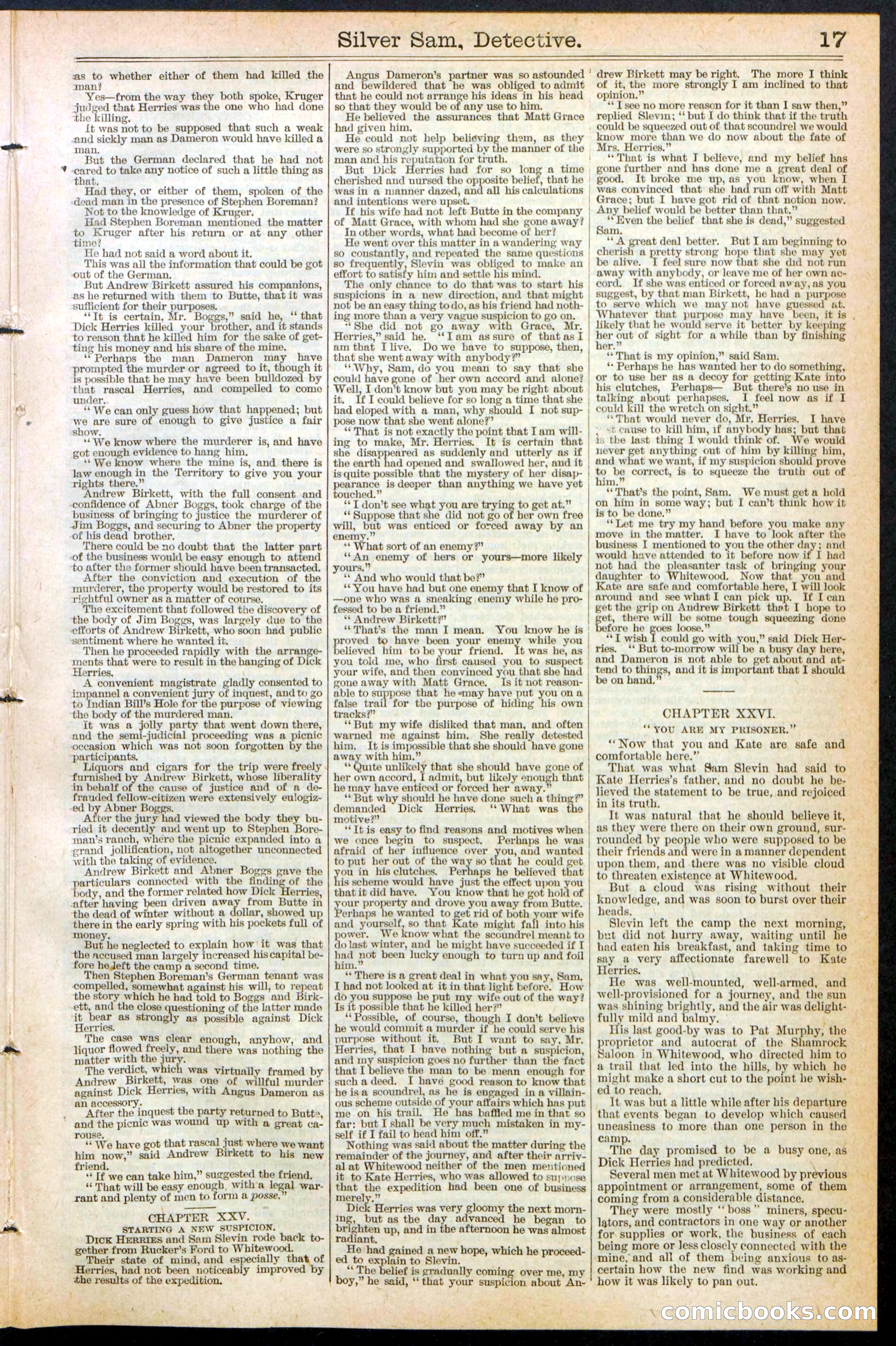
A restored page from Pulp Fiction, 1886. Page through the whole issue in the reader above.
📄 Transcribed text from this page (OCR, searchable)
Machine-transcribed from the original scan — historical spelling and the odd misread are preserved.
St after having been driven awa the dead of winter without a dollar, showed up Silver Sam, Detective. 17 as to whether either of them had killed the man? Yes—from the way they both spoke, Kruger judged that Herries was the one who had done the killing. {t was not to be supposed that such a weak and sickly man as Dameron would have killed a man. But the German declared that he had not cared to take any notice of such a little thing as that, Had they, or either of them, spoken of the dead man in the presence of Stephen Boreman? Not to the knowledge of Kruger. Had Stephen Boreman mentioned the matter to Kruger after his return or at any other time? fle had not said a word about it. This was all the information that could be got out of the German. But Andrew Birkett assured his companions, as he returned with them to Butte, that it was sufficient for their purposes. ‘Tt is certain, Mr. Boggs,” said he, “ that Dick Herries killed your brother, and it stands to reason that he killed him for the sake of get- ting his money and his share of the mine. ‘Perhaps the man Dameron may have prompted the murder or agreed to it, though it is possible that he may have been bulldozed by that rascal Herries, and compelled to come under, ‘‘ We can only guess how that happened; but we are sure of enough to give justice a fair show. ‘‘ We know where the murderer is, and have got enough evidence to hang him. ‘¢ We know where the mine is, and there is law enough in the Territory to give you your rights there.” Andrew Birkett, with the full consent and confidence of Abner Boggs, took charge of the business of bringing to justice the murderer of Jim Boggs, and securing to Abner the property of his dead brother. There could be no doubt that the latter part of the business would be easy enough to attend to after the former should have been transacted. After the conviction and execution of the murderer, the property would be restored to its ricehtful owner as a matter of course. The excitement that followed the discovery of the body of Jim Boggs, was largely due to the efforts of Andrew Birkett, who soon had public sentiment where he wanted it. Then he proceeded rapidly with the arrange- ments that were to result in the hanging of Dick Herries, A convenient magistrate gladly consented to impannel a convenient jury of inquest, and to go to Indian Bill’s Hole for the purpose of viewing the body of the murdered man. It was a jolly party that went down there, and the semi-judicial proceeding was a picnic occasion which was not soon forgotten by the participants. Liquors and cigars for the trip were freely furnished by Andrew Birkett, whose liberality in behalf of the cause of justice and of a de- frauded fellow-citizen were extensively eulogiz- ed by Abner Boggs. After the jury had viewed the body they bu- ried it decently and went up to Stephen Bore- man’s ranch, where the picnic expanded into a erand jollification, not altogether unconnected with the taking of evidence. Andrew Birkett and Abner Boggs gave the particulars connected with the finding of the body, and the former related how Dick Herries, from Butte in there in the early spring with his pockets full of money. , But he neglected to explain how’ it was that the accused man largely increased his capital be- fore heJeft the camp a second time. Then Stephen Boreman’s German tenant was compelled, somewhat against his will, to repeat the story which he had told to Boggs and Birk- ett, and the close questioning of the latter made it bear as strongly as possible against Dick Herries. The case was clear enough, anyhow, and liquor flowed freely, and there was nothing the matter with the jury. The verdict, which was virtually framed by Andrew Birkett, was one of willful murder against Dick Herries, with Angus Dameron as an accessory. After the inquest the party returned to Butte, and the picnic was wound up with a great ca- rouse, : ‘We have got that rascal just where we want him now,” said Andrew Birkett to his new friend. ‘If we can take him,” suggested the friend. “That will be easy enough, witha legal war- rant and plenty of men to form a posse,” CHAPTER XXV. STARTING A NEW SUSPICION, Dick HEerRRIEs and Sam Slevin rode back to- gether from Rucker’s Ford to Whitewood. Their state of mind, and eapectany tego Herries, had not been noticeably improved by the results of the expedition. vias en pe a, : a at Angus Dameron’s partner was so astounded ' drew Birkett may be right. The more I think and bewildered that he was obliged to admit that he could not arrange his ideas in his head so that they would be of any use to him. He believed the assurances that Matt Grace had given him. He could not help believing them, as they were so strongly supported by the manner of the man and his reputation for truth. But Dick Herrice had for so long a time cherished and nursed the opposite belief, that he was in a manner dazed, and all his calculations and intentions were upset. If his wife had not left Butte in the company of Matt Grace, with whom had she gone away? In other words, what had become of her? He went over this matter in a wandering way so constantly, and repeated the same questions | so frequently, Slevin was obliged to make an | effort to satisfy him and settle his mind. The only chance to do that was to start his suspicions in a new direction, and that might | not be an easy thing to do, as bis friend had noth- ing more than a very vague suspicion to go on. “She did not go away with Grace, Mr. Herries,” said he. ‘“‘Ilam assure of that as I am that Ilive. Dowe have to suppose, then, that she went away with anybody?” ‘Why, Sam, do you mean to say that she could have gone of her own accord and alone? Well, I don’t know but you may be right about | it. had eloped with a man, why should I not sup- pose now that she went alone?’ “That is not exactly the point that Iam will- ing to make, Mr. Herries. It is certain that she disappeared as suddenly and utterly as if the earth had opened and swallowed her, and it If I could believe for so long a time that she | is quite possible that the mystery of her disap- | pearance is deeper than anything we have yet touched,” ‘*T don’t see what you are trying to get at.” ** Suppose that she did not go of her own free will, but was enticed or forced away by an enemy.” ‘‘ What sort of an enemy?” “An enemy of hers or yours—more likely ours.” ‘* And who would that be?” **'You have had but one enemy that I know of —one who was a sneaking enemy while he pro- fessed to be a friend.” ** Andrew Birkett?’ “That’s the man I mean. You know he is sroved to have been your aa? velieved him to be your friend. It was he, as you told me, who first caused you to suspect your wife, and then convinced you that she had gone away with Matt Grace, Is it not reason- able to A that he emay have put you ona false trail for the purpose of hiding his own tracks?” “But my wife disliked that man, and often warned me against him, She really detested him. It is impossible that she should have gone away with him.” **(uite unlikely that she should have gone of her own accord, [ admit, but likely enough that he may have enticed or forced her away.” ‘** But why should he have done such a thing?” demanded Dick Herries. ‘‘What was the motive?” ‘‘Ttis easy to find reasons and motives when we once begin to suspect. Perhaps he was afraid of her influence over you, and wanted to put her out of the way so that he could get you in his clutches. Perhaps he believed that ris scheme would have just the effect upon you that it did have. You know that he got hold of your property and drove you away from Butte. erhaps he wanted to get rid of both your wife and yourself, so that Kate might fall into his power. We know what the scoundrel meant to do last winter, and he might have succeeded if I aa not been lucky enough to turn up and foil im. ‘** There is a great deal in what you say, Sam, I had not looked at it in that light before. How do you ep he put my wife out of the way? Is it possible that he killed her?” ‘** Possible, of course, though I don’t believe he would commit a murder if he could serve his purpose without it. But I want to say, Mr. Herries, that I have nothing but a suspicion, and my suspicion goes no further than the fact that I believe the man to be mean enough for such a deed. I have good reason to know that he isa scoundrel, as he is engaged in a villain- ous scheme outside of your affairs which has put me on his trail. He has baffled me in that so far: but I shall be very much mistaken in my- self if I fail to head him off.” Nothing was said about the matter during the remainder of the journey, and after their arriv- al at Whitewood neither of the men mentioned it to Kate Herries, who was allowed to su; spose that the expedition had been one of business merely,” Dick Herries was very gloomy the next morn- ing, but as the day advanced he be to brighten up, and in the afternoon he was almost iia h © had gained a new hope, which he proceed- ed to explain to Slevin. .. “ The belief is gradually coming over me, my boy,” he said, ‘‘ that your suspicion about An- while you | of it, the more strongly I am inclined to that opinion.” ‘* T see no more reason for it than I saw then,” replied Slevin; ‘‘ but I do think that if the truth could be squeezed out of that scoundrel we would know more than we do now about the fate of Mrs. Herries.” “That is what I believe, and my belief has gone further and has done me a great deal of good, It broke me up, as you know, when I was convinced that she had run off with Matt Grace; but I have got rid of that notion now. Any belief would be better than that.” Ac Even the belief that she is dead,” suggested 1m. ‘‘ A great deal better. But I am beginning to cherish a pretty strong hope that she may yet be alive. I feel sure now that she did not run away with anybody, or leave me of her own ac- cord, If she was enticed or forced away, as you suggest, by that man Birkett, he had a purpose to serve which we may not have guessed at. Whatever that purpose may have been, it is likely that he would serve it better by keeping her out of sight for a while than by finishing her.” “That is my opinion,” said Sam. ** Perhaps he has wanted her to do something, or to use her as a decoy for getting Kate in his clutches, Perhaps— But there’s no use in talking about perhapses. I feel now as if I could kill the wretch on sight.” “That would never do, Mr, Herries. I have - st cause to kill him, if anybody has; but that is the last thing I would think ‘of. We would never get anything out of him by killing him, and what we want, if my suspicion should prove a be correct, is to squeeze the truth out of 1im. *That’s the point, Sam. We must get a hold on him in some way; but I can’t think how it is to be done.” ‘*Let me try my hand before you make any move in the matter. I have to look after the business I mentioned to you the other day; and would have attended to it before now if I had not had the pleasanter task of bringing your daughter to Whitewood, Now that you and Kate are safe and comfortable here, I will look around and see what I can pick up. If I can get the grip on Andrew Birkett thet I hope to get, there will be some tough squeezing done before he goes loose,” roe’ lab. could go with you,” said Dick Her- ries. ‘* But to-morrow will be a busy day here, and Dameron is not able to get about and at- tend to things, and it is important that I should be on hand.” CHAPTER XXVI. ‘“YOU ARE MY PRISONER.” “Now that you and Kate are safe and comfortable here.”’ That was what Sam Slevin had said to Kate Herries’s father, and no doubt he be- lieved the statement to be true, and rejoiced in its truth. It was natural that he should believe it, as they were there on their own ground, sur- rounded by people who were supposed to be their friends and were in a manner dependent upon them, and there was no visible cloud to threaten existence at Whitewood. But a cloud was rising without their Buy lege and was soon to burst over their 1eads. Slevin left the camp the next morning, but did not hurry away, waiting until he ~ had eaten his breakfast, and taking time to say a very affectionate farewell to Kate Herries. | He was well-mounted, well-armed, and — well-provisioned for a journey, and the sun was shining brightly, and the air was delight- fully mild and balmy. ; His last good-by was to Pat Murphy, the proprietor and autocrat of the Shamrock Saloon in Whitewood, who directed him to a trail that led into the hills, by which he- PT. re 4 Be. | } 4] { Bias. | < att Sok + mh 4 ~ ("va » # Ay , Fay fo ’ 4 hy i. a ‘ ri might make a short cut to the point he wish- ed to reach. It was but a little while after his departure that events began to develop which caused uneasiness to more than one person in the camp. The day promised to be a busy one, as | Dick Herries had predicted. appointment or arrangement, some of them coming from a considerable distance, Several men met at Whitewood by previous | a ! ced + _2 a Si 3 ’ They were mostly “boss” miners, specu- | lators, and contractors in one way or another for supplies or work, the business of each being more or Jess closely connected with the how it was likely to pan out. . a | mine, and all of them being anxious to as- — | certain how the new find was working and | fi f EO micboo CS).'G (9)